
USDA - Missouri State Office Newsletter - January 15, 2026
In This Issue:
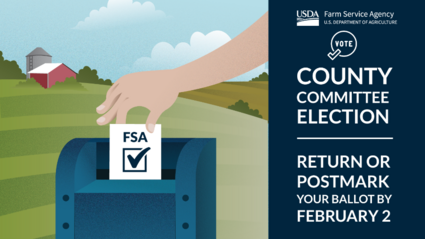
The U.S. Department of Agriculture (USDA) has revised the Farm Service Agency (FSA) county committee voting period, and eligible agricultural producers and private landowners across the country should begin receiving ballots beginning the week of Jan. 5.
Elections are occurring in certain Local Administrative Areas (LAA) for these committee members who make important decisions about how federal farm programs are administered locally. Producers and landowners must return ballots to their local FSA county office or have their ballots postmarked by Feb. 2, 2026, for those ballots to be counted. Newly elected members will take office on March 2, 2026.
To be eligible to vote in the county committee elections, producers must participate or cooperate in a USDA program and be assigned to the LAA that is up for election. Each year, at least one LAA in each COC jurisdiction is up for election on a three-year rotation, and each producer is assigned to vote in a single LAA. A cooperating producer is someone who has provided information about their farming or ranching operation to FSA, even if they have not applied or received program benefits.
For purposes of FSA county committee elections, every member of an American Indian tribe is considered an agricultural landowner if the land on which the tribal member’s voting eligibility is based is tribally owned or held in trust by the U.S. for the tribe, even if the individual does not personally produce a commodity on that land.
Tribal agricultural landowners 18 years and older can contact their local FSA county office to register to vote.
Nationwide, more than 7,700 dedicated members of the agriculture community serve on FSA county committees. The committees are comprised of three to 11 members who serve three-year terms. Committee members play a key role in how FSA delivers disaster recovery, safety-net, conservation, commodity and price support programs, as well as making decisions on county office employment and other agricultural issues.
Ballots must be postmarked or delivered in person to the local FSA office by close of business Feb. 2, 2026, to be counted. Newly elected committee members will take office March 2, 2026. Producers can identify LAAs up for election through a geographic information system locator tool available at fsa.usda.gov/elections and may confirm their LAA by contacting their local FSA office. Eligible voters who do not receive a ballot in the mail can request one from their local FSA county office.
Visit fsa.usda.gov/elections for more information on county committee elections. To learn more about FSA programs, producers can contact their local USDA Service Center.
|
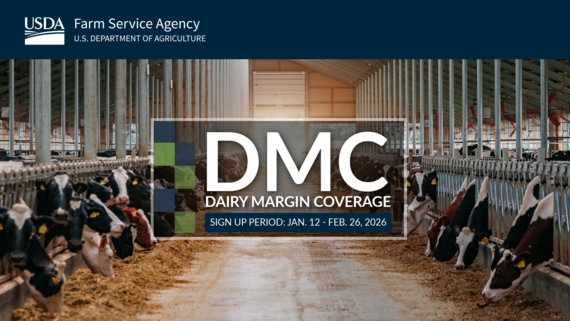
The U.S. Department of Agriculture (USDA) announced the enrollment period for the Dairy Margin Coverage (DMC) program for the 2026 coverage year, an important safety net program that provides producers with price support to help offset milk and feed price differences. Dairy producers can enroll in DMC from January 12, 2026, to February 26, 2026.
The One Big Beautiful Bill Act (OBBBA), signed by President Donald J. Trump on July 4, 2025, reauthorized DMC for calendar years 2026 through 2031 and provided substantial program improvements, including establishing new production history and increasing Tier 1 coverage.
The OBBBA increased DMC’s Tier 1 coverage level increased from five million pounds to six million pounds. All dairy operations that elect to enroll in DMC for 2026 will establish a new production history.
-
Existing dairy operations that started marketing milk on or before January 1, 2023, will use the higher of milk marketings for the years of 2021, 2022, or 2023.
-
New dairy operations starting after January 1, 2023, will use their first year of monthly milk marketings, even for a partial year.
-
Milk marketing statements or production evidence are required to establish a production history.
Dairy operations also have the option to lock-in coverage levels for six years (2026-2031) with premium fees discounted by 25%.
DMC offers different levels of coverage, including an option that is free to producers, minus a $100 administrative fee. To determine the appropriate level of DMC coverage for a specific dairy operation, producers can use the online dairy decision tool.
The U.S. Department of Agriculture’s Natural Resources Conservation Service (NRCS) established a national Jan. 15, 2026, batching deadline for the first funding round of key conservation programs. This national batching date ensures producers have a clear, consistent timeline for participating in Environmental Quality Incentives Program (EQIP), Conservation Stewardship Program (CSP), Agricultural Conservation Easement Program (ACEP), and Agricultural Management Assistance (AMA). This includes NRCS’ new Regenerative Pilot Program, which provides targeted Farmer First assistance through EQIP and CSP.
NRCS programs are continuous sign-up programs, but due to the government shutdown, the agency is implementing an initial national batching period to ensure producers have access to funding and support.
Updated NRCS Program Timelines
- All NRCS conservation programs remain continuous sign-up.
- Farmers and ranchers have until 15, 2026, to apply for the first batching period.
- National and State Conservation Innovation Grants (CIG) will follow later in the year.
- PL-566 and Emergency Watershed Protection (EWP) opportunities remain open for sponsors based on available funding.
Programs with a January 15, 2026, batching period deadline include:
For more information, please visit nrcs.usda.gov or contact your local USDA Service Center.
The Conservation Reserve Program (CRP) is a program administered by the Farm Service Agency (FSA) to conserve farmland for future generations while providing habitat for wildlife, reducing soil erosion, and improving water quality. Regular maintenance on CRP acres is needed to ensure the acreage continues to provide conservation benefits and remains in compliance with the CRP contract.
Regular Maintenance
Producers with CRP contracts are required to control all weeds, insects, pests, and other undesirable species to the extent necessary to ensure that the approved conservation cover is adequately protected and to ensure there is no adverse impact on surrounding land. Mowing is one of the allowable practices for weed control, but mowing for aesthetic purposes is never permitted. The Conservation Plan states the required weed control methods for each site.
Once a stand has been certified as fully established, participants are required to maintain plant diversity and stand density according to the Conservation Plan and offer (CRP-2) for the life of the contract. Stands that do not meet practice specific plant diversity or density requirements may be considered non-compliant. Refer to your conservation plan or contact FSA if you have any questions or concerns about the vegetative cover requirements.
Maintenance activities cannot occur during the primary nesting season for birds without written prior approval from the local county office. The primary nesting season in Missouri is May 1st through July 15th.
Mid-Contract Management
Regular maintenance for weed and pest control is separate from the Mid-Contract Management (MCM) requirement. MCM ensures plant diversity and wildlife benefits while ensuring protection of the soil and water resources. Such activities are site-specific and are for the purpose of enhancing the approved cover.
MCM must be completed between years four and six of a 10-year contract and between years seven and nine of a 15-year contract. The Conservation Plan will state what year MCM must take place.
Noncompliance with Maintenance Requirements
Failure to adequately maintain the stand may result in noncompliance with the terms and conditions of the CRP contract. Noncompliance can result in adverse actions up to and including termination of the CRP contract. Contracts that are out of compliance are ineligible to re-enroll, unless the stand is brought back into compliance prior to the enrollment deadline.
For general information about CRP, visit the Conservation Reserve Program webpage. For information about specific contracts, reach out to the local FSA office.
USDA recently announced a $700 million Regenerative Pilot Program to help American farmers adopt practices that improve soil health, enhance water quality, and boost long-term productivity, all while strengthening America’s food and fiber supply.
Administered by the USDA Natural Resources Conservation Service (NRCS), this new Regenerative Pilot Program delivers a streamlined, outcome-based conservation model—empowering producers to plan and implement whole-farm regenerative practices through a single application.
In FY2026, the Regenerative Pilot Program will focus on whole-farm planning that addresses every major resource concern—soil, water, and natural vitality—under a single conservation framework. USDA is dedicating $400 million through the Environmental Quality Incentives Program (EQIP) and $300 million through the Conservation Stewardship Program (CSP) to fund this first year of regenerative agriculture projects.
Learn more about the Regenerative Pilot Program.
Top of page
The Farm Service Agency (FSA) offers two types of set-aside programs to assist FSA direct loan borrowers. The set-aside programs are intended to help distressed borrowers as well as borrowers impacted by natural disasters.
Disaster Set-Aside Program
The Disaster Set-Aside Program (DSA) assists existing FSA direct loan borrowers who have been impacted by natural disasters. The DSA program provides short-term financial relief by allowing eligible borrowers to delay FSA direct loan payments that are due this year or next year (but not both). You may delay up to one full annual payment per loan and the delayed payment will be moved to the end of the loan term. You will not be required to pay this set-aside installment until the loan’s final due date.
The principal portion of the amount set-aside will continue to accrue interest at your loan’s existing interest rate.
To be eligible, borrowers must have operated a farm in a county declared a disaster area or a contiguous county at the time of the disaster. In addition, the borrower’s inability to make their upcoming payment must be due to the disaster.
To apply for DSA, borrowers must provide their local USDA Service Center with a letter requesting DSA, which must be signed by all parties liable for the debt. The letter must be provided to your local Service Center within eight months of the disaster declaration date. The application process also includes providing your actual production, income, and expense records for the last three years. FSA may also request additional information as needed to make an eligibility decision.
Distressed Borrower Set-Aside Program
FSA Direct Farm Loan Program borrowers whose loans were closed before Sept. 25, 2024, may be eligible for assistance under the Distressed Borrower Set-Aside Program (DBSA). Similar to DSA, DBSA also provides short-term financial relief by allowing eligible borrowers to delay FSA direct loan payments that are due this year or next year (but not both). You may delay up to one full annual payment per loan and the delayed payment will be moved to the end of the loan term. You will not be required to pay this set-aside installment until the loan’s final due date.
An increased benefit with DBSA is that the principal portion of the set-aside will accrue interest at a reduced rate of 0.125% rather than your loan’s existing interest rate.
To be eligible for DBSA, the borrower must demonstrate financial distress, but their inability to make the upcoming payment does not need to be due to a disaster.
The DBSA application process is similar to DSA as borrowers must provide their local USDA Service Center with a letter requesting DBSA, which must be signed by all parties liable for the debt. The application process also includes providing your actual production, income, and expense records for the last three years. FSA may also request additional information as needed to make an eligibility decision.
Important Factors for Both DSA and DBSA:
FSA direct loan borrowers are not able to obtain more than one set-aside per loan. Borrowers also cannot obtain both a DSA and DBSA simultaneously on the same loan. In addition, FSA direct loans with less than two years remaining are not eligible for a DSA or DBSA. Other eligibility requirements apply; we encourage you to contact your local Service Center for more information.
Both DSA and DBSA are intended to provide short-term relief for situations where borrowers anticipate the ability to resume paying their full annual installment(s) in the following year. If you require a more long-term form of financial relief, FSA has other potential options available through primary loan servicing (PLS).
For more information on DSA, DBSA, or PLS, please contact your county Service Center. You may also visit fsa.usda.gov.
Additional information, eligibility criteria and program limitations may be found within the Disaster Set-Aside and Distressed Borrower Set-Aside Program fact sheets.
USDA announced major updates to federal crop insurance, reducing red tape for farmers, modernizing long-standing policies, and expanding access to critical risk protection beginning with the 2026 crop year. The Expanding Access to Risk Protection (EARP) Final Rule streamlines requirements across multiple crops, responds to producer feedback, and strengthens USDA’s commitment to putting America’s farmers first.
Learn more about the EARP Final Rule.
USDA announced the next phase in the Farmer Bridge Assistance Program (FBA), the eligible commodity per-acre payment rates. In 2026, $12 billion will be paid to American farmers. Of that amount, $11 billion consists of one-time FBA program payments.
Eligible Row Crop Commodities and Payment Rates:
Below are the payment rates for the FBA eligible commodities that triggered a payment.
Commodity, Per Acre Payment Rates
- Barley: $20.51 • Canola: $23.57 • Chickpeas (Large): $26.46 • Chickpeas (Small): $33.36 • Corn: $44.36 • Cotton: $117.35 • Flax: $8.05 • Lentils: $23.98 • Mustard: $23.21 • Oats: $81.75 • Peanuts: $55.65 • Peas: $19.60 • Rice: $132.89 • Safflower: $24.86 • Sesame: $13.68 • Sorghum: $48.11 • Soybeans: $30.88 • Sunflower: $17.32 • Wheat: $39.35
Eligibility, Program Applications, and Crop Insurance Linkage
FBA payments are based on 2025 planted acres, Economic Research Service cost of production, and the World Agriculture Supply and Demand Estimate Report. Double crop acres, including all initial and subsequently planted crops, are eligible. Prevent plant acres are not eligible.
All intended row crop uses are eligible for FBA except grazing, volunteer stands, experimental, green manure, crops left standing and abandoned or cover crops.
Crop insurance linkage is not required; however, USDA strongly urges producers to take advantage of the new risk management tools provided for in the One Big Beautiful Bill Act (OBBBA) to best protect against future price risk and volatility. The OBBBA federal crop insurance improvements include expanding benefits for beginning farmers and ranchers, increasing coverage options, and making crop insurance more affordable.
Specialty Crop Assistance
Of the $12 billion being provided by the Commodity Credit Corporation Charter Act, up to $11 billion is being directed to eligible row crop producers and the remaining $1 billion of the $12 billion in assistance is reserved for specialty crops and sugar. Timelines for payments to producers of these crops are still under development and require additional understanding of market impacts and economic needs.
Producers, including specialty crop producers and stakeholder groups, can submit questions to farmerbridge@usda.gov.
More information on FBA is available online at https://www.fsa.usda.gov/fba or you can contact your local USDA FSA county office.
Sarah Campbell is the National Beginning Farmer and Rancher Coordinator for USDA. In this Ask the Expert, Sarah answers questions about common misconceptions about beginning farmer and rancher eligibility, available programs to help and how to chart your path as a beginning farmer.
Learn more about beginning farmers and ranchers.
Top of page
MISSOURI - USDA
|
|
Service Center Locator
|
|
FARM SERVICE AGENCY (FSA)
601 Business Loop 70 West, Suite 225 Columbia, MO 65203
Phone: 573-876-0925
Fax: 855-830-0680
fsa.usda.gov
State Executive Director
Ronnie Russell
Deputy State Executive Director
Vancant
|
NATURAL RESOURCE CONSERVATION SERVICE (NRCS)
601 Business Loop 70 West, Suite 250 Columbia, MO 65203
Phone: 573-876-0901
Fax: 855-865-2188
nrcs.usda.gov
State Conservationist
Scott Edwards
|
|
USDA is an equal opportunity provider, employer, and lender.
|
|






