Nevada January USDA Newsletter
In This Issue:
The U.S. Department of Agriculture (USDA) announced the enrollment period for the Dairy Margin Coverage (DMC) program for the 2026 coverage year, an important safety net program that provides producers with price support to help offset milk and feed price differences. Dairy producers can enroll in DMC from January 12, 2026, to February 26, 2026.
The One Big Beautiful Bill Act (OBBBA), signed by President Donald J. Trump on July 4, 2025, reauthorized DMC for calendar years 2026 through 2031 and provided substantial program improvements, including establishing new production history and increasing Tier 1 coverage.
The OBBBA increased DMC’s Tier 1 coverage level increased from five million pounds to six million pounds. All dairy operations that elect to enroll in DMC for 2026 will establish a new production history.
- Existing dairy operations that started marketing milk on or before January 1, 2023, will use the higher of milk marketings for the years of 2021, 2022, or 2023.
- New dairy operations starting after January 1, 2023, will use their first year of monthly milk marketings, even for a partial year.
- Milk marketing statements or production evidence are required to establish a production history.
Dairy operations also have the option to lock-in coverage levels for six years (2026-2031) with premium fees discounted by 25%.
DMC offers different levels of coverage, including an option that is free to producers, minus a $100 administrative fee. To determine the appropriate level of DMC coverage for a specific dairy operation, producers can use the online dairy decision tool.
For more information visit the DMC webpage or contact your local USDA Service Center.
The U.S. Department of Agriculture’s (USDA) updates to the Farm Service Agency’s (FSA) Farm Loan Programs are officially in effect. These changes, part of the Enhancing Program Access and Delivery for Farm Loans rule, are designed to increase financial flexibility for agricultural producers, allowing them to grow their operations, boost profitability, and build long-term savings.
These program updates reflect USDA’s ongoing commitment to supporting the financial success and resilience of farmers and ranchers nationwide, offering critical tools to help borrowers manage their finances more effectively.
What the new rules mean for you:
- Low-interest installment set-aside program: Financially distressed borrowers can now defer up to one annual loan payment at a reduced interest rate. This simplified option helps ease financial pressure while keeping farming operations running smoothly.
- Flexible repayment terms: New repayment options give borrowers the ability to increase their cash flow and build working capital reserves, allowing for long-term financial planning that includes saving for retirement, education, and other future needs.
- Reduced collateral requirements: FSA has lowered the amount of additional loan security needed for direct farm loans, making it easier for borrowers to leverage their existing equity without putting their personal residence at risk.
These new rules provide more financial freedom to borrowers. By giving farmers and ranchers better tools to manage their operations, we’re helping them build long-term financial stability. It’s all about making sure they can keep their land, grow their business, and invest in the future.
If you’re an FSA borrower or considering applying for a loan, now is the time to take advantage of these new policies. We encourage you to reach out to your local FSA farm loan staff to ensure you fully understand the wide range of loan making and servicing options available to assist with starting, expanding, or maintaining your agricultural operation.
To conduct business with FSA, please contact your local USDA Service Center.
The Farm Loan team in Elko County is already working on operating loans for spring 2026 and asks potential borrowers to submit their requests early so they can be timely processed. The farm loan team can help determine which loan programs are best for applicants.
FSA offers a wide range of low-interest loans that can meet the financial needs of any farm operation for just about any purpose. The traditional farm operating and farm ownership loans can help large and small farm operations take advantage of early purchasing discounts for spring inputs as well expenses throughout the year.
Microloans are a simplified loan program that will provide up to $50,000 for both Farm Ownership and Operating Microloans to eligible applicants. These loans, targeted for smaller and non-traditional operations, can be used for operating expenses, starting a new operation, purchasing equipment, and other needs associated with a farming operation. Loans to beginning farmers and members of underserved groups are a priority.
Other types of loans available include:
Marketing Assistance Loans allow producers to use eligible commodities as loan collateral and obtain a 9-month loan while the crop is in storage. These loans provide cash flow to the producer and allow them to market the crop when prices may be more advantageous.
Farm Storage Facility Loans can be used to build permanent structures used to store eligible commodities, for storage and handling trucks, or portable or permanent handling equipment. A variety of structures are eligible under this loan, including bunker silos, grain bins, hay storage structures, and refrigerated structures for vegetables and fruit. A producer may borrow up to $500,000 per loan.
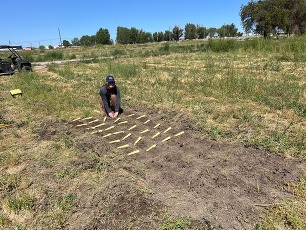
NRCS operates 25 Plant Materials Centers (PMCs), each based in ecologically distinct areas, to evaluate plants and vegetative technologies to support USDA conservation programs and practices. PMCs find vegetative solutions to reduce soil erosion, increase cropland soil health and productivity, improve water quality, produce forage and biomass, improve air quality, improve wildlife habitat (including pollinator habitat), restore wetlands, protect streambank and riparian areas, and stabilize coastal areas.
The NRCS’ network of PMCs is uniquely positioned to address local, regional, and national natural resource concerns through coordinated activities among the PMCs. NRCS works with cooperating programs to extend the capabilities of our plant materials efforts.
The Great Basin Plant Materials Center, located in Fallon, Nevada, is just over 82 acres and was established in 2006. It is the newest Plant Materials Center in the United States and it serves Nevada and portions of eastern California, southern Oregon, and western Utah. It is a source of native plants and technology for the low precipitation and high salinity areas found in the Great Basin.
Check out the 2025 activities in the annual report.
We are asking for your help with the UNR Extension Needs Assessment Survey. Your input is essential in helping us understand the challenges, opportunities, and resource needs in Agriculture, Horticulture, and Natural Resources. The goal of this survey is to gather valuable information that will guide the development of programs and resources to address the most pressing needs in our State.
Follow this link to start the Survey: Take the survey
Or copy and paste this URL into your internet browser: https://unr.az1.qualtrics.com/jfe/form/SV_9EQ4956w0vFjc9w
The questionnaire is brief, taking approximately 15 minutes to complete. Your participation is voluntary, and you may withdraw at any time. However, we would greatly appreciate it if you could respond to all questions. Your responses will be kept confidential, and the results will be shared in aggregated form through a report.
FSA/NRCS Contacts
Nevada State Office
300 Booth Street, Suite 2081 Reno, NV 89509
775-857-8500
|
State Executive Director
Philip Cowee
775.834.0895
|
NRCS State Conservationist
Heidi Ramsey
775.857.8500
|
|
Acting District Director District 1 FSA
Katie Nuffer
775.834.0882
|
District Director District 2 FSA
Claire Kehoe
775.738.6445 x 106
|
|
Elko
Tamara Thompson, Acting CED - FSA
775.738.6445 x 106
Allen Moody, Acting DC - NRCS
775.433.3921
|
Ely
Chris Ward, CED - FSA
775.738.6445 x 106
Joe Noyes, DC - NRCS
775.289.4065 x 105
|
|
Fallon
Krysta Roose, CED - FSA
775.423.5124 x 109
Albert Mulder, DC - NRCS
775.423.5124 x 114
|
Las Vegas
Dariya Zaporozhchenko,Urban Ag CED - FSA
702.407.1400
Jasmine Wilson, Urban Ag DC - NRCS
702.407.1400 x 6003
Jamie Gottilieb, DC-NRCS
775.623.5025 x 101
|
|
Lovelock
Ali Phillips, CED - FSA
775.273.2922 x 100
Cory Lytle, - Acting DC NRCS
775.857.8500
|
Minden
Jessica Gwerder, Acting DC - NRCS
775.782.3661
Caliente
Amanda Wheatley, Range Managment Specialist - NRCS
775.726.3101
|
|
Winnemucca
Leah Mori, CED - FSA
775.623.5025 x 107
Angela Williams, DC - NRCS
775.623.5025
|
Yerington
Julie Thompson, CED - FSA
775.463.2265
Carson Hicks, Acting District Conservationist- NRCS
775.463.2265
|
###
USDA is an equal opportunity provider, employer and lender
|