
South Dakota USDA Newsletter - December 2025
In This Issue:
Greetings from the South Dakota FSA State Office,
As we approach the end of the year and holidays, I want to take a moment to remind you of some upcoming program deadlines. We’re all very busy at this time of year. I want to make sure you’re on the right track when it comes to applying for program assistance.
The Farm Service Agency (FSA) recently announced the new Farmer Bridge Assistance (FBA) program that provides a one-time bridge payment to American farmers in response to temporary trade market disruptions and increased production costs. This program is based on FSA reported planted acres. Commodity-specific payment rates will be released by the end of December and we’re expecting pre-filled applications to go out to eligible producers during the week of Feb. 23 to meet the target of FBA payments processing by Feb. 28, 2026. We continue to work on FBA policies and provisions for specialty crop producer assistance. We understand you have questions. Producers, including specialty crop producers and stakeholder groups, can submit questions to farmerbridge@usda.gov. I will provide FBA updates as details unfold.
Sign-up is underway for Stage 2 of the Supplemental Disaster Relief Program (SDRP), which covers eligible crop, tree, bush and vine losses that were not covered under Stage 1 program provisions, including non-indemnified (shallow losses), uncovered, and quality losses. Producers have until April 30, 2026, to apply for both Stage 1 and Stage 2 assistance. I strongly encourage you to use the SDRP Stage 2 Pre-Application Checklist to ensure you have the required forms on file with your FSA county office and to help you start gathering supporting documentation that may be required. When you’re ready, please make an appointment with your local FSA office.
For the first time, USDA disaster assistance will cover shallow losses – losses that didn’t trigger a crop insurance or NAP indemnity but still hit the bottom line. We heard loud and clear from producers that this was a gap in previous programs. Stage 2 also covers uninsured losses and quality losses, everything from smoke-damaged fruit to forage that lost nutritional value due to weather extremes. If the crop’s value dropped because of a disaster, we’re going to recognize that loss.
FSA is also delivering additional disaster assistance through the Milk Loss Program (MLP) for dumped milk and the On-Farm Stored Commodity Loss Program (OFSCLP), which both have a Jan. 23, 2026, signup deadline.
2025 Overview – South Dakota FSA is Delivering on Our Promise to Put Farmers First
Over the past year, the Trump Administration and FSA have demonstrated our commitment to putting South Dakota Farmers First.
Since March 2025, FSA has supported farmers and ranchers in South Dakota through supplemental disaster assistance including $482.4 million through the Emergency Commodity Assistance Program, $19.6 million through the Emergency Livestock Relief Program and more than $293.8 million in SDRP Stage 1 payments to date.
Last month FSA provided $75.1 million in Agriculture Risk Coverage and Price Loss Coverage (ARC/PLC) payments as well as $141.2 million in Conservation Reserve Program (CRP) annual rental payments to producers and landowners in South Dakota. These payments came at a critical time as I know many of you are booking inputs and planning for the 2026 crop year.
This year, FSA also provided $75.5 million to producers through the Marketing Assistance Loan (MAL) program, which provides a short-term loan on eligible commodities that gives producers marketing flexibility to sell their crops when prices are more favorable.
In addition to farm program payments, FSA farm loan staff continue to see strong interest in our direct and guaranteed ownership and operating loans, which offer loans with flexible terms and favorable loan rates. Over the last fiscal year FSA obligated a total of $160.4 million in direct loans and $63.3 million in guaranteed loans across South Dakota. These loans help borrowers start or expand their agricultural operations, pay family living expenses and fund day-to-day operating expenses.
I’m proud of the support that the FSA staff in South Dakota have provided to our producers. We recognize the challenges that producers continue to face and I look forward to working on behalf of the Trump Administration and U.S. Secretary of Agriculture Brooke Rollins to ensure the success of the agriculture industry across the state.
Read more about how The Trump Administration has been working around the clock since January 20th to put American Farmers First.
It’s an honor to serve the farmers and ranchers in the great state of South Dakota.
Wishing you a safe and happy holiday season.
Sincerely,
Roger Chase
State Executive Director, South Dakota FSA
Top of page
Season’s Greetings,
As the calendar year of 2025 closes, I want to take a moment to reflect on the success and impact NRCS in South Dakota has made in conservation. In FY25, SD producers met with NRCS staff for technical support and voluntarily enrolled over 1.2 million acres into conservation plans and contracts with the NRCS programs: Environmental Quality Incentives Program (EQIP), Conservation Stewardship Program (CSP), Regional Conservation Partnership Program (RCPP), and Agricultural Conservation Easement Program (ACEP), both Agricultural Land Easements (ALE), and Wetland Reserve Easements (WRE), obligating over $128.7 million for conservation activities in SD while benefiting local economies. Showcasing the importance of these programs, the demand for financial assistance regularly outweighs the available funds. For example, in FY25, the EQIP had 1904 applications resulting in 298 contracts (16%), and the CSP had 605 applications, resulting in 291 contracts (48%). Previously established application due dates have been rescheduled, and all FY26 funding applications will be considered until January 15, 2026.
An approaching partner event to consider attending is the 2026 Soil Health Conference hosted by the SD Soil Health Coalition on January 13-14 in Aberdeen, SD. This educational event will offer learning opportunities no matter where you are on your soil health journey. Additionally, various “Our Amazing Grasslands” videos were prepared and published in 2025 by the SD Grassland Coalition and can be viewed here. These videos include stories of South Dakota conservation efforts, with the potential for tips or tools to be discovered while watching. To stay engaged with NRCS happenings, follow us on our NRCS-SD X account.
Wishing you happy holidays and safe travel as you connect with family and friends during this time. Thank you to all South Dakota farmers, ranchers, land managers, landowners, and NRCS partners who are moving the needle of conservation in our state forward.
Sincerely,
Jessica Michalski
Acting State Conservationist, South Dakota NRCS
Top of page
January 1, 2026 - New Year's Day Holiday - USDA Service Centers Closed
January 13-14, 2026 - 2026 South Dakota Soil Health Conference
January 15, 2026 - Deadline to apply for NRCS Conservation Stewardship Program (CSP) and Environmental Quality Incentive Program (EQIP)
January 19, 2026 - Martin Luther King, Jr. Holiday - USDA Service Centers Closed
January 23, 2026 - Deadline to apply for On-Farm Stored Commodity Loss Program
January 23, 2026 - Deadline to apply for the Milk Loss Program
January 23, 2026 - Deadline to apply for NRCS Regional Conservation Partnership Program (RCPP)
January 31, 2026 - Deadline to submit application for Food Safety Certification for Specialty Crops Program for calendar year 2025
January 31, 2026 - Deadline for wool and mohair producers to apply for loans and LDP’s and submit all required eligibility documents on wool shorn in calendar year 2025
April 30, 2026 - Deadline to apply for Supplemental Disaster Relief Program Stage 1 and Stage 2
December 2025
|
Farm Operating Loans — Direct
|
4.625% |
|
Farm Ownership Loans — Direct
|
5.750% |
|
Farm Ownership Loans — Direct Down Payment, Beginning Farmer or Rancher
|
1.750% |
|
Emergency Loans
|
3.750% |
|
Farm Storage Facility Loans (7 years)
|
3.875% |
Top of page
USDA’s Farm Service Agency (FSA) is delivering more than $16 billion in total Congressionally approved disaster relief. FSA is now accepting applications for assistance through the second stage of the Supplemental Disaster Relief Program (SDRP) from agricultural producers who suffered eligible non-indemnified, uncovered or quality crop losses due to qualifying natural disasters in 2023 and 2024.
Stage Two covers eligible crop, tree, bush and vine losses that were not covered under Stage One program provisions, including non-indemnified (shallow loss), uncovered and quality losses. Although the majority of payments from the first stage are already in the hands of producers helping them prepare for and invest in the next crop year, Stage One assistance, announced in July, remains available to producers who received an indemnity under crop insurance or the Noninsured Crop Disaster Assistance Program (NAP) for eligible crop losses due to qualifying 2023 and 2024 natural disaster events.
The deadline to apply for both Stage One and Stage Two assistance is April 30, 2026.
Additionally, FSA is taking applications for assistance from producers who had to dump or remove milk from the commercial market and who incurred losses of eligible farm stored commodities due to qualifying disaster events in 2023 and 2024.
SDRP Stage Two Program Details
SDRP Stage Two provides assistance for eligible crop, tree, bush and vine losses not covered under Stage One, including:
-
Non-Indemnified Losses (Including Shallow Losses)
- Insured losses through federal crop insurance that did not trigger a crop insurance indemnity.
- Losses with NAP coverage that did not trigger a NAP payment.
-
Uncovered Losses (Uninsured Losses)
- Includes losses that were not insured through federal crop insurance or NAP.
-
Quality Losses
- Includes quality losses to commodities indicated by:
- A decrease in value based on discounts due to the physical condition of the crop supported by applicable grading factors
- A decline in the nutritional value of forage crops supported by documented forage tests.
- Producers will certify to an SDRP quality loss percentage.
FSA is establishing block grants with Connecticut, Hawaii, Maine, and Massachusetts that cover crop losses; therefore, producers with losses on land physically located in these states are not eligible for SDRP program payments.
For information on program eligibility and to download an application checklist, visit fsa.usda.gov/sdrp.
More information will be provided in early 2026 regarding a separate enrollment period for quality losses covered by SDRP Stage One as well as for insured producers in Puerto Rico who were not included in Stage One because data was not available when pre-filled applications were mailed.
Milk and On-Farm Stored Crop Loss Assistance
The Milk Loss Program provides up to $1.65 million in payments to eligible dairy operations for milk that was dumped or removed without compensation from the commercial milk market because of a qualifying natural disaster event in 2023 and/or 2024.
Producers who suffered losses of eligible harvested commodities while stored in on-farm structures in 2023 and/or 2024 due to a qualifying natural disaster event may be eligible for assistance through the On-Farm Stored Commodity Loss Program, which provides for up to $5 million to impacted producers.
The deadline to apply for milk and on-farm stored commodity losses is Jan. 23, 2026. Information and fact sheets for both programs are available online at fsa.usda.gov/mlp for milk loss and fsa.usda.gov/ofsclp for on-farm stored commodity losses.
To make an appointment to apply, call your local County FSA Office.
Top of page
The Livestock Indemnity Program (LIP) provides assistance to you for livestock deaths in excess of normal mortality caused by adverse weather, disease and attacks by animals reintroduced into the wild by the federal government or protected by federal law.
For disease losses, FSA county committees can accept veterinarian certifications that livestock deaths were directly related to adverse weather and unpreventable through good animal husbandry and management.
For 2025 livestock losses, you must file a notice of loss, provide the following supporting documentation, and application for payment to your local FSA office by March 2, 2026.
- Proof of death documentation
- Copy of grower’s contracts
- Proof of normal mortality documentation
- Livestock beginning inventory documentation
USDA has established normal mortality rates for each type and weight range of eligible livestock, i.e. Adult Beef Cow = 1.5% and Non-Adult Beef Cattle = 5%. These established percentages reflect losses that are considered expected or typical under “normal” conditions.
For more information, contact your local USDA Service Center or visit fsa.usda.gov.
Top of page
Producers in Bennett, Custer, Fall River, Jackson, Oglala Lakota, and Pennington Counties are eligible to apply for 2025 Livestock Forage Disaster Program (LFP) benefits on small grain, native pasture, improved pasture.
LFP provides compensation if you suffer grazing losses for covered livestock due to drought on privately owned or cash leased land or fire on federally managed land.
County committees can only accept LFP applications after notification is received by the National Office of qualifying drought or if a federal agency prohibits producers from grazing normal permitted livestock on federally managed lands due to qualifying fire. You must complete a CCC-853 and the required supporting documentation no later than March 2, 2026, for 2025 losses.
For additional information about LFP, including eligible livestock and fire criteria, contact your local USDA Service Center or visit fsa.usda.gov.
Top of page
Marketing Assistance Loans (MALs) and Loan Deficiency Payments (LDPs) provide financing and marketing assistance for wheat, feed grains, soybeans, and other oilseeds, pulse crops, rice, peanuts, cotton, wool and honey. MALs provide you with interim financing after harvest to help you meet cash flow needs without having to sell your commodities when market prices are typically at harvest-time lows. A producer who is eligible to obtain a loan, but agrees to forgo the loan, may obtain an LDP if such a payment is available. Marketing loan provisions and LDPs are not available for sugar and extra-long staple cotton.
FSA is now accepting requests for 2025 MALs and LDPs for all eligible commodities after harvest. Requests for loans and LDPs shall be made on or before the final availability date for the respective commodities.
Commodity certificates are available to loan holders who have outstanding nonrecourse loans for wheat, upland cotton, rice, feed grains, pulse crops (dry peas, lentils, large and small chickpeas), peanuts, wool, soybeans and designated minor oilseeds. These certificates can be purchased at the posted county price (or adjusted world price or national posted price) for the quantity of commodity under loan, and must be immediately exchanged for the collateral, satisfying the loan. MALs redeemed with commodity certificates are not subject to Adjusted Gross Income provisions.
To be considered eligible for an LDP, you must have form CCC-633EZ, Page 1 on file at your local FSA Office before losing beneficial interest in the crop. Pages 2, 3 or 4 of the form must be submitted when payment is requested.
Marketing loan gains (MLGs) and loan deficiency payments (LDPs) are no longer subject to payment limitations, actively engaged in farming and cash-rent tenant rules.
Adjusted Gross Income (AGI) provisions state that if your total applicable three-year average AGI exceeds $900,000, then you’re not eligible to receive an MLG or LDP. You must have a valid CCC-941 on file to earn a market gain of LDP. The AGI does not apply to MALs redeemed with commodity certificate exchange.
For more information and additional eligibility requirements, contact your local County USDA Service Center or visit fsa.usda.gov.
Top of page
The Farm Loan team in South Dakota is already working on operating loans for spring 2026 and asks potential borrowers to submit their requests early so they can be timely processed. The farm loan team can help determine which loan programs are best for applicants.
FSA offers a wide range of low-interest loans that can meet the financial needs of any farm operation for just about any purpose. The traditional farm operating and farm ownership loans can help large and small farm operations take advantage of early purchasing discounts for spring inputs as well expenses throughout the year.
Microloans are a simplified loan program that will provide up to $50,000 for both Farm Ownership and Operating Microloans to eligible applicants. These loans, targeted for smaller and non-traditional operations, can be used for operating expenses, starting a new operation, purchasing equipment, and other needs associated with a farming operation. Loans to beginning farmers and members of underserved groups are a priority.
Other types of loans available include:
Marketing Assistance Loans allow producers to use eligible commodities as loan collateral and obtain a 9-month loan while the crop is in storage. These loans provide cash flow to the producer and allow them to market the crop when prices may be more advantageous.
Farm Storage Facility Loans can be used to build permanent structures used to store eligible commodities, for storage and handling trucks, or portable or permanent handling equipment. A variety of structures are eligible under this loan, including bunker silos, grain bins, hay storage structures, and refrigerated structures for vegetables and fruit. A producer may borrow up to $500,000 per loan.
Top of page
Farm loan borrowers who have pledged real estate as security for their Farm Service Agency (FSA) direct or guaranteed loans are responsible for maintaining loan collateral. Borrowers must obtain prior consent or approval from FSA or the guaranteed lender for any transaction that affects real estate security. These transactions include, but are not limited to:
- Leases of any kind
- Easements of any kind
- Subordinations
- Partial releases
- Sales
Failure to meet or follow the requirements in the loan agreement, promissory note, and other security instruments could lead to nonmonetary default which could jeopardize your current and future loans.
It is critical that borrowers keep an open line of communication with their FSA loan staff or guaranteed lender when it comes to changes in their operation. For more information on borrower responsibilities, read Your FSA Farm Loan Compass.
Top of page
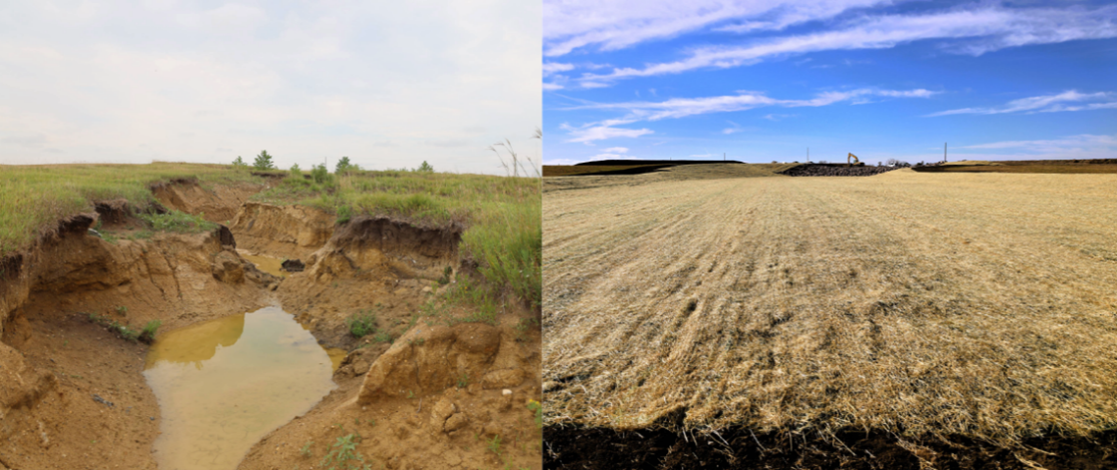 The left photo is the pre-construction, upstream view of the gulley, and the right photo is of the completed project taken in the same location.
The United States Department of Agriculture’s (USDA) Natural Resources Conservation Service (NRCS) in South Dakota (SD) offers natural disaster assistance through the Emergency Watershed Program (EWP), which provides technical and financial assistance to help local communities and sponsors relieve imminent threats to life and property caused by floods, fires, windstorms, and other natural disasters that impair a watershed, not requiring a disaster declaration by federal or state government officials for program assistance to begin.
Lake Dimock is a 20-minute drive south of Mitchell and is near a township road and a private landowner’s property. This lake has two spillways, with the primary concrete spillway at the north end of the dam embankment, and the secondary earth/grass “auxiliary” spillway near the center of the embankment. Water will run through the primary spillway first, then, if the elevation of the water gets high enough, it flows through the secondary auxiliary and over the township road. Twice within the last five years, during the extreme snowmelt and rainfall events in 2019 and 2024, extreme flooding caused damaging flows through the secondary auxiliary that spilled out into the neighboring landowner’s pasture. Those extremely powerful flows of water created a massive gully. If not fixed, another extreme rainfall event would likely have caused the gully to worsen, eventually eroding upstream, working its way through the road, and eventually even draining the lake. If that type of erosion had occurred, it would have disrupted traffic, emergency services, and potentially disrupted power and telecommunications for the surrounding residents. To remedy this issue, NRCS’s EWP was utilized to repair the gully by installing a rock rip rap chute through a signed project agreement with SD Game, Fish and Parks (GFP), owner of Lake Dimock, and the project sponsor.
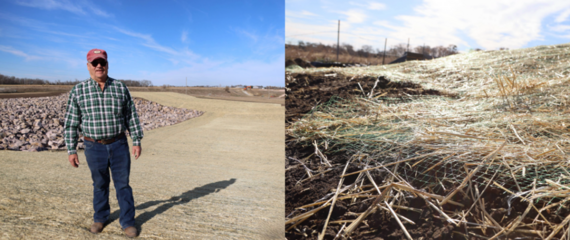 Bill Kummer standing in front of the newly established rip rap (left photo) and a close-up of the temporary straw erosion control blanket (ECB), which will provide cover for the seeded grass and cover crop during the winter months (right photo).
The neighboring landowner, Bill Kummer, granted permission for the project. When asked about the completed project, Bill replied, “I’m really pleased with it; the aesthetic is great.” In the meantime, to prevent erosion and encourage grass and cover crop growth in the spring, 100% weed-free straw was laid on top of the seeded field, which is secured in place in between two layers of degradable photosynthetic netting that will slowly degrade from sun exposure in four to six months, more formally known as an erosion control blanket (ECB), which will provide security against elemental erosion throughout the winter. The seed mix used for this field was the Department of Transportation’s type “G” mix, which includes switch grass, Indian grass, big bluestem, and Western wheat grass, with rye serving as a cover crop. Kummer plans to let freshly planted grass and cover crops establish before ever cutting it for hay.
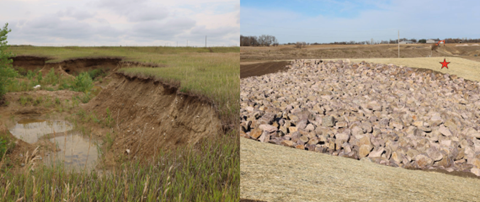 The head cut and gully in the auxiliary spillway facing south before construction (left photo), and after riprap construction facing north (right photo)—to better visualize, a red “x” marks where the “before construction” photo was taken. The gully was made by water flowing from west to east.
Working in tandem with our partner in conservation, GFP awarded a construction contract to Lidel Construction of Sioux Falls, with construction staking and inspection led by Banner Associates. Engineer James Gilkerson with GFP designed the project—a final review of the design was completed by NRCS engineers. When disasters occur, NRCS programs, including the EWP, can support a sponsor's design and plan for a locally led recovery effort. Visit your local NRCS office to discuss your goals and learn how an NRCS specialist or program can support and expand your operational efforts.
Top of page
The U.S. Department of Agriculture’s Risk Management Agency (RMA) made significant enhancements to federal crop insurance programs by expanding benefits for beginning farmers and ranchers, increasing coverage options, and making crop insurance more affordable and accessible across multiple insurance programs.
Putting American Farmers First with Enhanced Support for Beginning Farmers and Ranchers
Beginning farmers and ranchers will receive substantially increased premium support during their first decade of farming operations, making crop insurance more affordable for the next generation of American agricultural producers. The enhanced benefits mean beginning farmers and ranchers will now receive:
- 15 percentage points additional subsidy for the first two crop years
- 13 percentage points for the third crop year
- 11 percentage points for the fourth crop year
- 10 percentage points for years five through ten
These benefits build upon existing support that waives administrative fees and provides base premium subsidies. A beginning farmer or rancher is now defined as an individual who has not actively operated and managed a farm or ranch for more than 10 crop years.
Making Crop Insurance More Accessible with Expanded Coverage Options
Improvements to area-based crop insurance programs include:
- Whole Farm Revenue Protection (WFRP) maximum coverage level increase from 85% to 90%, providing producers with enhanced protection for diversified operations.
- Supplemental Coverage Option (SCO) premium support increase from 65% to 80%, making this valuable gap coverage more affordable. Additionally, producers can now purchase SCO regardless of their Area Risk Coverage (ARC) elections with the Farm Service Agency, dramatically increasing accessibility.
- Enhanced Coverage Option (ECO) and similar programs including Margin Coverage Option (MCO), Hurricane Insurance Protection Wind Index (HIP-WI), and Fire Insurance Protection Smoke Index (FIP-SI) will also receive the increased 80% in premium support, making comprehensive coverage more affordable than ever.
- SCO coverage will also expand to a coverage level of 90% (from 86%). Producers will have access to this option in 2026 via the ECO product, which has identical coverage at the same cost and premium support levels. USDA will then change the SCO policy for the 2027 crop year.
These changes will be effective for all crops with sales closing dates on or after July 1, 2025.
RMA will provide additional guidance on other provisions within the One Big Beautiful Bill Act as implementation details are finalized. Producers should contact their local crop insurance agent or visit the RMA website for more information about how these changes may affect their coverage options.
Top of page
USDA in South Dakota
200 4th Street SW
Huron, SD 57350
FSA Phone: (605) 352-1160
NRCS Phone: (605) 352-1200
RMA Phone: (406) 651-8450
|
|
Get Started at Your USDA Service Center
|
|
Farm Service Agency
State Executive Director:
Roger Chase
Deputy State Executive Director:
Ryan Vanden Berge
Administrative Officer:
Theresa Hoadley
Program Managers:
Owen Fagerhaug - Conservation
Logan Kopfmann - Disaster Relief
Donita Garry - Program Delivery
Bridget Weber - Farm Loan Program,
Acting
|
Natural Resources Conservation
Service
Acting State Conservationist:
Jessica Michalski
Assistant State Conservationists:
Jessica Michalski - Ecological Sciences
James Reedy - Engineering
Nathan Jones - Soils
Val Dupraz - Programs
Colette Kessler - Partnerships
Deke Hobbick - Compliance
Denise Gauer - Management & Strategy
|
|
South Dakota Farm Service Agency
South Dakota Natural Resources Conservation Service
|
|






