
NRCS-Michigan Conservation Notes Newsletter - January/February 2026
 In This Issue:

State Conservationist Diane Gray
NRCS announced a national application batching deadline of Jan. 15, 2026 for Environmental Quality Incentives Program (EQIP), Conservation Stewardship Program (CSP), and the Agricultural Conservation Easement Program.
The EQIP and CSP sign-up includes funding through the Regenerative Pilot Program which is highlighted in this newsletter. A request for proposals for national and state Conservation Innovation Grants will be announced in the next calendar year.
Although program applications are accepted on a continuous basis, EQIP, CSP, and ACEP applications must be received by Jan. 15, 2026, to be considered for the current round of funding.
~
|

I wish to recognize and honor the life and career of Paul Holowka. Paul passed away unexpectedly at the age of 48 on August 27.
Paul was the district conservationist serving Bay County at the time of his death. He began his NRCS career in 2010 as a student trainee in Texas before moving to Michigan.
On behalf of NRCS I extend my deepest condolences to his three children as well as his extended family, friends, and colleagues.
~
Finally, I hope everyone at NRCS-Michigan, along with our conservation partners, enjoyed a Merry Christmas and New Year. I hope you were able to enjoy the time with your friends and families.
|
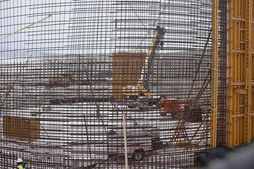
Tony Jandernoa has been a dairyman for 40 years and never considered getting into the petroleum business. That changed about four years ago when he was approached by Ag-Grid Energy, a company that partners with dairy farmers to produce natural gas and electricity with anaerobic digesters.
Ag-Grid is constructing two anaerobic digesters at Jandernoa’s 2,000-head dairy farm near Lake Odessa in Ionia County. One of the digesters, which will exclusively utilize manure from the dairy, will receive financial assistance through the Environmental Quality Incentives Program. The other digester will utilize manure as well as food waste from a yet-to-be determined source. According to Ag-Grid, the two digesters will recycle over 100,000 gallons of manure per day, and 20,000 gallons of food waste.
Once the digesters go into operation, anticipated in Fall 2026, methane produced by the digesters will be processed on site into renewable natural gas (RNG). The RNG will mostly be sold, with some used to produce electricity to power the facility.
|
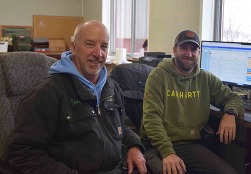
Tony is a first-generation dairy farmer who worked on neighbors’ dairies while growing up near Fowler. The dairy near Lake Odessa, Meadowbrook Dairy, is one of three dairies he owns and operates with his son Kyle. Some of the manure from his other two dairies, in Clinton County, will be brought to the digesters at Meadowbrook.
There is strong demand for manure fertilizer from crop producers, Tony said. Meadowbrook has underground lines to move manure to farm fields over 6 miles away. Manure processed through the digester will still be used as fertilizer. Nutrients in manure from the digester may be more available to crops than unprocessed manure, Tony said. The processed manure will have another attribute his neighbors may appreciate, it will have less odor.
Construction was still underway on Dec. 9, when about 90 yards of concrete were poured into a form making part of a digestor wall. The walls surrounding the digesters are about 30 feet tall and 18 inches thick. When construction is completed, the digesters will be backfilled so they will only extend about 8 feet above the ground. The inside of the forms was heated to about 60 degrees prior to being filled. Construction was expected to stop in the coming weeks until spring, said Abu Akki, director of business development for Ag-Grid who was on site along with other company employees.
|
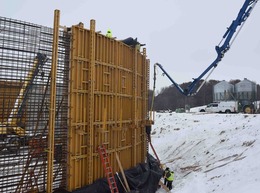
When the digesters are completed, liquid manure and food waste will be added and “seeded” with bacteria to produce methane. The contents of the digesters will slowly warm to about 90 degrees Fahrenheit for full production, said Akki. The gas produced at the site will be upgraded from biogas to methane and pressurized on site. Only one digester will contain both manure and food waste, he said.
The company prefers pre-consumer food waste from companies rather than post-consumer waste that can contain packaging and other contaminants. All of Ag-Grid's anaerobic digesters have a food waste component, Akki said. This is the company’s first digester project in the Midwest with five others located in the Eastern U.S.
|
Top of page

U.S. Secretary of Agriculture Brooke L. Rollins, U.S. Health and Human Services Secretary Robert F. Kennedy, Jr., and Centers for Medicare & Medicaid Services Administrator Dr. Mehmet Oz announced a $700 million Regenerative Pilot Program to help American farmers adopt practices that improve soil health, enhance water quality, and boost long-term productivity, all while strengthening America’s food and fiber supply.
Administered by NRCS, this new Regenerative Pilot Program delivers a streamlined, outcome-based conservation model—empowering producers to plan and implement whole-farm regenerative practices through a single application. The initiative highlights USDA’s commitment to putting Farmers First and advancing the Make America Healthy Again (MAHA) agenda by building a healthier, more resilient food system.
In FY2026, the Regenerative Pilot Program will focus on whole-farm planning that addresses every major resource concern—soil, water, and natural vitality—under a single conservation framework. USDA is dedicating $400 million through the Environmental Quality Incentives Program (EQIP) and $300 million through the Conservation Stewardship Program (CSP) to fund this first year of regenerative agriculture projects.
Read more.
|
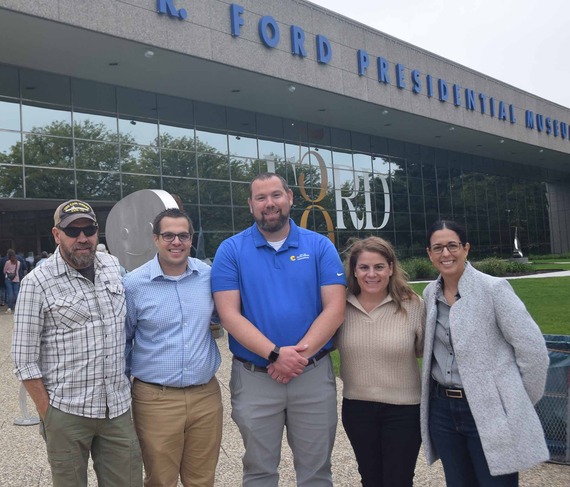 NRCS Senior Advisor for Field Operations Kelli Evans (far right) , visited a proposed PL-566 project in Grand Rapids on a visit to Michigan in September. She was accompanied by Great Lakes Whitewater and NRCS staff. While in Michigan, she also met with NRCS staff and stakeholders.
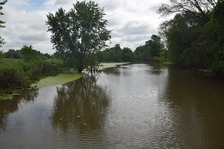
The Michigan Department of Environment, Great Lakes, and Energy (EGLE) announced today about $2.9 million in Nonpoint Source (NPS) Program grants. These funds will support eight projects that will prevent, reduce, or eliminate polluted runoff and other nonpoint sources of pollution – caused when rain, snowmelt, or wind carry pollutants from land into lakes, streams, or wetlands.
The purpose of these grants is to carry out locally developed watershed management priorities that EGLE has approved to help restore impaired waters and protect high-quality waters by reducing NPS sediments, nutrients, bacteria, and other contaminants. These Nonpoint Pollution Control grants are funded through the Renew Michigan Fund and Section 319 of the Federal Clean Water Act. The projects recommended for funding will:
- Address high levels of bacteria from human sources in the Thornapple River Watershed with outreach to homeowners, technical assistance, and funding for the repair and replacement of failing on-site septic systems.
- Replace an undersized railroad-stream crossing in the Grand Traverse Bay Watershed to restore proper stream dimensions and sediment transport mechanisms to improve stream health and natural stream function.
- Implement livestock best management practices in the Ottawa-Stony North and Munuscong River watersheds to address sources of sediment, nutrient, and E. coli impairments. Practices will include improvements to on-site manure management, restricting livestock access to surface water, and adding livestock stream crossings.
- Develop an Inland Waterway stewardship guide to educate residents and recreational users across six major waterbodies including Crooked, Pickerel, Burt, and Mullet lakes as well as Indian and Cheboygan rivers on best management practices for reducing nutrient runoff, managing invasive species, and protecting shorelines. The project will leverage resources from statewide initiatives to drive action and increase public awareness and stewardship.
- Protect approximately 300 acres in the Grand River Watershed and 552 acres in the Manistee River Watershed with water quality-based permanent conservation easements. Combined, these easements will prevent 33.6 tons of sediment, 542 pounds of nitrogen, and 112 pounds of phosphorus from entering Michigan waterways.
The following Michigan based organizations have been awarded funding:
- Legacy Land Conservancy, Ann Arbor: $377,038
- Washtenaw County Soil Conservation District, Ann Arbor: $383,484
- Southwest Michigan Land Conservancy, Galesburg: $239,216
- Barry Conservation District, Hastings: $339,462
- Tip of the Mitt Watershed Council, Petoskey: $45,356
- Chippewa Luce Mackinac Conservation District, Sault Ste. Marie: $500,000
- Grand Traverse Regional Land Conservancy, Traverse City: $415,673
- The Watershed Center Grand Traverse Bay, Traverse City: $614,993
A total of 17 applications requesting about $6.4 million were received in response to the request for proposals (RFP).
The grants are issued by EGLE's NPS Program, which helps local stakeholders reduce pollution and excess runoff by supporting efforts to develop and launch watershed management plans.
The NPS Program typically issues an RFP each year for this funding source, with the next available opportunity to be released in January 2026. The RFP will be posted at Michigan.gov/NPS.
|
Top of page

January 2026
29 - Michigan Manure Summit, 9:30 a.m. to 4 p.m., Okemos Events Center - Okemos, for more information and to register go to canr.msu.edu/events
29 - Biochar Seminar and Expo, 8 a.m. to 3 p.m., Saginaw Valley Research & Extension Center - Frankenmuth, for more information and to register go to tuscolacd.com or call 989/673-8174 ext. 3
|
February
4 - 2026 Southeast Michigan Vegetable & Field Crops Grower Winter Meeting, 8:30 a.m. to 3 p.m., Old Mill Museum - Dundee, for more information go to canr.msu.edu/events
5 - 2026 Cultivating Resilience Winter Conference, 8:30 a.m. to 3 p.m., Pinnacle Center - Hudsonville, for more information and to register (by Jan. 28) go to ottawacd.org
5 - Soil Fertility and Nutrient Management Training 2, 9 a.m. to 3 p.m., Clinton County Smith Hall - St. Johns, for more information and to register go to canr.msu.edu/events
12 - Mecosta Conservation District Presents: Birding 101 - An Educational Workshop, 5:30 p.m. to 7:30 p.m., Antler's Fireside Grill - Canadian Lakes, for more information go to members.macd.org/event-calendar
25 - Great Lakes Field Crops Irrigation Meeting 2026, 9 a.m. to 4 p.m., Blue Gate Theatre - Shipshewana, Ind., for more information go to canr.msu.edu/events
26 - Tuscola CD Pruning Workshop, 9 a.m. to 3 p.m., Saginaw Valley Research & Extension Center - Frankenmuth, for more information and to register go to tuscolacd.com or call 989/673-8174 ext. 3
March
17 - Michigan Envirothon Region 4 Competition, 9 a.m. to 2 p.m., Kalamazoo Nature Center - Kalamazoo, for more information go to members.macd.org/event-calendar or email schaubfarmnb@outlook.com
24 - Michigan Envirothon Region 2 Competition, 9 a.m. to 2 p.m., Boardman River Nature Center - Traverse City, for more information go to members.macd.org/event-calendar or email schaubfarmnb@outlook.com
26 - Michigan Envirothon Region 1 Competition, 9 a.m. to 2 p.m., Ottawa National Forest Visitor Center - Watersmeet, for more information go to members.macd.org/event-calendar or email schaubfarmnb@outlook.com
26 - Michigan Envirothon Region 3 Competition, 9 a.m. to 2 p.m., Hartley Outdoor Education Center - St. Charles, for more information go to members.macd.org/event-calendar or email schaubfarmnb@outlook.com
Top of page
|








