
West Virginia Farm Service Agency State Newsletter - September 3, 2025
In This Issue:

Ask USDA is now available as a tool for FSA customers to ask questions about FSA programs and services.
Ask USDA, available at ask.usda.gov provides information for all USDA programs. Ask USDA allows USDA customers to search for and read answers about FSA programs and services in the same location as they read about other USDA programs and services.
Customers are able to submit questions through email, chat, and phone if they need more information. This improved customer service approach provides a one-stop shopping experience that covers all of USDA’s many programs.
|
Top of page
The Farm Service Agency (FSA) makes loans to youth to establish and operate agricultural income-producing projects in connection with 4-H clubs, FFA and other agricultural groups. Projects must be planned and operated with the help of the organization advisor, produce sufficient income to repay the loan and provide the youth with practical business and educational experience. The maximum loan amount is $10,000.
Youth Loan Eligibility Requirements:
- Be a citizen of the United States (which includes Puerto Rico, the Virgin Islands, Guam, American Samoa, the Commonwealth of the Northern Mariana Islands) or a legal resident alien
- Be 10 years to 20 years of age
- Comply with FSA’s general eligibility requirements
- Conduct a modest income-producing project in a supervised program of work as outlined above
- Demonstrate capability of planning, managing and operating the project under guidance and assistance from a project advisor. The project supervisor must recommend the youth loan applicant, along with providing adequate supervision.
For help preparing the application forms, contact your local County USDA Service Center or visit fsa.usda.gov.
|
The Farm Service Agency (FSA) administers two programs that have specific safety net benefits for producers of honeybees and honey. The Noninsured Crop Disaster Assistance Program (NAP) and the Emergency Assistance for Livestock, Honeybees and Farm-Raised Fish Program (ELAP) assist producers when disasters impact honey production or damage or destroy colonies, hives or honeybee feed.
NAP is designed to reduce financial losses when natural disasters result in lower yields or crop losses, including honey. NAP coverage is equivalent to catastrophic insurance, meaning it covers up to 50 percent of a producer’s normal yield (must have at least a 50 percent loss) at 55 percent of the average market price. The 2018 Farm Bill reinstates higher levels of coverage, from 50 to 65 percent of expected production in 5 percent increments, at 100 percent of the average market price. Producers of organics and crops marketed directly to consumers also may exercise the “buy-up” option to obtain NAP coverage of 100 percent of the average market price at the coverage levels of between 50 and 65 percent of expected production.
The NAP service fee is the lesser of $325 per crop or $825 per producer per administrative county, not to exceed a total of $1,950 for a producer with farming interests in multiple counties. You must apply for NAP coverage by Dec. 31st prior to the year for which you’re seeking coverage.
ELAP covers colony losses, honeybee hive losses (the physical structure) and honeybee feed losses in instances where the colony, hive or feed has been destroyed by a natural disaster or, in the case of colony losses, because of Colony Collapse Disorder. Colony losses must be in excess of normal mortality.
Both the NAP and ELAP programs require you to report the number of colonies you have in production to FSA by Jan. 2, 2026. You must notify FSA within 30 calendar days of changes in the total number of colonies or when honeybees are moved to another county.
For both programs, you must notify FSA within 15 calendar days of when a loss occurs or from when the loss is apparent. To learn more about programs for honey and honeybee producers, contact your local County USDA Service Center or visit fsa.usda.gov.
Top of page
 |
|
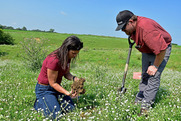
A key part of NRCS’s 90-year history was the establishment of the conservation planning process by Hugh Hammond Bennett. Bennett was the agency’s first chief and is considered the “father of soil conservation.” He believed in considering each farm’s unique conditions when developing a conservation plan.
A conservation plan is a document outlining the strategies and actions that should be taken to protect and manage natural resources on a specific area of land. It serves as a blueprint for achieving conservation goals. To develop a conservation plan, a conservation planner and the customer (farmer, rancher or landowner) collaborate during the conservation planning process.
Bennett believed that agency employees must walk the land with the customer and see their natural resource challenges and opportunities firsthand. Bennett also understood that natural resource concerns could not be treated in isolation; soil, water, air, plants, animals, and humans are all part of an integrated system that is inter-dependent.
Learn more about how conservation planning has evolved over the years.
|
Top of page
West Virginia Farm Service Agency State Newsletter
1550 Earl L Core Road
Morgantown, WV 26505
Phone: 304-284-4800
Service Center Locator
State Executive Director - Keith Richmond
Deputy State Executive Director - Joshua Lewis
|
|






