
NRCS-Michigan Conservation Notes Newsletter - July/August 2025
 In This Issue:

State Conservationist Diane Gray
If the mission of NRCS had to be reduced to one word, it would be stewardship. Our mission is to help farmers and landowners be good stewards of the land, by conserving our soil, water, air, and wildlife resources. That is why it is so encouraging that Michigan producers are choosing to enroll their land in the Conservation Stewardship Program.
This year Michigan requested and received an additional $12 million in CSP funding. This will allow NRCS to provide $24.5 million to support our farmers and private forestland owners stewardship efforts. The program has more than doubled since 2022, when 306 producers entered into CSP contracts for $10.2 million in financial assistance.
Behind the numbers, CSP supports the ongoing conservation efforts of producers with annual payments and provides incentives for expanding conservation efforts. Many producers were utilizing stewardship practices like conservation tillage and cover crops before programs like EQIP provided financial assistance for these practices. CSP provides financial support to maintain their ongoing stewardship practices and to do even more.
The program provides additional financial assistance for new enhancements like using precision application technology to use less pesticides and herbicides. Forest owners can improve wildlife habitat by creating snags and dens. CSP offers assistance for a wide variety of conservation enhancements for all types of agricultural and forest operations. The ongoing efforts of CSP stewards will protect the natural resources all of us depend on.
|
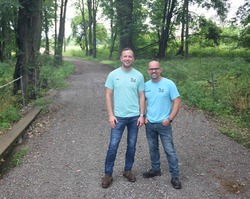
Knowing where their food comes from and preserving the lineage of heritage livestock are the motivation behind Two Men and a Hen in Mecosta County.
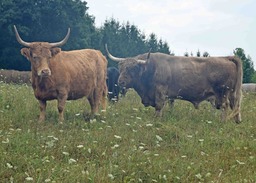
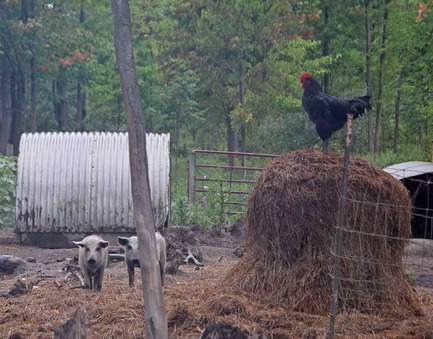
Christopher and Ryan Thatcher raise Irish Dexter and Miniature Highland cattle and Mangalitsa pigs, along with chickens and a few peacocks on their now 160-acre farm. They started out in 2016, buying a 40-acre farm that once belonged to a family friend.
Preservation of genetic lines was their first motivation for selecting their livestock breeds, said Christopher. Irish Dexter and Miniature Highlands have advantages over conventional breeds like Angus and Herefords. Both are hearty breeds, well adapted to living in Michigan weather and are efficient foragers. They are also much smaller than conventional breeds, about one-half to one-third the weight and are known for being easy to handle. These traits are important as the two hope to farm into their 70s, said Christopher.
|
Initially they grazed 11 acres and began working with NRCS in 2019 after having their farm environmentally verified through the Michigan Agricultural Environmental Assurance Program. Christopher and Ryan enrolled their farm in the Environmental Quality Incentives Program in 2022. The first practices they implemented with EQIP financial assistance were fence and heavy use area protection around their existing waterers as part of their prescribed grazing plan, said District Conservationist Jennifer Taylor.
They purchased an almost-adjoining 120 acres of land in 2021, almost adjoining because a county drain and a wetland easement separated the two properties. To facilitate access, their EQIP contract included a stream crossing, installing a layer of rock over geotextile fabric so they can move cattle and equipment through the county drain without causing erosion or damage to the riparian area. Other EQIP practices they implemented include additional watering facilities, livestock pipeline, and livestock trails and walkways. The stream crossing was the big one they most appreciated, said Ryan.
|
Two Men and Hen now has about 75 adult head of cattle grazing about 70 acres divided into over 40 paddocks for rotational grazing. They sell their cattle and pigs for meat, by halves or wholes, and also as feeders and breeding stock. Dexters and Highland cattle are popular breeds for homestead livestock operations, said Ryan. Mangalitsa pigs are also well adapted for Michigan, they grow a long coat in winter and shed in summer like the Dexter cattle.
Being a specialized operation and relatively far from large cities, Two Men and a Hen utilize social media as part of their marketing. The farm has 23,000 followers on Facebook where they post photos and videos of livestock and the latest happenings. They’ve had buyers come from as far as Detroit and Chicago. They’ve sold Mangalitsa pigs to people with Hungarian ancestry who butchered the hogs on site.
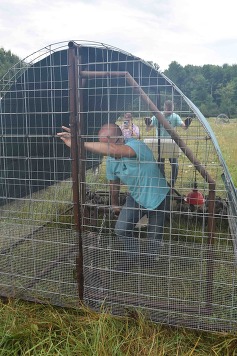
Christopher and Ryan’s immediate goal is to continue improving the quality of forage on their land. Their cattle are grass fed except for a small amount of grain each day to provide needed minerals they can’t get from grazing. They’ve needed to purchase additional hay to make up for what their pasture can’t provide. With their prescribed grazing plan, the quality of their pastures will slowly improve. They’ve already seen changes with healthier forage by rotating livestock and resting paddocks, adding pasture poultry with a chicken tractor, and by livestock processing forage. They’ve observed desirable plants self-seeding and sprouting in manure while finding dung beetle activity breaking down the cattle manure.
It's been a pleasure working with Two Men and A Hen, said Taylor. We have worked together to overcome obstacles, learned together, and continue to laugh and have fun while doing it. I look forward to working with them and see further improvements to their pasture. We are also exploring forest management together.
|
 |
Top of page
If you’re a farmer or other operator, you may be asked to participate in a survey to gather in-depth information about the use of conservation practices on cultivated cropland.
The 2025 Conservation Effects Assessment Project (CEAP) Survey is a joint effort between USDA’s Natural Resources Conservation Service (NRCS) and National Agricultural Statistics Service (NASS). NASS will visit approximately 23,000 operators across the contiguous U.S. in August and September 2025 to determine survey eligibility. A more in-depth follow-up survey will be conducted starting in November 2025.
This is the second of three years of surveys conducted by NASS. Once surveying is complete, NRCS will combine the data with information from the National Resources Inventory, NRCS field staff, and multiple data sources to estimate environmental and management outcomes of conservation on cultivated cropland across U.S. farms. NRCS will publish the findings as a CEAP Cropland Assessment report. CEAP Cropland Assessments quantify the effects of voluntary conservation efforts across the nation’s cropland at both regional and national scales.
“The farmer is the solution and not the problem. They address issues like water quality and soil health every day on their operations through voluntary conservation” said NRCS Deputy Chief Terron Hillsman. Deputy Chief Hillsman goes on to say, “It is important we measure and quantify benefits of conservation implemented not only through financial and technical assistance provided by NRCS but also through the voluntary efforts of farmers so they can receive credit for the amazing work they are doing to protect our nation’s natural resources and increase the sustainability of American agriculture. CEAP Cropland Assessments enable producers to tell their conservation success stories, conservation partners to improve the science and delivery of programs and practices, and policymakers to prioritize programs that enable farmers to address resource concerns.”
Top of page

September
4 - Who's who & What's what? - Wetland Compliance, 8:30 a.m. to noon, Ovid Township Hall - Coldwater, for more information or to RSVP go to branchcd.org or call 517/278-2725 or email RSVP@
5 - Michigan Specialty Cut Flower Farm Tour, 10 a.m. to noon, 50330 Mill St. - Three Rivers, for more information go to canr.msu.edu/events
10 - 2025 Summer Field Day, 9 a.m. to noon, 24241 M-60 – Mendon, for more information to canr.msu.edu/events
10 - Blueberry Field Day, 10 a.m. to 3 p.m., Trevor Nichols Research & Extension Center - Fennville, for more information go to canr.msu.edu/events
10 - Tribal Food Producer Information Session, 12:30 p.m. to 1:30 p.m., virtual event, for more information and to register go to canr.msu.edu/events
20 - Michigan Specialty Cut Flower Farm Tour, 2 p.m. to 4 p.m., 2745 S Sashabaw Rd. – Ortonville, for more information go to canr.msu.edu/events
21 - Conservation Pool Party – hosted by Michigan Vernal Pools Partnership and MSU Extension , 1 p.m. to 3 p.m., 2020 E Mt Hope Ave. – Lansing, for more information go to canr.msu.edu/events
24 - Flint Food Summit, 10 a.m. to 5 p.m., Flint Farmers' Market - Flint, for more information go to canr.msu.edu/events
|
October
4 - Michigan Beekeepers Association Fall Conference, 9 a.m. to 5 p.m., Washtenaw Community College – Ann Arbor, for more information go to canr.msu.edu/events
9 - Organic Apple Orchard Tour at Third Leaf Farms, 4 p.m. to 6 p.m., Third Leaf Farm – Greenville, for more information go to canr.msu.edu/events
11 - Farm Field Day with Fisheye Farm, 1 p.m. to 3 p.m., Fisheye Farms - Detroit, for more information go to canr.msu.edu/events
Top of page
|








