
Mississippi State News - August 2025.
In This Issue:

The USDA Farm Service Agency’s (FSA) Direct Farm Ownership loans can help farmers and ranchers become owner-operators of family farms, improve and expand current operations, increase agricultural productivity, and assist with land tenure to save farmland for future generations.
There are three types of Direct Farm Ownership Loans: regular, down payment and joint financing. FSA also offers a Direct Farm Ownership Microloan option for smaller financial needs up to $50,000.
Joint financing allows FSA to provide more farmers and ranchers with access to capital. FSA lends up to 50 percent of the total amount financed. A commercial lender, a state program or the seller of the property being purchased, provides the balance of loan funds, with or without an FSA guarantee. The maximum loan amount for a joint financing loan is $600,000, and the repayment period for the loan is up to 40 years.
The operation must be an eligible farm enterprise. Farm Ownership loan funds cannot be used to finance non-farm enterprises and all applicants must be able to meet general eligibility requirements. Loan applicants are also required to have participated in the business operations of a farm or ranch for at least three years out of the 10 years prior to the date the application is submitted. The applicant must show documentation that their participation in the business operation of the farm or ranch was not solely as a laborer.
For more information about farm loans, contact your local County USDA Service Center or visit fsa.usda.gov.
|
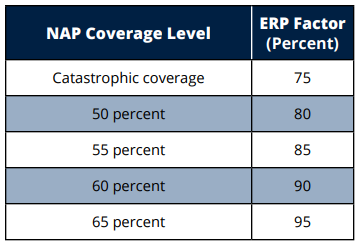
The Farm Service Agency’s (FSA) Noninsured Crop Disaster Assistance Program (NAP) provides financial assistance to producers of non-insurable crops, including mechanically harvested forage with NAP coverage, to protect against natural disasters that occur during the coverage, resulting in loss of production, loss of value, or prevented planting of an eligible crop.If you have NAP coverage on mechanically harvested forage, you must:
- Maintain separate production records for each unit, crop, practice, crop type, and intended use.
- Submit production records to FSA by the designated production reporting date for the crop.
- Notify your FSA administrative county office before grazing, abandoning, or destroying forage acreage reported, on FSA form FSA-578, as intended to be mechanically harvested; and request an appraisal.
- Notify your FSA administrative county office of a loss and timely file CCC-576, Notice of Loss and Application for Payment, Part B, the earlier of:
- 15 calendar days after the disaster occurs, or damage first becomes apparent.
- 15 calendar days after the crop’s normal harvest date.
- If you change your intended use or experience a loss during the coverage period, you must:
- Establish and maintain representative sample areas when an appraisal of the acreage is required.
- Inform your FSA administrative county office of the location of representative sample areas within 15 days of placing the panels.
- Request an appraisal of the representative sample areas at the end of harvest period but before first freeze.
For more information on NAP and NAP compliance requirements you must follow to retain NAP coverage, contact your local USDA service center.
|
USDA Farm Service Agency (FSA) reminds you to report prevented planted and failed acres in order to establish or retain FSA program eligibility for some programs.
You should report crop acreage you intended to plant, but due to natural disaster, were prevented from planting. Prevented planting acreage must be reported on form CCC-576, Notice of Loss, no later than 15 calendar days after the final planting date as established by FSA and the Risk Management Agency (RMA).
Additionally, if you have failed acres, you should also use form CCC-576, Notice of Loss, to report failed acres.
For hand-harvested crops and certain perishables, you must notify FSA of damage or loss through the administrative county office within 72 hours of the date of damage or loss first becomes apparent. This notification can be provided by filing a CCC-576, email, fax or phone. If you notify the County Office by any method other than by filing the CCC-576, you are still required to file a CCC-576, Notice of Loss, within the required 15 calendar days.
For losses on crops covered by the Noninsured Crop Disaster Assistance Program (NAP), you must file a Notice of Loss within 15 days of the occurrence of the disaster or when losses become apparent. You must timely file a Notice of Loss for failed acres on all crops including grasses.
To file a Notice of Loss, contact your local County USDA Service Center or visit www.fsa.usda.gov.
The National Environmental Policy Act (NEPA) requires Federal agencies to consider all potential environmental impacts for federally funded projects before the project is approved.
For all Farm Service Agency (FSA) programs, an environmental review must be completed before actions are approved, such as site preparation or ground disturbance. These programs include, but are not limited to, the Emergency Conservation Program (ECP), Farm Storage Facility Loan (FSFL) program and farm loans. If project implementation begins before FSA has completed an environmental review, the request will be denied. Although there are exceptions regarding the Stafford Act and emergencies, it’s important to wait until you receive written approval of your project proposal before starting any actions.
Applications cannot be approved until FSA has copies of all permits and plans. Contact your local FSA office early in your planning process to determine what level of environmental review is required for your program application so that it can be completed timely.

The U.S. Department of Agriculture (USDA) Farm Service Agency (FSA) county committees are a critical component of the day-to-day operations of FSA and allow grassroots input and local administration of federal farm programs.
Committees are comprised of locally elected agricultural producers responsible for the fair and equitable administration of FSA farm programs in their counties. Committee members are accountable to the Secretary of Agriculture. If elected, members become part of a local decision-making and farm program delivery process.
A county committee is composed of 3 to 11 elected members from Local Administrative Areas (LAA). Each member serves a three-year term. To be eligible for nomination and hold office as a committee member or alternate, a person must fulfill each of the following requirements:
- Be eligible to vote in an FSA county committee election*.
- Reside in the LAA that is up for election.
- Must not have been:
- Removed or disqualified from:
- FSA county committee membership or alternate membership, or
- FSA employment.
- Removed for cause from any public office or have been convicted of fraud, larceny, embezzlement or any other felony.
- Dishonorably discharged from any branch of the armed services.
*The following requirements must be met for a person to be eligible to vote in the county committee elections:
- Be of legal voting age or, if not of legal voting age, supervise and conduct the farming operation of an entire farm.
- Have an interest in a farm or ranch as either:
- An individual who meets one or more of the following
- Is eligible and capable to vote in one’s own right.
- Is a partner of a general partnership.
- Is a member of a joint venture.
- Is an authorized representative of a legal entity
- Participates or cooperates in any FSA program that is provided by law. A cooperating producer is someone who has provided information about their farming or ranching operation(s) but may not have applied or received FSA program benefits.
All nomination forms for the 2025 election must be postmarked or received in the local USDA Service Center by Aug. 1, 2025. For more information on FSA county committee elections, including fact sheets, nomination forms and FAQs, visit fsa.usda.gov/elections
|
|
USDA/FSA
Mississippi State Office
6311 Ridgewood Road
Suite W100
Jackson, MS 39211
PH: 601-965-4300
State Executive Director
Christopher McDonald
Deputy State Executive Director
Demetrice Evans
|
|






