
Columbia County and Walla Walla County Updates - August 12, 2025
In This Issue:
August 15, 2025 - Deadline to apply for the Emergency Commodity Assistance Program (ECAP)
September 1, 2025 - Labor Day. Offices will be closed.
September 2, 2025 – Deadline to obtain 2025 crop year NAP coverage for cabbage (for seed or fresh); canola; carrots (for seed); cauliflower (for seed or fresh); onions (for seed, fresh, or processing); rapeseed; rutabaga (for seed or fresh); turnips (for seed or fresh); and any other fall planted crops not mentioned in other closing dates.
September 3, 2025 Monthly Webinar Series: Topic TBD. Submit your topic idea!
September 26, 2025 - Deadline to complete all changes to farming operations for FY2024 that result in succession of interest ARC/PLC contracts
September 26, 2025 - Deadline to update eligibility documentation for FY2025. This includes the CCC-902 and the AD-1026.
September 30, 2025 - Deadline for all CRP contracts to be approved by FSA. This includes all types of CRP such as General, Continuous, CREP, TIP, etc.
September 30, 2025 - Acreage reporting deadline for aquaculture.
September 30, 2025 - NAP application closing date for aquaculture, beets (for stecklings), Christmas trees, floriculture, garlic, mink, mushrooms, turf grass sod, and biennial & perennial forages and mixed forages for hay, seed, or grazing.
October 13, 2025 – Columbus Day. USDA Service Centers will be closed.
The USDA Farm Service Agency (FSA) opened enrollment on July 10 for the Supplemental Disaster Relief Program (SDRP), which provides assistance for eligible crop losses due to natural disasters in 2023 and 2024.
Eligible U.S. Drought Monitor Losses
To qualify for drought related losses, the loss must have occurred in a county rated by the U.S. Drought Monitor as having a D2 (severe drought) for eight consecutive weeks, D3 (extreme drought), or greater intensity level during the applicable calendar year. View the list of counties eligible for SDRP due to qualifying drought for 2023 and 2024.
Other Eligible Disaster Events and Related Conditions
Below is a list of all qualifying disaster events with the eligible related conditions in parentheses:
- Wildfires
- Hurricanes (including related excessive wind, storm surges, tornadoes, tropical storms, and tropical depression)
- Floods (including related silt and debris)
- Derechos (including related excessive wind)
- Excessive heat
- Tornadoes
- Winter storms (including related blizzard and excessive wind)
- Freeze (including a polar vortex)
- Smoke exposure
- Excessive moisture
- Qualifying drought
Related conditions must have occurred as a direct result of the indicated disaster event.
Losses due to Hail
Hail is not a qualifying disaster event, but you may be eligible if it was directly related to a qualifying disaster event.
For example, if a producer’s crop suffered damage from hail, but the hail damage was directly related to a tornado, then this would qualify for an SDRP payment since tornado is a qualifying disaster event.
Documentation for Spot Checks
Producers who certify that a qualifying disaster event caused the loss should be prepared to provide documentation to support their self-certification if they are selected for a spot check. Documentation is not required to be submitted with your application. Additionally, producers are not required to verify the cause of loss with their crop insurance agent.
Producers should complete the pre-filled application that was mailed on July 9. If you received a crop insurance indemnity in 2023 or 2024 and did not receive an application, please visit your local FSA office and they can print your pre-filled application.
For additional help with your application, please review the FSA-526 Instructions for Stage 1. Learn more about SDRP, eligibility and future insurance requirements by visiting fsa.usda.gov/sdrp.
USDA is issuing up to $10 billion directly to agricultural producers through the Emergency Commodity Assistance Program (ECAP) for the 2024 crop year. Administered by USDA’s Farm Service Agency (FSA), ECAP will help agricultural producers mitigate the impacts of increased input costs and falling commodity prices.
Authorized by the American Relief Act, 2025, these economic relief payments are based on planted and prevented planted crop acres for eligible commodities for the 2024 crop year. To streamline and simplify the delivery of ECAP, FSA sent pre-filled applications to producers who submitted acreage reports to FSA for 2024 eligible ECAP commodities. Producers do not have to wait for their pre-filled ECAP application to apply. They can visit fsa.usda.gov/ecap to apply using a login.gov account or contact their local FSA office to request an application once the signup period opens.
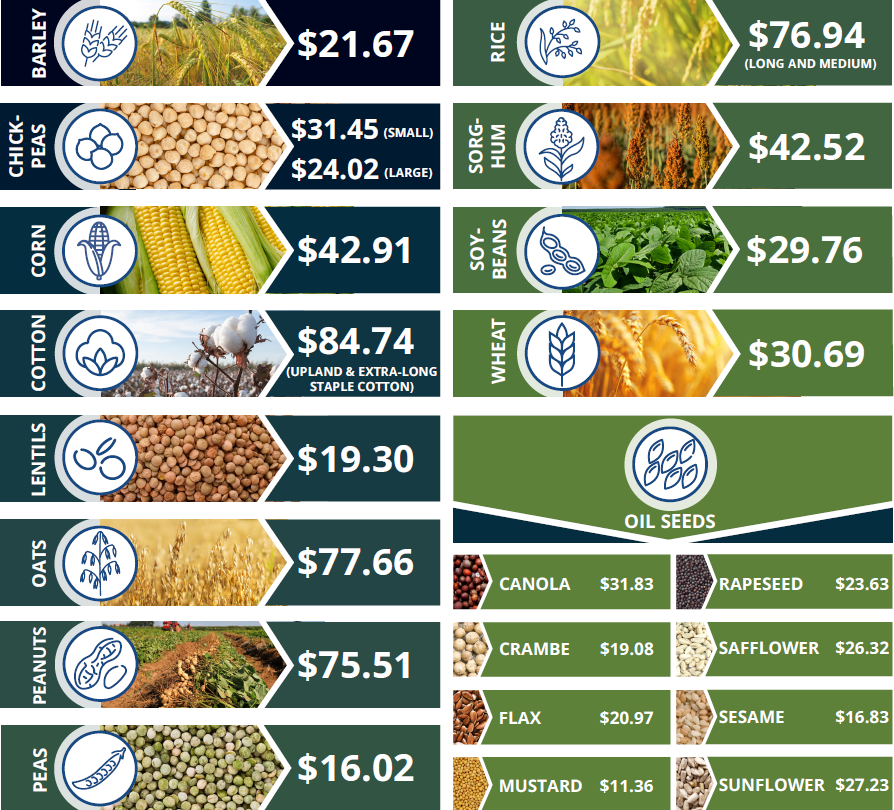
Eligible Commodities and Payment Rates
The commodities below are eligible for these per-acre payment rates:
 Producer Eligibility
Eligible producers must report 2024 crop year planted and prevented planted acres to FSA on an FSA-578, Report of Acreage form. Producers who have not previously reported 2024 crop year acreage or filed a notice of loss for prevented planted crops must submit an acreage report by the Aug. 15, 2025, deadline. Eligible producers can visit fsa.usda.gov/ecap for eligibility and payment details.
Applying for ECAP
Producers must submit ECAP applications to their local FSA county office by Aug. 15, 2025. Only one application is required for all ECAP eligible commodities nationwide. ECAP applications can be submitted to FSA in-person, electronically using Box and One-Span, by fax or by applying online at fsa.usda.gov/ecap utilizing a secure login.gov account.
If not already on file for the 2024 crop year, producers must have the following forms on file with FSA:
- Form AD-2047, Customer Data Worksheet.
- Form CCC-901, Member Information for Legal Entities (if applicable).
- Form CCC-902, Farm Operating Plan for an individual or legal entity.
- Form CCC 943, 75 percent of Average Gross Income from Farming, Ranching, or Forestry Certification (if applicable).
- AD-1026, Highly Erodible Land Conservation (HELC) and Wetland Conservation (WC) Certification.
- SF-3881, Direct Deposit.
Except for the new CCC-943, most producers, especially those who have previously participated in FSA programs, likely have these forms on file. However, those who are uncertain and want to confirm the status of their forms or need to submit the new CCC-943, can contact their local FSA county office.
If a producer does not receive a pre-filled ECAP application, and they planted or were prevented from planting ECAP eligible commodities in 2024, they should contact their local FSA office.
ECAP Payments and Calculator
ECAP payments will be issued as applications are approved. Initial ECAP payments will be factored by 85% to ensure that total program payments do not exceed available funding. If additional funds remain, FSA may issue a second payment.
ECAP assistance will be calculated using a flat payment rate for the eligible commodity multiplied by the eligible reported acres. Payments are based on acreage and not production. For acres reported as prevented plant, ECAP assistance will be calculated at 50%.
For ECAP payment estimates, producers are encouraged to visit fsa.usda.gov/ecap to use the ECAP online calculator.

The Conservation Reserve Program (CRP) is a program administered by the Farm Service Agency (FSA) to conserve farmland for future generations while providing habitat for wildlife, reducing soil erosion, and improving water quality. Regular maintenance on CRP acres is needed to ensure the acreage continues to provide conservation benefits and remains in compliance with the CRP contract.
Regular Maintenance
Producers with CRP contracts are required to control all weeds, insects, pests, and other undesirable species to the extent necessary to ensure that the approved conservation cover is adequately protected and to ensure there is no adverse impact on surrounding land. Mowing is one of the allowable practices for weed control, but mowing for aesthetic purposes is never permitted. The Conservation Plan states the required weed control methods for each site.
Once a stand has been certified as fully established, participants are required to maintain plant diversity and stand density according to the Conservation Plan and offer (CRP-2) for the life of the contract. Stands that do not meet practice specific plant diversity or density requirements may be considered non-compliant. Refer to your conservation plan or contact FSA if you have any questions or concerns about the vegetative cover requirements.
Maintenance activities cannot occur during the primary nesting season for birds without written prior approval from the local county office. The primary nesting season in Washington is April 1 through July 1.
Mid-Contract Management
Regular maintenance for weed and pest control is separate from the Mid-Contract Management (MCM) requirement. MCM ensures plant diversity and wildlife benefits while ensuring protection of the soil and water resources. Such activities are site-specific and are for the purpose of enhancing the approved cover.
MCM must be completed between years four and six of a 10-year contract and between years seven and nine of a 15-year contract. The Conservation Plan will state what year MCM must take place.
Noncompliance with Maintenance Requirements
Failure to adequately maintain the stand may result in noncompliance with the terms and conditions of the CRP contract. Noncompliance can result in adverse actions up to and including termination of the CRP contract. Contracts that are out of compliance are ineligible to re-enroll, unless the stand is brought back into compliance prior to the enrollment deadline.
For general information about CRP, visit the Conservation Reserve Program webpage. For information about specific contracts, reach out to the local FSA office.
|
Top of page
USDA Service Center
Walla Walla County Service Center
325 N. 13th Ave
Walla Walla, WA 99362
Phone: 509-522-6347 x2
Columbia County Service Center
531 Cameron St.
Dayton, WA 99328
Phone: 509-382-2421 x2
Service Center Locator
FSA County Executive Director - Kelley Betts
FSA Farm Loan Officer - Beth Farias
NRCS District Conservationist - Tracy Hanger
|
|






