
Idaho State Office FSA Newsletter - August 12, 2025
In This Issue:
-
August 15: Emergency Commodity Assistance Program (ECAP) Deadline
-
September 1: Labor Day (Office Closed)
Click here to learn more about local deadlines and ongoing programs.
Top of page
 USDA is issuing up to $10 billion directly to agricultural producers through the Emergency Commodity Assistance Program (ECAP) for the 2024 crop year. Administered by USDA’s Farm Service Agency (FSA), ECAP will help agricultural producers mitigate the impacts of increased input costs and falling commodity prices.
Authorized by the American Relief Act, 2025, these economic relief payments are based on planted and prevented planted crop acres for eligible commodities for the 2024 crop year. To streamline and simplify the delivery of ECAP, FSA sent pre-filled applications to producers who submitted acreage reports to FSA for 2024 eligible ECAP commodities. Producers do not have to wait for their pre-filled ECAP application to apply. They can visit fsa.usda.gov/ecap to apply using a login.gov account or contact their local FSA office to request an application once the signup period opens.
Eligible Commodities and Payment Rates
The commodities below are eligible for these per-acre payment rates:
|
· Wheat - $30.69
|
Eligible oilseeds:
|
|
· Corn - $42.91
|
· Canola – $31.83
|
|
· Sorghum - $42.52
|
· Crambe – $19.08
|
|
· Barley - $21.67
|
· Flax - $20.97
|
|
· Oats - $77.66
|
· Mustard - $11.36
|
|
· Upland cotton & Extra-long staple cotton - $84.74
|
· Rapeseed -$23.63
|
|
· Long & medium grain rice - $76.94
|
· Safflower - $26.32
|
|
· Peanuts - $75.51
|
· Sesame - $16.83
|
|
· Soybeans - $29.76
|
· Sunflower – $27.23
|
|
· Dry peas - $16.02
|
|
|
· Lentils - $19.30
|
|
|
· Small Chickpeas - $31.45
|
|
|
· Large Chickpeas - $24.02
|
|
Producer Eligibility
Eligible producers must report 2024 crop year planted and prevented planted acres to FSA on an FSA-578, Report of Acreage form. Producers who have not previously reported 2024 crop year acreage or filed a notice of loss for prevented planted crops must submit an acreage report by the Aug. 15, 2025, deadline. Eligible producers can visit fsa.usda.gov/ecap for eligibility and payment details.
Applying for ECAP
Producers must submit ECAP applications to their local FSA county office by Aug. 15, 2025. Only one application is required for all ECAP eligible commodities nationwide. ECAP applications can be submitted to FSA in-person, electronically using Box and One-Span, by fax or by applying online at fsa.usda.gov/ecap utilizing a secure login.gov account.
If not already on file for the 2024 crop year, producers must have the following forms on file with FSA:
-
Form AD-2047, Customer Data Worksheet.
-
Form CCC-901, Member Information for Legal Entities (if applicable).
-
Form CCC-902, Farm Operating Plan for an individual or legal entity.
-
Form CCC 943, 75 percent of Average Gross Income from Farming, Ranching, or Forestry Certification (if applicable).
-
AD-1026, Highly Erodible Land Conservation (HELC) and Wetland Conservation (WC) Certification.
-
SF-3881, Direct Deposit.
Except for the new CCC-943, most producers, especially those who have previously participated in FSA programs, likely have these forms on file. However, those who are uncertain and want to confirm the status of their forms or need to submit the new CCC-943, can contact their local FSA county office.
If a producer does not receive a pre-filled ECAP application, and they planted or were prevented from planting ECAP eligible commodities in 2024, they should contact their local FSA office.
ECAP Payments and Calculator
ECAP payments will be issued as applications are approved. Initial ECAP payments will be factored by 85% to ensure that total program payments do not exceed available funding. If additional funds remain, FSA may issue a second payment.
ECAP assistance will be calculated using a flat payment rate for the eligible commodity multiplied by the eligible reported acres. Payments are based on acreage and not production. For acres reported as prevented plant, ECAP assistance will be calculated at 50%.
For ECAP payment estimates, producers are encouraged to visit fsa.usda.gov/ecap to use the ECAP online calculator.
NAP provides financial assistance to you for crops that aren’t eligible for crop insurance to protect against lower yields or crops unable to be planted due to natural disasters including freeze, hail, excessive moisture, excessive wind or hurricanes, flood, excessive heat and qualifying drought (includes native grass for grazing), among others.
To receive payment, you had to purchase NAP coverage for 2025 crops and file a notice of loss the earlier of 15 days of the occurrence of the disaster or when losses become apparent or 15 days of the final harvest date. For hand-harvested crops and certain perishable crops, you must notify FSA within 72 hours of when a loss becomes apparent.
Eligible crops must be commercially produced agricultural commodities for which crop insurance is not available, including perennial grass forage and grazing crops, fruits, vegetables, mushrooms, floriculture, ornamental nursery, aquaculture, turf grass, ginseng, honey, syrup, bioenergy, and industrial crops.
For more information on NAP, contact your local County USDA Service Center or visit fsa.usda.gov/nap.
U.S. Secretary of Agriculture Brooke L. Rollins announced that agricultural producers who suffered eligible crop losses due to natural disasters in 2023 and 2024 can now apply for $16 billion in assistance through the Supplemental Disaster Relief Program (SDRP).
To expedite the implementation of SDRP, USDA’s Farm Service Agency (FSA) is delivering assistance in two stages. This first stage is open to producers with eligible crop losses that received assistance under crop insurance or the Noninsured Crop Disaster Assistance Program during 2023 and 2024. Stage One sign up will start in person at FSA county offices on July 10 and prefilled applications were mailed to producers, July 9. SDRP Stage Two signups for eligible shallow or uncovered losses will begin in early fall.
SDRP Stage One
FSA is launching a streamlined, pre-filled application process for eligible crop, tree, and vine losses by leveraging existing Noninsured Crop Disaster Assistance Program (NAP) and Risk Management Agency (RMA) indemnified loss data. The pre-filled applications were mailed on July 9, 2025.
Eligibility
Eligible losses must be the result of natural disasters occurring in calendar years 2023 and/or 2024. These disasters include wildfires, hurricanes, floods, derechos, excessive heat, tornadoes, winter storms, freeze (including a polar vortex), smoke exposure, excessive moisture, qualifying drought, and related conditions.
To qualify for drought related losses, the loss must have occurred in a county rated by the U.S. Drought Monitor as having a D2 (severe drought) for eight consecutive weeks, D3 (extreme drought), or greater intensity level during the applicable calendar year.
Producers in Connecticut, Hawaii, Maine, and Massachusetts will not be eligible for SDRP program payments. Instead, these states chose to cover eligible crop, tree, bush, and vine losses through separate block grants. These block grants are funded through the $220M provided for this purpose to eligible states in the American Relief Act.
How to Apply
To apply for SDRP, producers must submit the FSA-526, Supplemental Disaster Relief Program (SDRP) Stage One Application, in addition to having other forms on file with FSA.
SDRP Stage One Payment Calculation
Stage One payments are based on the SDRP adjusted NAP or Federal crop insurance coverage level the producer purchased for the crop. The net NAP or net federal crop insurance payments (NAP or crop insurance indemnities minus administrative fees and premiums) will be subtracted from the SDRP calculated payment amount.
For Stage One, the total SDRP payment to indemnified producers will not exceed 90% of the loss and an SDRP payment factor of 35% will be applied to all Stage One payments. If additional SDRP funds remain, FSA may issue a second payment.
Future Insurance Coverage Requirements
All producers who receive SDRP payments are required to purchase federal crop insurance or NAP coverage for the next two available crop years at the 60% coverage level or higher. Producers who fail to purchase crop insurance for the next two available crop years will be required to refund the SDRP payment, plus interest, to USDA.
SDRP Stage 2
FSA will announce additional SDRP assistance for uncovered losses, including non-indemnified shallow losses and quality losses and how to apply later this fall.
Learn more by visiting fsa.usda.gov/sdrp.
This announcement follows Secretary Rollins’ comprehensive plan to deliver the total amount of Congressionally appropriated $30 billion in disaster assistance to farmers and ranchers this year. These programs will complement the forthcoming state block grants that USDA is working with 14 different states to develop.
To date, USDA has issued more than $7.8 billion in Emergency Commodity Assistance Program (ECAP) payments to eligible producers. Additionally, USDA has provided over $1 billion in emergency relief through the Emergency Livestock Relief Program to producers who suffered grazing losses due to drought or wildfires in calendar years 2023 and 2024.
USDA disaster assistance information can be found on farmers.gov, including the Disaster Assistance Discovery Tool, Disaster-at-a-Glance fact sheet, Loan Assistance Tool, and the FarmRaise online FSA education hub. Payment details will be updated here weekly. For more information, contact your local USDA Service Center.
|
Producers in some Idaho Counties are eligible to apply for 2025 Livestock Forage Disaster Program (LFP) benefits.
LFP provides compensation if you suffer grazing losses for covered livestock due to drought on privately owned or cash leased land or fire on federally managed land.
County committees can only accept LFP applications after notification is received by the National Office of qualifying drought or if a federal agency prohibits producers from grazing normal permitted livestock on federally managed lands due to qualifying fire. You must complete a CCC-853 and the required supporting documentation no later than March 2, 2026, for 2025 losses.
For additional information about LFP, including eligible livestock and fire criteria, contact your local County USDA Service Center or visit fsa.usda.gov.
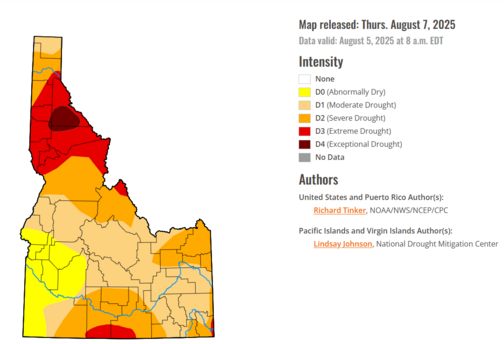
This is likely no surprise to you, but drought persists across the western U.S. and is intensifying in some areas. No geographic area is immune to the potential of drought at any given time. The U.S. Drought Monitor provides a weekly drought assessment, and it plays an important role in USDA programs that help farmers and ranchers recover from drought.
Fact #1 - Numerous agencies use the Drought Monitor to inform drought-related decisions.
The map identifies areas of drought and labels them by intensity on a weekly basis. It categorizes the entire country as being in one of six levels of drought. The first two, None and Abnormally Dry (D0), are not considered to be drought. The next four describe increasing levels of drought: Moderate (D1), Severe (D2), Extreme (D3) and Exceptional (D4).
While many entities consult the Drought Monitor for drought information, drought declarations are made by federal, state and local agencies that may or may not use the Drought Monitor to inform their decisions. Some of the ways USDA uses it to determine a producer’s eligibility for certain drought assistance programs, like the Livestock Forage Disaster Program and Emergency Haying or Grazing on Conservation Reserve Program acres and to “fast-track” Secretarial drought disaster designations.
Fact #2 - U.S. Drought Monitor is made with more than precipitation data.
When you think about drought, you probably think about water, or the lack of it. Precipitation plays a major role in the creation of the Drought Monitor, but the map’s author considers numerous indicators, including drought impacts and local insight from over 450 expert observers around the country. Authors use several dozen indicators to assess drought, including precipitation, streamflow, reservoir levels, temperature and evaporative demand, soil moisture and vegetation health. Because the drought monitor depicts both short and long‐term drought conditions, the authors must look at data for multiple timeframes. The final map produced each week represents a summary of the story being told by all the pieces of data. To help tell that story, authors don’t just look at data. They converse over the course of the map-making week with experts across the country and draw information about drought impacts from media reports and private citizens.
Fact #3 - A real person, using real data, updates the map.
Each week’s map author, not a computer, processes and analyzes data to update the drought monitor. The map authors are trained climatologists or meteorologists from the National Drought Mitigation Center at the University of Nebraska-Lincoln (the academic partner and website host of the Drought Monitor), the National Oceanic and Atmospheric Administration and USDA. The author’s job is to do what a computer can’t – use their expertise to reconcile the sometimes-conflicting stories told by each stream of data into a single assessment.
Fact #4 - The Drought Monitor provides a current snapshot, not a forecast.
The Drought Monitor is a “snapshot” of conditions observed during the most recent week and builds off the previous week’s map. The map is released on Thursdays and depicts conditions based on data for the week that ended the preceding Tuesday. Rain that falls on the Wednesday just before the USDM’s release won’t be reflected until the next map is published. This provides a consistent, week‐to‐week product and gives the author a window to assess the data and come up with a final map.
Fact #5 – Your input can be part of the drought-monitoring process.
State climatologists and other trained observers in the drought monitoring network relay on-the-ground information from numerous sources to the US Drought monitor author each week. That can include information that you contribute.
The Drought Monitor serves as a trigger for multiple forms of federal disaster relief for agricultural producers, and sometimes producers contact the author to suggest that drought conditions in their area are worse than what the latest drought monitor shows. When the author gets a call like that, it prompts them to look closely at all available data for that area, to see whether measurements of precipitation, temperature, soil moisture and other indicators corroborate producer-submitted reports. This is the process that authors follow whether they receive one report or one hundred reports, although reports from more points may help state officials and others know where to look for impacts.
There are multiple ways to contribute your observations:
-
Talk to your state climatologist - Find the current list at the American Association of State Climatologists website.
-
Email - Emails sent to droughtmonitor@unl.edu inform the USDM authors.
-
Become a CoCoRaHS observer - Submit drought reports along with daily precipitation observations to the Community Collaborative Rain, Hail & Snow Network.
-
Submit Condition Monitoring Observer Reports (CMOR) - go.unl.edu/CMOR.
For more information, read our Ask the Expert blog with a NDMC climatologist or visit farmers.gov/protection-recovery.
|
Farm Service Agency (FSA) borrowers with farms located in designated primary or contiguous disaster areas who are unable to make their scheduled FSA loan payments should consider the Disaster Set-Aside (DSA) program.
DSA is available to producers who suffered losses as a result of a natural disaster and relieves immediate and temporary financial stress. FSA is authorized to consider setting aside the portion of a payment/s needed for the operation to continue on a viable scale.
Borrowers must have at least two years left on the term of their loan in order to qualify.
Borrowers have eight months from the date of the disaster designation to submit a complete application. The application must include a written request for DSA signed by all parties liable for the debt along with production records and financial history for the operating year in which the disaster occurred. FSA may request additional information from the borrower in order to determine eligibility.
All farm loans must be current or less than 90 days past due at the time the DSA application is complete. Borrowers may not set aside more than one installment on each loan.
The amount set-aside, including interest accrued on the principal portion of the set-aside, is due on or before the final due date of the loan.
For more information, contact your local County USDA Service Center or visit fsa.usda.gov.
|
Top of page
Idaho FSA State Office
9173 West Barnes Drive, Ste. B
Boise, Idaho 83709
Phone: 208-378-5650
Fax: 855-516-8875
|
| |
|
Idaho State Executive Director
Kevin Andrus ~ 208-378-5656 Kevin.Andrus2@usda.gov
Deputy State Executive Director
Nick Treasure ~ 208-378-5671 nicholas.treasure@usda.gov
Farm Program Chief
Kyla Pearson ~ 208-378-5667 kyla.pearson@usda.gov
|
Administrative Officer
Brandi May ~ 208-378-5670 brandi.may@usda.gov
Farm Loan Chief
Susan R. Smith ~ 208-378-5664 susan.r.smith@usda.gov
|
|
Idaho FSA State Committee
TBA ~ Committee Chair
TBA, Member
Next State Committee Meeting: TBA
Note: To check the status of your FSA Farm Loan (FLP) account, call 1-888-518-4983 or check with your local office. To find contact information for your local office go to www.fsa.usda.gov/id
|
|






