Rhode Island Service Center Newsletter - August 11, 2025
In This Issue:
-
August 8, 2025 - Deadline to apply for the Grassland Conservation Reserve Program (CRP).
-
August 13 and 14, 2025 - USDA Beginning Farmer and Rancher Veterans Webinars.
-
August 15, 2025 - Deadline to submit application for the Emergency Commodity Assistance Program (ECAP).
-
August 27, 2025 - Rhode Island NRCS State Technical Committee Meeting, 9:30 a.m. - 12:30 p.m., USDA Service Center Main Conference Room, 60 Quaker Lane, Warwick. Virtual link provided upon request.
-
September 30, 2025 - Deadline to submit 2026 application for coverage for value loss crops for the Noninsured Crop Disaster Assistance Program (NAP) - this includes mollusks, Christmas trees, flowers, and turf.
-
September 30, 2025 - Deadline to submit acreage report for value loss crops.
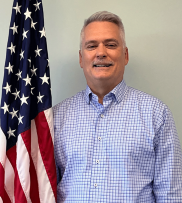
On July 14, 2025, Thomas L. Morgart, long-term USDA Natural Resources Conservation Service State Conservationist for Connecticut, assumed the additional duties of Acting State Conservationist for Rhode Island.
Tom has worked in several NRCS leadership roles, including as the Environmental Quality Incentives Program (EQIP) program manager and assistant state conservationist for programs in Maryland. He has also served as the Chesapeake Bay Watershed Initiative coordinator, the acting National EQIP team leader in the NRCS national headquarters in Washington, D.C., and acting state conservationist in Maryland prior to being selected as Connecticut’s State Conservationist.
Morgart has overseen successes in the agency's Emergency Watershed Protection Flood Plain Easement Program and has worked closely with conservation partners to implement the Regional Conservation Partnership Program. A fierce proponent for equality in the workplace, Morgart volunteered for the position of co-chair on the NRCS National Civil Rights Advisory Committee to the Chief. He continues to serve in that capacity.
Morgart grew up in western Pennsylvania and spent summers working for relatives on two different family farms. He earned a Bachelor of Science in Horticulture from Pennsylvania State University. Please join us in welcoming Tom Morgart to Rhode Island!
We thank Brunilda Velez-Diaz for her service as NRCS Rhode Island’s Acting State Conservationist for the previous three months. Bruni has returned to her duties as NRCS Rhode Island’s Assistant State Conservationist for Programs, directing the agency’s financial assistance and easement programs in partnership with state and local entities.
^ back to top
|
The Rhode Island State Technical Committee meeting will be held on Wednesday, August 27, 2025, from 9:30 a.m.–12:30 p.m. at the USDA Service Center Conference Room, 60 Quaker Lane, Warwick, RI, with virtual option provided.
State Technical Committees serve in an advisory capacity to NRCS and other agencies of the U.S. Department of Agriculture (USDA) on the implementation of the natural resources conservation provisions of Farm Bill legislation. Committees are intended to include members from a wide variety of natural resource and agricultural interests.
The meeting is open to the public, but registration is required so that participants can be provided with a link to access the meeting. To register, please contact Jermaine Jenkins, Assistant State Conservationist for Field Operations, at 401-822-8824 or jermaine.jenkins@usda.gov. Learn more about State Technical Committees.
^ back to top
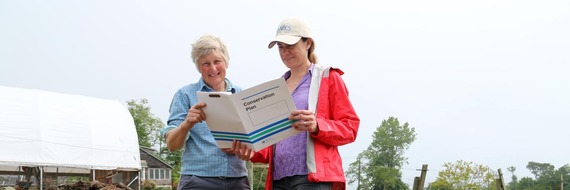 A key part of NRCS’s 90-year history was the establishment of the conservation planning process by Hugh Hammond Bennett. Bennett was the agency’s first chief and is considered the “father of soil conservation.” He believed in considering each farm’s unique conditions when developing a conservation plan.
A conservation plan is a document outlining the strategies and actions that should be taken to protect and manage natural resources on a specific area of land. It serves as a blueprint for achieving conservation goals. To develop a conservation plan, a conservation planner and the customer (farmer, rancher or landowner) collaborate during the conservation planning process.
Bennett believed that agency employees must walk the land with the customer and see their natural resource challenges and opportunities firsthand. Bennett also understood that natural resource concerns could not be treated in isolation; soil, water, air, plants, animals, and humans are all part of an integrated system that is inter-dependent.
Learn more about how conservation planning has evolved over the years.
^ back to top
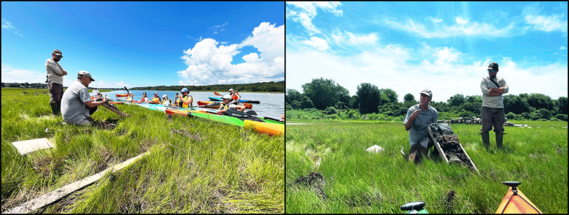
NRCS-RI Soil Scientist Jim Turenne & USFWS biologist, Nick Ernst, discuss coastal soils and saltmarsh restoration along Narrow River, RI, during July 15, 2025, Society of Wetland Scientists Tour.
Our NRCS Resource Conservationists provide expertise, training and resources to our staff, partners and clients on agronomy, biology, cultural resources, fish & wildlife, forestry, native plants, oyster reef restoration, pasture management, pollinators, soil health, urban agriculture, watershed planning, and wetlands.
On July 15th our intrepid Assistant State Soil Scientist, Jim Turenne, braved the heat to lead a field demonstration introducing NRCS Coastal Soil Surveys and saltmarsh restoration work conducted by NRCS and our partners at the U.S. Fish & Wildlife Service (USFWS) and Save the Bay. Our audience included 23 members of the Society of Wetland Scientists on a kayaking tour of Narrow River in Narragansett, RI, as part of their annual meeting in Providence, along with partners from Save the Bay and USFWS.
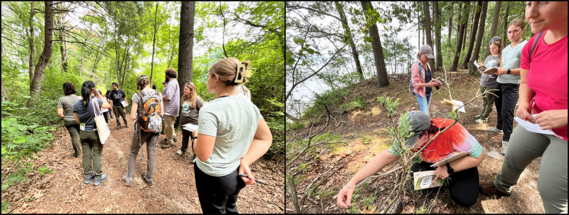
On July 31st, NRCS partner affiliates Paul Dolan (RI Resource Conservation & Development Council) and Dr. Christopher Riely (URI Natural Resources Science Department) held a field training session for NRCS and Conservation District field staff on identifying common regional forest plants and trees during the growing season. The training location at Goddard Memorial State Park's bayside woodlands allowed staff to observe a variety of forest understory, shrubs, and canopy species on a short loop walk. Trainers discussed plant ID tips and tools, including the Arbor Day Foundation's "What is that Tree?" guide, and led staff through the forest to observe species characteristics. Staff then tested their plant ID skills in the field. For more information on Rhode Island’s soils and plants, visit www.RI.nrcs.usda.gov.
^ back to top
Left: Dr. Christopher Riely leads NRCS and District planners on a plant ID tour in Goddard Park in Warwick, RI. Right: staff use Arbor Day Foundation's tree guide to ID plants.
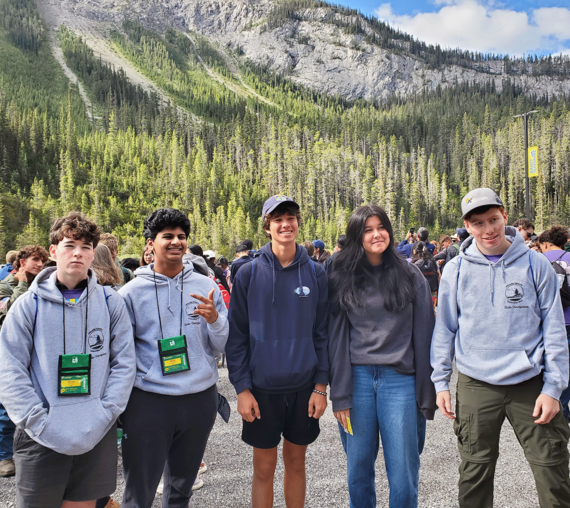
2025 RI Envirothon Champs from The Wheeler School at the International Envirothon Competition in Calgary, Canada, July 20-26, 2025, left to right: Peter Kennedy, Milin Jayaraman, Lucas Murphy, Amelie Johnson, and David Battle-Cardemil.
For the second year in a row, the Rhode Island State Champion Wheeler School Envirothon team comprised of David Battle-Cardemil (Captain), Amelie Johnson, Peter Kennedy, Lucas Murphy, and Milin Jayaraman competed in the National Conservation Foundation (NCF)-Envirothon International Championships – held this year in Calgary, Alberta, Canada, from July 20-26.
Rhode Island’s team placed 11th overall (an impressive improvement over their 37th place finish last year) in a field of 51 total teams from across the U.S., Canada, and China. Congratulations to the team for representing Wheeler and the state of Rhode Island in an exemplary manner throughout the competition!
Wheeler also placed third in Wildlife, tied for third in Soils, tied for fourth in Forestry, tied for eighth in the current environmental issue presentation, and placed twelfth in Aquatics. A complete list of awards for all the teams can be found on the NCF-Envirothon website. Learn more…
^ back to top
U.S. Secretary of Agriculture Brooke L. Rollins announced that agricultural producers who suffered eligible crop losses due to natural disasters in 2023 and 2024 can now apply for $16 billion in assistance through the Supplemental Disaster Relief Program (SDRP).
To expedite the implementation of SDRP, USDA’s Farm Service Agency (FSA) is delivering assistance in two stages. This first stage is open to producers with eligible crop losses that received assistance under crop insurance or the Noninsured Crop Disaster Assistance Program during 2023 and 2024. Stage One sign up will start in person at FSA county offices on July 10 and prefilled applications were mailed to producers on July 9. SDRP Stage Two signups for eligible shallow or uncovered losses will begin in early fall.
SDRP Stage One
FSA is launching a streamlined, pre-filled application process for eligible crop, tree, and vine losses by leveraging existing Noninsured Crop Disaster Assistance Program (NAP) and Risk Management Agency (RMA) indemnified loss data. The pre-filled applications were mailed on July 9, 2025.
Eligibility
Eligible losses must be the result of natural disasters occurring in calendar years 2023 and/or 2024. These disasters include wildfires, hurricanes, floods, derechos, excessive heat, tornadoes, winter storms, freeze (including a polar vortex), smoke exposure, excessive moisture, qualifying drought, and related conditions.
To qualify for drought related losses, the loss must have occurred in a county rated by the U.S. Drought Monitor as having a D2 (severe drought) for eight consecutive weeks, D3 (extreme drought), or greater intensity level during the applicable calendar year.
Producers in Connecticut, Hawaii, Maine, and Massachusetts will not be eligible for SDRP program payments. Instead, these states chose to cover eligible crop, tree, bush, and vine losses through separate block grants. These block grants are funded through the $220M provided for this purpose to eligible states in the American Relief Act.
How to Apply
To apply for SDRP, producers must submit the FSA-526, Supplemental Disaster Relief Program (SDRP) Stage One Application, in addition to having other forms on file with FSA.
SDRP Stage One Payment Calculation
Stage One payments are based on the SDRP adjusted NAP or Federal crop insurance coverage level the producer purchased for the crop. The net NAP or net federal crop insurance payments (NAP or crop insurance indemnities minus administrative fees and premiums) will be subtracted from the SDRP calculated payment amount.
For Stage One, the total SDRP payment to indemnified producers will not exceed 90% of the loss and an SDRP payment factor of 35% will be applied to all Stage One payments. If additional SDRP funds remain, FSA may issue a second payment.
Future Insurance Coverage Requirements
All producers who receive SDRP payments are required to purchase federal crop insurance or NAP coverage for the next two available crop years at the 60% coverage level or higher. Producers who fail to purchase crop insurance for the next two available crop years will be required to refund the SDRP payment, plus interest, to USDA.
SDRP Stage 2
FSA will announce additional SDRP assistance for uncovered losses, including non-indemnified shallow losses and quality losses and how to apply later this fall.
Learn more by visiting fsa.usda.gov/sdrp.
This announcement follows Secretary Rollins’ comprehensive plan to deliver the total amount of Congressionally appropriated $30 billion in disaster assistance to farmers and ranchers this year. These programs will complement the forthcoming state block grants that USDA is working with 14 different states to develop.
To date, USDA has issued more than $7.8 billion in Emergency Commodity Assistance Program (ECAP) payments to eligible producers. Additionally, USDA has provided over $1 billion in emergency relief through the Emergency Livestock Relief Program to producers who suffered grazing losses due to drought or wildfires in calendar years 2023 and 2024.
USDA disaster assistance information can be found on farmers.gov, including the Disaster Assistance Discovery Tool, Disaster-at-a-Glance fact sheet, Loan Assistance Tool, and the FarmRaise online FSA education hub. Payment details will be updated here weekly. For more information, contact your local RI FSA Office at (401) 828-3120 (ext. 1) or email Lillian Toth at Lillian.Toth@usda.gov.
^ back to top
USDA Name County Farm Service Agency (FSA) reminds producers of approaching application deadlines for purchasing risk coverage for some crops through the Noninsured Crop Disaster Assistance Program (NAP). NAP provides financial assistance to producers of non-insurable crops impacted by natural disasters that result in lower yields, crop losses, or prevented crop planting.
NAP covers losses from natural disasters on crops for which no permanent federal crop insurance program is available, including forage and grazing crops, fruits, vegetables, floriculture, ornamental nursery, aquaculture, turf grass and more.
Upcoming application deadlines for NAP coverage in Name County for the 2026 production season include:
- Value loss crops including mollusks, Christmas trees, flowers, and Turf : September 30th, 2025
NAP basic coverage is available at 55% of the average market price for crop losses that exceed 50% of expected production. Buy-up coverage is available in some cases. NAP offers higher levels of coverage, ranging from 50% to 65% of expected production in 5% increments, at 100% of the average market price. Producers of organic crops and crops marketed directly to consumers also may exercise the “buy-up” option to obtain NAP coverage of 100% of the average market price at coverage levels ranging between 50% and 65% of expected production. Buy-up coverage is not available for crops intended for grazing.
For all coverage levels, the NAP service fee is the lesser of $325 per crop or $825 per producer per county, not to exceed a total of $1,950 for a producer with farming interests in multiple counties. Premiums apply for buy-up coverage.
If a producer has a Socially Disadvantaged, Limited Resource, Beginning and Veteran Farmer or Rancher Certification (form CCC-860) on file with FSA, it may serve as an application for basic coverage for all eligible crops beginning with crop year 2022. These producers will have all NAP-related service fees for basic coverage waived. These producers may also receive a 50% premium reduction if higher levels of coverage are elected on form CCC-471, prior to the application closing date for each crop.
To learn more about NAP visit fsa.usda.gov/nap or contact your local RI FSA Office at (401) 828-3120 (ext. 1) or email Lillian Toth at Lillian.Toth@usda.gov.
^ back to top
Are you interested in working with USDA to start or grow your farm, ranch, or private forest operation, but don’t know where to start?
Whether you’re looking to access capital or disaster assistance through USDA’s Farm Service Agency (FSA) or address natural resource concerns on your land with assistance from USDA’s Natural Resources Conservation Service (NRCS), a great place to start is farmers.gov.
Farmers.gov is a one-stop shop for information about the assistance available from FSA and NRCS. The site also offers many easy-to-use tools for farmers, ranchers, and private forestland owners, whether you are reaching out for the first time or are a long-term customer with a years-long relationship with USDA.
With a farmers.gov account you can:
- Complete an AD-2047, Customer Data Worksheet, prior to your first meeting with FSA and NRCS.
- View farm loan payments history from FSA.
- View cost share assistance received and anticipated from NRCS conservation programs.
- Request conservation assistance from NRCS as well as view and track your conservation plans, practices, and contracts.
- View, print, and export detailed farm records and farm/tract maps for the current year, which are particularly useful when fulfilling acreage reporting requirements.
- Print FSA-156 EZ, Abbreviated Farm Record and your Producer Farm Data Report for the current year.
- Pay FSA debt using the “Make an FSA Payment” feature
- Apply for a farm loan online, view information on your existing loans, and make USDA direct farm loan payments using the Pay My Loan feature.
Learn how to create a farmers.gov account today!
^ back to top
The USDA Farm Service Agency (FSA) opened enrollment on July 10 for the Supplemental Disaster Relief Program (SDRP), which provides assistance for eligible crop losses due to natural disasters in 2023 and 2024.
Eligible U.S. Drought Monitor Losses
To qualify for drought related losses, the loss must have occurred in a county rated by the U.S. Drought Monitor as having a D2 (severe drought) for eight consecutive weeks, D3 (extreme drought), or greater intensity level during the applicable calendar year. View the list of counties eligible for SDRP due to qualifying drought for 2023 and 2024.
Other Eligible Disaster Events and Related Conditions
Producers who received an indemnity in 2023 or 2024 but did not qualify based on the U.S. Drought monitor may still be eligible for assistance. If your county did not trigger based on the U.S. Drought Monitor, do not certify “drought” as the cause of loss on your application as it will not be approved. Instead, producers should review all qualifying disaster events and related conditions such as excessive heat or excessive wind and select all applicable causes of loss.
Below is a list of all qualifying disaster events with the eligible related conditions in parentheses:
- Wildfires
- Hurricanes (including related excessive wind, storm surges, tornadoes, tropical storms, and tropical depression)
- Floods (including related silt and debris)
- Derechos (including related excessive wind)
- Excessive heat
- Tornadoes
- Winter storms (including related blizzard and excessive wind)
- Freeze (including a polar vortex)
- Smoke exposure
- Excessive moisture
- Qualifying drought
Related conditions must have occurred as a direct result of the indicated disaster event.
Losses due to Hail
Hail is not a qualifying disaster event, but you may be eligible if it was directly related to a qualifying disaster event.
For example, if a producer’s crop suffered damage from hail, but the hail damage was directly related to a tornado, then this would qualify for an SDRP payment since tornado is a qualifying disaster event.
Documentation for Spot Checks
Producers who certify that a qualifying disaster event caused the loss should be prepared to provide documentation to support their self-certification if they are selected for a spot check. Documentation is not required to be submitted with your application. Additionally, producers are not required to verify the cause of loss with their crop insurance agent.
Producers should complete the pre-filled application that was mailed on July 9. If you received a crop insurance indemnity in 2023 or 2024 and did not receive an application, please visit your local FSA office and they can print your pre-filled application.
For additional help with your application, please review the FSA-526 Instructions for Stage 1. Learn more about SDRP, eligibility and future insurance requirements by visiting fsa.usda.gov/sdrp.
^ back to top
USDA – Rhode Island
60 Quaker Lane
Warwick, RI 02886
|
Natural Resources Conservation Service (NRCS)
401-828-1300 | www.RI.nrcs.usda.gov
|
|
Eastern RI – Serving Newport and Bristol counties
|
|
NRCS Field Office
Kat Zuromski, Acting District Conservationist
401-786-1389/ Kathryn.Zuromski@usda.gov
|
Conservation District Office
401-934-0842/ info@easternriconservation.org
|
|
Northern RI – Serving Providence County
|
|
NRCS Field Office
Ghyllian Alger, Acting District Conservationist
401-822-8835/ Ghyllian.Alger@usda.gov
|
Conservation District Office
401-934-0840/ mallard.nricd@gmail.com
|
|
Southern RI – Serving Kent and Washington counties
|
|
NRCS Field Office
Jameson Long, District Conservationist
401-822-8837/ Jameson.Long@usda.gov
|
Conservation District Office
401-661-5761/ gfuller@sricd.org
|
|
|
|
RI FSA County Office, Suite 49
RI FSA Farm Loan Team, Suite 62
RI FSA State Office, Suite 62
|
401-828-3120 Option 1
401-828-3120 Option 2
401-828-3120 Option 3
|
|
County Committee
|
|
Gilbert Rathbun Jr., Chairperson
John Sousa, Member
Howard Tucker III, Member
|
Erin Cabot, Vice Chairperson
William Coulter, Member
Dawn M Spears, SDA Member
|
|
|
|