
TN State Newsletter - August 1, 2025

We are transitioning into the dog days of summer and rapidly moving toward the fall. I hope the upcoming harvest season will be a little less challenging than the spring has been. The county offices are busy wrapping up acreage reporting so, make sure ALL your crops are reported to secure eligibility for current and future programs. Stage 1 of the Supplemental Disaster Relief Program for producers having indemnified crop loss in 2023 and 2024 is in full swing, and Stage 2, for producers having uncovered (or shallow) crop losses will be announced at a later date. Please watch for current and future program updates as we move toward 2026. The agriculture industry faces many challenges including weather, market fluctuations, input costs, etc. But please know that FSA is here for you and we are standing by to provide the disaster recovery, safety-net, price support, conservation and credit assistance you need. Tennessee FSA and I are fully committed to putting Farmers First!
|
In This Issue:
The U.S. Department of Agriculture (USDA) is issuing up to $10 billion directly to agricultural producers through the Emergency Commodity Assistance Program (ECAP) for the 2024 crop year. Administered by USDA’s Farm Service Agency (FSA), ECAP will help agricultural producers mitigate the impacts of increased input costs and falling commodity prices.
Authorized by the American Relief Act, 2025, these economic relief payments are based on planted and prevented planted crop acres for eligible commodities for the 2024 crop year. To streamline and simplify the delivery of ECAP, FSA will begin sending pre-filled applications to producers who submitted acreage reports to FSA for 2024 eligible ECAP commodities soon after the signup period opens on March 19, 2025. Producers do not have to wait for their pre-filled ECAP application to apply. They can visit fsa.usda.gov/ecap to apply using a login.gov account or contact their local FSA office to request an application once the signup period opens.
Eligible Commodities and Payment Rates
The commodities below are eligible for these per-acre payment rates:
|
· Wheat - $30.69
|
Eligible oilseeds:
|
|
· Corn - $42.91
|
· Canola – $31.83
|
|
· Sorghum - $42.52
|
· Crambe – $19.08
|
|
· Barley - $21.67
|
· Flax - $20.97
|
|
· Oats - $77.66
|
· Mustard - $11.36
|
|
· Upland cotton & Extra-long staple cotton - $84.74
|
· Rapeseed -$23.63
|
|
· Long & medium grain rice - $76.94
|
· Safflower - $26.32
|
|
· Peanuts - $75.51
|
· Sesame - $16.83
|
|
· Soybeans - $29.76
|
· Sunflower – $27.23
|
|
· Dry peas - $16.02
|
|
|
· Lentils - $19.30
|
|
|
· Small Chickpeas - $31.45
|
|
|
· Large Chickpeas - $24.02
|
|
Producer Eligibility
Eligible producers must report 2024 crop year planted and prevented planted acres to FSA on an FSA-578, Report of Acreage form. Producers who have not previously reported 2024 crop year acreage or filed a notice of loss for prevented planted crops must submit an acreage report by the Aug. 15, 2025, deadline. Eligible producers can visit fsa.usda.gov/ecap for eligibility and payment details.
Applying for ECAP
Producers must submit ECAP applications to their local FSA county office by Aug. 15, 2025. Only one application is required for all ECAP eligible commodities nationwide. ECAP applications can be submitted to FSA in-person, electronically using Box and One-Span, by fax or by applying online at fsa.usda.gov/ecap utilizing a secure login.gov account.
If not already on file for the 2024 crop year, producers must have the following forms on file with FSA:
-
Form AD-2047, Customer Data Worksheet.
-
Form CCC-901, Member Information for Legal Entities (if applicable).
-
Form CCC-902, Farm Operating Plan for an individual or legal entity.
-
Form CCC 943, 75 percent of Average Gross Income from Farming, Ranching, or Forestry Certification (if applicable).
-
AD-1026, Highly Erodible Land Conservation (HELC) and Wetland Conservation (WC) Certification.
-
SF-3881, Direct Deposit.
Except for the new CCC-943, most producers, especially those who have previously participated in FSA programs, likely have these forms on file. However, those who are uncertain and want to confirm the status of their forms or need to submit the new CCC-943, can contact their local FSA county office.
If a producer does not receive a pre-filled ECAP application, and they planted or were prevented from planting ECAP eligible commodities in 2024, they should contact their local FSA office.
ECAP Payments and Calculator
ECAP payments will be issued as applications are approved. Initial ECAP payments will be factored by 85% to ensure that total program payments do not exceed available funding. If additional funds remain, FSA may issue a second payment.
ECAP assistance will be calculated using a flat payment rate for the eligible commodity multiplied by the eligible reported acres. Payments are based on acreage and not production. For acres reported as prevented plant, ECAP assistance will be calculated at 50%.
For ECAP payment estimates, producers are encouraged to visit fsa.usda.gov/ecap to use the ECAP online calculator.

Farm loan borrowers who have pledged real estate as security for their Farm Service Agency (FSA) direct or guaranteed loans are responsible for maintaining loan collateral. Borrowers must obtain prior consent or approval from FSA or the guaranteed lender for any transaction that affects real estate security. These transactions include, but are not limited to:
- Leases of any kind
- Easements of any kind
- Subordinations
- Partial releases
- Sales
Failure to meet or follow the requirements in the loan agreement, promissory note, and other security instruments could lead to nonmonetary default which could jeopardize your current and future loans.
It is critical that borrowers keep an open line of communication with their FSA loan staff or guaranteed lender when it comes to changes in their operation. For more information on borrower responsibilities, read Your FSA Farm Loan Compass.
|

The Conservation Stewardship Program (CSP) is sometimes misunderstood. It is perceived by some as complicated or not for small operations, and neither of those perceptions is true. CSP is designed to help you take your existing conservation efforts on your operation to the next higher level while maintaining your current ones. It’s supposed to help you add to what you’re already doing, either by enhancing your current practices or adding new ones.
The Natural Resources Conservation Service (NRCS) works one-on-one with you to develop a conservation plan under CSP to implement these additions or enhancements and help strengthen your operation.
Under CSP, you receive annual payments to help you maintain your existing conservation efforts and enhance them using new conservation practices or activities. CSP contracts last five years, with the opportunity to compete for a contract renewal if you successfully fulfill the initial contract and agree to achieve additional conservation objectives.
CSP is often misunderstood, so here are a few “myths” about the program that we want to dispel.
Myth #1: The deadline to apply for CSP in my state has already passed, so I don’t need to think about applying until next year.
Don’t wait to apply! We accept applications year-round, but funding decisions are made locally at specific times and that “ranking date” may be coming up soon in your area. If we already have your application, it will be considered at the next ranking date. Plus, if you start planning now, you will be ready for application ranking dates as they approach. See program application ranking dates for all states at https://www.nrcs.usda.gov/ranking-dates.
Myth #2: Enrolling land in CSP is complicated and time-consuming.
If you have a farm and tract number (available from USDA’s Farm Service Agency) and have kept good farm records, you’re already well on your way. You just need to complete a three-page NRCS-CPA-1200 form, see Applications and Forms. You can even complete this form online if you create a farmers.gov account at https://www.farmers.gov/account.
Read more myths.
|
U.S. Secretary of Agriculture Brooke L. Rollins announced today that agricultural producers who suffered eligible crop losses due to natural disasters in 2023 and 2024 can now apply for $16 billion in assistance through the Supplemental Disaster Relief Program (SDRP).
To expedite the implementation of SDRP, USDA’s Farm Service Agency (FSA) is delivering assistance in two stages. This first stage is open to producers with eligible crop losses that received assistance under crop insurance or the Noninsured Crop Disaster Assistance Program during 2023 and 2024. Stage One sign up will start in person at FSA county offices on July 10 and prefilled applications are being mailed to producers today, July 9. SDRP Stage Two signups for eligible shallow or uncovered losses will begin in early fall.
SDRP Stage One
FSA is launching a streamlined, pre-filled application process for eligible crop, tree, and vine losses by leveraging existing Noninsured Crop Disaster Assistance Program (NAP) and Risk Management Agency (RMA) indemnified loss data. The pre-filled applications will be mailed on July 9, 2025.
Eligibility
Eligible losses must be the result of natural disasters occurring in calendar years 2023 and/or 2024. These disasters include wildfires, hurricanes, floods, derechos, excessive heat, tornadoes, winter storms, freeze (including a polar vortex), smoke exposure, excessive moisture, qualifying drought, and related conditions.
To qualify for drought related losses, the loss must have occurred in a county rated by the U.S. Drought Monitor as having a D2 (severe drought) for eight consecutive weeks, D3 (extreme drought), or greater intensity level during the applicable calendar year.
Producers in Connecticut, Hawaii, Maine, and Massachusetts will not be eligible for SDRP program payments. Instead, these states chose to cover eligible crop, tree, bush, and vine losses through separate block grants. These block grants are funded through the $220M provided for this purpose to eligible states in the American Relief Act.
How to Apply
To apply for SDRP, producers must submit the FSA-526, Supplemental Disaster Relief Program (SDRP) Stage One Application, in addition to having other forms on file with FSA.
SDRP Stage One Payment Calculation
Stage One payments are based on the SDRP adjusted NAP or Federal crop insurance coverage level the producer purchased for the crop. The net NAP or net federal crop insurance payments (NAP or crop insurance indemnities minus administrative fees and premiums) will be subtracted from the SDRP calculated payment amount.
For Stage One, the total SDRP payment to indemnified producers will not exceed 90% of the loss and an SDRP payment factor of 35% will be applied to all Stage One payments. If additional SDRP funds remain, FSA may issue a second payment.
Future Insurance Coverage Requirements
All producers who receive SDRP payments are required to purchase federal crop insurance or NAP coverage for the next two available crop years at the 60% coverage level or higher. Producers who fail to purchase crop insurance for the next two available crop years will be required to refund the SDRP payment, plus interest, to USDA.
SDRP Stage 2
FSA will announce additional SDRP assistance for uncovered losses, including non-indemnified shallow losses and quality losses and how to apply later this fall.
Learn more by visiting fsa.usda.gov/sdrp.
This announcement follows Secretary Rollins’ comprehensive plan to deliver the total amount of Congressionally appropriated $30 billion in disaster assistance to farmers and ranchers this year. These programs will complement the forthcoming state block grants that USDA is working with 14 different states to develop.
To date, USDA has issued more than $7.8 billion in Emergency Commodity Assistance Program (ECAP) payments to eligible producers. Additionally, USDA has provided over $1 billion in emergency relief through the Emergency Livestock Relief Program to producers who suffered grazing losses due to drought or wildfires in calendar years 2023 and 2024.
USDA disaster assistance information can be found on farmers.gov, including the Disaster Assistance Discovery Tool, Disaster-at-a-Glance fact sheet, Loan Assistance Tool, and the FarmRaise online FSA education hub. Payment details will be updated here weekly. For more information, contact your local USDA Service Center.
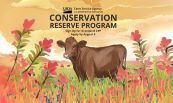
The U.S. Department of Agriculture (USDA) today announced that agricultural producers and private landowners can now enroll in the Grassland Conservation Reserve Program (Grassland CRP). The sign-up runs from today, July 14, to Aug. 8, 2025. Grassland CRP, offered by USDA’s Farm Service Agency (FSA), is a voluntary working lands conservation program that enables participants to conserve grasslands while also continuing most grazing and haying practices.
Grassland CRP emphasizes support for grazing operations, plant and animal biodiversity, and grasslands and land with shrubs and forbs under the greatest threat of conversion.
“Through the conservation of America’s essential grasslands, Grassland CRP supports continued agricultural productivity while at the same time prioritizing private lands stewardship,” said FSA Administrator Bill Beam. “By offering landowners the best of both worlds — economic viability and working lands preservation — Grassland CRP provisions support USDA’s commitment to Farmers First.”
CRP, USDA’s flagship conservation program, celebrates its 40th anniversary this year. For four decades, CRP has provided financial and technical support to agricultural producers and landowners whose accepted acres are placed under contract for 10-15 years and who agree to voluntarily convert the land to beneficial vegetative cover to improve water quality, prevent soil erosion and support wildlife habitat. The American Relief Act, 2025, extended provisions for CRP through Sept. 30, 2025.
Currently, more than 25.8 million acres are enrolled in CRP, with nearly 9.7 million acres in Grassland CRP. On May 12, FSA opened General and Continuous CRP enrollment for 2025. FSA is currently reviewing submitted offers and will announce accepted offers at a later date. Due to the 27-million-acre statutory cap, only 1.8 million acres are available for all CRP enrollment this fiscal year.
Landowners and producers interested in Grassland CRP should contact their local USDA Service Center to learn more or apply for the program before the Aug. 8 deadline.
FSA helps America’s farmers, ranchers and forest landowners invest in, improve, protect and expand their agricultural operations through the delivery of agricultural programs for all Americans. FSA implements agricultural policy, administers credit and loan programs, and manages conservation, commodity, disaster recovery and marketing programs through a national network of state and county offices and locally elected county committees. For more information, visit fsa.usda.gov.
|

Ask USDA is now available as a tool for FSA customers to ask questions about FSA programs and services.
Ask USDA, available at ask.usda.gov provides information for all USDA programs. Ask USDA allows USDA customers to search for and read answers about FSA programs and services in the same location as they read about other USDA programs and services.
Customers are able to submit questions through email, chat, and phone if they need more information. This improved customer service approach provides a one-stop shopping experience that covers all of USDA’s many programs.
|
Top of page
|






