
Alaska State FSA August Newsletter - 22 August 2025
In This Issue:
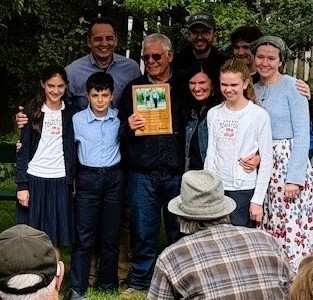
On Friday, I was pleased to attend the Farm Family of the Year event at the Alaska State Fair, honoring Mike Mosesian and his family as they received the prestigious Farm Family of the Year award.
Did you know that Mike comes from a multi-generational family of grape growers in California’s Central Valley? He moved to Alaska in 1972, looked around to see what the state needed, and saw an opportunity—tomatoes. By growing fresh tomatoes for local grocery stores, he tapped into a critical market and began building what would become the largest greenhouse growing operation in Alaska.
Over the years, Mike has grown much more than tomatoes. He’s grown a thriving business by meeting the needs of Alaskan consumers and setting a high standard for what local agriculture can achieve. Today, his success stands as an example for producers across the state.
Please join me in supporting our neighbor and friend, Mike Mosesian, and Bell’s Nursery, as they continue to contribute to Alaska’s local economy and food security. Their work is a vital part of a stronger, more self-reliant Alaska.
See you in the field,
Arthur Keyes
arthur.keyes@usda.gov
(907)761-7750
|
 |
Northern County Updates
The Delta Junction office regular hours:
Monday, Wednesday & Friday- 8:00am-4:30pm
Tuesday, Thursday- 8:00am-12:00pm;
12:00pm-4:30pm by appointment only.
The Delta Junction office will be CLOSED Friday, August 29th.
Southern County Updates
The Palmer FSA staff will be in the Wasilla NRCS office every Thursday from 8:30am-4pm.
Chris Dickinson, Southern County Program Analyst, will be visiting the Kenai Peninsula September 2nd-5th. Come in and sign up for RTCP! Office hours will be held as follows:
Homer NRCS office: Tuesday, September 2nd from 12:00pm-4:30pm
Wednesday, September 3rd from 8:00am-3:00pm
Kenai NRCS office: Thursday, September 4th from 8:00am-4:30pm
Friday, September 5th from 8:00am-11:00am
If you would like to set up a visit to your farm with Chris Dickinson, please contact him at (907)761-7772.
Upcoming Office Closures:
Monday, September 1st for Labor Day
Monday, October 13th for Columbus Day
Upcoming Deadlines:
Monday, September 1st- 2026 NAP Deadline for Floriculture (Peonies), Aquaculture and Turf Grass
Tuesday, September 30th- 2025 RTCP Application Deadline
Tuesday, September 30th- 2026 Acreage Reporting Deadline for Value-loss crops (including Peonies) and controlled environment crops (except nursery)
Tuesday, September 30th- 2026 NAP Deadline for Perennial Grass Forage and Honey
Monday, November 3rd- 2025 RTCP Deadline to submit supporting documentation
Click here to learn more about upcoming deadlines and ongoing programs
Top of page
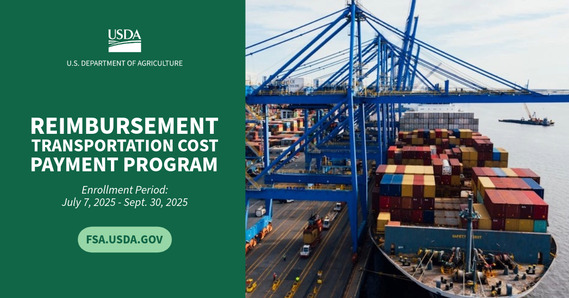 The U.S. Department of Agriculture (USDA) in Alaska opened enrollment for the Reimbursement Transportation Cost Payment Program (RTCP) for fiscal year 2025. The enrollment period began July 7 and will run through Sept. 30. The deadline for producers to provide supporting documentation is Nov. 3, 2025.
RTCP helps U.S. farmers and ranchers offset a portion of the cost of transporting agricultural products over long distances.
The Full-Year Continuing Appropriations and Extensions Act, 2025 authorized $3.5 million for RTCP and allows farmers and livestock producers in Alaska, Hawaii and insular areas including the Commonwealth of Puerto Rico, Guam, American Samoa, Commonwealth of Northern Mariana Islands, Virgin Islands of the United States, Federated States of Micronesia, Republic of the Marshall Islands and Republic of Palau, to recover costs to transport agricultural commodities or inputs used to produce an agricultural commodity.
Roughly $3.5 million was issued to more than 1,100 producers, in all eligible areas combined, through the 2024 RTCP.
RTCP payments are calculated based on the costs incurred for transportation of agricultural commodities or inputs during a 12-month period, subject to an $8,000 per producer cap per fiscal year. A higher payment cap may be determined if claims for payments do not exceed available funding. Therefore, applicants are encouraged to submit all eligible receipts. If claims for payments exceed the funds available from the program for a fiscal year, payments will be reduced on a pro-rata basis.
Farmers and livestock producers interested in participating in RTCP can obtain applications and other documents by calling toll-free 1-866-794-1079.
Top of page
USDA Alaska Farm Service Agency (FSA) reminds producers of approaching application deadlines for purchasing risk coverage for some crops through the Noninsured Crop Disaster Assistance Program (NAP). NAP provides financial assistance to producers of non-insurable crops impacted by natural disasters that result in lower yields, crop losses, or prevented crop planting.
NAP covers losses from natural disasters on crops for which no permanent federal crop insurance program is available, including forage and grazing crops, fruits, vegetables, floriculture, ornamental nursery, aquaculture, turf grass and more.
Upcoming application deadlines for NAP coverage in Alaska for the 2026 production season include:
September 1, 2025:
- Floriculture (including Peonies)
- Aquaculture
- Turf Grass
September 30, 2025:
- Perennial Grass for Forage
- Honey
NAP basic coverage is available at 55% of the average market price for crop losses that exceed 50% of expected production. Buy-up coverage is available in some cases. NAP offers higher levels of coverage, ranging from 50% to 65% of expected production in 5% increments, at 100% of the average market price. Producers of organic crops and crops marketed directly to consumers also may exercise the “buy-up” option to obtain NAP coverage of 100% of the average market price at coverage levels ranging between 50% and 65% of expected production. Buy-up coverage is not available for crops intended for grazing.
For all coverage levels, the NAP service fee is the lesser of $325 per crop or $825 per producer per county, not to exceed a total of $1,950 for a producer with farming interests in multiple counties. Premiums apply for buy-up coverage.
If a producer has a Socially Disadvantaged, Limited Resource, Beginning and Veteran Farmer or Rancher Certification (form CCC-860) on file with FSA, it may serve as an application for basic coverage for all eligible crops beginning with crop year 2022. These producers will have all NAP-related service fees for basic coverage waived. These producers may also receive a 50% premium reduction if higher levels of coverage are elected on form CCC-471, prior to the application closing date for each crop.
To learn more about NAP visit fsa.usda.gov/nap or contact your Northern County USDA Service Center at (907)895-4242 ext. 2 or Southern County FSA Office at (907)761-7738.
Top of page
Are you interested in working with USDA to start or grow your farm, ranch, or private forest operation, but don’t know where to start?
Whether you’re looking to access capital or disaster assistance through USDA’s Farm Service Agency (FSA) or address natural resource concerns on your land with assistance from USDA’s Natural Resources Conservation Service (NRCS), a great place to start is farmers.gov.
Farmers.gov is a one-stop shop for information about the assistance available from FSA and NRCS. The site also offers many easy-to-use tools for farmers, ranchers, and private forestland owners, whether you are reaching out for the first time or are a long-term customer with a years-long relationship with USDA.
With a farmers.gov account you can:
- Complete an AD-2047, Customer Data Worksheet, prior to your first meeting with FSA and NRCS.
- View farm loan payments history from FSA.
- View cost share assistance received and anticipated from NRCS conservation programs.
- Request conservation assistance from NRCS as well as view and track your conservation plans, practices, and contracts.
- View, print, and export detailed farm records and farm/tract maps for the current year, which are particularly useful when fulfilling acreage reporting requirements.
- Print FSA-156 EZ, Abbreviated Farm Record and your Producer Farm Data Report for the current year.
- Pay FSA debt using the “Make an FSA Payment” feature
- Apply for a farm loan online, view information on your existing loans, and make USDA direct farm loan payments using the Pay My Loan feature.
Learn how to create a farmers.gov account today!
Top of page
The Conservation Reserve Program (CRP) is a program administered by the Farm Service Agency (FSA) to conserve farmland for future generations while providing habitat for wildlife, reducing soil erosion, and improving water quality. Regular maintenance on CRP acres is needed to ensure the acreage continues to provide conservation benefits and remains in compliance with the CRP contract.
Regular Maintenance
Producers with CRP contracts are required to control all weeds, insects, pests, and other undesirable species to the extent necessary to ensure that the approved conservation cover is adequately protected and to ensure there is no adverse impact on surrounding land. Mowing is one of the allowable practices for weed control, but mowing for aesthetic purposes is never permitted. The Conservation Plan states the required weed control methods for each site.
Once a stand has been certified as fully established, participants are required to maintain plant diversity and stand density according to the Conservation Plan and offer (CRP-2) for the life of the contract. Stands that do not meet practice specific plant diversity or density requirements may be considered non-compliant. Refer to your conservation plan or contact FSA if you have any questions or concerns about the vegetative cover requirements.
Maintenance activities cannot occur during the primary nesting season for birds without written prior approval from the local county office. The primary nesting season in Alaska is May 15 through June 25.
Mid-Contract Management
Regular maintenance for weed and pest control is separate from the Mid-Contract Management (MCM) requirement. MCM ensures plant diversity and wildlife benefits while ensuring protection of the soil and water resources. Such activities are site-specific and are for the purpose of enhancing the approved cover.
MCM must be completed between years four and six of a 10-year contract and between years seven and nine of a 15-year contract. The Conservation Plan will state what year MCM must take place.
Noncompliance with Maintenance Requirements
Failure to adequately maintain the stand may result in noncompliance with the terms and conditions of the CRP contract. Noncompliance can result in adverse actions up to and including termination of the CRP contract. Contracts that are out of compliance are ineligible to re-enroll, unless the stand is brought back into compliance prior to the enrollment deadline.
For general information about CRP, visit the Conservation Reserve Program webpage. For information about specific contracts, reach out to the local FSA office.
Top of page
The Farm Service Agency (FSA) offers two types of set-aside programs to assist FSA direct loan borrowers. The set-aside programs are intended to help distressed borrowers as well as borrowers impacted by natural disasters.
Disaster Set-Aside Program
The Disaster Set-Aside Program (DSA) assists existing FSA direct loan borrowers who have been impacted by natural disasters. The DSA program provides short-term financial relief by allowing eligible borrowers to delay FSA direct loan payments that are due this year or next year (but not both). You may delay up to one full annual payment per loan and the delayed payment will be moved to the end of the loan term. You will not be required to pay this set-aside installment until the loan’s final due date.
The principal portion of the amount set-aside will continue to accrue interest at your loan’s existing interest rate.
To be eligible, borrowers must have operated a farm in a county declared a disaster area or a contiguous county at the time of the disaster. In addition, the borrower’s inability to make their upcoming payment must be due to the disaster.
To apply for DSA, borrowers must provide their local USDA Service Center with a letter requesting DSA, which must be signed by all parties liable for the debt. The letter must be provided to your local Service Center within eight months of the disaster declaration date. The application process also includes providing your actual production, income, and expense records for the last three years. FSA may also request additional information as needed to make an eligibility decision.
Distressed Borrower Set-Aside Program
FSA Direct Farm Loan Program borrowers whose loans were closed before Sept. 25, 2024, may be eligible for assistance under the Distressed Borrower Set-Aside Program (DBSA). Similar to DSA, DBSA also provides short-term financial relief by allowing eligible borrowers to delay FSA direct loan payments that are due this year or next year (but not both). You may delay up to one full annual payment per loan and the delayed payment will be moved to the end of the loan term. You will not be required to pay this set-aside installment until the loan’s final due date.
An increased benefit with DBSA is that the principal portion of the set-aside will accrue interest at a reduced rate of 0.125% rather than your loan’s existing interest rate.
To be eligible for DBSA, the borrower must demonstrate financial distress, but their inability to make the upcoming payment does not need to be due to a disaster.
The DBSA application process is similar to DSA as borrowers must provide their local USDA Service Center with a letter requesting DBSA, which must be signed by all parties liable for the debt. The application process also includes providing your actual production, income, and expense records for the last three years. FSA may also request additional information as needed to make an eligibility decision.
Important Factors for Both DSA and DBSA:
FSA direct loan borrowers are not able to obtain more than one set-aside per loan. Borrowers also cannot obtain both a DSA and DBSA simultaneously on the same loan. In addition, FSA direct loans with less than two years remaining are not eligible for a DSA or DBSA. Other eligibility requirements apply; we encourage you to contact your local Service Center for more information.
Both DSA and DBSA are intended to provide short-term relief for situations where borrowers anticipate the ability to resume paying their full annual installment(s) in the following year. If you require a more long-term form of financial relief, FSA has other potential options available through primary loan servicing (PLS).
For more information on DSA, DBSA, or PLS, please contact your Northern County USDA Service Center at (907)895-4242 ext. 2 or Southern County FSA Office at (907)761-7738. You may also visit fsa.usda.gov.
Top of page
Alaska State Farm Service Agency
|
800 E Palmer-Wasilla Hwy., Suite 216
Palmer, AK 99645
Phone: 907-761-7738
Fax: 855-638-4864
|
|
Alaska FSA Website
|
|
Northern County FSA Service Center
PO BOX 585
Delta Junction AK 99737
Phone: 907-895-4242 ext. 2
Fax: 855-711-9095
Email: akdeltajun-fsa@usda.gov
Northern County Committee
Steve Helkenn- Committee Chair
Becky Hammond- Vice Chair
Matt Bates- Member
|
Southern County FSA Office
800 E Palmer-Wasilla Hwy., Ste 216
Palmer AK 99645
Phone: 907-761-7773
Fax: 855-638-4864
Email: akpalmer-fsa@usda.gov
Southern County Committee
Carol Symonds- Committee Chair
Ina Jones- Vice Chair
Abby Ala- Member
|
|
Hours: Monday-Friday 8:00 a.m.- 4:30 p.m.
|
|






