
Kentucky FSA Newsletter - July 2025
In This Issue:

I want to take a moment to thank everyone for visiting our offices and completing your crop reports. Crop reporting is always a busy time of year for our staff and this year, with delayed planting, made it more hectic than usual.
Our historically wet year continues with rainfall breaking records in many parts of the state for this time of year. Most producers have gotten in all that they can plant and are now watching the weather for suitable days to spray and cultivate. Hay cutting continues to be tough with only short windows of clear weather in the forecast. The weather has at least given producers with grazing livestock favorable conditions for pasture growth.
I would like to give everyone a few quick reminders about current FSA activities. We are currently accepting nominations for our FSA County Committees across the state. The committees are a critical component of the day-to-day operations of FSA and allow grassroots input and local administration of federal farm programs. On July 10, we began signup for the Supplemental Disaster Relief Program. This program provides assistance to producers for necessary expenses due to losses of revenue, quality, or production of crops due to weather related events in 2023 and 2024. We also have numerous counties that are accepting applications for our Emergency Conservation Program for recovery from various disasters across the state. If you have been impacted by a natural disaster, I encourage you to contact your local USDA Service Center.
As always, the Kentucky Farm Service Agency is here to assist and serve our agricultural producers. Our mission is to continue to put Farmers First. Please don’t hesitate to contact our dedicated team to find out how we can support your operation.
Respectfully,
David Wayne, State Executive Director
Kentucky FSA
|
Nominations are now being accepted for farmers and ranchers to serve on local U.S. Department of Agriculture (USDA) Farm Service Agency (FSA) county committees. These committees make important decisions about how federal farm programs are administered locally. All nomination forms for the 2025 election must be postmarked or received in the local FSA office by Aug. 1, 2025.
Elections for committee members will occur in certain Local Administrative Areas (LAA). LAAs are elective areas for FSA committees in a single county or multi-county jurisdiction and may include LAAs that are focused on an urban or suburban area.
Producers interested in serving on the FSA county committee can locate their LAA through a geographic information system locator tool available at fsa.usda.gov/elections and determine if their LAA is up for election by contacting their local FSA office.
Agricultural producers may be nominated for candidacy for the county committee if they:
- Participate or cooperate in a USDA program.
- Reside in the LAA that is up for election this year.
A cooperating producer is someone who has provided information about their farming or ranching operation to FSA, even if they have not applied or received program benefits.
Individuals may nominate themselves or others and qualifying organizations may also nominate candidates. USDA encourages all eligible producers to nominate, vote and hold office.
Nationwide, more than 7,700 dedicated members of the agriculture community serve on FSA county committees. The committees are made up of three to 11 members who serve three-year terms. Committee members play a key role in how FSA delivers disaster recovery, conservation, commodity and price support programs, as well as making decisions on county office employment and other agricultural issues.
Urban and Suburban County Committees
FSA urban county committees work to promote urban, indoor and other emerging agricultural production practices. Urban committee members are nominated and elected to serve by local urban producers in the same jurisdiction. Urban county committee members provide outreach to ensure urban producers understand USDA programs, serve as the voice of other urban producers and assist in program implementation that support the needs of growing urban communities.
The 27 cities with urban county committees are listed at fsa.usda.gov/elections and farmers.gov/urban.
More Information
Producers should contact their local FSA office today to register and find out how to get involved in their county’s election, including if their LAA is up for election this year. To be considered, a producer must be registered and sign an FSA-669A nomination form. This form and other information about FSA county committee elections are available at fsa.usda.gov/elections.
All nomination forms for the 2025 election must be postmarked or received in the local USDA Service Center by the Aug.1, 2025, deadline. Election ballots will be mailed to eligible voters in November 2025.
U.S. Secretary of Agriculture Brooke L. Rollins announced that agricultural producers who suffered eligible crop losses due to natural disasters in 2023 and 2024 can now apply for $16 billion in assistance through the Supplemental Disaster Relief Program (SDRP).
To expedite the implementation of SDRP, USDA’s Farm Service Agency (FSA) is delivering assistance in two stages. This first stage is open to producers with eligible crop losses that received assistance under crop insurance or the Noninsured Crop Disaster Assistance Program during 2023 and 2024. Stage One sign up will start in person at FSA county offices on July 10 and prefilled applications are being mailed to producers today, July 9. SDRP Stage Two signups for eligible shallow or uncovered losses will begin in early fall.
SDRP Stage One
FSA is launching a streamlined, pre-filled application process for eligible crop, tree, and vine losses by leveraging existing Noninsured Crop Disaster Assistance Program (NAP) and Risk Management Agency (RMA) indemnified loss data. The pre-filled applications will be mailed on July 9, 2025.
Eligibility
Eligible losses must be the result of natural disasters occurring in calendar years 2023 and/or 2024. These disasters include wildfires, hurricanes, floods, derechos, excessive heat, tornadoes, winter storms, freeze (including a polar vortex), smoke exposure, excessive moisture, qualifying drought, and related conditions.
To qualify for drought related losses, the loss must have occurred in a county rated by the U.S. Drought Monitor as having a D2 (severe drought) for eight consecutive weeks, D3 (extreme drought), or greater intensity level during the applicable calendar year.
Producers in Connecticut, Hawaii, Maine, and Massachusetts will not be eligible for SDRP program payments. Instead, these states chose to cover eligible crop, tree, bush, and vine losses through separate block grants. These block grants are funded through the $220M provided for this purpose to eligible states in the American Relief Act.
How to Apply
To apply for SDRP, producers must submit the FSA-526, Supplemental Disaster Relief Program (SDRP) Stage One Application, in addition to having other forms on file with FSA.
SDRP Stage One Payment Calculation
Stage One payments are based on the SDRP adjusted NAP or Federal crop insurance coverage level the producer purchased for the crop. The net NAP or net federal crop insurance payments (NAP or crop insurance indemnities minus administrative fees and premiums) will be subtracted from the SDRP calculated payment amount.
For Stage One, the total SDRP payment to indemnified producers will not exceed 90% of the loss and an SDRP payment factor of 35% will be applied to all Stage One payments. If additional SDRP funds remain, FSA may issue a second payment.
Future Insurance Coverage Requirements
All producers who receive SDRP payments are required to purchase federal crop insurance or NAP coverage for the next two available crop years at the 60% coverage level or higher. Producers who fail to purchase crop insurance for the next two available crop years will be required to refund the SDRP payment, plus interest, to USDA.
SDRP Stage 2
FSA will announce additional SDRP assistance for uncovered losses, including non-indemnified shallow losses and quality losses and how to apply later this fall.
Learn more by visiting fsa.usda.gov/sdrp.
This announcement follows Secretary Rollins’ comprehensive plan to deliver the total amount of Congressionally appropriated $30 billion in disaster assistance to farmers and ranchers this year. These programs will complement the forthcoming state block grants that USDA is working with 14 different states to develop.
To date, USDA has issued more than $7.8 billion in Emergency Commodity Assistance Program (ECAP) payments to eligible producers. Additionally, USDA has provided over $1 billion in emergency relief through the Emergency Livestock Relief Program to producers who suffered grazing losses due to drought or wildfires in calendar years 2023 and 2024.
USDA disaster assistance information can be found on farmers.gov, including the Disaster Assistance Discovery Tool, Disaster-at-a-Glance fact sheet, Loan Assistance Tool, and the FarmRaise online FSA education hub. Payment details will be updated here weekly. For more information, contact your local USDA Service Center.
Top of page
The U.S. Department of Agriculture’s (USDA) updates to the Farm Service Agency’s (FSA) Farm Loan Programs are officially in effect. These changes, part of the Enhancing Program Access and Delivery for Farm Loans rule, are designed to increase financial flexibility for agricultural producers, allowing them to grow their operations, boost profitability, and build long-term savings.
These program updates reflect USDA’s ongoing commitment to supporting the financial success and resilience of farmers and ranchers nationwide, offering critical tools to help borrowers manage their finances more effectively.
What the new rules mean for you:
- Low-interest installment set-aside program: Financially distressed borrowers can now defer up to one annual loan payment at a reduced interest rate. This simplified option helps ease financial pressure while keeping farming operations running smoothly.
- Flexible repayment terms: New repayment options give borrowers the ability to increase their cash flow and build working capital reserves, allowing for long-term financial planning that includes saving for retirement, education, and other future needs.
- Reduced collateral requirements: FSA has lowered the amount of additional loan security needed for direct farm loans, making it easier for borrowers to leverage their existing equity without putting their personal residence at risk.
These new rules provide more financial freedom to borrowers. By giving farmers and ranchers better tools to manage their operations, we’re helping them build long-term financial stability. It’s all about making sure they can keep their land, grow their business, and invest in the future.
If you’re an FSA borrower or considering applying for a loan, now is the time to take advantage of these new policies. We encourage you to reach out to your local FSA farm loan staff to ensure you fully understand the wide range of loan making and servicing options available to assist with starting, expanding, or maintaining your agricultural operation.
To conduct business with FSA, please contact your local USDA Service Center.
Top of page
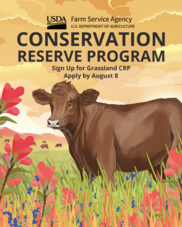
The U.S. Department of Agriculture (USDA) today announced that agricultural producers and private landowners can now enroll in the Grassland Conservation Reserve Program (Grassland CRP). The sign-up runs from today, July 14, to Aug. 8, 2025. Grassland CRP, offered by USDA’s Farm Service Agency (FSA), is a voluntary working lands conservation program that enables participants to conserve grasslands while also continuing most grazing and haying practices.
Grassland CRP emphasizes support for grazing operations, plant and animal biodiversity, and grasslands and land with shrubs and forbs under the greatest threat of conversion.
CRP, USDA’s flagship conservation program, celebrates its 40th anniversary this year. For four decades, CRP has provided financial and technical support to agricultural producers and landowners whose accepted acres are placed under contract for 10-15 years and who agree to voluntarily convert the land to beneficial vegetative cover to improve water quality, prevent soil erosion and support wildlife habitat. The American Relief Act, 2025, extended provisions for CRP through Sept. 30, 2025.
Currently, more than 25.8 million acres are enrolled in CRP, with nearly 9.7 million acres in Grassland CRP. On May 12, FSA opened General and Continuous CRP enrollment for 2025. FSA is currently reviewing submitted offers and will announce accepted offers at a later date. Due to the 27-million-acre statutory cap, only 1.8 million acres are available for all CRP enrollment this fiscal year.
Landowners and producers interested in Grassland CRP should contact their local USDA Service Center to learn more or apply for the program before the Aug. 8 deadline.
FSA helps America’s farmers, ranchers and forest landowners invest in, improve, protect and expand their agricultural operations through the delivery of agricultural programs for all Americans. FSA implements agricultural policy, administers credit and loan programs, and manages conservation, commodity, disaster recovery and marketing programs through a national network of state and county offices and locally elected county committees. For more information, visit fsa.usda.gov.
|
Top of page
The U.S. Department of Agriculture (USDA) is issuing up to $10 billion directly to agricultural producers through the Emergency Commodity Assistance Program (ECAP) for the 2024 crop year. Administered by USDA’s Farm Service Agency (FSA), ECAP will help agricultural producers mitigate the impacts of increased input costs and falling commodity prices.
Authorized by the American Relief Act, 2025, these economic relief payments are based on planted and prevented planted crop acres for eligible commodities for the 2024 crop year. To streamline and simplify the delivery of ECAP, FSA will begin sending pre-filled applications to producers who submitted acreage reports to FSA for 2024 eligible ECAP commodities soon after the signup period opens on March 19, 2025. Producers do not have to wait for their pre-filled ECAP application to apply. They can visit fsa.usda.gov/ecap to apply using a login.gov account or contact their local FSA office to request an application once the signup period opens.
Eligible Commodities and Payment Rates
The commodities below are eligible for these per-acre payment rates:
|
· Wheat - $30.69
|
Eligible oilseeds:
|
|
· Corn - $42.91
|
· Canola – $31.83
|
|
· Sorghum - $42.52
|
· Crambe – $19.08
|
|
· Barley - $21.67
|
· Flax - $20.97
|
|
· Oats - $77.66
|
· Mustard - $11.36
|
|
· Upland cotton & Extra-long staple cotton - $84.74
|
· Rapeseed -$23.63
|
|
· Long & medium grain rice - $76.94
|
· Safflower - $26.32
|
|
· Peanuts - $75.51
|
· Sesame - $16.83
|
|
· Soybeans - $29.76
|
· Sunflower – $27.23
|
|
· Dry peas - $16.02
|
|
|
· Lentils - $19.30
|
|
|
· Small Chickpeas - $31.45
|
|
|
· Large Chickpeas - $24.02
|
|
Producer Eligibility
Eligible producers must report 2024 crop year planted and prevented planted acres to FSA on an FSA-578, Report of Acreage form. Producers who have not previously reported 2024 crop year acreage or filed a notice of loss for prevented planted crops must submit an acreage report by the Aug. 15, 2025, deadline. Eligible producers can visit fsa.usda.gov/ecap for eligibility and payment details.
Applying for ECAP
Producers must submit ECAP applications to their local FSA county office by Aug. 15, 2025. Only one application is required for all ECAP eligible commodities nationwide. ECAP applications can be submitted to FSA in-person, electronically using Box and One-Span, by fax or by applying online at fsa.usda.gov/ecap utilizing a secure login.gov account.
If not already on file for the 2024 crop year, producers must have the following forms on file with FSA:
-
Form AD-2047, Customer Data Worksheet.
-
Form CCC-901, Member Information for Legal Entities (if applicable).
-
Form CCC-902, Farm Operating Plan for an individual or legal entity.
-
Form CCC 943, 75 percent of Average Gross Income from Farming, Ranching, or Forestry Certification (if applicable).
-
AD-1026, Highly Erodible Land Conservation (HELC) and Wetland Conservation (WC) Certification.
-
SF-3881, Direct Deposit.
Except for the new CCC-943, most producers, especially those who have previously participated in FSA programs, likely have these forms on file. However, those who are uncertain and want to confirm the status of their forms or need to submit the new CCC-943, can contact their local FSA county office.
If a producer does not receive a pre-filled ECAP application, and they planted or were prevented from planting ECAP eligible commodities in 2024, they should contact their local FSA office.
ECAP Payments and Calculator
ECAP payments will be issued as applications are approved. Initial ECAP payments will be factored by 85% to ensure that total program payments do not exceed available funding. If additional funds remain, FSA may issue a second payment.
ECAP assistance will be calculated using a flat payment rate for the eligible commodity multiplied by the eligible reported acres. Payments are based on acreage and not production. For acres reported as prevented plant, ECAP assistance will be calculated at 50%.
For ECAP payment estimates, producers are encouraged to visit fsa.usda.gov/ecap to use the ECAP online calculator.
Top of page
In this Ask the Expert, Jack Carlile, Farm Loan Manager for the USDA Farm Service Agency (FSA), answers questions about farm operating loans and when producers should apply in order to secure funds for the current crop year.
As the Farm Loan Manager for the Cherokee County Service Center, Jack is responsible for managing the loan making and loan servicing activities for five counties in northeast Oklahoma. His office provides services for over 650 farm loan customers. Jack was raised on a cross bred cow/calf operation that his grandparents started. Over the years, each generation has added to the operation by purchasing additional pasture. The operation also grows and bales their own hay. Jack’s agriculture background and degree in agriculture economics from Oklahoma State University help him better understand the financing needs of his producers.
Who can apply for FSA Farm Loans?
Anyone can apply for FSA’s loan programs. Applications will be considered on basic eligibility requirements. To apply for a loan, you must meet the following general eligibility requirements including:
- Be a U.S. citizen or qualified alien.
- Operator of a family farm or ranch.
- Have a satisfactory credit history.
- Unable to obtain credit elsewhere at reasonable rates and terms to meet actual needs.
- Not be delinquent on any federal debts.
To read the full blog visit farmers.gov/blog/ask-the-expert-farm-operating-loan-qa-with-jack-carlile.
Top of page
Farm Loan Programs
|
Farm Programs
|
90-Day Treasury Bill
|
4.125%
|
Farm Storage Facility Loans
|
3 Year
|
3.875%
|
Farm Operating Loans - Direct
|
5.0%
|
Farm Storage Facility Loans
|
5 Year
|
4.0%
|
Farm Ownership Loans - Direct
|
5.875%
|
Farm Storage Facility Loans
|
7 Year
|
4.25%
|
Limited Resource Loans
|
5.000%
|
Farm Storage Facility Loans
|
10 Year
|
4.5%
|
Farm Ownership Loans - Direct FO Down Payment
|
1.875%
|
Farm Storage Facility Loans
|
12 Year
|
4.625%
|
Emergency Loans
|
3.750%
|
Commodity Loans
|
5.125%
|
|
|
CCC Borrowing Rate
|
4.125%
|
Kentucky FSA State Office
771 Corporate Dr., Ste 205
Lexington, KY 40503
Phone: 859-224-7601
State Webpage
|
|
Contact your local USDA Service Center for assistance with FSA loans or programs
|
Kentucky FSA State Committee
|
|








