
North Dakota FSA eNews - July, 2025
In This Issue:
July 15, 2025: Acreage Reporting Deadline for 2025 Crop Year Spring Planted Crops and Perennial Forage
July 15, 2025: Deadline to complete 2024 ARC-IC Yield Certifications
July 15, 2025: NAP Production Reporting Deadline
July 18, 2025: Deadline to submit new offers of Continuous Conservation Reserve Program
August 15, 2025: 2024 ECAP Application Deadline
March 2, 2026: Deadline to file applications for livestock disaster programs
I’m excited to serve as the North Dakota Farm Service Agency (FSA) State Executive Director again, after serving in this position during the first Trump Administration. Besides working with FSA staff, I still farm with my two sons in Steele County. As someone who has farmed for over 40 years, I know the importance of timely delivery of FSA farm programs to producers, which all starts at the county level with our staff.
Recent weather challenges and natural disasters that have spanned across the state have kept county staff busy. We are working to help producers by offering disaster programs in counties that have received substantial damage by wildfires, high winds, derechos, and tornadoes. I’d like to remind producers that were adversely affected to make sure to document all damages and losses, to ensure eligibility for disaster programs.
Even with our state being hit with multiple natural disaster in the past couple of months, I’m impressed and proud of how resilient and positive our producers, customers, and communities remain. On my daily commute, I only need to look out the window at the green grass, regrowth, and lush fields to be reminded how blessed we are to live in North Dakota. The recent Independence Day holiday also served as a great reminder that we are blessed to have the opportunities and freedom afforded by living in America.
State Executive Director, North Dakota FSA
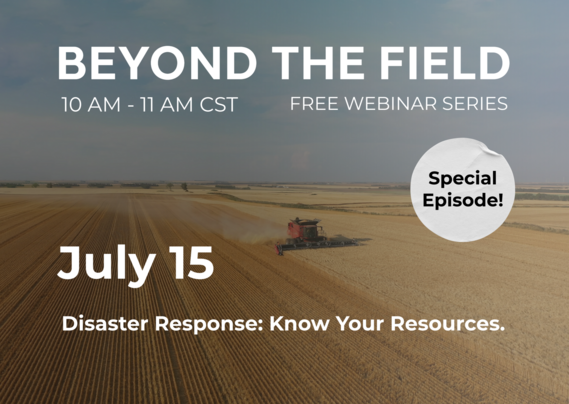 Join us for a free special webinar: “Disaster Response: Know your Resources,” on July 15 at 10 a.m., as experts from Farmers Union Insurance, State Farm Service Agency Office and the Bank of North Dakota discuss disaster relief options for producers impacted by recent storms.
Click the button to register today!
Sign-up begins July 10
U.S. Secretary of Agriculture Brooke L. Rollins announced today that agricultural producers who suffered eligible crop losses due to natural disasters in 2023 and 2024 can now apply for $16 billion in assistance through the Supplemental Disaster Relief Program (SDRP).
To expedite the implementation of SDRP, USDA’s Farm Service Agency (FSA) is delivering assistance in two stages. This first stage is open to producers with eligible crop losses that received assistance under crop insurance or the Noninsured Crop Disaster Assistance Program during 2023 and 2024. Stage One sign up will start in person at FSA county offices on July 10 and prefilled applications are being mailed to producers today, July 9. SDRP Stage Two signups for eligible shallow or uncovered losses will begin in early fall.
SDRP Stage One
FSA is launching a streamlined, pre-filled application process for eligible crop, tree, and vine losses by leveraging existing Noninsured Crop Disaster Assistance Program (NAP) and Risk Management Agency (RMA) indemnified loss data. The pre-filled applications will be mailed on July 9, 2025.
Eligibility
Eligible losses must be the result of natural disasters occurring in calendar years 2023 and/or 2024. These disasters include wildfires, hurricanes, floods, derechos, excessive heat, tornadoes, winter storms, freeze (including a polar vortex), smoke exposure, excessive moisture, qualifying drought, and related conditions.
To qualify for drought related losses, the loss must have occurred in a county rated by the U.S. Drought Monitor as having a D2 (severe drought) for eight consecutive weeks, D3 (extreme drought), or greater intensity level during the applicable calendar year.
Producers in Connecticut, Hawaii, Maine, and Massachusetts will not be eligible for SDRP program payments. Instead, these states chose to cover eligible crop, tree, bush, and vine losses through separate block grants. These block grants are funded through the $220M provided for this purpose to eligible states in the American Relief Act.
How to Apply
To apply for SDRP, producers must submit the FSA-526, Supplemental Disaster Relief Program (SDRP) Stage One Application, in addition to having other forms on file with FSA.
SDRP Stage One Payment Calculation
Stage One payments are based on the SDRP adjusted NAP or Federal crop insurance coverage level the producer purchased for the crop. The net NAP or net federal crop insurance payments (NAP or crop insurance indemnities minus administrative fees and premiums) will be subtracted from the SDRP calculated payment amount.
For Stage One, the total SDRP payment to indemnified producers will not exceed 90% of the loss and an SDRP payment factor of 35% will be applied to all Stage One payments. If additional SDRP funds remain, FSA may issue a second payment.
Future Insurance Coverage Requirements
All producers who receive SDRP payments are required to purchase federal crop insurance or NAP coverage for the next two available crop years at the 60% coverage level or higher. Producers who fail to purchase crop insurance for the next two available crop years will be required to refund the SDRP payment, plus interest, to USDA.
SDRP Stage 2
FSA will announce additional SDRP assistance for uncovered losses, including non-indemnified shallow losses and quality losses and how to apply later this fall.
Learn more by visiting fsa.usda.gov/sdrp.
This announcement follows Secretary Rollins’ comprehensive plan to deliver the total amount of Congressionally appropriated $30 billion in disaster assistance to farmers and ranchers this year. These programs will complement the forthcoming state block grants that USDA is working with 14 different states to develop.
To date, USDA has issued more than $7.8 billion in Emergency Commodity Assistance Program (ECAP) payments to eligible producers. Additionally, USDA has provided over $1 billion in emergency relief through the Emergency Livestock Relief Program to producers who suffered grazing losses due to drought or wildfires in calendar years 2023 and 2024.
USDA disaster assistance information can be found on farmers.gov, including the Disaster Assistance Discovery Tool, Disaster-at-a-Glance fact sheet, Loan Assistance Tool, and the FarmRaise online FSA education hub. Payment details will be updated here weekly. For more information, contact your local USDA Service Center.
Agricultural operations in North Dakota have been significantly impacted by recent severe weather including tornadoes, derecho winds, hail, lightning, and flooding. The U.S. Department of Agriculture (USDA) has technical and financial assistance available to help farmers and livestock producers recover from these adverse weather events. Impacted producers should contact their local USDA Service Center to report losses and learn more about program options available to assist in their recovery from crop, land, infrastructure, and livestock losses and damages.
USDA Disaster Assistance
Producers who experience livestock deaths in excess of normal mortality or sell injured livestock at a reduced price may be eligible for the Livestock Indemnity Program (LIP). To participate in LIP, producers will have to provide acceptable documentation of death losses or evidence of reduced sales resulting from an eligible adverse weather event and must submit a notice of loss and program payment application to the USDA Farm Service Agency (FSA) no later than March 2, 2026, for 2025 calendar year losses. Livestock producers who experience losses related to tornadoes should check with their local FSA office for LIP eligibility criteria.
Meanwhile, the Emergency Assistance for Livestock, Honeybees, and Farm-Raised Fish Program (ELAP) provides eligible producers with compensation for feed and grazing losses. For ELAP, producers are required to complete a notice of loss and submit a payment application to their local FSA office no later than the annual program application deadline, March 2, 2026, for 2025 calendar year losses.
Additionally, eligible orchardists and nursery tree growers may be eligible for cost-share assistance through the Tree Assistance Program (TAP) to replant or rehabilitate eligible trees, bushes or vines. TAP complements the Noninsured Crop Disaster Assistance Program (NAP) or crop insurance coverage, which covers the crop but not the plants or trees in all cases. For TAP, a program application must be filed within 90 days of the disaster event or the date when the loss of the trees, bushes or vines is apparent.
“Impacted producers should timely report all crop, livestock and farm infrastructure damages and losses to their local FSA county office as soon as possible,” said Brad Thykeson, State Executive Director for FSA in North Dakota. “As you evaluate your operation, take time to gather important documents you will need to get assistance, including farm records, herd inventory, receipts and pictures of damages or losses.”
FSA also offers a variety of direct and guaranteed farm loans, including operating and emergency farm loans, to producers unable to secure commercial financing. Producers in counties with a primary or contiguous disaster designation may be eligible for low interest emergency loans to help them recover from production and physical losses. Loans can help producers replace essential property, purchase inputs like livestock, equipment, feed and seed, cover family living expenses or refinance farm-related debts and other needs.
Additionally, FSA offers several loan servicing options available for borrowers who are unable to make scheduled payments on their farm loan programs debt to the agency because of reasons beyond their control.
The Farm Storage Facility Loan Program (FSFL) provides low-interest financing so producers can build, repair, replace or upgrade facilities to store commodities. Loan terms vary from three to 12 years. Producers who incurred damage to or loss of their equipment or infrastructure funded by the FSFL program should contact their insurance agent and their local USDA Service Center. Producers in need of on-farm storage should also contact USDA.
Risk Management
Producers with NAP coverage should report crop damage to their local FSA office and must file a Notice of Loss (CCC-576) within 15 days of the loss becoming apparent, except for hand-harvested crops, which should be reported in writing within 72 hours.
Producers with risk protection through Federal Crop Insurance should report crop damage to their crop insurance agent within 72 hours of discovering damage and be sure to follow up in writing within 15 days.
“Crop insurance and other USDA risk management options are offered to help producers manage risk because we never know what nature has in store for the future,” said Alexa Talkington Acting Director of USDA’s Risk Management Agency (RMA) Regional Office that covers North Dakota. “The Approved Insurance Providers, loss adjusters and agents are experienced and well-trained in handling these types of events.”
Conservation
FSA’s Emergency Conservation Program (ECP) and Emergency Forest Restoration Program (EFRP) can assist landowners and forest stewards with financial and technical assistance to restore fencing, damaged farmland or forests, and remove debris from agricultural areas.
USDA’s Natural Resources Conservation Service (NRCS) is always available to provide technical assistance during the recovery process by assisting producers to plan and implement conservation practices on farms and working forests impacted by natural disasters.
The Environmental Quality Incentives Program (EQIP) can help producers plan and implement conservation practices on land impacted by natural disasters.
“The Natural Resources Conservation Service can be a very valuable partner to help landowners with their recovery and resiliency efforts,” said Dan Hovland, NRCS State Conservationist in North Dakota. “Our staff will work one-on-one with landowners to make assessments of the damages and develop approaches that focus on effective recovery of the land.”
Assistance for Communities
Additional NRCS programs include the Emergency Watershed Protection (EWP) program, which assists local government sponsors with the cost of addressing watershed impairments or hazards such as debris removal and streambank stabilization.
Eligible sponsors include cities, counties, towns or any federally recognized Native American tribe or tribal organization. Sponsors must submit a formal request (by mail or email) to the NRCS state conservationist for assistance within 60 days of the natural disaster occurrence or 60 days from the date when access to the sites become available. For more information sponsors should please contact their local NRCS office.
More Information
Additional USDA disaster assistance information can be found on farmers.gov, including USDA resources specifically for producers impacted by tornadoes. Those resources include the Disaster Assistance Discovery Tool, Disaster-at-a-Glance fact sheet and Loan Assistance Tool. Additionally, FarmRaise partnered with FSA to launch an online education hub comprised of videos, tools and interactive resources, including farm loan information and LIP and ELAP decision tools. For FSA and NRCS programs, producers should contact their local USDA Service Center. For assistance with a crop insurance claim, producers and landowners should contact their crop insurance agent.
If you’ve suffered excessive livestock death losses and grazing or feed losses due to recent winter storms, you may be eligible for USDA disaster assistance programs. The Livestock Indemnity Program (LIP) provides assistance to producers for livestock deaths in excess of normal mortality caused by adverse weather, disease and attacks by animals reintroduced into the wild by the federal government or protected by federal law.
For disease losses, FSA county committees can accept veterinarian certifications that livestock deaths were directly related to adverse weather and unpreventable through good animal husbandry and management.
For 2025 livestock losses, producers must file a notice of loss, provide the following supporting documentation, and application for payment to their local FSA office by March 2, 2026.
- Proof of death documentation
- Copy of grower’s contracts
- Proof of normal mortality documentation
- Livestock beginning inventory documentation
USDA has established normal mortality rates for each type and weight range of eligible livestock in North Dakota. These established percentages reflect losses that are considered expected or typical under “normal” conditions.
Producers should record all pertinent information regarding livestock losses due to the eligible adverse weather or loss condition, including:
- Documentation of the number, kind, type, and weight range of livestock that have died, supplemented if possible by photographs or video records of ownership and losses;
- Rendering truck receipts by kind, type and weight - important to document prior to disposal;
- Beginning inventory supported by birth recordings or purchase receipts;
- Documentation from Animal Plant Health Inspection Service, Department of Natural Resources, or other sources to substantiate eligible death losses due to an eligible loss condition;
- Documentation that livestock were removed from grazing pastures due to an eligible adverse weather or loss condition;
- Costs of transporting livestock feed to eligible livestock, such as receipts for equipment rental fees for hay lifts and snow removal;
- Feed purchase receipts if feed supplies or grazing pastures are destroyed;
For more information, contact your Local County USDA Service Center or visit fsa.usda.gov.
If you’ve suffered livestock feed or grazing losses due to recent severe storms, you could be eligible for assistance through the Emergency Assistance for Livestock, Honeybees, and Farm-Raised Fish Program (ELAP). ELAP provides emergency assistance to eligible livestock, honeybee, and farm-raised fish producers who have losses due to disease, adverse weather or other conditions, such as tornadoes, blizzards, and wildfires, not covered by other agricultural disaster assistance programs.
Eligible losses include:
-
Livestock - grazing losses not covered under the Livestock Forage Disaster Program (LFP), loss of purchased feed and/or mechanically harvested feed due to an eligible adverse weather event, and additional cost of transporting water and feed because of an eligible drought. ELAP covers physically damaged or destroyed livestock feed that was purchased, or mechanically harvested forage or feedstuffs intended for use as feed for your eligible livestock. In order to be considered eligible, harvested forage must be baled. Forage that is only cut, raked or windrowed is not eligible. Please maintain records and receipts documenting that livestock were removed from the grazing pasture due to severe storms, costs of transporting livestock feed to eligible livestock, receipts for equipment rental fees for hay lifts, feed purchase receipts and the number of gallons of water transported to livestock due to water shortages.
-
Honeybee - loss of purchased feed due to an eligible adverse weather event, cost of additional feed purchased above normal quantities due to an eligible adverse weather condition, viable colony losses in excess of normal mortality due to an eligible weather event or loss condition, including CCD, and hive losses due to eligible adverse weather.
-
Farm-Raised Fish - death losses in excess of normal mortality and/or loss of purchased feed due to an eligible adverse weather event.
If you’ve suffered eligible livestock, honeybee, or farm-raised fish losses during calendar year 2025, you must file a notice of loss and an application for payment by March 2, 2026.
Farmers and ranchers know all too well that natural disasters can be a common, and likely a costly, variable to their operation. The Farm Service Agency (FSA) has emergency assistance programs to provide assistance when disasters strike, and for some of those programs, a disaster designation may be the eligibility trigger.
FSA administers four types of disaster designations.
USDA Secretarial Disaster Designation
- The designation process can be initiated by individual farmers, local government officials, State governors, State agriculture commissions, tribal councils or the FSA State Executive Director
- This designation is triggered by a 30-percent or greater production loss to at least one crop because of a natural disaster, or at least one producer who sustained individual losses because of a natural disaster and is unable to obtain commercial financing to cover those losses
- In 2012, USDA developed a fast-track process for disaster declarations for severe drought. This provides for a nearly automatic designation when, during the growing season, any portion of a county meets the D2 (Severe Drought) drought intensity value for eight consecutive weeks or a higher drought intensity value for any length of time as reported by the U.S. Drought Monitor (https://www.droughtmonitor.unl.edu/)
Administrator’s Physical Loss Notification
- This designation is initiated by the FSA State Executive Director.
- The designation is triggered by physical damage and losses because of a natural disaster, including but not limited to dead livestock, collapsed buildings, and destroyed farm structures.
Presidential Designation
- A Presidential major disaster designation and emergency declaration is initiated by the Governor of the impacted state through the Federal Emergency Management Agency (FEMA).
- This designation is triggered by damage and losses caused by a disaster of such severity and magnitude that effective response is beyond the capability of the State and local governments.
Quarantine Designation
- This designation is requested of the Secretary of Agriculture by the FSA State Executive Director.
- A quarantine designation is triggered by damage and losses caused by the effects of a plant or animal quarantine approved by the Secretary under the Plant Protection Act or animal quarantine laws.
All four types of designations immediately trigger the availability of low-interest emergency loans to eligible producers in all primary and contiguous counties. FSA borrowers in these counties who are unable to make their scheduled payments on any debt may be authorized to have certain set asides. Additional disaster assistance requiring a designation may also be provided by new programs in the future.
For more information on FSA disaster programs and disaster designations, visit fsa.usda.gov/disaster.
The National Environmental Policy Act (NEPA) requires Federal agencies to consider all potential environmental impacts for federally funded projects before the project is approved.
For all Farm Service Agency (FSA) programs, an environmental review must be completed before actions are approved, such as site preparation or ground disturbance. These programs include, but are not limited to, the Emergency Conservation Program (ECP), Farm Storage Facility Loan (FSFL) program and farm loans. If project implementation begins before FSA has completed an environmental review, the request will be denied. Although there are exceptions regarding the Stafford Act and emergencies, it’s important to wait until you receive written approval of your project proposal before starting any actions.
Applications cannot be approved until FSA has copies of all permits and plans. Contact your local FSA office early in your planning process to determine what level of environmental review is required for your program application so that it can be completed timely.
After spring planting is complete, agricultural producers should make an appointment with the North Dakota Farm Service Agency (FSA) to complete crop acreage reports before the applicable deadline.
How to File a Report
A crop acreage report documents a crop grown on a farm or ranch, its intended use and location. Producers should file an accurate crop acreage report for all crops and land uses, including failed acreage and prevented planted acreage before the applicable deadline.
The Acreage Reporting Deadline for 2025 Crop Year Spring Planted Crops and Perennial Forage is July 15, 2025 for all North Dakota Counties.
To file a crop acreage report, producers need to provide:
- Crop and crop type or variety
- Intended crop use
- Number of crop acres
- Map with approximate crop boundaries
- Planting date(s)
- Planting pattern, when applicable
- Producer share(s)
- Irrigation practice(s)
- Acreage prevented from planting, when applicable
- Other required information
Acreage Reporting Details
The following exceptions apply to acreage reporting dates:
- If the crop has not been planted by the acreage reporting deadline, then the acreage must be reported no later than 15 calendar days after planting is completed.
- If a producer acquires additional acreage after the acreage reporting deadline, then the acreage must be reported no later than 30 calendar days after purchase or acquiring the lease. Appropriate documentation must be provided to the county office.
Noninsured Crop Disaster Assistance Program (NAP) policy holders should note that the acreage reporting date for NAP-covered crops is the acreage reporting date or 15 calendar days before grazing or crop harvesting begins, whichever is earlier.
Producers with perennial forage crops should check with their local FSA office to see if their crops are eligible for continuous certification, which rolls the certified acreage forward each year until a change is made.
Prevented Planted Acreage
Producers should also report the crop acreage they intended to plant but were unable to because of a natural disaster, including drought. Prevented planted acreage must be reported on form CCC-576, Notice of Loss. The prevented planting deadline has been extended for 2025 spring seeded crops. Producers who intended to plant this spring, but were unable due to weather conditions, now have until the acreage reporting deadline for the applicable crop being claimed as prevented planting. July 15 is a major deadline for most crops, but acreage reporting deadlines vary by county and by crop.
Farmers.gov Portal
Producers can access their FSA farm records, maps, and common land units through the farmers.gov customer portal. The portal allows producers to export field boundaries as shapefiles and import and view other shapefiles, such as precision agriculture boundaries within farm records mapping. Producers can view, print and label their maps for acreage reporting purposes. A login.gov account that is linked to a USDA customer record is required to use the portal.
Producers can visit farmers.gov/account to learn more about creating an account. Producers who have the authority to act on behalf of another customer as a grantee via an FSA-211 Power of Attorney form, Business Partner Signature Authority or as a member of a business with signature authority can now access information for the business in the farmers.gov portal.
Electronic Geospatial Acreage Reporting
Acreage reports using precision agriculture planting boundaries can be filed electronically with an approved insurance provider or an authorized third-party provider, who will then share the file with FSA staff. Producers should notify their local FSA office if they submitted an electronic geospatial acreage report containing precision planting boundaries that they want to use as part of their FSA acreage report.
More Information
Producers can make an appointment to report acres by contacting their local USDA Service Center.
Updates to Acreage Reporting and Prevented Planted Acres
The USDA Farm Service Agency (FSA) made several policy updates to acreage reporting and prevented planted acres.
Prevented Planted Acres
In order to certify prevented planted acreage due to drought, all of the following must apply:
- The area that is prevented from being planted has insufficient soil moisture for germination of seed on the final planting date for non-irrigated acreage
- Prolonged precipitation deficiencies that meet the D3 or D4 level as determined by the U.S. Drought Monitor
- Verifiable information must be collected from sources whose business or purpose is recording weather conditions as determined by FSA and the sources include, but are not limited to:
- S. National Weather Service
- Bureau of Reclamation
- S. Army Corps of Engineers
- National Institute of Food and Agriculture
- Natural Resources Conservation Service
- Local irrigation authorities responsible for water allocations
- State Department of Water Resources
- National Institute of Food and Agriculture
- Other sources responsible for the collection of water data or regulation of water resources (water allocations).
FSA reminds producers to report prevented planted and failed acres in order to establish or retain FSA program eligibility for some programs. You should report crop acreage you intended to plant, but due to natural disaster, were prevented from planting. Prevented planting acreage must be reported on form CCC-576, Notice of Loss, no later than 15 calendar days after the final planting date as established by FSA and the Risk Management Agency (RMA).
Late-Filed Acreage Reports
FSA can now accept late-filed acreage reports without a field visit if the producer can provide proof of existence, including specific acres of the crop, and disposition. Producers are required to pay the late filed fee.
Proof of existence of the crop includes, but is not limited to:
- seed receipts showing the amount, variety, and date purchased;
- receipts for cleaning, treating, etc., for seed planted on the farm;
- a written contract or documentation of an oral contract to produce a specific crop;
- evidence that was accepted and approved by the RMA or another USDA agency;
- precision planting, spraying, or harvesting geospatial data or maps;
- drone photos with location and notable physical boundaries;
- other aerial or ground imagery with the ability to determine date, acres, and crop.
Proof of disposition of the crop includes, but is not limited to:
- receipts showing number and units sold if the sale can be positively identified as sale of the crop for the farm for the year represented;
- a written contract or documentation of an oral contract to produce a specific crop;
- records showing the crop was fed to livestock;
- documentation of payment for custom harvesting indicating acreage, location, and crop year;
- evidence that was accepted and approved by another USDA agency.
The U.S. Department of Agriculture’s Farm Service Agency (FSA) is extending the prevented planting crop reporting deadline for producers affected by spring flooding, excessive moisture, or qualifying drought.
Producers who intended to plant this spring, but were unable due to weather conditions, now have until the acreage reporting deadline for the applicable crop being claimed as prevented planting. July 15 is a major deadline for most crops, but acreage reporting deadlines vary by county and by crop.
Producers need to report prevented planting acres to retain eligibility for FSA program benefits. Normally, the prevented planting reporting deadline is 15 calendar days after the final planting date for a crop as established by FSA and the Risk Management Agency (RMA). The prevented planting reporting deadline extension only applies to FSA and does not change any RMA crop insurance reporting deadline requirements.
The extension does not apply to crops covered by FSA’s Noninsured Crop Disaster Assistance Program (NAP). Producers should check with their local FSA office regarding prevented planting provisions for NAP-covered crops.
Producers are encouraged to contact their local FSA office as soon as possible to make an appointment to report prevented planting acres and submit their spring crop acreage report. To locate your local FSA office, visit farmers.gov/service-locator.
If you’re enrolled in the Agriculture Risk Coverage (ARC) or Price Loss Coverage (PLC) programs, you must protect all cropland and noncropland acres on the farm from wind and water erosion and noxious weeds. By signing ARC county or individual contracts and PLC contracts, you agree to effectively control noxious weeds on the farm according to sound agricultural practices. If you fail to take necessary actions to correct a maintenance problem on your farm that is enrolled in ARC or PLC, the County Committee may elect to terminate your contract for the program year.
NAP provides financial assistance to you for crops that aren’t eligible for crop insurance to protect against lower yields or crops unable to be planted due to natural disasters including freeze, hail, excessive moisture, excessive wind or hurricanes, flood, excessive heat and qualifying drought (includes native grass for grazing), among others.
To receive payment, you had to purchase NAP coverage for 2025 crops and file a notice of loss the earlier of 15 days of the occurrence of the disaster or when losses become apparent or 15 days of the final harvest date. For hand-harvested crops and certain perishable crops, you must notify FSA within 72 hours of when a loss becomes apparent.
Eligible crops must be commercially produced agricultural commodities for which crop insurance is not available, including perennial grass forage and grazing crops, fruits, vegetables, mushrooms, floriculture, ornamental nursery, aquaculture, turf grass, ginseng, honey, syrup, bioenergy, and industrial crops.
For more information on NAP, contact your local County USDA Service Center or visit fsa.usda.gov/nap.
The Noninsured Crop Disaster Assistance Program (NAP) provides financial assistance to you for crops that aren’t eligible for crop insurance to protect against lower yields or crops unable to be planted due to natural disasters including freeze, hail, excessive moisture, excessive wind or hurricanes, flood, excessive heat and qualifying drought (includes native grass for grazing), among others.
In order to participate, you must obtain NAP coverage for the crop year by the applicable deadline using form CCC-471 “Application for Coverage” and pay the service fee. Application closing dates vary by crop. Producers are also required to submit an acceptable crop acreage report. Additionally, NAP participants must provide:
- The quantity of all harvested production of the crop in which the producer held an interest during the crop year
- The disposition of the harvested crop, such as whether it is marketable, unmarketable, salvaged or used differently than intended
- Acceptable crop production records (when requested by FSA)
Producers who fail to report acreage and production information for NAP-covered crops could see reduced or zero NAP assistance. These reports are used to calculate the approved yield.
If your NAP-covered crops are affected by a natural disaster, notify your FSA office by completing Part B of form CCC-576 “Notice of Loss and Application for Payment.” This must be completed within 15 calendar days of the occurrence of the disaster or when losses become apparent or 15 days of the final harvest date. For hand-harvested crops and certain perishable crops, you must notify FSA within 72 hours of when a loss becomes apparent.
To receive benefits, you must also complete Parts D, E, F, G and H of the CCC-576 “Notice of Loss and Application for Payment” within 60 days of the last day of coverage for the crop year for any NAP covered crops. The CCC-576 requires acceptable appraisal information. Producers must provide evidence of production and note whether the crop was marketable, unmarketable, salvaged or used differently than intended.
Eligible crops must be commercially produced agricultural commodities for which crop insurance is not available, including perennial grass forage and grazing crops, fruits, vegetables, mushrooms, floriculture, ornamental nursery, aquaculture, turf grass, ginseng, honey, syrup, bioenergy, and industrial crops.
For more information on NAP, contact your local County USDA Service Center at visit fsa.usda.gov/nap.
The Farm Service Agency’s (FSA) Noninsured Crop Disaster Assistance Program (NAP) provides financial assistance to producers of non-insurable crops, including mechanically harvested forage with NAP coverage, to protect against natural disasters that occur during the coverage, resulting in loss of production, loss of value, or prevented planting of an eligible crop.
If you have NAP coverage on mechanically harvested forage, you must:
- Maintain separate production records for each unit, crop, practice, crop type, and intended use.
- Submit production records to FSA by the designated production reporting date for the crop.
- Notify your FSA administrative county office before grazing, abandoning, or destroying forage acreage reported, on FSA form FSA-578, as intended to be mechanically harvested; and request an appraisal.
- Notify your FSA administrative county office of a loss and timely file CCC-576, Notice of Loss and Application for Payment, Part B, the earlier of:
- 15 calendar days after the disaster occurs, or damage first becomes apparent.
- 15 calendar days after the crop’s normal harvest date.
- If you change your intended use or experience a loss during the coverage period, you must:
- Establish and maintain representative sample areas when an appraisal of the acreage is required.
- Inform your FSA administrative county office of the location of representative sample areas within 15 days of placing the panels.
- Request an appraisal of the representative sample areas at the end of harvest period but before first freeze.
For more information on NAP and NAP compliance requirements you must follow to retain NAP coverage, contact your local USDA service center.
The U.S. Department of Agriculture (USDA) reminds specialty crop producers that the application period for the Food Safety Certification for Specialty Crops (FSCSC) program for program year 2025 opened Jan. 1, 2025, and runs through Jan. 31, 2026. The program has been expanded to include medium-sized businesses in addition to small businesses. Eligible specialty crop growers can apply for assistance for expenses related to obtaining or renewing a food safety certification.
Program Details
FSCSC covers a percentage of the specialty crop operation’s cost of obtaining or renewing its on-farm food safety certification, as well as a portion of related expenses.
Eligible FSCSC applicants must be a specialty crop operation; meet the definition of a small or medium-size business and have paid eligible expenses related to certification.
- A small business has an average annual monetary value of specialty crops sold by the applicant during the three-year period preceding the program year of no more than $500,000.
- A medium size business has an average annual monetary value of specialty crops the applicant sold during the three-year period preceding the program year of at least $500,001 but no more than $1,000,000.
Specialty crop operations can receive the following cost assistance:
- Developing a food safety plan for first-time food safety certification.
- Maintaining or updating an existing food safety plan.
- Food safety certification.
- Certification upload fees.
- Microbiological testing for products, soil amendments and water.
- Training.
FSCSC payments are calculated separately for each eligible cost category. Details about payment rates and limitations are available at farmers.gov/food-safety.
Applying for Assistance
For program year 2025, the application period began Jan. 1, 2025, and runs through Jan. 31, 2026. FSA will issue 50% of the calculated payment for program year 2025 following application approval, with the remaining amount to be paid after the application deadline. If calculated payments exceed the amount of available funding, payments will be prorated.
Specialty crop producers can apply by completing the FSA-888-1, Food Safety Certification for Specialty Crops Program (FSCSC) for Program Years 2024 and 2025 application. The application, along with the AD-2047, Customer Data Worksheet and SF-3881, ACH Vendor/Miscellaneous Payment Enrollment Form, if not already on file with FSA, can be submitted to the FSA county office at any USDA Service Center nationwide by mail, fax, hand delivery or via electronic means. Producers with an eAuthentication account can apply for FSCSC online. Producers interested in creating an eAuthentication account should visit farmers.gov/sign-in.
Visit farmers.gov/food-safety for additional program details, eligibility information and application forms.
Farm loan borrowers who have pledged real estate as security for their Farm Service Agency (FSA) direct or guaranteed loans are responsible for maintaining loan collateral. Borrowers must obtain prior consent or approval from FSA or the guaranteed lender for any transaction that affects real estate security. These transactions include, but are not limited to:
- Leases of any kind
- Easements of any kind
- Subordinations
- Partial releases
- Sales
Failure to meet or follow the requirements in the loan agreement, promissory note, and other security instruments could lead to nonmonetary default which could jeopardize your current and future loans.
It is critical that borrowers keep an open line of communication with their FSA loan staff or guaranteed lender when it comes to changes in their operation. For more information on borrower responsibilities, read Your FSA Farm Loan Compass.
The FSFL program provides low-interest financing to build or upgrade storage facilities and to purchase portable (new or used) structures, equipment including on-farm liquified petroleum tanks for eligible commodities for use as fuel storage for grain dryer equipment.
Loans up to $100,000 can be secured by a promissory note/security agreement. Loans or aggregate loan totals exceeding $100,000 require additional security in the form of real estate or an irrevocable letter of credit. Participants are required to provide a down payment of 15 percent, with CCC providing a loan for the remaining 85 percent of the eligible net cost of the storage facility and permanent drying and handling equipment. Loan terms of 3, 5, 7, 10 or 12 years are available depending on the amount of the loan and loan type. Interest rates for each term rate may be different and are based on the rate which CCC borrows from the Treasury Department.
Sign-up for the FSFL program is continuous throughout the year. All requests for FSFL prior to loan approval require a site inspection for an environmental assessment in accordance to National Environmental Protection Agency (NEPA) requirements showing no adverse impacts. FSFL policy requires the following actions cannot occur at the proposed FSFL location prior to the environmental assessment being completed:
- accepting delivery of equipment and/or materials in previously undisturbed areas
- site preparation or foundation construction in previously undisturbed areas
- no alteration to any structures that are 50 years old or older or within a historic district
If any of the above are completed prior to FSA completing the on-site assessment, the approval of the FSFL may be delayed and/or ineligible.
Outstanding commodity loans from crop year 2024 can be repaid at any time at principal plus interest. If the sales proceeds are needed to repay the loan, a marketing authorization (CCC-681-1) can be requested. The request can either be made in person or by telephone. The marketing authorization allows for the selection of a delivery period to the buyer of either 15 or 30 calendar days. Marketing Authorizations which are requested after loan maturity date are limited to a delivery period of 15 days. All parties who signed the note are responsible for repaying the loan. If the buyer does not repay the loan as required by the marketing authorization, CCC will make demand for repayment on the producers who signed the note. Repayment of quantities delivered to the buyer are required within 15 days of the expiration date of the marketing authorization.
When changes in farm ownership or operation take place, a farm reconstitution is necessary. The reconstitution — or recon — is the process of combining or dividing farms or tracts of land based on the farming operation.
To be effective for the current fiscal year, farm combinations and farm divisions must be requested by August 1 of the fiscal year for farms subject to the Agriculture Risk Coverage (ARC) and Price Loss Coverage (PLC) program. A reconstitution is considered to be requested when all of the required signatures are on FSA-155 and all other applicable documentation, such as proof of ownership, is submitted.
Total Conservation Reserve Program (CRP) and non-ARC/PLC farms may be reconstituted at any time.
The following are the different methods used when doing a farm recon:
-
Estate Method — the division of bases, allotments and quotas for a parent farm among heirs in settling an estate
-
Designation of Landowner Method — may be used when (1) part of a farm is sold or ownership is transferred; (2) an entire farm is sold to two or more persons; (3) farm ownership is transferred to two or more persons; (4) part of a tract is sold or ownership is transferred; (5) a tract is sold to two or more persons; or (6) tract ownership is transferred to two or more persons. In order to use this method, the land sold must have been owned for at least three years, or a waiver granted, and the buyer and seller must sign a Memorandum of Understanding
-
DCP Cropland Method — the division of bases in the same proportion that the DCP cropland for each resulting tract relates to the DCP cropland on the parent tract
-
Default Method — the division of bases for a parent farm with each tract maintaining the bases attributed to the tract level when the reconstitution is initiated in the system.
For questions on your farm reconstitution, contact your local County USDA Service Center.
Farm Service Agency (FSA) is committed to providing our farm loan borrowers the tools necessary to be successful. FSA staff will provide guidance and counsel from the loan application process through the borrower’s graduation to commercial credit. While it is FSA’s commitment to advise borrowers as they identify goals and evaluate progress, it is crucial for borrowers to communicate with their farm loan staff when changes occur. It is the borrower’s responsibility to alert FSA to any of the following:
- Any proposed or significant changes in the farming operation
- Any significant changes to family income or expenses
- The development of problem situations
- Any losses or proposed significant changes in security
If a farm loan borrower can’t make payments to suppliers, other creditors, or FSA on time, contact your farm loan staff immediately to discuss loan servicing options.
For more information on FSA farm loan programs, contact your local county USDA Service Center or visit fsa.usda.gov.
Using the correct signature when doing business with FSA can save time and prevent a delay in program benefits.
The following are FSA signature guidelines:
- Married individuals must sign their given name.
- Example—Mary Doe and John Doe are married. When signing FSA forms, each must use their given name, and may not sign with the name of their spouse. Mrs. Mary Doe may not sign documents as Mrs. John Doe. For Farm Loan Purposes, spouses may not sign on behalf of the other as an authorized signatory, a signature will be needed for each. For a minor, FSA requires the minor's signature and one from the minor’s parent. There are certain exceptions where a minor’s signature may be accepted without obtaining the signature of one of the parents. Despite minority status, a youth executing a promissory note for a Youth Loan will incur full personal liability for the debt and will sign individually.
Note: By signing a document with a minor, the parent is liable for actions of the minor and may be liable for refunds, liquidated damages, or other penalties, etc.
When signing on one’s behalf the signature must agree with the name typed or printed on the form or be a variation that does not cause the name and signature to be in disagreement. Example - John W. Smith is on the form. The signature may be John W. Smith or J.W. Smith or J. Smith. Or Mary J. Smith may be signed as Mrs. Mary Joe Smith, M.J. Smith, Mary Smith, etc.
FAXED signatures will be accepted for certain forms and other documents provided the acceptable program forms are approved for FAXED signatures. Producers are responsible for the successful transmission and receipt of FAXED information.
Examples of documents not approved for FAXED signatures include:
- Promissory note
- Assignment of payment
- Joint payment authorization
- Acknowledgement of commodity certificate purchase
Spouses may sign documents on behalf of each other for FSA and CCC programs in which either spouse has an interest, unless written notification denying a spouse this authority has been provided to the county office. Spouses cannot sign on behalf of each other as an authorized signatory for partnerships, joint ventures, corporations or other similar entities. Likewise, a spouse cannot sign a document on behalf of the other in order to affirm the eligibility of oneself.
Any member of a general partnership can sign on behalf of the general partnership and bind all members unless the Articles of Partnership are more restrictive. Spouses may sign on behalf of each other’s individual interest in a partnership, unless notification denying a spouse that authority is provided to the county office. Acceptable signatures for general partnerships, joint ventures, corporations, estates, and trusts must consist of an indicator “by” or “for” the individual’s name, individual’s name and capacity, or individual’s name, capacity, and name of entity.
Farm Storage Facility Loan, 3-Year Term: 3.875%
Farm Storage Facility Loan, 5-Year Term: 4.000%
Farm Storage Facility Loan, 7-Year Term: 4.250%
Farm Storage Facility Loan, 10-Year Term: 4.500%
Farm Storage Facility Loan, 12-Year Term: 4.625%
Commodity Loans: 5.125%
Top of page
North Dakota FSA eNews
North Dakota State Office
1025 28th St. South
Fargo, ND 58103
Phone: 701-239-5224
Fax: 855-813-6644
|
|
State Office Staff:
State Executive Director: Brad Thykeson
Deputy State Executive Director: Kristen Knudtson
Administrative Officer: Amber Briss
Compliance/Payment Limitations: Kristen Knudtson, Acting
Conservation/Livestock: Beau Peterson
ARC/PLC/NAP/Disaster: Brandi Laframboise
Farm Loan Programs: Ryan Lindbom, Acting
Price Support: Brian Haugen
Outreach/Communication Coordinator: Cierra Hauck
|
| |
|
| |
|








