
Newsletter - July 2025
In This Issue:

Nominations are now being accepted for farmers and ranchers to serve on local U.S. Department of Agriculture (USDA) Farm Service Agency (FSA) county committees. These committees make important decisions about how federal farm programs are administered locally. All nomination forms for the 2025 election must be postmarked or received in the local FSA office by Aug. 1, 2025.
Elections for committee members will occur in certain Local Administrative Areas (LAA). LAAs are elective areas for FSA committees in a single county or multi-county jurisdiction and may include LAAs that are focused on an urban or suburban area.
Producers interested in serving on the FSA county committee can locate their LAA through a geographic information system locator tool available at fsa.usda.gov/elections and determine if their LAA is up for election by contacting their local FSA office.
Agricultural producers may be nominated for candidacy for the county committee if they:
- Participate or cooperate in a USDA program.
- Reside in the LAA that is up for election this year.
A cooperating producer is someone who has provided information about their farming or ranching operation to FSA, even if they have not applied or received program benefits.
Individuals may nominate themselves or others and qualifying organizations may also nominate candidates. USDA encourages all eligible producers to nominate, vote and hold office.
Nationwide, more than 7,700 dedicated members of the agriculture community serve on FSA county committees. The committees are made up of three to 11 members who serve three-year terms. Committee members play a key role in how FSA delivers disaster recovery, conservation, commodity and price support programs, as well as making decisions on county office employment and other agricultural issues.
More Information
Producers should contact their local FSA office today to register and find out how to get involved in their county’s election, including if their LAA is up for election this year. To be considered, a producer must be registered and sign an FSA-669A nomination form. This form and other information about FSA county committee elections are available at fsa.usda.gov/elections.
All nomination forms for the 2025 election must be postmarked or received in the local USDA Service Center by the Aug.1, 2025, deadline. Election ballots will be mailed to eligible voters in November 2025.
The U.S. Department of Agriculture (USDA) opened enrollment today for the Reimbursement Transportation Cost Payment Program (RTCP) for fiscal year 2025. The enrollment period begins July 7 and will run through Sept. 30. The deadline for producers to provide supporting documentation is Nov. 3, 2025.
RTCP helps U.S. farmers and ranchers offset a portion of the cost of transporting agricultural products over long distances.
The Full-Year Continuing Appropriations and Extensions Act, 2025 authorized $3.5 million for RTCP and allows farmers and livestock producers in Alaska, Hawaii and insular areas including the Commonwealth of Puerto Rico, Guam, American Samoa, Commonwealth of Northern Mariana Islands, Virgin Islands of the United States, Federated States of Micronesia, Republic of the Marshall Islands and Republic of Palau, to recover costs to transport agricultural commodities or inputs used to produce an agricultural commodity.
Roughly $3.5 million was issued to more than 1,100 producers, in all eligible areas combined, through the 2024 RTCP.
RTCP payments are calculated based on the costs incurred for transportation of agricultural commodities or inputs during a 12-month period, subject to an $8,000 per producer cap per fiscal year. A higher payment cap may be determined if claims for payments do not exceed available funding. Therefore, applicants are encouraged to submit all eligible receipts. If claims for payments exceed the funds available from the program for a fiscal year, payments will be reduced on a pro-rata basis.
Farmers and livestock producers interested in participating in RTCP can obtain applications and other documents by their FSA County Office or by calling toll-free 1-866-794-1079.
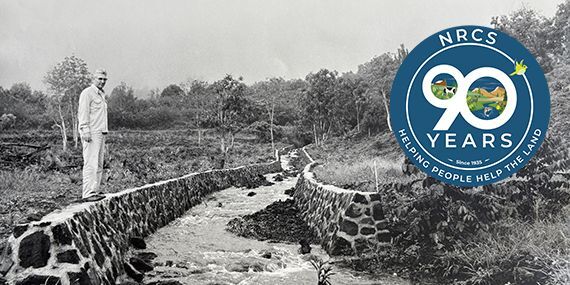 NRCS is celebrating its 90th anniversary this year. We began our celebration by posting a blog and an interactive timeline about NRCS history and a video about how we’ve helped farmers over the years. We’ve also been sharing some historical photos on social media that show how our mission has changed and stayed the same over the years.
Now, we’d like for you to join us in our celebration. We’d like to hear your stories and see photos of your operation – Then and Now.
Does your agricultural operation have a fascinating history you’d like to share? Are there interesting stories about how your operation came to be or how it’s evolved? Do you have photos of your operation from its beginnings to the present day? If so, we want to hear from you!
This summer, we want to highlight how things have changed on your operation over the years in our #ThenAndNow campaign on NRCS and FarmersGov social media.
Here’s how to participate:
- Find a few historical photos of your operation from when it began - Then.
- Using your smartphone or digital camera, take photos of your operation - Now.
- In a few sentences, tell us: how has your operation changed over the years? How has it expanded, modernized equipment and practices, or transformed with conservation?
- Include your name, the location of your operation, and links to any social media accounts you manage to promote your operation.
- Submit the above to SM.FPAC.NRCS.Facebook@usda.gov by Friday, August 1, 2025.
Please note that by submitting your photo/video, you are granting USDA permission to use these materials for outreach and education purposes.
Follow NRCS on X and Facebook, and FarmersGov on Facebook, X , and Instagram. We look forward to seeing and sharing your stories!
The U.S. Department of Agriculture (USDA) today announced that agricultural producers and private landowners can now enroll in the Grassland Conservation Reserve Program (Grassland CRP). The sign-up runs from today, July 14, to Aug. 8, 2025. Grassland CRP, offered by USDA’s Farm Service Agency (FSA), is a voluntary working lands conservation program that enables participants to conserve grasslands while also continuing most grazing and haying practices.
Grassland CRP emphasizes support for grazing operations, plant and animal biodiversity, and grasslands and land with shrubs and forbs under the greatest threat of conversion.
“Through the conservation of America’s essential grasslands, Grassland CRP supports continued agricultural productivity while at the same time prioritizing private lands stewardship,” said FSA Administrator Bill Beam. “By offering landowners the best of both worlds — economic viability and working lands preservation — Grassland CRP provisions support USDA’s commitment to Farmers First.”
CRP, USDA’s flagship conservation program, celebrates its 40th anniversary this year. For four decades, CRP has provided financial and technical support to agricultural producers and landowners whose accepted acres are placed under contract for 10-15 years and who agree to voluntarily convert the land to beneficial vegetative cover to improve water quality, prevent soil erosion and support wildlife habitat. The American Relief Act, 2025, extended provisions for CRP through Sept. 30, 2025.
Currently, more than 25.8 million acres are enrolled in CRP, with nearly 9.7 million acres in Grassland CRP. On May 12, FSA opened General and Continuous CRP enrollment for 2025. FSA is currently reviewing submitted offers and will announce accepted offers at a later date. Due to the 27-million-acre statutory cap, only 1.8 million acres are available for all CRP enrollment this fiscal year.
Landowners and producers interested in Grassland CRP should contact their local USDA Service Center to learn more or apply for the program before the Aug. 8 deadline.
FSA helps America’s farmers, ranchers and forest landowners invest in, improve, protect and expand their agricultural operations through the delivery of agricultural programs for all Americans. FSA implements agricultural policy, administers credit and loan programs, and manages conservation, commodity, disaster recovery and marketing programs through a national network of state and county offices and locally elected county committees. For more information, visit fsa.usda.gov.
 Water can be tricky, especially in the farming community, there always seems to be either too much or not enough. But what if you had the ability to actively control the water on your farm?
Drainage Water Management (DWM) may be your answer. DWM is a conservation practice that allows farmers to manage the timing and amount of water leaving their fields through the subsurface drainage system. Instead of allowing water to flow freely through the drainage system, farmers can strategically manage it using water control structures, which slows or stops the outflow of water when drainage is not needed. This simple yet powerful adjustment can have far-reaching benefits for both the farm’s productivity and the community’s environmental wellbeing.
At its core, DWM involves placing a water control structure, typically a series of adjustable boards or gates, at the outlet of a drainage system. By strategically raising or lowering these boards, farmers can manage the water table in their fields. During the growing season or periods of heavy precipitation, boards can be removed to promote proper drainage for planting and field access. In contrast, during the non-growing season or drought, boards can be installed to hold water in the soil profile. This stored water can reduce nutrient loss, especially nitrates, by slowing the movement of water through the soil and keeping valuable nutrients in place for future crops.
One of the primary benefits of DWM for farmers is reduced nutrient loss. This is achieved by reducing the total drainage volume and associated nutrient loads from the drainage system. Additionally, in times of drought or inconsistent rainfall, fields with managed drainage may retain more moisture, improving crop yields. This contributes to better water quality downstream, helping protect rivers, lakes and other local waterbodies from nutrient loading and harmful algal blooms.
The USDA Natural Resources Conservation Service (NRCS) offers support to farmers interested in implementing DWM. Through technical planning and financial assistance programs such as the Environmental Quality Incentives Program (EQIP), NRCS can help landowners design and install appropriate water control structures tailored to their fields. NRCS staff work directly with producers to evaluate the landscape, determine the feasibility of the practice and develop a site-specific drainage water management plan, where appropriate. With the right tools, planning and support, this practice can make a real difference on your farm and beyond.
| Program |
Interest Rates |
| Farm Operating - Direct |
5.000% |
| Farm Operating - Microloan |
5.000% |
| Farm Ownership - Direct |
5.875% |
| Farm Ownership - Microloan |
5.875% |
| Farm Ownership - Direct, Joint Financing |
3.875% |
| Farm Ownership - Down Payment |
1.875% |
| Emergency Loan - Amount of Actual Loss |
3.750% |
| Effective as of July 1, 2025 |
Top of page
Hawaii State and Pacific Basin
|
|
USDA website: https://www.usda.gov
Farmer.gov website: https://www.farmers.gov
|
|
Hawaii and Pacific Basin FSA State Office USDA Farm Service Agency
Prince Jonah Kuhio Kalanianaole (PJKK) Federal Building
P.O. Box 50065
300 Ala Moana Blvd. Rm 5-108
Honolulu, Hawaii 96850
Telephone: (808) 600-2964
Toll Free: 1-866-794+1079
Fax: (855) 356-9493
Website: Hawaii State and Pacific Basin Farm Service Agency
Shirley Nakamura
Deputy State Executive Director
shirley.nakamura@usda.gov
|
Natural Resources Conservation Service Pacific Islands Area
Prince Jonah Kuhio Kalanianaole (PJKK) Federal Building
P. O. Box 50004
300 Ala Moana Blvd. Rm 4-118 Honolulu, Hawaii 96850
Telephone: (808) 600-2911
Fax: (855) 838-6330
Website: Natural Resources Conservation Service - Pacific Islands Area
J.B. Martin
State Director
jb.martin@usda.gov
|
|






