
Adams County, PA Newsletter - July 2, 2025
In This Issue:
From the Desk of the CED
It's that time! Please contact the office to schedule an appointment to report your acreage. Beat the rush for corn and soybeans and report early. Let us know if you need copies of your maps. We look forward to seeing you soon!
Dates to Remember:
July 4, 2025: Independence Day Holiday (Office Closed)
July 15, 2025: Deadline to Report Corn, Soybeans, Grain Sorghum, CRP/CREP,
Perennial forage and All Other Crops
August 1, 2025: Nomination deadline for FSA County Committees
August 15, 2025: Emergency Commodity Assistance Program (ECAP) Deadline
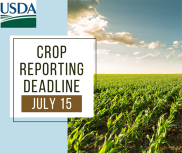
After spring planting is complete, agricultural producers should make an appointment with the Name County Farm Service Agency (FSA) to complete crop acreage reports before the applicable deadline.
How to File a Report
A crop acreage report documents a crop grown on a farm or ranch, its intended use and location. Producers should file an accurate crop acreage report for all crops and land uses, including failed acreage and prevented planted acreage before the applicable deadline.
The following acreage reporting dates are applicable in Adams County:
-
July 15: Corn, soybeans, hay, pasture,
grain sorghum, CRP/CREP, hemp etc.
-
August 15: Beans, cabbage
To file a crop acreage report, producers need to provide:
- Crop and crop type or variety
- Intended crop use
- Number of crop acres
- Map with approximate crop boundaries
- Planting date(s)
- Planting pattern, when applicable
- Producer share(s)
- Irrigation practice(s)
- Acreage prevented from planting, when applicable
- Other required information
Acreage Reporting Details
The following exceptions apply to acreage reporting dates:
- If the crop has not been planted by the acreage reporting deadline, then the acreage must be reported no later than 15 calendar days after planting is completed.
- If a producer acquires additional acreage after the acreage reporting deadline, then the acreage must be reported no later than 30 calendar days after purchase or acquiring the lease. Appropriate documentation must be provided to the county office.
Noninsured Crop Disaster Assistance Program (NAP) policy holders should note that the acreage reporting date for NAP-covered crops is the acreage reporting date or 15 calendar days before grazing or crop harvesting begins, whichever is earlier.
Producers with perennial forage crops should check with their local FSA office to see if their crops are eligible for continuous certification, which rolls the certified acreage forward each year until a change is made.
Call your local Adams County FSA office at 717-334-4216 x 2 and make your appointment today.
|
Top of page
Prevented Planting Deadline Extended for 2025 Spring Seeded Crops
The U.S. Department of Agriculture’s Farm Service Agency (FSA) is extending the prevented planting crop reporting deadline for producers affected by spring flooding, excessive moisture, or qualifying drought.
Producers who intended to plant this spring, but were unable due to weather conditions, now have until the acreage reporting deadline for the applicable crop being claimed as prevented planting. July 15 is a major deadline for most crops, but acreage reporting deadlines vary by county and by crop.
Producers need to report prevented planting acres to retain eligibility for FSA program benefits. Normally, the prevented planting reporting deadline is 15 calendar days after the final planting date for a crop as established by FSA and the Risk Management Agency (RMA). The prevented planting reporting deadline extension only applies to FSA and does not change any RMA crop insurance reporting deadline requirements.
The extension does not apply to crops covered by FSA’s Noninsured Crop Disaster Assistance Program (NAP). Producers should check with their local FSA office regarding prevented planting provisions for NAP-covered crops.
Producers are encouraged to contact their local FSA office as soon as possible to make an appointment to report prevented planting acres and submit their spring crop acreage report. To locate your local FSA office, visit farmers.gov/service-locator.
|
The U.S. Department of Agriculture (USDA) Farm Service Agency (FSA) is now accepting nominations for county committee members and encourages all farmers, ranchers, and FSA program participants to take part in the Name County Committee election nomination process.
Elections will occur in certain Local Administrative Areas (LAA) for members. LAAs are elective areas for FSA committees in a single county or multi-county jurisdiction. For Adams County, elections will take place in LAA 2, which consists of Butler, Franklin, Huntington, Latimore, Menallen and Tyrone townships. Customers can identify which LAA they or their farming or ranching operation is in by using our GIS locator tool available at fsa.usda.gov/elections.
County committee members make important decisions about how Federal farm programs are administered locally. All nomination forms for the 2025 election must be postmarked or received in the local FSA office by Aug. 1, 2025.
Agricultural producers who participate or cooperate in a USDA program and reside in the LAA that is up for election this year, may be nominated for candidacy for the county committee. A cooperating producer is someone who has provided information about their farming or ranching operation to FSA, even if they have not applied or received program benefits.
Individuals may nominate themselves or others and qualifying organizations may also nominate candidates. USDA encourages minority producers, women, and beginning farmers or ranchers to nominate, vote and hold office.
Nationwide, more than 7,700 dedicated members of the agricultural community serve on FSA county committees. The committees are made up of 3 to 11 members who serve three-year terms. Committee members are vital to how FSA carries out disaster programs, as well as conservation, commodity and price support programs, county office employment and other agricultural issues.
For more information on FSA county committee elections, including fact sheets, nomination forms and FAQs, visit fsa.usda.gov/elections.
Top of page
The U.S. Department of Agriculture’s (USDA) updates to the Farm Service Agency’s (FSA) Farm Loan Programs are officially in effect. These changes, part of the Enhancing Program Access and Delivery for Farm Loans rule, are designed to increase financial flexibility for agricultural producers, allowing them to grow their operations, boost profitability, and build long-term savings.
These program updates reflect USDA’s ongoing commitment to supporting the financial success and resilience of farmers and ranchers nationwide, offering critical tools to help borrowers manage their finances more effectively.
What the new rules mean for you:
- Low-interest installment set-aside program: Financially distressed borrowers can now defer up to one annual loan payment at a reduced interest rate. This simplified option helps ease financial pressure while keeping farming operations running smoothly.
- Flexible repayment terms: New repayment options give borrowers the ability to increase their cash flow and build working capital reserves, allowing for long-term financial planning that includes saving for retirement, education, and other future needs.
- Reduced collateral requirements: FSA has lowered the amount of additional loan security needed for direct farm loans, making it easier for borrowers to leverage their existing equity without putting their personal residence at risk.
These new rules provide more financial freedom to borrowers. By giving farmers and ranchers better tools to manage their operations, we’re helping them build long-term financial stability. It’s all about making sure they can keep their land, grow their business, and invest in the future.
If you’re an FSA borrower or considering applying for a loan, now is the time to take advantage of these new policies. We encourage you to reach out to your local FSA farm loan staff to ensure you fully understand the wide range of loan making and servicing options available to assist with starting, expanding, or maintaining your agricultural operation.
To conduct business with FSA, please contact your local USDA Service Center.
Top of page
Adams USDA Service Center
670 Old Harrisburg Road
Suite 203
Gettysburg, PA 17202
Phone: 717-334-4216
Fax: 855-778-8843
|
| |
|
FSA County Executive Director
Callihan Dice, 717-549-4661 callihan.dice@usda.gov
FSA Farm Loan Manager
Diane Drabish, 717-549-4665 diane.drabish@usda.gov
|
NRCS District Conservationist
Lindsey Bream, 717-549-4672 lindsey.bream@usda.gov
NRCS Supervisory District Conservationist
Eric Samus, 717-894-3001
eric.samus@usda.gov
|
USDA Service Center Hours
8:00 am - 4:30 pm, Monday - Friday |
|






