
West Virginia Farm Service Agency Monthly Newsletter - July 2, 2025
In This Issue:
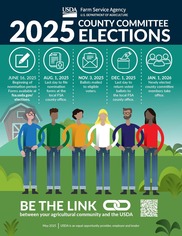
The U.S. Department of Agriculture (USDA) Farm Service Agency (FSA) is now accepting nominations for county committee members and encourages all farmers, ranchers, and FSA program participants to take part in the County Committee election nomination process.
Elections will occur in certain Local Administrative Areas (LAA) for members. LAAs are elective areas for FSA committees in a single county or multi-county jurisdiction. Customers can identify which LAA they or their farming or ranching operation is in by using our GIS locator tool available at fsa.usda.gov/elections.
County committee members make important decisions about how Federal farm programs are administered locally. All nomination forms for the 2025 election must be postmarked or received in the local FSA office by Aug. 1, 2025.
Agricultural producers who participate or cooperate in a USDA program and reside in the LAA that is up for election this year, may be nominated for candidacy for the county committee. A cooperating producer is someone who has provided information about their farming or ranching operation to FSA, even if they have not applied or received program benefits.
Individuals may nominate themselves or others and qualifying organizations may also nominate candidates. USDA encourages minority producers, women, and beginning farmers or ranchers to nominate, vote and hold office.
Nationwide, more than 7,700 dedicated members of the agricultural community serve on FSA county committees. The committees are made up of 3 to 11 members who serve three-year terms. Committee members are vital to how FSA carries out disaster programs, as well as conservation, commodity and price support programs, county office employment and other agricultural issues.
For more information on FSA county committee elections, including fact sheets, nomination forms and FAQs, visit fsa.usda.gov/elections.
|
Top of page
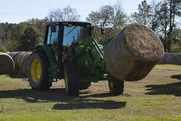
The Farm Service Agency’s (FSA) Noninsured Crop Disaster Assistance Program (NAP) provides financial assistance to producers of non-insurable crops, including mechanically harvested forage with NAP coverage, to protect against natural disasters that occur during the coverage, resulting in loss of production, loss of value, or prevented planting of an eligible crop.
If you have NAP coverage on mechanically harvested forage, you must:
- Maintain separate production records for each unit, crop, practice, crop type, and intended use.
- Submit production records to FSA by the designated production reporting date for the crop.
- Notify your FSA administrative county office before grazing, abandoning, or destroying forage acreage reported, on FSA form FSA-578, as intended to be mechanically harvested; and request an appraisal.
- Notify your FSA administrative county office of a loss and timely file CCC-576, Notice of Loss and Application for Payment, Part B, the earlier of:
- 15 calendar days after the disaster occurs, or damage first becomes apparent.
- 15 calendar days after the crop’s normal harvest date.
- If you change your intended use or experience a loss during the coverage period, you must:
- Establish and maintain representative sample areas when an appraisal of the acreage is required.
- Inform your FSA administrative county office of the location of representative sample areas within 15 days of placing the panels.
- Request an appraisal of the representative sample areas at the end of harvest period but before first freeze.
For more information on NAP and NAP compliance requirements you must follow to retain NAP coverage, contact your local USDA service center.
|
The Farm Service Agency’s (FSA) Farm Storage Facility Loan (FSFL) program provides low-interest financing to help you build or upgrade storage facilities and to purchase portable (new or used) structures, equipment and storage and handling trucks.
Eligible commodities include corn, grain sorghum, rice, soybeans, oats, peanuts, wheat, barley, minor oilseeds harvested as whole grain, pulse crops (lentils, chickpeas and dry peas), hay, honey, renewable biomass, fruits, nuts and vegetables for cold storage facilities, controlled atmosphere storage, floriculture, hops, malted small grains, maple sap, maple syrup, rye, milk, cheese, butter, yogurt, meat and poultry (unprocessed), eggs, and aquaculture (excluding systems that maintain live animals through uptake and discharge of water). Qualified facilities include grain bins, hay barns and cold storage facilities for eligible commodities.
Loans up to $50,000 can be secured by a promissory note/security agreement, loans between $50,000 and $100,000 may require additional security, and loans exceeding $100,000 require additional security.
You do not need to demonstrate the lack of commercial credit availability to apply. The loans are designed to assist a diverse range of farming operations, including small and mid-sized businesses, new farmers, operations supplying local food and farmers markets, non-traditional farm products, and underserved producers.
For more information, contact your local County USDA Service Center or visit fsa.usda.gov/pricesupport.
Top of page
 |
|
In this Ask the Expert, Jack Carlile, Farm Loan Manager for the USDA Farm Service Agency (FSA), answers questions about farm operating loans and when producers should apply in order to secure funds for the current crop year.
As the Farm Loan Manager for the Cherokee County Service Center, Jack is responsible for managing the loan making and loan servicing activities for five counties in northeast Oklahoma. His office provides services for over 650 farm loan customers. Jack was raised on a cross bred cow/calf operation that his grandparents started. Over the years, each generation has added to the operation by purchasing additional pasture. The operation also grows and bales their own hay. Jack’s agriculture background and degree in agriculture economics from Oklahoma State University help him better understand the financing needs of his producers.
Who can apply for FSA Farm Loans?
Anyone can apply for FSA’s loan programs. Applications will be considered on basic eligibility requirements. To apply for a loan, you must meet the following general eligibility requirements including:
- Be a U.S. citizen or qualified alien.
- Operator of a family farm or ranch.
- Have a satisfactory credit history.
- Unable to obtain credit elsewhere at reasonable rates and terms to meet actual needs.
- Not be delinquent on any federal debts.
To read the full blog visit farmers.gov/blog/ask-the-expert-farm-operating-loan-qa-with-jack-carlile.
|
Top of page
West Virginia Farm Service Agency
1550 Earl L Core Road
Morgantown, WV 26505
Phone: 304-284-4800
Service Center Locator
Deputy State Executive Director - Joshua Lewis
|
|






