
TN State Newsletter - June 30, 2025
In This Issue:
If you’re a new farmer or rancher, can help you get started or grow your operation through a variety of programs and services, from farm loans to crop insurance, and conservation programs to disaster assistance. We offer dedicated help to beginning farmers and ranchers. USDA considers anyone who has operated a farm or ranch for less than ten years to be a beginning farmer or rancher.
The first step is to find your local USDA Service Center by visiting farmers.gov/service-center-locator. Call your local Farm Service Agency (FSA) office to make an appointment to establish a farm number. You can establish a farm number for any land being used for agricultural purposes that is over 0.01 acre.
You’ll need to bring the following to your appointment:
- Proof of identify (driver’s license, social security card, IRS Employer Identification Number (EIN))
- Proof of Ownership (copy of recorded deed or recorded land contract)
- Lease agreements
- Entity Identification Status (articles of incorporation, trust and estate documents, or partnership agreement)
FSA staff will work with you one-on-one to review your documents and register your farm with FSA. Registering your farm allows you to apply for FSA and other USDA programs.
After your farm is registered, you can meet with FSA and Natural Resources Conservation Service (NRCS) staff to discuss your business and conservation goals. FSA and NRCS staff can help you determine program eligibility and walk you through the application process.
Depending on your operation, you may want to consider crop insurance. The USDA’s Risk Management Agency provides crop insurance to help you manage risks on your farm. There are many types of insurance products available for a wide variety of production practices, including organic and sustainable agriculture.
More Information
Applying for FSA Guaranteed Loans
FSA guaranteed loans allow lenders to provide agricultural credit to farmers who do not meet the lender's normal underwriting criteria. Farmers and ranchers apply for a guaranteed loan through a lender, and the lender arranges for the guarantee. FSA can guarantee up to 95 percent of the loss of principal and interest on a loan. Guaranteed loans can be used for both farm ownership and operating purposes.
Guaranteed farm ownership loans can be used to purchase farmland, construct or repair buildings, develop farmland to promote soil and water conservation or to refinance debt.
Guaranteed operating loans can be used to purchase livestock, farm equipment, feed, seed, fuel, farm chemicals, insurance and other operating expenses.
FSA can guarantee farm ownership and operating loans up to $2,251,000. Repayment terms vary depending on the type of loan, collateral and the producer's ability to repay the loan. Operating loans are normally repaid within seven years and farm ownership loans are not to exceed 40 years.
For more information on guaranteed loans, contact your local County USDA Service Center or visit fsa.usda.gov.
|
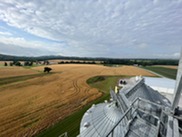
USDA’s Farm Service Agency (FSA) celebrated 25 years of the agency’s popular Farm Storage Facility Loan Program (FSFL) this May. For a quarter century, family-owned agricultural operations have received low-interest financing through the program to enhance or expand their operations and manage marketing of the commodities they produce by building or upgrading permanent and portable storage facilities and purchasing needed handling equipment.
The FSFL program was created in May 2000 to address existing on-farm grain storage needs. Since the program’s inception, more than 40,000 loans have been issued for on-farm storage, increasing storage capacity by one billion bushels. While many producers primarily associate the program with grain storage, over the past 25 years the eligible storage has expanded to include a wide variety of facilities and related equipment - new or used and permanent or portable - including hay barns, bulk tanks, and facilities for cold storage. Drying, handling and storage equipment is also eligible, including skid steers and storage and handling trucks.
Eligibility
Eligible commodities for storage loans include grains, oilseeds, peanuts, pulse crops, hay, hemp, honey, renewable biomass commodities, fruits and vegetables, floriculture, hops, seed cotton, wool, maple sap, maple syrup, milk, cheese, yogurt, butter, eggs, unprocessed meat and poultry, rye and aquaculture. Most recently, controlled atmosphere storage was added as an eligible facility and bison meat has been also added to the list of eligible commodities.
FSFL is an excellent financing program to address on-farm storage and handling needs for small and mid-sized farms, and for new farmers. Loan terms vary from three to 12 years. The maximum loan amount for storage facilities is $500,000. The maximum loan amount for storage and handling trucks is $100,000.
In 2016, FSA introduced a new storage loan category, the microloan, for loans with an aggregate balance up to $50,000. Microloans offer a 5% down payment requirement, compared to a 15% down payment for a regular FSFL, and microloans waive the regular three-year production history requirement.
How to apply
Loan applications should be filed in the administrative FSA county office that maintains a producer’s farm records. Producers can contact their FSA County Office to make an appointment. Beginning farmers who haven’t worked with FSA can visit farmers.gov/your-business/beginning-farmers for more information or view the New Farmers Fact Sheet.
For more information, visit the FSFL webpage, view the fact sheet and our Ask the Expert Blog, or contact your FSA County Office.
|
On April 27, 1935, Congress established the Soil Conservation Service, which would later become the Natural Resources Conservation Service (NRCS), as a permanent agency in the U.S. Department of Agriculture. For 90 years, NRCS has helped farmers, ranchers and forestland owners make critical investments in their operations and local communities to keep working lands working and boost agricultural production, while at the same time improving the quality of our air, water, soil, and wildlife habitats.
See our compilation of videos, stories and resources here.
When changes in farm ownership or operation take place, a farm reconstitution is necessary. The reconstitution — or recon — is the process of combining or dividing farms or tracts of land based on the farming operation.
To be effective for the current fiscal year, farm combinations and farm divisions must be requested by August 1 of the fiscal year for farms subject to the Agriculture Risk Coverage (ARC) and Price Loss Coverage (PLC) program. A reconstitution is considered to be requested when all of the required signatures are on FSA-155 and all other applicable documentation, such as proof of ownership, is submitted.
Total Conservation Reserve Program (CRP) and non-ARC/PLC farms may be reconstituted at any time.
The following are the different methods used when doing a farm recon:
-
Estate Method — the division of bases, allotments and quotas for a parent farm among heirs in settling an estate
-
Designation of Landowner Method — may be used when (1) part of a farm is sold or ownership is transferred; (2) an entire farm is sold to two or more persons; (3) farm ownership is transferred to two or more persons; (4) part of a tract is sold or ownership is transferred; (5) a tract is sold to two or more persons; or (6) tract ownership is transferred to two or more persons. In order to use this method, the land sold must have been owned for at least three years, or a waiver granted, and the buyer and seller must sign a Memorandum of Understanding
-
DCP Cropland Method — the division of bases in the same proportion that the DCP cropland for each resulting tract relates to the DCP cropland on the parent tract
-
Default Method — the division of bases for a parent farm with each tract maintaining the bases attributed to the tract level when the reconstitution is initiated in the system.
For questions on your farm reconstitution, contact your local County USDA Service Center.
|

The U.S. Department of Agriculture’s Farm Service Agency (FSA) is extending the prevented planting crop reporting deadline for producers affected by spring flooding, excessive moisture, or qualifying drought.
Producers who intended to plant this spring, but were unable due to weather conditions, now have until the acreage reporting deadline for the applicable crop being claimed as prevented planting. July 15 is a major deadline for most crops, but acreage reporting deadlines vary by county and by crop.
Producers need to report prevented planting acres to retain eligibility for FSA program benefits. Normally, the prevented planting reporting deadline is 15 calendar days after the final planting date for a crop as established by FSA and the Risk Management Agency (RMA). The prevented planting reporting deadline extension only applies to FSA and does not change any RMA crop insurance reporting deadline requirements.
The extension does not apply to crops covered by FSA’s Noninsured Crop Disaster Assistance Program (NAP). Producers should check with their local FSA office regarding prevented planting provisions for NAP-covered crops.
Producers are encouraged to contact their local FSA office as soon as possible to make an appointment to report prevented planting acres and submit their spring crop acreage report. To locate your local FSA office, visit farmers.gov/service-locator.
|
Top of page
|






