
East Otter Tail County, MN USDA Service Center Bulletin - June 10, 2025
In This Issue:

June is Dairy Month! Raise a glass of milk to all the dedicated dairy farmers across the US who work hard every day to sustainably produce milk that is full of 13 essential nutrients. From cheese to ice cream to yogurt to butter or just a nice cold glass of milk, there are so many ways to celebrate dairy this month and every month! Thank you for all you do.
Acreage Reporting – NOW IS THE TIME TO REPORT YOUR 2025 PLANTED CROP AND CRP ACRES. In order to maintain program eligibility and benefits, you must timely file your acreage reports each year by July 15th. Your acreage reporting maps are available to be picked up at any time. Please have your maps filled out and turned in as soon as you finish planting. This allows the county office time to load the maps in the system and provide you with the FSA-578 for signature by the deadline. Remember, the certification process is not done until you have signed and returned the FSA-578 form. Avoid the rush, stop in soon!
Conservation Programs – Are there areas of your fields that are environmentally sensitive or provide issues? These areas you may want to consider enrolling in CRP which could help both the condition of the land and your farm profitability. A practice established under the 2018 Farm Bill is CP43 Prairie Strips which could be used on perimeter of fields to replace conservation issues with headlands, irrigation corners, and salinity areas on cropland. Land that is not currently enrolled in CRP or expiring CRP may be offered for enrollment during Continuous CRP signup 63. The first batching period ended on June 6, 2025, but continue to submit offers for Continuous CRP for potential future batching periods through July 31, 2025.
CRP – Primary Nesting Season: The CRP primary nesting season begins June 1st and runs through August 1st – Required CRP management and maintenance activities may not be conducted during this timeframe. CRP Participants must refrain from mowing or spraying unless you have contacted FSA to receive permission to control weeds or rodents by spot spraying or spot mowing. We would also advise contract holders to take some time and explore your CRP acreage throughout the year to ensure you do not have volunteer trees or noxious weeds. It is a CRP participant’s responsibility to maintain their CRP practice and failure to do so could result in penalties of noncompliance up to and including contract termination.
CRP Participants - CRP establishment activities must be completed by the deadline specified in your approved conservation plan and FSA-848. Now is a great time to start planning and scheduling establishment activities for the year. Practice establishment that is not completed timely could be determined to be a violation of the CRP Contract terms and conditions as outlined in the CRP-1 appendix. In very limited circumstances an extension of time may be allowed to complete required establishment activities however, you must make a request in writing to the FSA CED/COC. Please remember to keep track of those required activities completed for potential cost-share purposes and inspections. Please call the office if you have any questions or concerns about completing these scheduled actions by the deadline specified in your approved plan and FSA-848.
Emergency Commodity Assistance Program (ECAP) – Signup for ECAP started on March 19th and ends on August 15, 2025. Your application will be prepopulated based on your 2024 crop acreage certification based on your share of the eligible crop. The eligible acres include planted acres plus 50% of prevented plant acres. Payments are based on 85% of the payment rate. If additional funds are available after the signup period ends, a second payment for remaining funds may be issued. Late filed certification options are available for those who did not certify their eligible 2024 crops. Please contact our office for options. See the article below for additional details. Producers are welcome to come to the office to sign, request the application be sent out for signature, or can visit fsa.usda.gov/ecap to apply using a login.gov account. The turn-around has been quick and payments have been going out. ECAP Fact Sheet.
Farm Records & Other Changes – If you are making any changes to your farming operation (land sold/purchased, renting new land, or dropping leased land) please notify FSA immediately after these changes occur. Updating your records now will save you time when signing up for ARCPLC, reporting your acres, and ensuring maps are ready. FSA is not notified by the County Recorder’s Office of these sales. In addition, notify FSA if your bank account has changed.
Livestock Reminder – A reminder for all livestock producers to keep records throughout the year. It becomes essential to have inventory and loss records when applying for our Livestock Indemnity Program (LIP) due to eligible adverse weather events. LIP provides disaster assistance to livestock owners who experience livestock deaths, in excess of normal mortality, caused by eligible events for calendar year 2025.
Timely Report Ownership and Operator Changes – Producers who are buying, selling, or renting different land must notify the County Office as soon as possible after the transaction. Please provide a copy of the recorded deed for any purchased land. FSA is not notified by the County Recorder's Office of these sales. Also, if you will be renting new land, we will need a copy of the lease before we can add you to the farm and/or give you information about the farm, such as maps, base acres, yields, etc. Updating records now will save you time later. If you have changed banks or bank account, please provide FSA with your updated account information as to not miss out on future payments.
Farm Loan Program (FLP) Update: The Credit Team that works with our farm loan programs (annual operating and farm ownership loans) encourages everyone that may need assistance from the FSA office to apply sooner rather than later. The Credit Team members, which service East Otter Tail, can be reached at the USDA Service Center in Detroit Lakes at 218-847-9392 or Fergus Falls at 218-739-4694.
Farm Storage Facility Loan: Did you know FSA’s Farm Storage Facility Loan Program (FSFL) can help you with your storage and handling needs? During harvest, were you thinking that you really could use a truck, grain cart, sugar beet cart, auger, or another piece of equipment to meet your handling needs? Do you need additional storage? Are interest rates at your local lender holding you back from making that purchase? Then why don’t you give our FSFL program a chance to help you:
- Acquire new or used storage and handling trucks;
- Acquire portable or permanently affixed storage and handling equipment;
- Acquire new or used storage bins.
A variety of structures, handling equipment, and trucks are eligible under this loan, including new and used - dryers, augers, trucks, grain trailers (hopper, live bottom, end dump), including semi tractors, baggers, bale wrappers, grain carts, sugar beet carts, forklifts and skid steers, bulk tanks, propane tanks, hay barns, facilities for cold storage, storage, drying, & handling facilities, and many more options available.
A producer may borrow up to $500,000 per loan, with a minimum down payment of 15 percent. Loan terms range from 3 to 12 years, depending on the amount of the loan with favorable interest rates (4.375 - 4.75%) currently. Producers must demonstrate storage needs based on three years of production history for storage facilities. FSA also provides a microloan option that, while available to all eligible farmers and ranchers, also should be of particular interest to new or small producers where there is a need for financing options for loans up to $50,000 at a lower down payment with reduced documentation. Applicants for all loans will be charged a nonrefundable $100 application fee. If there is construction required, which would include ground disturbance such as site preparation, an environmental review must be completed before actions are approved. Contact your local FSA office early in your planning process to determine what level of environmental review is required for your program application so that it can be completed timely.
As Always - Stay Safe and Healthy! - Julie
|
Important Dates and Deadlines
June 15 - FSA County Committee nomination period begins
June 19 – USDA Service Center closed in observance of Juneteenth holiday
July 4 – USDA Service Center closed in observance of Independence Day
July 15 – Deadline to report and certify 2025 acres including pasture and CRP
July 31 – Deadline to submit offer for enrollment in Continuous CRP
August 1 – FSA County Committee nomination deadline
August 15 – Deadline to signup through the Emergency Commodity Assistance Program (ECAP)
June 2025 Interest Rates
Farm Loan Program
5.000% - Farm Operating Loans, Direct
5.750% - Farm Ownership Loans, Direct
3.750% - Farm Ownership, Joint Financing
1.750% - Farm Ownership Loans, Beginning Farmer Down Payment
Farm Storage Facility Loan Program
3.875% - Farm Storage Facility Loans, 3-Year
4.000% - Farm Storage Facility Loans, 5-Year
4.125% - Farm Storage Facility Loans, 7-Year
4.375% - Farm Storage Facility Loans, 10-Year
4.500% - Farm Storage Facility Loans, 12-Year
Keep Connected with FSA: With all of the existing programs and new programs becoming available to assist you, I don’t want you to miss out on any of these deadlines. I highly encourage you to sign up for our text message alerts. FSA provides text message alerts (no more than 2 per month) for important reminders and deadlines. Don’t miss out on getting these reminders.
Let’s get you signed up right now!
Take out your phone,
send a message to 372-669 with MNEastOtterTail in the box of the text,
and hit send.
If you did these 3 easy steps you are signed up to receive text alerts. Thanks for doing this and you will receive quick reminders of important deadlines.

The U.S. Department of Agriculture (USDA) Farm Service Agency (FSA) will open nominations for county committee members on June 16, 2025, and encourages all farmers, ranchers, and FSA program participants to take part in the East Otter Tail County Committee election nomination process.
Elections will occur in certain Local Administrative Areas (LAA) for members. LAAs are elective areas for FSA committees in a single county or multi-county jurisdiction.
For East Otter Tail County, elections will take place in LAA #3, which consists of Girard, Henning, Inman, Oak Valley, Folden, Elmo, Woodside, Parkers Prairie and Eastern townships.
Customers can identify which LAA they or their farming or ranching operation is in by using our GIS locator tool available at fsa.usda.gov/elections.
County committee members make important decisions about how Federal farm programs are administered locally. All nomination forms for the 2025 election must be postmarked or received in the local FSA office by August 1, 2025.
Agricultural producers who participate or cooperate in a USDA program and reside in the LAA that is up for election this year, may be nominated for candidacy for the county committee. A cooperating producer is someone who has provided information about their farming or ranching operation to FSA, even if they have not applied or received program benefits.
Individuals may nominate themselves or others and qualifying organizations may also nominate candidates. USDA encourages minority producers, women, and beginning farmers or ranchers to nominate, vote and hold office.
Nationwide, more than 7,700 dedicated members of the agricultural community serve on FSA county committees. The committees are made up of 3 to 11 members who serve three-year terms. Committee members are vital to how FSA carries out disaster programs, as well as conservation, commodity and price support programs, county office employment and other agricultural issues.
For more information on FSA county committee elections, including fact sheets, nomination forms and FAQs, visit fsa.usda.gov/elections
|
Top of page
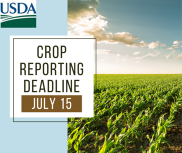
You have a lot at stake in making sure your crop insurance acreage reporting is accurate and on time. If you fail to report on time, you may not be protected. If you report too much acreage, you may pay too much premium. If you report too little acreage, you may recover less when you file a claim.
Crop insurance agents often say that mistakes in acreage reporting are the easiest way for producers to have an unsatisfactory experience with crop insurance. Don’t depend on your agent to do this important job for you. Your signature on the bottom of the acreage reporting form makes it, legally, your responsibility. Double-check it for yourself.
Remember - acreage reporting is your responsibility. Doing it right will save you money. Always get a copy of your report immediately after signing and filing it with your agent and keep it with your records. Remember, it is your responsibility to report crop damage to your agent within 72 hours of discovery. Never put damaged acreage to another use without prior written consent of the insurance adjuster. You don’t want to destroy any evidence of a possible claim. Learn more by visiting RMA’s website
|
Cover crops are planted because of their excellent benefits, including improving the health and function of soil. This leads to better nutrient cycling, improved water infiltration and more consistent yields over time. Cover crops also suppress weeds, prevent erosion, control diseases and pests as well as help pollinators.
Farmers not familiar with how mixtures of cover crops work together might ask, “Why would I want to plant a cover crop that uses up all my water?” But using diverse annual cropping rotations and cover crop combinations increases soil organic matter. And for each 1 percent in organic matter, there is a 25 percent increase in water holding capacity and up to 30 pounds an acre more of available nitrogen.
While cover crops use some water in the soil profile to grow, they simultaneously improve the soil structure by building soil aggregates, providing armor for the soil surface, and recharging the water in the soil profile though increased infiltration.
Common cover crops in Minnesota for single species it is common to have oats, annual rye, or winter cereal rye. For multi-species it is common to see oats, radish, turnip mixes and/or winter cereal rye, radish, turnip mixes.
For more information, contact the East Otter Tail County USDA Service Center at 218-346-4260 or visit nrcs.usda.gov. You can also watch this NRCS video on cover crops.
Top of page

USDA’s Farm Service Agency (FSA) celebrated 25 years of the agency’s popular Farm Storage Facility Loan Program (FSFL) this May. For a quarter century, family-owned agricultural operations have received low-interest financing through the program to enhance or expand their operations and manage marketing of the commodities they produce by building or upgrading permanent and portable storage facilities and purchasing needed handling equipment.
The FSFL program was created in May 2000 to address existing on-farm grain storage needs. Since the program’s inception, more than 40,000 loans have been issued for on-farm storage, increasing storage capacity by one billion bushels. While many producers primarily associate the program with grain storage, over the past 25 years the eligible storage has expanded to include a wide variety of facilities and related equipment - new or used and permanent or portable - including hay barns, bulk tanks, and facilities for cold storage. Drying, handling and storage equipment is also eligible, including skid steers and storage and handling trucks.
Eligibility
Eligible commodities for storage loans include grains, oilseeds, peanuts, pulse crops, hay, hemp, honey, renewable biomass commodities, fruits and vegetables, floriculture, hops, seed cotton, wool, maple sap, maple syrup, milk, cheese, yogurt, butter, eggs, unprocessed meat and poultry, rye and aquaculture. Most recently, controlled atmosphere storage was added as an eligible facility and bison meat has been also added to the list of eligible commodities.
FSFL is an excellent financing program to address on-farm storage and handling needs for small and mid-sized farms, and for new farmers. Loan terms vary from three to 12 years. The maximum loan amount for storage facilities is $500,000.
In 2016, FSA introduced a new storage loan category, the microloan, for loans with an aggregate balance up to $50,000. Microloans offer a 5% down payment requirement, compared to a 15% down payment for a regular FSFL, and microloans waive the regular three-year production history requirement.
How to apply
Loan applications should be filed in the administrative FSA county office that maintains a producer’s farm records. Producers can contact their FSA County Office to make an appointment. Beginning farmers who haven’t worked with FSA can visit farmers.gov/your-business/beginning-farmers for more information or view the New Farmers Fact Sheet.
For more information, visit the FSFL webpage, view the fact sheet and our Ask the Expert Blog, or contact your FSA County Office.
|
The U.S. Department of Agriculture’s (USDA) updates to the Farm Service Agency’s (FSA) Farm Loan Programs are officially in effect. These changes, part of the Enhancing Program Access and Delivery for Farm Loans rule, are designed to increase financial flexibility for agricultural producers, allowing them to grow their operations, boost profitability, and build long-term savings.
These program updates reflect USDA’s ongoing commitment to supporting the financial success and resilience of farmers and ranchers nationwide, offering critical tools to help borrowers manage their finances more effectively. What the new rules mean for you:
- Low-interest installment set-aside program: Financially distressed borrowers can now defer up to one annual loan payment at a reduced interest rate. This simplified option helps ease financial pressure while keeping farming operations running smoothly.
- Flexible repayment terms: New repayment options give borrowers the ability to increase their cash flow and build working capital reserves, allowing for long-term financial planning that includes saving for retirement, education, and other future needs.
- Reduced collateral requirements: FSA has lowered the amount of additional loan security needed for direct farm loans, making it easier for borrowers to leverage their existing equity without putting their personal residence at risk.
These new rules provide more financial freedom to borrowers. By giving farmers and ranchers better tools to manage their operations, we’re helping them build long-term financial stability. It’s all about making sure they can keep their land, grow their business, and invest in the future.
If you’re an FSA borrower or considering applying for a loan, now is the time to take advantage of these new policies. We encourage you to reach out to your local FSA farm loan staff to ensure you fully understand the wide range of loan making and servicing options available to assist with starting, expanding, or maintaining your agricultural operation.
To conduct business with FSA, please contact your local USDA Service Center.
Top of page
|






