
West Virginia Farm Service Agency State Newsletter - June 9, 2025
In This Issue:
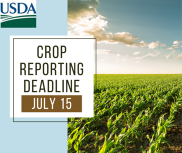
After spring planting is complete, agricultural producers should make an appointment with their local Farm Service Agency (FSA) office to complete crop acreage reports before the applicable deadline.
How to File a Report
A crop acreage report documents a crop grown on a farm or ranch, its intended use and location. Producers should file an accurate crop acreage report for all crops and land uses, including failed acreage and prevented planted acreage before the applicable deadline.
The following acreage reporting dates for West Virginia:
July 15, 2025 CRP/CREP, All other crops
July 31, 2025 Hemp
To file a crop acreage report, producers need to provide:
- Crop and crop type or variety
- Intended crop use
- Number of crop acres
- Map with approximate crop boundaries
- Planting date(s)
- Planting pattern, when applicable
- Producer share(s)
- Irrigation practice(s)
- Acreage prevented from planting, when applicable
- Other required information
Acreage Reporting Details
The following exceptions apply to acreage reporting dates:
- If the crop has not been planted by the acreage reporting deadline, then the acreage must be reported no later than 15 calendar days after planting is completed.
- If a producer acquires additional acreage after the acreage reporting deadline, then the acreage must be reported no later than 30 calendar days after purchase or acquiring the lease. Appropriate documentation must be provided to the county office.
Noninsured Crop Disaster Assistance Program (NAP) policy holders should note that the acreage reporting date for NAP-covered crops is the acreage reporting date or 15 calendar days before grazing or crop harvesting begins, whichever is earlier.
Producers with perennial forage crops should check with their local FSA office to see if their crops are eligible for continuous certification, which rolls the certified acreage forward each year until a change is made.
Prevented Planted Acreage
Producers should also report the crop acreage they intended to plant but were unable to because of a natural disaster, including drought. Prevented planted acreage must be reported on form CCC-576, Notice of Loss, no later than 15 calendar days after the final planting date as established by FSA and USDA’s Risk Management Agency (RMA).
Farmers.gov Portal
Producers can access their FSA farm records, maps, and common land units through the farmers.gov customer portal. The portal allows producers to export field boundaries as shapefiles and import and view other shapefiles, such as precision agriculture boundaries within farm records mapping. Producers can view, print and label their maps for acreage reporting purposes. A login.gov account that is linked to a USDA customer record is required to use the portal.
Producers can visit farmers.gov/account to learn more about creating an account. Producers who have the authority to act on behalf of another customer as a grantee via an FSA-211 Power of Attorney form, Business Partner Signature Authority or as a member of a business with signature authority can now access information for the business in the farmers.gov portal.
Electronic Geospatial Acreage Reporting
Acreage reports using precision agriculture planting boundaries can be filed electronically with an approved insurance provider or an authorized third-party provider, who will then share the file with FSA staff. Producers should notify their local FSA office if they submitted an electronic geospatial acreage report containing precision planting boundaries that they want to use as part of their FSA acreage report.
More Information
For more information, producers should contact their USDA Service Center.
|
Top of page
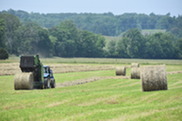
The Farm Service Agency’s (FSA) Noninsured Crop Disaster Assistance Program (NAP) provides financial assistance to producers of non-insurable crops, including mechanically harvested forage with NAP coverage, to protect against natural disasters that occur during the coverage, resulting in loss of production, loss of value, or prevented planting of an eligible crop.
If you have NAP coverage on mechanically harvested forage, you must:
· Maintain separate production records for each unit, crop, practice, crop type, and intended use.
· Submit production records to F
· Notify your FSA administrative county office before grazing, abandoning, or destroying forage acreage reported, on FSA form FSA-578, as intended to be mechanically harvested; and request an appraisal.
· Notify your FSA administrative county office of a loss and timely file CCC-576, Notice of Loss and Application for Payment, Part B, the earlier of:
o 15 calendar days after the disaster occurs, or damage first becomes apparent.
o 15 calendar days after the crop’s normal harvest date.
· If you change your intended use or experience a loss during the coverage period, you must:
o Establish and maintain representative sample areas when an appraisal of the acreage is required.
o Inform your FSA administrative county office of the location of representative sample areas within 15 days of placing the panels.
o Request an appraisal of the representative sample areas at the end of harvest period but before first freeze.
For more information on NAP and NAP compliance requirements you must follow to retain NAP coverage, contact your local USDA Service Center.
|
The U.S. Department of Agriculture’s (USDA) updates to the Farm Service Agency’s (FSA) Farm Loan Programs are officially in effect. These changes, part of the Enhancing Program Access and Delivery for Farm Loans rule, are designed to increase financial flexibility for agricultural producers, allowing them to grow their operations, boost profitability, and build long-term savings.
These program updates reflect USDA’s ongoing commitment to supporting the financial success and resilience of farmers and ranchers nationwide, offering critical tools to help borrowers manage their finances more effectively.
What the new rules mean for you:
· Low-interest installment set-aside program: Financially distressed borrowers can now defer up to one annual loan payment at a reduced interest rate. This simplified option helps ease financial pressure while keeping farming operations running smoothly.
· Flexible repayment terms: New repayment options give borrowers the ability to increase their cash flow and build working capital reserves, allowing for long-term financial planning that includes saving for retirement, education, and other future needs.
· Reduced collateral requirements: FSA has lowered the amount of additional loan security needed for direct farm loans, making it easier for borrowers to leverage their existing equity without putting their personal residence at risk.
These new rules provide more financial freedom to borrowers. By giving farmers and ranchers better tools to manage their operations, we’re helping them build long-term financial stability. It’s all about making sure they can keep their land, grow their business, and invest in the future.
If you’re an FSA borrower or considering applying for a loan, now is the time to take advantage of these new policies. We encourage you to reach out to your local FSA farm loan staff to ensure you fully understand the wide range of loan making and servicing options available to assist with starting, expanding, or maintaining your agricultural operation.
To conduct business with FSA, please contact your local USDA Service Center.
Top of page
 |
|
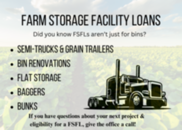
The Farm Service Agency’s (FSA) Farm Storage Facility Loan (FSFL) program provides low-interest financing to help you build or upgrade storage facilities and to purchase portable (new or used) structures, equipment and storage and handling trucks.
Eligible commodities include corn, grain sorghum, rice, soybeans, oats, peanuts, wheat, barley, minor oilseeds harvested as whole grain, pulse crops (lentils, chickpeas and dry peas), hay, honey, renewable biomass, fruits, nuts and vegetables for cold storage facilities, controlled atmosphere storage, floriculture, hops, malted small grains, maple sap, maple syrup, rye, milk, cheese, butter, yogurt, meat and poultry (unprocessed), eggs, and
aquaculture (excluding systems that maintain live animals through uptake and discharge of water). Qualified facilities include grain bins, hay barns and cold storage facilities for eligible commodities.
Loans up to $50,000 can be secured by a promissory note/security agreement, loans between $50,000 and $100,000 may require additional security, and loans exceeding $100,000 require additional security.
You do not need to demonstrate the lack of commercial credit availability to apply. The loans are designed to assist a diverse range of farming operations, including small and mid-sized businesses, new farmers, operations supplying local food and farmers markets, non-traditional farm products, and underserved producers.
For more information, contact your USDA Service Center. or visit fsa.usda.gov/pricesupport.
|
Top of page
West Virginia Farm Service Agency
1550 Earl L Core Road
Morgantown, WV 26505
Phone: 304-284-4800
|
|
Assistant State Executive Director
Joshua S. Lewis
|
| |
|
| |
|






