
Indiana FSA State Newsletter - June 16, 2025
In This Edition of the Indiana FSA State Newsletter:
The U.S. Department of Agriculture (USDA) Farm Service Agency (FSA) opens nominations for county committee members on June 16, 2025 and encourages all farmers, producers, and FSA program participants to take part in the County Committee election nomination process.
Elections will occur in certain Local Administrative Areas (LAA) for members. LAAs are elective areas for FSA committees in a single county or multi-county jurisdiction. Customers can identify which LAA they or their farming or ranching operation is in by using our GIS locator tool available at fsa.usda.gov/elections.
County committee members make important decisions about how Federal farm programs are administered locally. All nomination forms for the 2025 election must be postmarked or received in the local FSA office by Aug. 1, 2025.
Agricultural producers who participate or cooperate in a USDA program and reside in the LAA that is up for election this year, may be nominated for candidacy for the county committee. A cooperating producer is someone who has provided information about their farming or ranching operation to FSA, even if they have not applied or received program benefits.
Individuals may nominate themselves or others and qualifying organizations may also nominate candidates. USDA encourages minority producers, women, and beginning farmers or ranchers to nominate, vote and hold office.
Nationwide, more than 7,700 dedicated members of the agricultural community serve on FSA county committees. The committees are made up of 3 to 11 members who serve three-year terms. Committee members are vital to how FSA carries out disaster programs, as well as conservation, commodity and price support programs, county office employment and other agricultural issues.
For more information on FSA county committee elections, including fact sheets, nomination forms and FAQs, visit fsa.usda.gov/elections.
If you’re enrolled in the Agriculture Risk Coverage (ARC) or Price Loss Coverage (PLC) programs, you must protect all cropland and noncropland acres on the farm from wind and water erosion and noxious weeds. By signing ARC county or individual contracts and PLC contracts, you agree to effectively control noxious weeds on the farm according to sound agricultural practices. If you fail to take necessary actions to correct a maintenance problem on your farm that is enrolled in ARC or PLC, the County Committee may elect to terminate your contract for the program year.
All producers are encouraged to contact their local FSA office for more information on the final planting date for specific crops. The final planting dates vary by crop, planting period and county so please contact your local FSA office for a list of county-specific planting deadlines. The timely planting of a crop, by the final planting date, may prevent loss of program benefits.
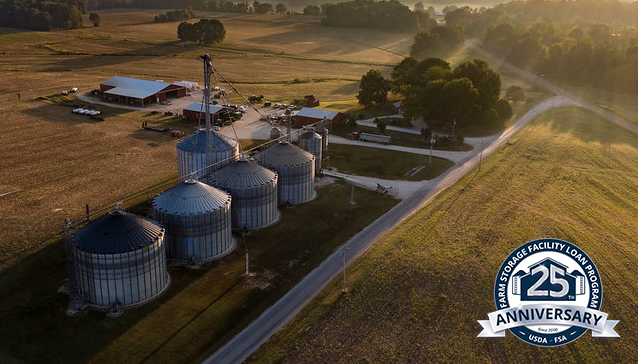 USDA’s Farm Service Agency (FSA) celebrated 25 years of the agency’s popular Farm Storage Facility Loan Program (FSFL) this May. For a quarter century, family-owned agricultural operations have received low-interest financing through the program to enhance or expand their operations and manage marketing of the commodities they produce by building or upgrading permanent and portable storage facilities and purchasing needed handling equipment.
The FSFL program was created in May 2000 to address existing on-farm grain storage needs. Since the program’s inception, more than 40,000 loans have been issued for on-farm storage, increasing storage capacity by one billion bushels. While many producers primarily associate the program with grain storage, over the past 25 years the eligible storage has expanded to include a wide variety of facilities and related equipment - new or used and permanent or portable - including hay barns, bulk tanks, and facilities for cold storage. Drying, handling and storage equipment is also eligible, including skid steers and storage and handling trucks.
Eligibility
Eligible commodities for storage loans include grains, oilseeds, peanuts, pulse crops, hay, hemp, honey, renewable biomass commodities, fruits and vegetables, floriculture, hops, seed cotton, wool, maple sap, maple syrup, milk, cheese, yogurt, butter, eggs, unprocessed meat and poultry, rye and aquaculture. Most recently, controlled atmosphere storage was added as an eligible facility and bison meat has been also added to the list of eligible commodities.
FSFL is an excellent financing program to address on-farm storage and handling needs for small and mid-sized farms, and for new farmers. Loan terms vary from three to 12 years. The maximum loan amount for storage facilities is $500,000. The maximum loan amount for storage and handling trucks is $100,000.
In 2016, FSA introduced a new storage loan category, the microloan, for loans with an aggregate balance up to $50,000. Microloans offer a 5% down payment requirement, compared to a 15% down payment for a regular FSFL, and microloans waive the regular three-year production history requirement.
How to apply
Loan applications should be filed in the administrative FSA county office that maintains a producer’s farm records. Producers can contact their FSA County Office to make an appointment. Beginning farmers who haven’t worked with FSA can visit farmers.gov/your-business/beginning-farmers for more information or view the New Farmers Fact Sheet.
For more information, visit the FSFL webpage, view the fact sheet and our Ask the Expert Blog, or contact your FSA County Office.
USDA’s Natural Resources Conservation Service can help you conserve water and build resilience to drought, through conservation practices that improve irrigation efficiency, boost soil health, and manage grazing lands.
Irrigation Efficiency
USDA helps you improve your irrigation efficiency to ensure each drop of water is used wisely. Saving water on your farm can help during drought and can offset rising water costs; reduce expenditures for energy, chemicals, and labor; and enhance revenues through higher crop yields and improved crop quality. Funded conservation practices include conversion to more efficient irrigation systems, such as micro-irrigation or subsurface drip irrigation, installation of irrigation pipeline, irrigation water management, structures for water control, and flow meters. Tools like drip irrigation, which provides water precisely where and when it’s needed, can achieve greater precision with flow meters and soil moisture sensors.
Soil Health
In addition, soil health conservation practices, such as reduced- or no-till, cover crops, mulching and residue management can help to make your soil, and the plants you grow or animals you raise, healthier. Healthier soil can absorb and retain more water for longer periods of time, making your farm or ranch more resilient to drought. Using soil health practices, you can conserve water by increasing your soil’s water-holding capacity and use conservation tillage to keep the ground covered, reducing water loss through transpiration and evaporation.
And soil health practices increase organic matter, and each pound of organic matter can hold up to 20 pounds of water. Every 1% increase in organic matter results in as much as 25,000 gallons of soil water per acre. Each 1% increase in organic matter can also provide up to 30 pounds of more available nitrogen per acre. That means less money and time spent on inputs like water and fertilizer, which make your operation more profitable.
Rotational/Prescribed Grazing, Water Sources for Livestock
Drought also impacts grazing lands, and NRCS works with you to increase the resilience of your livestock operation. Ranchers can adapt to dry conditions in two main ways: increasing the availability and suitability of forage and ensuring that cattle have an adequate and reliable source of water. For forage, rotational or prescribed grazing (rotating cattle among pastures) can relieve pressure on stressed vegetation and ensure a more consistent supply of forage for animals. NRCS conservationists can also work with you to plant more drought-tolerant forage species, plants best suited to local soils and conditions. For reliable sources of water, NRCS can help you with installing watering facilities, water wells, or water pipeline for livestock. Having available forage and water for livestock can make a big difference in difficult drought conditions.
USDA and NRCS are here for you, helping you recover from drought and prepare for the next one. For more information on drought recovery assistance at farmers.gov/protection-recovery/drought. For more information on conservation practices to make your operation more resilient to drought in future years, go to www.nrcs.usda.gov.
Using the correct signature when doing business with FSA can save time and prevent a delay in program benefits.
The following are FSA signature guidelines:
- Married individuals must sign their given name.
- Example—Mary Doe and John Doe are married. When signing FSA forms, each must use their given name, and may not sign with the name of their spouse. Mrs. Mary Doe may not sign documents as Mrs. John Doe. For Farm Loan Purposes, spouses may not sign on behalf of the other as an authorized signatory, a signature will be needed for each. For a minor, FSA requires the minor's signature and one from the minor’s parent. There are certain exceptions where a minor’s signature may be accepted without obtaining the signature of one of the parents. Despite minority status, a youth executing a promissory note for a Youth Loan will incur full personal liability for the debt and will sign individually.
Note: By signing a document with a minor, the parent is liable for actions of the minor and may be liable for refunds, liquidated damages, or other penalties, etc.
When signing on one’s behalf the signature must agree with the name typed or printed on the form or be a variation that does not cause the name and signature to be in disagreement. Example - John W. Smith is on the form. The signature may be John W. Smith or J.W. Smith or J. Smith. Or Mary J. Smith may be signed as Mrs. Mary Joe Smith, M.J. Smith, Mary Smith, etc.
FAXED signatures will be accepted for certain forms and other documents provided the acceptable program forms are approved for FAXED signatures. Producers are responsible for the successful transmission and receipt of FAXED information.
Examples of documents not approved for FAXED signatures include:
- Promissory note
- Assignment of payment
- Joint payment authorization
- Acknowledgement of commodity certificate purchase
Spouses may sign documents on behalf of each other for FSA and CCC programs in which either spouse has an interest, unless written notification denying a spouse this authority has been provided to the county office.
Spouses cannot sign on behalf of each other as an authorized signatory for partnerships, joint ventures, corporations or other similar entities. Likewise, a spouse cannot sign a document on behalf of the other in order to affirm the eligibility of oneself.
Any member of a general partnership can sign on behalf of the general partnership and bind all members unless the Articles of Partnership are more restrictive. Spouses may sign on behalf of each other’s individual interest in a partnership, unless notification denying a spouse that authority is provided to the county office. Acceptable signatures for general partnerships, joint ventures, corporations, estates, and trusts must consist of an indicator “by” or “for” the individual’s name, individual’s name and capacity, or individual’s name, capacity, and name of entity.
Whether you rent or own your land, a conservation plan is critical to maintain and improve farm productivity. Plans of any kind are important as they set goals and outline how to reach them. Conservation plans are roadmaps for improving your operation while conserving natural resources. They provide proven strategies that landowners can use to solve identified natural resource concerns and take advantage of conservation opportunities.
USDA’s Natural Resources Conservation Service can help you develop a conservation plan. This technical assistance from NRCS is free, and it can help you reduce soil loss from erosion, solve issues with soil, air and water quality, reduce potential damage from excess water and drought, enhance the quality of wildlife habitat, address waste management concerns, and improve the long-term sustainability of the country’s natural resources.
How does conservation planning work? You’ll meet with a planner from NRCS for a science-based evaluation of your problems and opportunities on your land. The NRCS staff member, often a district conservationist or conservation planning technician, then analyzes the findings and recommends the best strategies to address your problems and achieve valuable opportunities.
If you’re interested in conservation planning, contact your County USDA Service Center at or visit nrcs.usda.gov.
The Farm Service Agency (FSA) assists beginning farmers to finance agricultural enterprises. Under these designated farm loan programs, FSA can provide financing to eligible applicants through either direct or guaranteed loans. FSA defines a beginning farmer as a person who:
- Has operated a farm for not more than 10 years
- Will materially and substantially participate in the operation of the farm
- Agrees to participate in a loan assessment, borrower training and financial management program sponsored by FSA
- Does not own a farm in excess of 30 percent of the county’s average size farm.
For more information contact your FSA County Office.
Farm Service Agency (FSA) loans require applicants to have a satisfactory credit history. A credit report is requested for all FSA direct farm loan applicants. These reports are reviewed to verify outstanding debts, see if bills are paid timely and to determine the impact on cash flow.
Information on your credit report is strictly confidential and is used only as an aid in conducting FSA business.
Our farm loan staff will discuss options with you if you have an unfavorable credit report and will provide a copy of your report. If you dispute the accuracy of the information on the credit report, it is up to you to contact the issuing credit report company to resolve any errors or inaccuracies.
There are multiple ways to remedy an unfavorable credit score:
- Make sure to pay bills on time
- Setting up automatic payments or automated reminders can be an effective way to remember payment due dates.
- Pay down existing debt
- Keep your credit card balances low
- Avoid suddenly opening or closing existing credit accounts
FSA’s farm loan staff will guide you through the process, which may require you to reapply for a loan after improving or correcting your credit report.
For more information on FSA farm loan programs, contact your County USDA Service Center at visit fsa.usda.gov.
The Distressed Borrower Set-Aside Program (DBSA) provides certain USDA FSA direct loan borrowers the opportunity to set-aside one loan payment to the end of the loan term if they are unable to make their scheduled installment. DBSA results in the borrower accruing significantly reduced interest and allows them to become current on their loans and continue farming.
When a borrower indicates they are in financial distress, or when they become 90 days past due on an FSA direct loan, they are notified of the availability of the Distressed Borrower Set-Aside Program (DBSA). Payments that are set-aside must be repaid prior to the final maturity of the note, with any principal set-aside accruing interest at a reduced rate of 0.125% until it is repaid or restructured.
Eligibility to receive the DBSA will primarily be determined based on the following criteria:
- The loan receiving the DBSA was outstanding as of September 25, 2024.
- The borrower is unable to pay all family living and farm operating expenses, payments to FSA and other creditors;
- The borrower must have acted in good faith and complied with written agreements with FSA;
- The borrower must not be in nonmonetary default;
- The borrower must be current or not more than 150 days past due on any FSA loan when the DBSA application is completed.
- No loan to be set-aside may have a remaining term of less than two years;
- DBSA cannot be used with a concurrent Primary Loan Servicing action;
- Loans must not be accelerated;
- After the DBSA is completed, the borrower will be current on all FSA loans;
- The amount set aside will not exceed one year’s payment on the FSA loan;
- No loan may have more than one active set-aside at a time; and
- The borrower must be able to develop a positive cash-flow projection for the coming year.
For additional information on the Distressed Borrower Set-Aside Program, or to apply for DBSA, borrowers should contact their USDA FSA Farm Loan official to setup an appointment.
USDA offers disaster assistance and low-interest loan programs to assist you with recovery efforts following recent severe storms. Available programs and loans include:
Disaster Assistance Programs:
-
Livestock Indemnity Program (LIP) - offers payments to eligible producers for livestock death losses in excess of normal mortality due to adverse weather.
-
Tree Assistance Program (TAP) – provides assistance to eligible orchardists and nursery tree growers for qualifying tree, shrub and vine losses due to natural disaster.
-
Emergency Assistance for Livestock, Honeybees, and Farm-Raised Fish Program (ELAP) - provides emergency relief for losses due to feed or water shortages, disease, adverse weather, or other conditions, which are not adequately addressed by other disaster programs.
-
Emergency Loan Program – available to producers with agriculture operations located in a county under a primary or contiguous Secretarial Disaster designation. These low interest loans help producers recover from production and physical losses due to adverse weather. Additionally, FSA has a variety of loan servicing options available for borrowers who are unable to make scheduled payments on their farm loan debt to FSA because of reasons beyond their control.
-
Farm Storage Facility Loans (FSFLs) - provides low-interest financing so producers can build or upgrade facilities to store commodities. Loan terms vary from 3 to 12 years. Contact FSA if you’re in need of on-farm storage.
Risk Management (must have purchased coverage):
-
Non-Insured Crop Disaster Assistance Program (NAP) - provides financial assistance to producers of non-insurable crops when low yields, loss of inventory, or prevented planting occur due to natural disasters including severe storms (includes native grass for grazing).
-
Federal Crop Insurance – producers with federal crop insurance should timely report losses to their crop insurance agent.
Conservation:
-
Emergency Conservation Program (ECP) - provides emergency funding for farmers and ranchers to rehabilitate land severely damaged by natural disasters; includes fence loss.
-
Emergency Forest Restoration Program – provides funding to restore privately owned forests damaged by natural disasters.
-
Environmental Quality Incentives Program (EQIP) – helps producers plan and implement conservation practices on farms, ranches, and working forests impacted by natural disasters.
Assistance for Communities
-
Emergency Watershed Protection (EWP) program - assists local government sponsors with the cost of addressing watershed impairments or hazards such as debris removal and streambank stabilization.
To establish or retain Farm Service Agency (FSA) program eligibility, you must report prevented planting and failed acres (crops and grasses). Prevented planting acreage must be reported on form CCC-576, Notice of Loss, no later than 15 calendar days after the final planting date as established by FSA and Risk Management Agency.
For more information on these programs, producers should contact their County USDA Service Center or visit fsa.usda.gov/disaster.
After spring planting is complete, agricultural producers should make an appointment with their County Farm Service Agency (FSA) to complete crop acreage reports before the applicable deadline.
How to File a Report
A crop acreage report documents a crop grown on a farm or ranch, its intended use and location. Producers should file an accurate crop acreage report for all crops and land uses, including failed acreage and prevented planted acreage before the applicable deadline.
The following acreage reporting dates are applicable in Indiana:
-
June 16, 2025, - Cucumbers planted 5/10-6/15 in Knox County.
-
July 15, 2025, - All others crops, and report CRP. Cucumbers planted 5/10-6/15 in All Other Indiana Counties.
-
August 15, 2025, - Cucumbers planted 6/16-8/5 in Fulton, LaPorte, Porter and St. Joesph Counties.
-
September 15, 2025, - Cucumbers planted 6/1-8/15 in Knox County.
To file a crop acreage report, producers need to provide:
- Crop and crop type or variety
- Intended crop use
- Number of crop acres
- Map with approximate crop boundaries
- Planting date(s)
- Planting pattern, when applicable
- Producer share(s)
- Irrigation practice(s)
- Acreage prevented from planting, when applicable
- Other required information
Acreage Reporting Details
The following exceptions apply to acreage reporting dates:
- If the crop has not been planted by the acreage reporting deadline, then the acreage must be reported no later than 15 calendar days after planting is completed.
- If a producer acquires additional acreage after the acreage reporting deadline, then the acreage must be reported no later than 30 calendar days after purchase or acquiring the lease. Appropriate documentation must be provided to the county office.
Noninsured Crop Disaster Assistance Program (NAP) policy holders should note that the acreage reporting date for NAP-covered crops is the acreage reporting date or 15 calendar days before grazing or crop harvesting begins, whichever is earlier.
Producers with perennial forage crops should check with their local FSA office to see if their crops are eligible for continuous certification, which rolls the certified acreage forward each year until a change is made.
Prevented Planted Acreage
Producers should also report the crop acreage they intended to plant but were unable to because of a natural disaster, including drought. Prevented planted acreage must be reported on form CCC-576, Notice of Loss, no later than 15 calendar days after the final planting date as established by FSA and USDA’s Risk Management Agency (RMA).
Farmers.gov Portal
Producers can access their FSA farm records, maps, and common land units through the farmers.gov customer portal. The portal allows producers to export field boundaries as shapefiles and import and view other shapefiles, such as precision agriculture boundaries within farm records mapping. Producers can view, print and label their maps for acreage reporting purposes. A login.gov account that is linked to a USDA customer record is required to use the portal.
Producers can visit farmers.gov/account to learn more about creating an account. Producers who have the authority to act on behalf of another customer as a grantee via an FSA-211 Power of Attorney form, Business Partner Signature Authority or as a member of a business with signature authority can now access information for the business in the farmers.gov portal.
Electronic Geospatial Acreage Reporting
Acreage reports using precision agriculture planting boundaries can be filed electronically with an approved insurance provider or an authorized third-party provider, who will then share the file with FSA staff. Producers should notify their local FSA office if they submitted an electronic geospatial acreage report containing precision planting boundaries that they want to use as part of their FSA acreage report.
More Information
For more information, producers should contact their Indiana County FSA office.
USDA announced loan interest rates for June 2025, which are effective June 1, 2025. USDA’s FSA loans provide important access to capital to help agricultural producers start or expand their farming operation, purchase equipment and storage structures, or meet cash flow needs.
FSA also offers guaranteed loans through commercial lenders at rates set by those lenders.
Interest rates for Operating and Ownership loans for June 2025 are as follows:
Commodity and Storage Facility Loans
Additionally, FSA provides low-interest financing to producers to build or upgrade on-farm storage facilities and purchase handling equipment and loans that provide interim financing to help producers meet cash flow needs without having to sell their commodities when market prices are low. Funds for these loans are provided through the Commodity Credit Corporation (CCC) and are administered by FSA.
-
Commodity Loans (less than one year disbursed): 5.000%
- Farm Storage Facility Loans:
- Three-year loan terms: 3.875%
- Five-year loan terms: 4.000 %
- Seven-year loan terms: 4.125%
- Ten-year loan terms: 4.375%
- Twelve-year loan terms: 4.500%
Check your eligibility for FSA loans and find the right loans to fit your needs by utilizing the Farm Loan Assistance Tool.
Additionally, FSA provides low-interest financing to producers to build or upgrade on-farm storage facilities and purchase handling equipment and loans that provide interim financing to help producers meet cash flow needs without having to sell their commodities when market prices are low. Funds for these loans are provided through the Commodity Credit Corporation (CCC) and are administered by FSA.
|
June 1
|
Date used to establish ownership interest for person or legal entity for program purposes.
|
|
June 1
|
Date used for the determination of minor child for program purposes.
|
|
June 2
|
NAP Sales Closing Date for Nursery (Ornamental Nursery & Nonornamental Propagation Nursery) for the Crop Year June 1 - May 31.
|
|
June 2
|
Final Date to Obtain Loans or Loan Deficiency Payments (LDP’s) on 2024 Harvested Feed Grains and Soybeans.
|
|
June 6
|
End of 1st Batching period for Continuous SU63.
|
|
June 6
|
Deadline to make offers for General CRP SU64.
|
|
June 16
|
Nominations open for the 2025 County Committee (COC) Election.
|
|
June 16
|
Acreage Reporting Date for Cucumbers (Planted 5/1 to 5/31) in Knox County.
|
|
June 19
|
Offices Closed in Observance of Juneteenth National Independence Day.
|
|
July 4
|
Offices Closed in Observance of Independence Day.
|
|
July 15
|
Final Date to Submit a Prevented Planting Claim for Soybeans.
|
|
July 15
|
Final Date to Submit a Prevented Planting Claim for Corn.
|
|
July 15
|
Final Acreage Reporting Date for All Other Crops & CRP (Including Cucumbers Planted 5/10-6/15 in All Other Indiana Counties).
|
|
July 31
|
Deadline for producers to submit signed offers to FSA for Continuous CRP SU63.
|
Top of Page
|








