
Winnebago County - June 09, 2025
In This Issue:
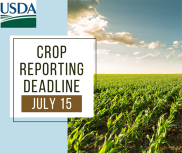
Maps are available at the Winnebago County FSA Office for acreage reporting purposes. If you wish to receive your maps by e-mail, please call our office or email @ iathompson-fsa@usda.gov.
The acreage reporting deadline for corn and soybeans in Winnebago County is July 15, 2025.
In order to maintain program eligibility and benefits, you must file timely acreage reports. Failure to file an acreage report by the crop acreage reporting deadline may cause ineligibility for future program benefits. FSA will not accept acreage reports provided more than a year after the acreage reporting deadline.
Producers are encouraged to file their acreage reports as soon as planting is completed.
|

The U.S. Department of Agriculture announced the release of Congressionally mandated Emergency Livestock Relief Program (ELRP) payments to cover grazing losses due to eligible drought or wildfire events in 2023 and/or 2024.
USDA’s Farm Service Agency (FSA) is leveraging existing Livestock Forage Disaster Program (LFP) data to streamline payment calculations and expedite relief. Emergency relief payments are automatically issued for producers who have an approved LFP application on file for 2023 and/or 2024.
The American Relief Act, 2025, provided funds for emergency relief payments. This program is the first of two programs authorized to assist with eligible losses suffered by livestock producers. FSA will announce additional ELRP assistance for other losses authorized by the Act, including flooding, later this summer.
ELRP Eligibility
ELRP payment eligibility requires livestock producers to have suffered grazing losses in a county rated by the U.S. Drought Monitor as having a D2 (severe drought) for eight consecutive weeks or a D3 (extreme drought) or higher level of drought intensity during 2023, 2024 or both calendar years, and have applied and been approved for LFP.
Additionally, producers whose permitted grazing on federally managed lands was reduced due to wildfire are also eligible for ELRP, if they applied and were approved for LFP in 2023, 2024 or both calendar years.
To streamline and simplify the delivery of ELRP benefits, producers are not required to submit an application for payment; however, they must have the following forms on file with FSA:
• CCC-853, Livestock Forage Disaster Program Application
• Form AD-2047, Customer Data Worksheet.
• Form CCC-902, Farm Operating Plan for an individual or legal entity.
• Form CCC-901, Member Information for Legal Entities (if applicable).
• Form FSA-510, Request for an Exception to the $125,000 Payment Limitation for Certain Programs (if applicable). This form is required to be on file for both 2023 and 2024 to be eligible for the payment limitation exception.
• SF-3881, Direct Deposit.
• AD-1026, Highly Erodible Land Conservation (HELC) and Wetland Conservation (WC) Certification.
Most producers, especially those who have previously participated in FSA programs, likely have these forms on file. However, those who are uncertain and want to confirm the status of their forms, can contact their local FSA county office.
ELRP Payment Calculation
To expedite payments to eligible livestock producers, determine eligibility, and calculate an ELRP payment, FSA uses livestock inventories and drought-affected forage acreage or restricted animal units and grazing days due to wildfire already reported by the producer on the CCC-853, Livestock Forage Disaster Program Application form, for 2023, 2024 or both calendar years.
ELRP payments will be equal to the eligible livestock producer’s gross LFP calculated payment for the calendar year multiplied by an ELRP 2023 or 2024 payment factor to determine the total gross ELRP payments for 2023 and/or 2024. The initial payment factor for 2023 and 2024 ELRP payments is 35%. If additional funds remain, FSA may issue a second payment.
Supplemental Disaster Assistance Timeline
USDA is fully committed to expediting remaining disaster assistance provided by the American Relief Act, 2025. On May 7, we launched our 2023/2024 Supplemental Disaster Assistance public landing page where the status of USDA disaster assistance and block grant rollout timeline can be tracked. The page is updated regularly and accessible through fsa.usda.gov.
The Act also authorized $10 billion in economic loss assistance to producers of covered commodities based on 2024 planted and prevented planted acres. To date, USDA has delivered more than $7.7 billion to producers through the Emergency Commodity Assistance Program (ECAP). The ECAP deadline is Aug. 15, 2025. Contact your local FSA county office for information.
To learn more visit the ELRP website: https://www.fsa.usda.gov/resources/programs/emergency-livestock-relief-program-elrp.
|

The new customer kiosks from USDA’s Farm Service Agency are now available at every county office nationwide. These kiosks help to streamline your visit to your local county office and easily access a variety of features such as signing FSA documents, utilizing the Loan Assistance Tool, browsing USDA programs, accessing the internet, accessing necessary personal information, and signing up for a Login.gov account, which provides access to farmers.gov level two features and other USDA and U.S. Government web resources. Future kiosk functionality enhancements include a customer check-in application, self-service option for FSA program applications and documents, financial inquiries and more.
Learn more about how FSA is modernizing our customer experience here: https://www.farmers.gov/blog/ask-expert-qa-on-fsas-new-county-office-customer-kiosks-with-caleb-gildea.
|

USDA’s Farm Service Agency (FSA) celebrated 25 years of the agency’s popular Farm Storage Facility Loan Program (FSFL) this May. For a quarter century, family-owned agricultural operations have received low-interest financing through the program to enhance or expand their operations and manage marketing of the commodities they produce by building or upgrading permanent and portable storage facilities and purchasing needed handling equipment.
The FSFL program was created in May 2000 to address existing on-farm grain storage needs. Since the program’s inception, more than 40,000 loans have been issued for on-farm storage, increasing storage capacity by one billion bushels. While many producers primarily associate the program with grain storage, over the past 25 years the eligible storage has expanded to include a wide variety of facilities and related equipment - new or used and permanent or portable - including hay barns, bulk tanks, and facilities for cold storage. Drying, handling and storage equipment is also eligible, including skid steers and storage and handling trucks.
Eligibility
Eligible commodities for storage loans include grains, oilseeds, peanuts, pulse crops, hay, hemp, honey, renewable biomass commodities, fruits and vegetables, floriculture, hops, seed cotton, wool, maple sap, maple syrup, milk, cheese, yogurt, butter, eggs, unprocessed meat and poultry, rye and aquaculture. Most recently, controlled atmosphere storage was added as an eligible facility and bison meat has been also added to the list of eligible commodities.
FSFL is an excellent financing program to address on-farm storage and handling needs for small and mid-sized farms, and for new farmers. Loan terms vary from three to 12 years. The maximum loan amount for storage facilities is $500,000. The maximum loan amount for storage and handling trucks is $100,000.
In 2016, FSA introduced a new storage loan category, the microloan, for loans with an aggregate balance up to $50,000. Microloans offer a 5% down payment requirement, compared to a 15% down payment for a regular FSFL, and microloans waive the regular three-year production history requirement.
How to apply
Loan applications should be filed in the administrative FSA county office that maintains a producer’s farm records. Producers can contact their FSA County Office to make an appointment. Beginning farmers who haven’t worked with FSA can visit farmers.gov/your-business/beginning-farmers for more information or view the New Farmers Fact Sheet.
For more information, visit the FSFL webpage, view the fact sheet and our Ask the Expert Blog, or contact your FSA County Office.
|

The Conservation Stewardship Program (CSP) is sometimes misunderstood. It is perceived by some as complicated or not for small operations, and neither of those perceptions is true. CSP is designed to help you take your existing conservation efforts on your operation to the next higher level while maintaining your current ones. It’s supposed to help you add to what you’re already doing, either by enhancing your current practices or adding new ones.
The Natural Resources Conservation Service (NRCS) works one-on-one with you to develop a conservation plan under CSP to implement these additions or enhancements and help strengthen your operation.
Under CSP, you receive annual payments to help you maintain your existing conservation efforts and enhance them using new conservation practices or activities. CSP contracts last five years, with the opportunity to compete for a contract renewal if you successfully fulfill the initial contract and agree to achieve additional conservation objectives.
CSP is often misunderstood, so here are a few “myths” about the program that we want to dispel.
Myth #1: The deadline to apply for CSP in my state has already passed, so I don’t need to think about applying until next year.
Don’t wait to apply! We accept applications year-round, but funding decisions are made locally at specific times and that “ranking date” may be coming up soon in your area. If we already have your application, it will be considered at the next ranking date. Plus, if you start planning now, you will be ready for application ranking dates as they approach. See program application ranking dates for all states at https://www.nrcs.usda.gov/ranking-dates.
Myth #2: Enrolling land in CSP is complicated and time-consuming.
If you have a farm and tract number (available from USDA’s Farm Service Agency) and have kept good farm records, you’re already well on your way. You just need to complete a three-page NRCS-CPA-1200 form, see Applications and Forms. You can even complete this form online if you create a farmers.gov account at https://www.farmers.gov/account.
Read more myths @ https://www.farmers.gov/blog/myth-busters-common-misconceptions-about-conservation-stewardship-program
|
Top of page
Winnebago County USDA Service Center
173 First Avenue
Thompson, IA 50478
Phone: 641-584-2221
Fax: 855-208-7474
|
| |
|
FSA Staff
Josh Delger, County Director joshua.delger@usda.gov
Kevin Hauan
Andrew Knudtson
Halie Haugen
County Committee
Steve Bosma
Sam Beenken
Stephanie Wooge
|
NRCS Staff
Josiah Olson, District Conservationist josiah.olson@usda.gov
Lynn Kluver, Soil Conservation Tech.
Ashley Casey, Conservation Assistant
Farm Loan Manager
Brent Bjelland brent.bjelland@usda.gov
|
|
FSA Office Email: iathompson-fsa@usda.gov
|
|






