Greetings from the new State Executive Director! My name is Roger Chase, and I am excited to serve South Dakota agriculture in this position.
I am proud to say that I have been involved in agriculture all my life.My wife Michelle and I farm with our oldest son Derek and his family on the same farm near Huron where I grew up. I am the second generation on this farm which is a diversified grain and livestock farm. We raise corn, soybeans, and alfalfa. The livestock operation is a cow calf operation, and we feed additional cattle as well.
I also have been involved in the real estate business for 37 years. I started in farm management while still in college and then became involved in all types of real estate sales from residential, business and land.
I served as a Beadle County Commissioner from 2001-2008 and served in the South Dakota Legislature from 2017-2024. I’m proud of the fact that in the legislature I was always known as a friend of agriculture. I served on the House Agriculture and Natural Resources Committee all eight years and served as the chair of the committee the last two years that I was in the legislature. I was proud to sponsor legislation to promote agriculture, conservation and infrastructure development for the future of South Dakota.
I am very thankful for the opportunity to serve South Dakota and agriculture in this new role. I’m committed to open lines of communication with South Dakota producers, stakeholders and the agriculture community at large.Agricultural producers experience many challenges each year from markets to weather uncertainties. I look forward to working with all of you to navigate these challenges andmove agriculture forward!
I’d like to take this opportunity to provide important program updates. I’m pleased to announce that SD FSA recently provided over $19 million to producers through the Emergency Livestock Relief Program for producers impacted by drought and wildfires in 2023 and/or 2024. We also have six counties in South Dakota eligible for drought recovery assistance through the Livestock Forage Disaster Program: Bennett, Custer, Fall River, Jackson, Oglala Lakota, and Pennington. More details to come very soon on supplemental disaster assistance. You can visit thesupplementaldisaster assistance timeline webpage for details.
Once planting is complete, call your local FSA office to make an appointment to report your acres. The acreage reporting deadline is July 15, 2025.
Finally, serving on a Farm Service Agency County Committee is your chance to ensure that other producers who share your interests, your production practices, and your perspective are represented. All County Committee nomination forms for the 2025 election must be postmarked or received in the local FSA office by August 1, 2025.
For all these programs and more, contact our dedicated FSA staff in your local county office.
Sincerely,
Roger Chase State Executive Director USDA-Farm Service Agency
Many parts of South Dakota (SD) received much-needed moisture recently, meaning the landscape is greening and spring work is catching up. Although much of our state is looking greener, we are still technically “behind” on rainfall and now is a great time to consider planning for drought in the future. Aside from rain, great news this month comes in the form of a $2 million Water Bank Program for the Prairie Pothole Region of SD, North Dakota, and Minnesota. The purpose of the program is to preserve and improve major wetlands as habitat for migratory waterfowl and other wildlife by conserving surface waters, reducing erosion, improving water quality, and enhancing the natural beauty of the landscape.
Thank you to all SD farmers, ranchers, land managers, landowners, and NRCS partners who continue to tenaciously move the needle of conservation in our state.
Sincerely,
Tony Sunseri State Conservationist USDA-Natural Resources Conservation Service
After spring planting is complete, agricultural producers in State should make an appointment with their local Farm Service Agency (FSA) county office to complete crop acreage reports before the applicable deadline.
How to File a Report
A crop acreage report documents a crop grown on a farm or ranch, its intended use and location. Producers should file an accurate crop acreage report for all crops and land uses, including failed acreage and prevented planted acreage before the applicable deadline.
In South Dakota the acreage reporting deadline for all spring-seeded crops, Conservation Reserve Program acres, perennial grass acres and cover crops is July 15, 2025.
To file a crop acreage report, producers need to provide:
Crop and crop type or variety
Intended crop use
Number of crop acres
Map with approximate crop boundaries
Planting date(s)
Planting pattern, when applicable
Producer share(s)
Irrigation practice(s)
Acreage prevented from planting, when applicable
Other required information
Acreage Reporting Details
The following exceptions apply to acreage reporting dates:
If the crop has not been planted by the acreage reporting deadline, then the acreage must be reported no later than 15 calendar days after planting is completed.
If a producer acquires additional acreage after the acreage reporting deadline, then the acreage must be reported no later than 30 calendar days after purchase or acquiring the lease. Appropriate documentation must be provided to the county office.
Noninsured Crop Disaster Assistance Program (NAP) policy holders should note that the acreage reporting date for NAP-covered crops is the acreage reporting date or 15 calendar days before grazing or crop harvesting begins, whichever is earlier.
Producers with perennial forage crops should check with their local FSA office to see if their crops are eligible for continuous certification, which rolls the certified acreage forward each year until a change is made.
Farmers.gov Portal
Producers can access their FSA farm records, maps, and common land units through the farmers.gov customer portal. The portal allows producers to export field boundaries as shapefiles and import and view other shapefiles, such as precision agriculture boundaries within farm records mapping. Producers can view, print and label their maps for acreage reporting purposes. A login.gov account that is linked to a USDA customer record is required to use the portal.
Producers can visit farmers.gov/account to learn more about creating an account. Producers who have the authority to act on behalf of another customer as a grantee via an FSA-211 Power of Attorney form, Business Partner Signature Authority or as a member of a business can now access information for the business in the farmers.gov portal.
Electronic Geospatial Acreage Reporting
Acreage reports using precision agriculture planting boundaries can be filed electronically with an approved insurance provider or an authorized third-party provider, who will then share the file with FSA staff. Producers should notify their local FSA office if they submitted an electronic geospatial acreage report containing precision planting boundaries that they want to use as part of their FSA acreage report.
More Information
For more information, producers should contact their local USDA Service Center.
The U.S. Department of Agriculture’s Farm Service Agency (FSA) is extending the prevented planting crop reporting deadline for producers affected by spring flooding, excessive moisture, or qualifying drought.
Producers who intended to plant this spring, but were unable due to weather conditions, now have until the acreage reporting deadline for the applicable crop being claimed as prevented planting. July 15 is a major deadline for most crops, but acreage reporting deadlines vary by county and by crop.
Producers need to report prevented planting acres to retain eligibility for FSA program benefits. Normally, the prevented planting reporting deadline is 15 calendar days after the final planting date for a crop as established by FSA and the Risk Management Agency (RMA). The prevented planting reporting deadline extension only applies to FSA and does not change any RMA crop insurance reporting deadline requirements.
The extension does not apply to crops covered by FSA’s Noninsured Crop Disaster Assistance Program (NAP). Producers should check with their local FSA office regarding prevented planting provisions for NAP-covered crops.
Producers are encouraged to contact their local FSA office as soon as possible to make an appointment to report prevented planting acres and submit their spring crop acreage report. To locate your local FSA office, visit farmers.gov/service-locator.
The U.S. Department of Agriculture (USDA) Farm Service Agency (FSA) is now accepting nominations for county committee members and encourages all farmers, ranchers, and FSA program participants to take part in the County Committee election nomination process.
Elections will occur in certain Local Administrative Areas (LAA) for members. LAAs are elective areas for FSA committees in a single county or multi-county jurisdiction. Customers can identify which LAA they or their farming or ranching operation is in by using our GIS locator tool available at fsa.usda.gov/elections.
County committee members make important decisions about how Federal farm programs are administered locally. All nomination forms for the 2025 election must be postmarked or received in the local FSA office by Aug. 1, 2025.
Agricultural producers who participate or cooperate in a USDA program and reside in the LAA that is up for election this year, may be nominated for candidacy for the county committee. A cooperating producer is someone who has provided information about their farming or ranching operation to FSA, even if they have not applied or received program benefits.
Individuals may nominate themselves or others and qualifying organizations may also nominate candidates. USDA encourages minority producers, women, and beginning farmers or ranchers to nominate, vote and hold office.
Nationwide, more than 7,700 dedicated members of the agricultural community serve on FSA county committees. The committees are made up of 3 to 11 members who serve three-year terms. Committee members are vital to how FSA carries out disaster programs, as well as conservation, commodity and price support programs, county office employment and other agricultural issues.
For more information on FSA county committee elections, including fact sheets, nomination forms and FAQs, visit fsa.usda.gov/elections.
FSA and NRCS program applicants for benefits are required to submit a completed CCC-902 Farming Operation Plan and CCC-941 Average Gross Income (AGI) Certification and Consent to Disclosure of Tax Information for FSA to determine the applicant’s payment eligibility and establish the maximum payment limitation applicable to the program applicant.
Participants are not required to annually submit new CCC-902s for payment eligibility and payment limitation purposes unless a change in the farming operation occurs that may affect the previous determination of record. A valid CCC-902 filed by the participant is considered to be a continuous certification used for all payment eligibility and payment limitation determinations applicable for the program benefits requested.
Participants are responsible for ensuring that all CCC-902 and CCC-941 and related forms on file in the county office are updated, current, and correct. Participants are required to timely notify the county office of any changes in the farming operation that may affect the previous determination of record by filing a new or updated CCC-902 as applicable.
Changes that may require a new determination include, but are not limited to, a change of:
Shares of a contract, which may reflect:
A land lease from cash rent to share rent
A land lease from share rent to cash rent (subject to the cash rent tenant rule
A modification of a variable/fixed bushel-rent arrangement
The size of the producer’s farming operation by the addition or reduction of cropland that may affect the application of a cropland factor
The structure of the farming operation, including any change to a member's share
The contribution of farm inputs of capital, land, equipment, active personal labor, and/or active personal management
Farming interests not previously disclosed on CCC-902 including the farming interests of a spouse or minor child
Certifications of average AGI are required to be filed annually for participation in an annual USDA program. For multi-year conservation contracts and NRCS easements, a certification of AGI must be filed prior to approval of the contract or easement and is applicable for the duration of the contract period.
Participants are encouraged to file or review these forms within the deadlines established for each applicable program for which program benefits are being requested.
FSA Direct Farm Loan Program borrowers whose loans were closed before September 25, 2024, may be eligible for assistance under the Distressed Borrower Set-Aside Program (DBSA). DBSA is a servicing tool that may assist financially distressed borrowers by providing a one-time deferral of a past due or upcoming installment at a reduced interest rate. In certain situations, DBSA may be a viable alternative to Primary Loan Servicing.
The principal portion of the set-aside will continue to accrue interest at a reduced rate of 0.125%.Any payment set-aside must be repaid prior to the final maturity date of the note.
Additional information, eligibility criteria and program limitations may be found in the DBSA fact sheet.
If you have any questions or would like to request DBSA, contact Farm Service Agency (FSA) at your local USDA Service Center.
For Fiscal Year 2025, the Natural Resources Conservation Service (NRCS) is granted $2 million to fund landowner enrollment in the Water Bank Program (WBP) for the Prairie Pothole Region of South Dakota, North Dakota, and Minnesota.
The purposes of WBP include preserving and improving major wetlands as habitat for migratory waterfowl and other wildlife, conserving surface waters, reducing soil and wind erosion, contributing to flood control, improving water quality, improving subsurface moisture, and enhancing the natural beauty of the landscape.
Funded applicants receive an annual per acre payment: $50/acre on cropland, $35/acre for pastureland (including non-cropped wetlands), and $20/acre for forestland. All contracts are nonrenewable 10-year rental agreements based on high, medium, and low priority rankings for each land use:
High: Cropland impacted by flooding.
Medium: Pasture, hay and range lands impacted by flooding.
Low: Forest and other lands impacted by flooding.
Landowners impacted with flooding on cropland, pastureland, hayland, rangeland, forestland, and other lands are encouraged to apply. South Dakota is accepting applications June 5, 2025, to July 3, 2025.
More Information
To learn more about NRCS programs, producers can contact their local USDA Service Center. Producers can also apply for NRCS programs, manage conservation plans and contracts, and view and print conservation maps by logging into their farmers.gov account. If you don’t have an account, sign up today.
For 90 years, NRCS has helped farmers, ranchers and forestland owners make investments in their operations and local communities to improve the quality of our air, water, soil, and wildlife habitat. NRCS uses the latest science and technology to help keep working lands working, boost agricultural economies, and increase the competitiveness of American agriculture. NRCS provides one-on-one, personalized advice and financial assistance and works with producers to help them reach their goals through voluntary, incentive-based conservation programs. For more information, visit nrcs.usda.gov.
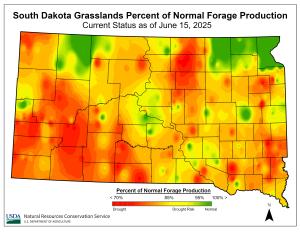
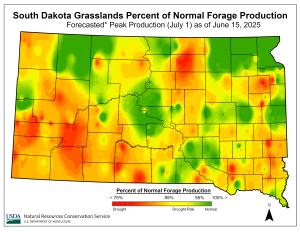
South Dakota (SD) Grassland Productivity Map conditions have changed across the state since last updated on June 1. These maps, produced through the SD Natural Resources Conservation Service (NRCS) Drought Tool, will be updated only one more time, reporting conditions as of July 1.
The "current status" map compares precipitation we have received to the average precipitation from the last two years. May and June have brought SD a much-needed drink of water across the state and conditions have improved greatly.
The “forecasted” map shows what peak forage production is predicted to look like if the remaining time between now and July 1 has average rainfall. As we get closer to July 1, we are less likely to catch up to "normal" in certain areas of the state.
Some parts of the state have been brought back to normal conditions, while others are still having a precipitation deficit compared to normal. Future moisture may set warm season forages up for success, however, most of our cool season forages are nearly done producing for the year. Consider speeding up your rotations or accessing alternative forages to give cool season-dominated pastures a rest if they are not looking good. Use the SD Grazing Exchange to see if there are any alternative forages (cover crops) available in your area!
The U.S. Department of Agriculture’s (USDA) Risk Management Agency (RMA) approved changes to improve insurance coverage for American livestock producers. These updates will take effect for the Livestock Risk Protection (LRP), Livestock Gross Margin (LGM), and Dairy Revenue Protection (DRP) insurance programs beginning with the 2026 crop year.
Livestock Risk Protection
LRP provides protection for livestock producers looking to insure against declining market prices. This program offers coverage levels ranging from 70% to 100% of the “expected ending values” (expected price at the end of the insurance period).
The changes to LRP include:
Modifying the termination date to Sept. 30 and the premium billing date to the first day of the second month after the end date of endorsement.
Adding two new types of LRP coverage:
Feeder Cattle - Unborn Calves will provide coverage for beef or beef/dairy cross calves sold within two weeks after birth.
Fed Cattle - Cull Cows will provide coverage for dairy cull cows with a coverage limitation of 13 weeks.
Allowing coverage based on a forward contract or purchase agreement.
Additional record requirement includes a copy of the purchase agreement and proof of delivery.
Adding drought exemption for Feeder Cattle that will be based on the Drought Monitor’s Drought Severity and Coverage Index (DSCI).
Adding additional record requirements for Feeder Cattle:
Applicable when livestock are purchased and not marketed within 60 days of the end date.
The sex of the feeder cattle must be verified in the marketing or purchase records.
Livestock Gross Margin
LGM provides protection to cattle, dairy and swine producers against unexpected decreases in gross margin (market value of livestock or milk minus input costs). The program calculates the expected gross margin for a period using future market prices and pays an indemnity to the extent that the actual gross margin is less than the expected gross margin.
The changes to LGM include:
Modifying the termination date to Aug. 31 and the premium billing date to the first day of the second month after the Specific Coverage Endorsement ended.
Dairy Revenue Protection
For dairy producers, DRP provides protection against a decline in revenue (yield and/or price) on the milk produced from dairy cows on a quarterly basis. The expected revenue is based on futures prices for milk and dairy commodities, and the amount of covered milk production elected by the dairy producer.
The changes to DRP include:
Modifying the DRP termination date to Jan. 31 and the premium billing date to the first day of the third month after the end date of endorsement.
Modifying the program to give additional flexibilities to producers impacted by an animal disease when they have suffered an eligible loss.
RMA is increasing the minimum declarable butterfat test to 4.00 pounds, increasing maximum declarable butterfat test to 6.00 pounds and increasing minimum declarable protein test to 3.20 pounds.
More Information
LRP, LGM and DRP are available to livestock producers in all states and counties. Crop insurance is sold and delivered solely through private crop insurance agents. A list of crop insurance agents is available online at the RMA Agent Locator. Producers can learn more about crop insurance and the modern farm safety net at rma.usda.gov or by contacting their RMA Regional Office. RMA’s Basics for Beginners provides information for those new to crop insurance.
If you need to request an accommodation, please contact Jean Wharton at (605) 352-1160 or jean.wharton@usda.gov by July 16, 2025, to request accommodations (e.g., an interpreter, translator, seating arrangements, etc.) or materials in an alternative format (e.g., Braille, large print, audiotape – captioning, etc.).