
USDA - Missouri State Office Newsletter - June 18, 2024.
In This Issue:
After planting is complete, agricultural producers in Missouri should make an appointment with their local Farm Service Agency (FSA) county office to complete crop acreage reports before the applicable deadline.
“In order to receive many USDA program benefits, producers should file an accurate crop acreage report by the applicable deadline,” said Deputy SED P. Jeremy Mosley, Missouri Executive Director in Missouri. “Call your local FSA office to make an appointment after planting is complete to report your acreage and take care of any other FSA-related business.”
How to File a Report
A crop acreage report documents a crop grown on a farm or ranch, its intended use and location. Producers should file an accurate crop acreage report for all crops and land uses, including failed acreage and prevented planted acreage before the applicable deadline.
Maps Are Available - Alternative Reporting:
Maps are available at your local FSA Office for acreage reporting purposes. If you wish to receive your maps by e-mail, please call your office or email the local staff. Please see the following acreage reporting deadlines for Missouri:
- July 15, 2025 - All Spring Planted Crops & Perennials
In order to maintain program eligibility and benefits, you must file timely acreage reports. Failure to file an acreage report by the crop acreage reporting deadline may cause ineligibility for future program benefits. FSA will not accept acreage reports provided more than a year after the acreage reporting deadline.
Producers are encouraged to file their acreage reports as soon as planting is completed.
The U.S. Department of Agriculture announced the release of Congressionally mandated Emergency Livestock Relief Program (ELRP) payments to cover grazing losses due to eligible drought or wildfire events in 2023 and/or 2024.
USDA’s Farm Service Agency (FSA) is leveraging existing Livestock Forage Disaster Program (LFP) data to streamline payment calculations and expedite relief. Emergency relief payments are automatically issued for producers who have an approved LFP application on file for 2023 and/or 2024.
The American Relief Act, 2025, provided funds for emergency relief payments. This program is the first of two programs authorized to assist with eligible losses suffered by livestock producers. FSA will announce additional ELRP assistance for other losses authorized by the Act, including flooding, later this summer.
ELRP Eligibility
ELRP payment eligibility requires livestock producers to have suffered grazing losses in a county rated by the U.S. Drought Monitor as having a D2 (severe drought) for eight consecutive weeks or a D3 (extreme drought) or higher level of drought intensity during 2023, 2024 or both calendar years, and have applied and been approved for LFP.
Additionally, producers whose permitted grazing on federally managed lands was reduced due to wildfire are also eligible for ELRP, if they applied and were approved for LFP in 2023, 2024 or both calendar years.
To streamline and simplify the delivery of ELRP benefits, producers are not required to submit an application for payment; however, they must have the following forms on file with FSA:
- CCC-853, Livestock Forage Disaster Program Application
-
Form AD-2047, Customer Data Worksheet.
-
Form CCC-902, Farm Operating Plan for an individual or legal entity.
-
Form CCC-901, Member Information for Legal Entities (if applicable).
- Form FSA-510, Request for an Exception to the $125,000 Payment Limitation for Certain Programs (if applicable). This form is required to be on file for both 2023 and 2024 to be eligible for the payment limitation exception.
-
SF-3881, Direct Deposit.
-
AD-1026, Highly Erodible Land Conservation (HELC) and Wetland Conservation (WC) Certification.
Most producers, especially those who have previously participated in FSA programs, likely have these forms on file. However, those who are uncertain and want to confirm the status of their forms, can contact their local FSA county office.
ELRP Payment Calculation
To expedite payments to eligible livestock producers, determine eligibility, and calculate an ELRP payment, FSA uses livestock inventories and drought-affected forage acreage or restricted animal units and grazing days due to wildfire already reported by the producer on the CCC-853, Livestock Forage Disaster Program Application form, for 2023, 2024 or both calendar years.
ELRP payments will be equal to the eligible livestock producer’s gross LFP calculated payment for the calendar year multiplied by an ELRP 2023 or 2024 payment factor to determine the total gross ELRP payments for 2023 and/or 2024. The initial payment factor for 2023 and 2024 ELRP payments is 35%. If additional funds remain, FSA may issue a second payment.
Supplemental Disaster Assistance Timeline
USDA is fully committed to expediting remaining disaster assistance provided by the American Relief Act, 2025. On May 7, we launched our 2023/2024 Supplemental Disaster Assistance public landing page where the status of USDA disaster assistance and block grant rollout timeline can be tracked. The page is updated regularly and accessible through fsa.usda.gov.
The Act also authorized $10 billion in economic loss assistance to producers of covered commodities based on 2024 planted and prevented planted acres. To date, USDA has delivered more than $7.7 billion to producers through the Emergency Commodity Assistance Program (ECAP). The ECAP deadline is Aug. 15, 2025. Contact your local FSA county office for information.
To learn more visit the ELRP website.
The Conservation Stewardship Program (CSP) is sometimes misunderstood. It is perceived by some as complicated or not for small operations, and neither of those perceptions is true. CSP is designed to help you take your existing conservation efforts on your operation to the next higher level while maintaining your current ones. It’s supposed to help you add to what you’re already doing, either by enhancing your current practices or adding new ones.
The Natural Resources Conservation Service (NRCS) works one-on-one with you to develop a conservation plan under CSP to implement these additions or enhancements and help strengthen your operation.
Under CSP, you receive annual payments to help you maintain your existing conservation efforts and enhance them using new conservation practices or activities. CSP contracts last five years, with the opportunity to compete for a contract renewal if you successfully fulfill the initial contract and agree to achieve additional conservation objectives.
CSP is often misunderstood, so here are a few “myths” about the program that we want to dispel.
Myth #1: The deadline to apply for CSP in my state has already passed, so I don’t need to think about applying until next year.
Don’t wait to apply! We accept applications year-round, but funding decisions are made locally at specific times and that “ranking date” may be coming up soon in your area. If we already have your application, it will be considered at the next ranking date. Plus, if you start planning now, you will be ready for application ranking dates as they approach. See program application ranking dates for all states at https://www.nrcs.usda.gov/ranking-dates.
Myth #2: Enrolling land in CSP is complicated and time-consuming.
If you have a farm and tract number (available from USDA’s Farm Service Agency) and have kept good farm records, you’re already well on your way. You just need to complete a three-page NRCS-CPA-1200 form, see Applications and Forms. You can even complete this form online if you create a farmers.gov account at https://www.farmers.gov/account.
Read more myths.
Nominations due Aug. 1

Nominations are now being accepted for farmers and ranchers to serve on local U.S. Department of Agriculture (USDA) Farm Service Agency (FSA) county committees. These committees make important decisions about how federal farm programs are administered locally. All nomination forms for the 2025 election must be postmarked or received in the local FSA office by Aug. 1, 2025.
Elections for committee members will occur in certain Local Administrative Areas (LAA). LAAs are elective areas for FSA committees in a single county or multi-county jurisdiction and may include LAAs that are focused on an urban or suburban area.
Producers interested in serving on the FSA county committee can locate their LAA through a geographic information system locator tool available at fsa.usda.gov/elections and determine if their LAA is up for election by contacting their local FSA office.
Agricultural producers may be nominated for candidacy for the county committee if they:
- Participate or cooperate in a USDA program.
- Reside in the LAA that is up for election this year.
A cooperating producer is someone who has provided information about their farming or ranching operation to FSA, even if they have not applied or received program benefits.
Individuals may nominate themselves or others and qualifying organizations may also nominate candidates. USDA encourages all eligible producers to nominate, vote and hold office.
Nationwide, more than 7,700 dedicated members of the agriculture community serve on FSA county committees. The committees are made up of three to 11 members who serve three-year terms. Committee members play a key role in how FSA delivers disaster recovery, conservation, commodity and price support programs, as well as making decisions on county office employment and other agricultural issues.
Urban and Suburban County Committees
FSA urban county committees work to promote urban, indoor and other emerging agricultural production practices. Urban committee members are nominated and elected to serve by local urban producers in the same jurisdiction. Urban county committee members provide outreach to ensure urban producers understand USDA programs, serve as the voice of other urban producers and assist in program implementation that support the needs of growing urban communities.
The 27 cities with urban county committees are listed at fsa.usda.gov/elections and farmers.gov/urban.
More Information
Producers should contact their local FSA office today to register and find out how to get involved in their county’s election, including if their LAA is up for election this year. To be considered, a producer must be registered and sign an FSA-669A nomination form. This form and other information about FSA county committee elections are available at fsa.usda.gov/elections.
All nomination forms for the 2025 election must be postmarked or received in the local USDA Service Center by the Aug.1, 2025, deadline. Election ballots will be mailed to eligible voters in November 2025.
|
The USDA Farm Service Agency’s (FSA) Direct Farm Ownership loans can help farmers and ranchers become owner-operators of family farms, improve and expand current operations, increase agricultural productivity, and assist with land tenure to save farmland for future generations.
There are three types of Direct Farm Ownership Loans: regular, down payment and joint financing. FSA also offers a Direct Farm Ownership Microloan option for smaller financial needs up to $50,000.
Joint financing allows FSA to provide more farmers and ranchers with access to capital. FSA lends up to 50 percent of the total amount financed. A commercial lender, a state program or the seller of the property being purchased, provides the balance of loan funds, with or without an FSA guarantee. The maximum loan amount for a joint financing loan is $600,000, and the repayment period for the loan is up to 40 years.
The operation must be an eligible farm enterprise. Farm Ownership loan funds cannot be used to finance nonfarm enterprises and all applicants must be able to meet general eligibility requirements. Loan applicants are also required to have participated in the business operations of a farm or ranch for at least three years out of the 10 years prior to the date the application is submitted. The applicant must show documentation that their participation in the business operation of the farm or ranch was not solely as a laborer.
For more information about farm loans, contact your local USDA Service Center or visit fsa.usda.gov.
The U.S. Department of Agriculture’s Farm Service Agency (FSA) is extending the prevented planting crop reporting deadline for producers affected by spring flooding, excessive moisture, or qualifying drought.
Producers who intended to plant this spring, but were unable due to weather conditions, now have until the acreage reporting deadline for the applicable crop being claimed as prevented planting. July 15 is a major deadline for most crops, but acreage reporting deadlines vary by county and by crop.
Producers need to report prevented planting acres to retain eligibility for FSA program benefits. Normally, the prevented planting reporting deadline is 15 calendar days after the final planting date for a crop as established by FSA and the Risk Management Agency (RMA). The prevented planting reporting deadline extension only applies to FSA and does not change any RMA crop insurance reporting deadline requirements.
The extension does not apply to crops covered by FSA’s Noninsured Crop Disaster Assistance Program (NAP). Producers should check with their local FSA office regarding prevented planting provisions for NAP-covered crops.
Producers are encouraged to contact their local FSA office as soon as possible to make an appointment to report prevented planting acres and submit their spring crop acreage report. To locate your local FSA office, visit farmers.gov/service-locator.
 Program payments to offset increased input costs, market decline
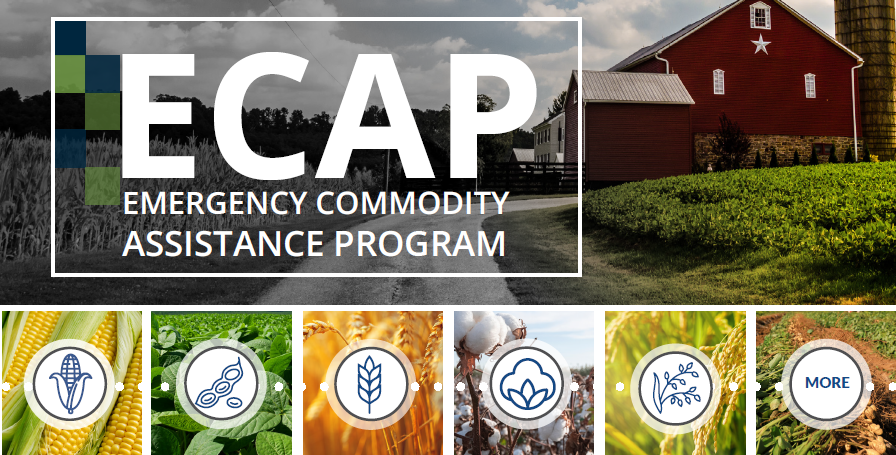
U.S. Secretary of Agriculture Brooke Rollins, on National Agriculture Day, announced that the U.S. Department of Agriculture (USDA) is issuing up to $10 billion directly to agricultural producers through the Emergency Commodity Assistance Program (ECAP) for the 2024 crop year. Administered by USDA’s Farm Service Agency (FSA), ECAP will help agricultural producers mitigate the impacts of increased input costs and falling commodity prices.
Authorized by the American Relief Act, 2025, these economic relief payments are based on planted and prevented planted crop acres for eligible commodities for the 2024 crop year. To streamline and simplify the delivery of ECAP, FSA will begin sending pre-filled applications to producers who submitted acreage reports to FSA for 2024 eligible ECAP commodities soon after the signup period opens on March 19, 2025. Producers do not have to wait for their pre-filled ECAP application to apply. They can visit fsa.usda.gov/ecap to apply using a login.gov account or contact their local FSA office to request an application once the signup period opens.
Eligible Commodities and Payment Rates
The commodities below are eligible for these per-acre payment rates:
|
· Wheat - $30.69
|
Eligible oilseeds:
|
|
· Corn - $42.91
|
· Canola – $31.83
|
|
· Sorghum - $42.52
|
· Crambe – $19.08
|
|
· Barley - $21.67
|
· Flax - $20.97
|
|
· Oats - $77.66
|
· Mustard - $11.36
|
|
· Upland cotton & Extra-long staple cotton - $84.74
|
· Rapeseed -$23.63
|
|
· Long & medium grain rice - $76.94
|
· Safflower - $26.32
|
|
· Peanuts - $75.51
|
· Sesame - $16.83
|
|
· Soybeans - $29.76
|
· Sunflower – $27.23
|
|
· Dry peas - $16.02
|
|
|
· Lentils - $19.30
|
|
|
· Small Chickpeas - $31.45
|
|
|
· Large Chickpeas - $24.02
|
|
Producer Eligibility
Eligible producers must report 2024 crop year planted and prevented planted acres to FSA on an FSA-578, Report of Acreage form. Producers who have not previously reported 2024 crop year acreage or filed a notice of loss for prevented planted crops must submit an acreage report by the Aug. 15, 2025, deadline. Eligible producers can visit fsa.usda.gov/ecap for eligibility and payment details.
Applying for ECAP
Producers must submit ECAP applications to their local FSA county office by Aug. 15, 2025. Only one application is required for all ECAP eligible commodities nationwide. ECAP applications can be submitted to FSA in-person, electronically using Box and One-Span, by fax or by applying online at fsa.usda.gov/ecap utilizing a secure login.gov account.
If not already on file for the 2024 crop year, producers must have the following forms on file with FSA:
-
Form AD-2047, Customer Data Worksheet.
-
Form CCC-901, Member Information for Legal Entities (if applicable).
-
Form CCC-902, Farm Operating Plan for an individual or legal entity.
- Form CCC 943, 75 percent of Average Gross Income from Farming, Ranching, or Forestry Certification (if applicable).
-
AD-1026, Highly Erodible Land Conservation (HELC) and Wetland Conservation (WC) Certification.
-
SF-3881, Direct Deposit.
Except for the new CCC-943, most producers, especially those who have previously participated in FSA programs, likely have these forms on file. However, those who are uncertain and want to confirm the status of their forms or need to submit the new Form-943, can contact their local FSA county office.
If a producer does not receive a pre-filled ECAP application, and they planted or were prevented from planting ECAP eligible commodities in 2024, they should contact their local FSA office.
ECAP Payments and Calculator
ECAP payments will be issued as applications are approved. Initial ECAP payments will be factored by 85% to ensure that total program payments do not exceed available funding. If additional funds remain, FSA may issue a second payment.
ECAP assistance will be calculated using a flat payment rate for the eligible commodity multiplied by the eligible reported acres. Payments are based on acreage and not production. For acres reported as prevented plant, ECAP assistance will be calculated at 50%.
For ECAP payment estimates, producers are encouraged to visit fsa.usda.gov/ecap to use the ECAP online calculator.
You have a lot at stake in making sure your crop insurance acreage reporting is accurate and on time. If you fail to report on time, you may not be protected. If you report too much acreage, you may pay too much premium. If you report too little acreage, you may recover less when you file a claim.
Crop insurance agents often say that mistakes in acreage reporting are the easiest way for producers to have an unsatisfactory experience with crop insurance. Don’t depend on your agent to do this important job for you. Your signature on the bottom of the acreage reporting form makes it, legally, your responsibility. Double-check it for yourself.
Remember - acreage reporting is your responsibility. Doing it right will save you money. Always get a copy of your report immediately after signing and filing it with your agent and keep it with your records. Remember, it is your responsibility to report crop damage to your agent within 72 hours of discovery. Never put damaged acreage to another use without prior written consent of the insurance adjuster. You don’t want to destroy any evidence of a possible claim. Learn more by visiting RMA’s website.
Top of page
On April 27, 1935, Congress established the Soil Conservation Service, which would later become the Natural Resources Conservation Service (NRCS), as a permanent agency in the U.S. Department of Agriculture. For 90 years, NRCS has helped farmers, ranchers and forestland owners make critical investments in their operations and local communities to keep working lands working and boost agricultural production, while at the same time improving the quality of our air, water, soil, and wildlife habitats.
See our compilation of videos, stories and resources here.
In April 2024, the USDA Animal and Plant Health Inspection Service (APHIS) announced the final rule that amends and strengthens our animal disease traceability regulations for certain cattle and bison. This rule went into effect on Nov. 5, 2024.
Learn more about seven common myths and misunderstandings about the new regulations.
Top of page
MISSOURI - USDA
|
|
Service Center Locator
|
|
FARM SERVICE AGENCY (FSA)
601 Business Loop 70 West, Suite 225 Columbia, MO 65203
Phone: 573-876-0925
Fax: 855-830-0680
fsa.usda.gov
State Executive Director
Vacant
Deputy State Executive Director
Jeremy Mosely
|
NATURAL RESOURCE CONSERVATION SERVICE (NRCS)
601 Business Loop 70 West, Suite 250 Columbia, MO 65203
Phone: 573-876-0901
Fax: 855-865-2188
nrcs.usda.gov
State Conservationist
Scott Edwards
|
|
USDA is an equal opportunity provider, employer, and lender.
|
|






