
Prince Edward/Nottoway USDA Service Center - May 14, 2025
In This Issue:
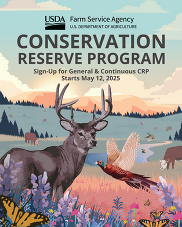
FSA accepting offers for both the General and Continuous CRP, including CREP
USDA announced several Conservation Reserve Program (CRP) enrollment opportunities for agricultural producers and landowners. USDA’s Farm Service Agency (FSA) is accepting offers for both the General and Continuous CRP today through June 6, 2025.
CRP, USDA’s flagship conservation program, celebrates its 40th anniversary this year. For four decades, CRP has provided financial and technical support to agricultural producers and landowners who place unproductive or marginal cropland under contract for 10-15 years and who agree to voluntarily convert the land to beneficial vegetative cover to improve water quality, prevent soil erosion and support wildlife habitat.
General CRP (Signup 64)
Agricultural producers and landowners submit offers for General CRP through a competitive bid process. Offers are ranked and scored, by FSA, using nationally established environmental benefits criteria. USDA will announce accepted offers once ranking and scoring for all offers is completed. In addition to annual rental payments, approved General CRP participants may also be eligible for cost-share assistance to establish long-term, resource-conserving vegetative cover.
Continuous CRP (Signup 63)
Unlike General CRP, Continuous CRP offers are not subject to a competitive bid process. To ensure enrolled acres do not exceed the current statutory cap of 27 million acres, FSA is accepting Continuous CRP offers on a first-come, first-served basis through June 6. However, should allotted CRP acreage remain available following the June 6 deadline, FSA will accept continuous CRP offers from interested landowners through July 31, 2025, and may be subsequently considered for acceptance, in batches, if it’s determined that the offered acres support USDA’s conservation priorities.
Continuous CRP participants voluntarily offer environmentally sensitive lands, typically smaller parcels than offered through General CRP including wetlands, riparian buffers, and varying wildlife habitats. In return, they receive annual rental payments and cost-share assistance to establish long-term, resource-conserving vegetative cover.
Continuous CRP enrollment options:
-
State Acres for Wildlife Enhancement Initiative: Restores vital habitat in order to meet high-priority state wildlife conservation goals.
-
Highly Erodible Land Initiative: Producers and landowners can enroll in CRP to establish long-term cover on highly erodible cropland that has a weighted erodibility index greater than or equal to 20.
-
Clean Lakes, Estuaries and Rivers (CLEAR) Initiative: Prioritizes water quality practices on the land that, if enrolled, will help reduce sediment loadings, nutrient loadings, and harmful algal blooms. The vegetative covers also contribute to increased wildlife populations.
-
CLEAR30 (a component of the CLEAR Initiative): Offers additional incentives for water quality practice adoption and can be accessed in 30-year contracts.
-
Conservation Reserve Enhancement Program: Addresses high priority conservation objectives of states and Tribal governments on agricultural lands in specific geographic areas.
Grassland and Expiring CRP Acres
FSA will announce dates for Grassland CRP signup in the near future.
Additionally, landowners with acres enrolled in CRP set to expire Sept. 30, 2025, can offer acres for re-enrollment beginning today. A producer can offer to enroll new acres into CRP and also offer to re-enroll any acres expiring Sept. 30, 2025.
More information on CRP participant and land eligibility, approved conservation practices and detailed program fact sheets, can be found at FSA’s CRP webpage.
For more information, contact your Prince Edward/Nottoway County USDA Service Center at (434) 392-4906 or visit fsa.usda.gov/nap
|

Maps are now available at the Prince Edward/Nottoway County FSA Office for acreage reporting purposes. If you wish to receive your maps by e-mail, please call our office. Please see the following acreage reporting deadlines:
May 15, 2025: Cabbage (Planted 3/16-4/15), Spring Oats, Potatoes, Tomatoes (Planted on or before 5/15)
June 15, 2025: Beans (Planted 3/4-5/25)
July 15, 2025: Beans (Planted 5/26-7/10), Tomatoes (Planted 5/16-7/5), Tomatoes, corn, soybeans, hay, pasture, CRP
July 31, 2025: Hemp
August 15, 2025: Cabbage (Planted 4/16-7/10)
September 15, 2025: Beans (Planted 7/15-9/5)
In order to maintain program eligibility and benefits, you must file timely acreage reports. Failure to file an acreage report by the crop acreage reporting deadline may cause ineligibility for future program benefits. FSA will not accept acreage reports provided more than a year after the acreage reporting deadline.
|
Top of page

Why are pollinators so important? That’s easy - food. One out of three bites of food can be attributed to these important creatures – such as bees, butterflies, moths, birds, beetles, bats, and a few other small mammals. Pollinators provide crucial assistance to fruit, vegetable and seed crops as well as other plants that produce fiber, medicine and fuel.
Many species of pollinators, however, are seeing decreasing populations because of habitat loss, disease, parasites and pesticide use. But there’s good news. There are simple ways you can help. It can be as easy as selecting high-quality pollinator plants for your garden. To find the best plants for your area, visit the websites of NRCS partners at the Xerces Society Pollinator Conservation Program or Pollinator Partnership.
If you operate a farm or ranch, NRCS can help you create habitat for pollinators. More pollinators can increase crop yields. Pollinator numbers can be increased by planting wildflowers in and around fields and choosing the right cover crops. NRCS offers more than three dozen conservation practices that assist in building healthier landscapes for pollinators. NRCS can also help fund the implementation of these practices.
Habitats used by pollinators attract beneficial insects that eat crop pests, and they may provide habitat for other wildlife, reduce soil erosion and improve water quality. MRCS encourages landowners installing conservation practices to prevent soil erosion or protect stream banks to also consider including wildflowers, shrubs and trees that support pollinators.
For more information, contact an NRCS employee at your local USDA service center.
|
Top of page
Farmers can use USDA farm ownership microloans to buy and improve property. These microloans are especially helpful to beginning or underserved farmers, U.S. veterans looking for a career in farming, and those who have small and mid-sized farming operations. Microloans have helped farmers and ranchers with operating costs, such as feed, fertilizer, tools, fencing, equipment, and living expenses since 2013.
Microloans can also help with farmland and building purchases and soil and water conservation improvements. FSA designed the expanded program to simplify the application process, expand eligibility requirements and expedite smaller real estate loans to help farmers strengthen their operations. Microloans provide up to $50,000 to qualified producers and can be issued to the applicant directly from the USDA Farm Service Agency (FSA).
For more information about farm loans, contact your County USDA Service Center or visit fsa.usda.gov.
|
Top of page

Special Emphasis: This Month - May
Dates to remember:
May 15 – USDA's Birthday
May 20 – World Bee Day
May 26 – Office Closed in observance of Memorial Day
May 31 – Final date to request marketing assistance loans on 2024 crops of corn, grain sorghum, and soybeans
June 6 – General CRP Signup Deadline
June 19 – Office closed in observance of Juneteenth
July 4 – Office closed in observance of Independence Day
July 15 – Acreage Reporting Deadline
July 31 – Continuous CRP Signup Deadline
Within 72 hours – NAP participants must report losses and completion of harvest on hand harvested and rapidly deteriorating crops.
Within 15 days – Report losses to crops insured under NAP (excluding hand harvested and rapidly deteriorating crops).
Ongoing – Submit an AD-1026 PRIOR to the land being cleared for agricultural use (forest and new ground) and PRIOR to hay and pasture field being converted to a row crop or vegetable crop.
Ongoing – Contact our office with farm record changes and banking information updates
Interest Rates:
Operating/Ownership Loan:
Farm Operating - 5.125%
Farm Ownership - 5.625%
Farm Ownership - Joint Financing: 3.6250%
Farm Ownership - Down Payment: 1.625%
Emergency - Actual Loss: 3.750%
Farm Storage Facility Loan:
3-year term - 3.875%
5-year term - 4.000%
7-year term - 4.125%
10-year term - 4.250%
12-year term - 4.375%
Marketing Assistance Loan:
Commodity Loan - 5.000%
|
Top of page
|






