
Alaska State FSA May Newsletter - 13 May 2025
In This Issue:
The Palmer FSA staff will be in the Wasilla NRCS office every Thursday from 8:30am-4pm.
The Delta Junction office will be closed Monday, June 2nd through Friday, June 6th. For immediate assistance, contact the Alaska State office at (907)761-7738 or by emailing akpalmer-fsa@usda.gov.
Upcoming Office Closures:
Monday, May 26th for Memorial Day
Thursday, June 19th for Juneteenth National Independence Day
Friday, July 4th for Independence Day
Upcoming Deadlines:
Friday, June 6th- General and Continuous CRP Signup Deadline
Tuesday, July 15th- 2025 Acreage Reporting Deadline for all other spring planted crops, CRP and perennial forage
Friday, August 15th- Emergency Commodity Assistance Program (ECAP) Deadline
Monday, September 1st- 2026 NAP Deadline for Floriculture (Peonies), Aquaculture and Turf Grass
Tuesday, September 30th- 2026 Acreage Reporting Deadline for Value-loss crops (including Peonies) and controlled environment crops (except nursery)
Tuesday, September 30th- 2026 NAP Deadline for Perennial Grass Forage and Honey
Click here to learn more about upcoming deadlines and ongoing programs
|
Top of page
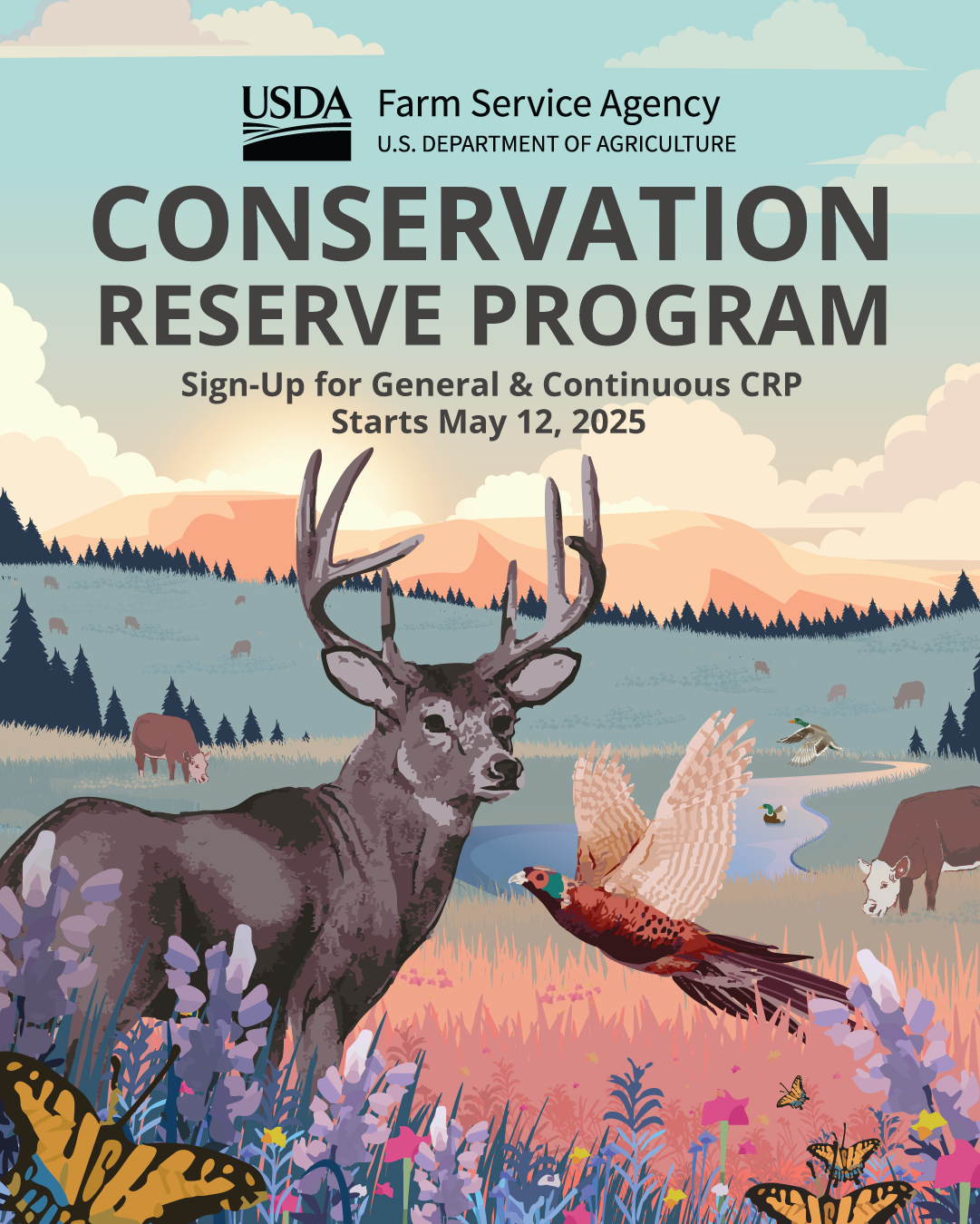 USDA announced several Conservation Reserve Program (CRP) enrollment opportunities for agricultural producers and landowners. USDA’s Farm Service Agency (FSA) is accepting offers for both the General and Continuous CRP May 12, 2025 through June 6, 2025.
CRP, USDA’s flagship conservation program, celebrates its 40th anniversary this year. For four decades, CRP has provided financial and technical support to agricultural producers and landowners who place unproductive or marginal cropland under contract for 10-15 years and who agree to voluntarily convert the land to beneficial vegetative cover to improve water quality, prevent soil erosion and support wildlife habitat. The American Relief Act, 2025, extended provisions for CRP through Sept. 30, 2025.
General CRP (Signup 64)
Agricultural producers and landowners submit offers for General CRP through a competitive bid process. Offers are ranked and scored, by FSA, using nationally established environmental benefits criteria. USDA will announce accepted offers once ranking and scoring for all offers is completed. In addition to annual rental payments, approved General CRP participants may also be eligible for cost-share assistance to establish long-term, resource-conserving vegetative cover.
Continuous CRP (Signup 63)
Unlike General CRP, Continuous CRP offers are not subject to a competitive bid process. To ensure enrolled acres do not exceed the current statutory cap of 27 million acres, FSA is accepting Continuous CRP offers on a first-come, first-served basis through June 6. However, should allotted CRP acreage remain available following the June 6 deadline, FSA will accept continuous CRP offers from interested landowners through July 31, 2025, and may be subsequently considered for acceptance, in batches, if it’s determined that the offered acres support USDA’s conservation priorities.
Continuous CRP participants voluntarily offer environmentally sensitive lands, typically smaller parcels than offered through General CRP including wetlands, riparian buffers, and varying wildlife habitats. In return, they receive annual rental payments and cost-share assistance to establish long-term, resource-conserving vegetative cover.
Continuous CRP enrollment options:
-
State Acres for Wildlife Enhancement Initiative: Restores vital habitat in order to meet high-priority state wildlife conservation goals.
-
Highly Erodible Land Initiative: Producers and landowners can enroll in CRP to establish long-term cover on highly erodible cropland that has a weighted erodibility index greater than or equal to 20.
-
Clean Lakes, Estuaries and Rivers (CLEAR) Initiative: Prioritizes water quality practices on the land that, if enrolled, will help reduce sediment loadings, nutrient loadings, and harmful algal blooms. The vegetative covers also contribute to increased wildlife populations.
-
CLEAR30 (a component of the CLEAR Initiative): Offers additional incentives for water quality practice adoption and can be accessed in 30-year contracts.
-
Conservation Reserve Enhancement Program: Addresses high priority conservation objectives of states and Tribal governments on agricultural lands in specific geographic areas.
Grassland and Expiring CRP Acres
FSA will announce dates for Grassland CRP signup in the near future.
Additionally, landowners with acres enrolled in CRP set to expire Sept. 30, 2025, can offer acres for re-enrollment beginning today. A producer can offer to enroll new acres into CRP and also offer to re-enroll any acres expiring Sept. 30, 2025.
For more information on CRP participant and land eligibility, approved conservation practices and detailed program fact sheets, visit FSA’s CRP webpage.
More Information
Interested producers should apply through the FSA at their local USDA Service Center.
Signed into law in 1985, CRP is one of the largest voluntary private-lands conservation programs in the United States. Originally intended to primarily control soil erosion and potentially stabilize commodity prices by taking marginal lands out of production, the program has evolved over the years, providing many conservation and economic benefits.
Top of page
The U.S. Department of Agriculture (USDA) reminds specialty crop producers that the application period for the Food Safety Certification for Specialty Crops (FSCSC) program for program year 2025 opened Jan. 1, 2025, and runs through Jan. 31, 2026. The program has been expanded to include medium-sized businesses in addition to small businesses. Eligible specialty crop growers can apply for assistance for expenses related to obtaining or renewing a food safety certification.
Program Details
FSCSC covers a percentage of the specialty crop operation’s cost of obtaining or renewing its on-farm food safety certification, as well as a portion of related expenses.
Eligible FSCSC applicants must be a specialty crop operation; meet the definition of a small or medium-size business and have paid eligible expenses related to certification.
- A small business has an average annual monetary value of specialty crops sold by the applicant during the three-year period preceding the program year of no more than $500,000.
- A medium size business has an average annual monetary value of specialty crops the applicant sold during the three-year period preceding the program year of at least $500,001 but no more than $1,000,000.
Specialty crop operations can receive the following cost assistance:
- Developing a food safety plan for first-time food safety certification.
- Maintaining or updating an existing food safety plan.
- Food safety certification.
- Certification upload fees.
- Microbiological testing for products, soil amendments and water.
- Training.
FSCSC payments are calculated separately for each eligible cost category. Details about payment rates and limitations are available at farmers.gov/food-safety.
Applying for Assistance
For program year 2025, the application period began Jan. 1, 2025, and runs through Jan. 31, 2026. FSA will issue 50% of the calculated payment for program year 2025 following application approval, with the remaining amount to be paid after the application deadline. If calculated payments exceed the amount of available funding, payments will be prorated.
Specialty crop producers can apply by completing the FSA-888-1, Food Safety Certification for Specialty Crops Program (FSCSC) for Program Years 2024 and 2025 application. The application, along with the AD-2047, Customer Data Worksheet and SF-3881, ACH Vendor/Miscellaneous Payment Enrollment Form, if not already on file with FSA, can be submitted to the FSA county office at any USDA Service Center nationwide by mail, fax, hand delivery or via electronic means. Producers with an eAuthentication account can apply for FSCSC online. Producers interested in creating an eAuthentication account should visit farmers.gov/sign-in.
Visit farmers.gov/food-safety for additional program details, eligibility information and application forms.
More Information
To learn more about FSA programs, producers can contact their local USDA Service Center.
Top of page

Using the correct signature when doing business with FSA can save time and prevent a delay in program benefits.
The following are FSA signature guidelines:
- Married individuals must sign their given name.
- Example—Mary Doe and John Doe are married. When signing FSA forms, each must use their given name, and may not sign with the name of their spouse. Mrs. Mary Doe may not sign documents as Mrs. John Doe. For Farm Loan Purposes, spouses may not sign on behalf of the other as an authorized signatory, a signature will be needed for each. For a minor, FSA requires the minor's signature and one from the minor’s parent. There are certain exceptions where a minor’s signature may be accepted without obtaining the signature of one of the parents. Despite minority status, a youth executing a promissory note for a Youth Loan will incur full personal liability for the debt and will sign individually.
Note: By signing a document with a minor, the parent is liable for actions of the minor and may be liable for refunds, liquidated damages, or other penalties, etc.
When signing on one’s behalf the signature must agree with the name typed or printed on the form or be a variation that does not cause the name and signature to be in disagreement. Example - John W. Smith is on the form. The signature may be John W. Smith or J.W. Smith or J. Smith. Or Mary J. Smith may be signed as Mrs. Mary Joe Smith, M.J. Smith, Mary Smith, etc.
FAXED signatures will be accepted for certain forms and other documents provided the acceptable program forms are approved for FAXED signatures. Producers are responsible for the successful transmission and receipt of FAXED information.
Examples of documents not approved for FAXED signatures include:
- Promissory note
- Assignment of payment
- Joint payment authorization
- Acknowledgement of commodity certificate purchase
Spouses may sign documents on behalf of each other for FSA and CCC programs in which either spouse has an interest, unless written notification denying a spouse this authority has been provided to the county office.
Spouses cannot sign on behalf of each other as an authorized signatory for partnerships, joint ventures, corporations or other similar entities. Likewise, a spouse cannot sign a document on behalf of the other in order to affirm the eligibility of oneself.
Any member of a general partnership can sign on behalf of the general partnership and bind all members unless the Articles of Partnership are more restrictive. Spouses may sign on behalf of each other’s individual interest in a partnership, unless notification denying a spouse that authority is provided to the county office. Acceptable signatures for general partnerships, joint ventures, corporations, estates, and trusts must consist of an indicator “by” or “for” the individual’s name, individual’s name and capacity, or individual’s name, capacity, and name of entity.
|
Top of page
The Certified Mediation Program (CMP), administered by the Farm Service Agency (FSA), offers mediation services to agricultural producers, creditors, and other parties involved in disputes. Mediation is a voluntary process where a neutral mediator assists the parties in negotiating a mutually acceptable resolution.
CMP aims to improve communication, foster understanding, and resolve conflicts without the need for litigation. This program covers a range of issues, including farm loans, adverse decisions by USDA agencies, rural housing loans, and other agricultural disputes.
Eligible applicants include agricultural producers, creditors, and other stakeholders involved in disputes related to farm loans, USDA program decisions, rural housing loans, and other agricultural issues. Mediation is available to any party seeking to resolve conflicts through a neutral and confidential process. Producers and stakeholders are encouraged to check with their local FSA office or certified state mediation program for specific requirements, application procedures, and additional program details.
Learn more on our Certified Mediation Program webpage.
Top of page
Farm Service Agency (FSA) loans require applicants to have a satisfactory credit history. A credit report is requested for all FSA direct farm loan applicants. These reports are reviewed to verify outstanding debts, see if bills are paid timely and to determine the impact on cash flow.
Information on your credit report is strictly confidential and is used only as an aid in conducting FSA business.
Our farm loan staff will discuss options with you if you have an unfavorable credit report and will provide a copy of your report. If you dispute the accuracy of the information on the credit report, it is up to you to contact the issuing credit report company to resolve any errors or inaccuracies.
There are multiple ways to remedy an unfavorable credit score:
- Make sure to pay bills on time
- Setting up automatic payments or automated reminders can be an effective way to remember payment due dates.
- Pay down existing debt
- Keep your credit card balances low
- Avoid suddenly opening or closing existing credit accounts
FSA’s farm loan staff will guide you through the process, which may require you to reapply for a loan after improving or correcting your credit report.
For more information on FSA farm loan programs, contact your Northern County USDA Service Center at (907)895-4242 ext. 2 or Southern County FSA Office at (907)761-7738 or visit fsa.usda.gov.
Top of page
FSA guaranteed loans allow lenders to provide agricultural credit to farmers who do not meet the lender's normal underwriting criteria. Farmers and ranchers apply for a guaranteed loan through a lender, and the lender arranges for the guarantee. FSA can guarantee up to 95 percent of the loss of principal and interest on a loan. Guaranteed loans can be used for both farm ownership and operating purposes.
Guaranteed farm ownership loans can be used to purchase farmland, construct or repair buildings, develop farmland to promote soil and water conservation or to refinance debt.
Guaranteed operating loans can be used to purchase livestock, farm equipment, feed, seed, fuel, farm chemicals, insurance and other operating expenses.
FSA can guarantee farm ownership and operating loans up to $2,251,000. Repayment terms vary depending on the type of loan, collateral and the producer's ability to repay the loan. Operating loans are normally repaid within seven years and farm ownership loans are not to exceed 40 years.
For more information on guaranteed loans, contact your Northern County USDA Service Center at (907)895-4242 ext. 2 or Southern County FSA Office at (907)761-7738 or visit fsa.usda.gov.
Top of page
Alaska State Farm Service Agency
|
800 E Palmer-Wasilla Hwy., Suite 216
Palmer, AK 99645
Phone: 907-761-7738
Fax: 855-638-4864
|
|
Alaska FSA Website
|
|
Northern County FSA Service Center
PO BOX 585
Delta Junction AK 99737
Phone: 907-895-4242 ext. 2
Fax: 855-711-9095
Email: akdeltajun-fsa@usda.gov
Northern County Committee
Steve Helkenn- Committee Chair
Becky Hammond- Vice Chair
Matt Bates- Member
Next meeting: May 20th at 9am
|
Southern County FSA Office
800 E Palmer-Wasilla Hwy., Ste 216
Palmer AK 99645
Phone: 907-761-7773
Fax: 855-638-4864
Email: akpalmer-fsa@usda.gov
Southern County Committee
Carol Symonds- Committee Chair
Ina Jones- Vice Chair
Abby Ala- Member
Next meeting: May 13th at 10am
|
|
Hours: Monday-Friday 8:00 a.m.- 4:30 p.m.
|
|






