
News & Updates from the Iowa Farm Service Agency - May 21, 2025
In This Issue:
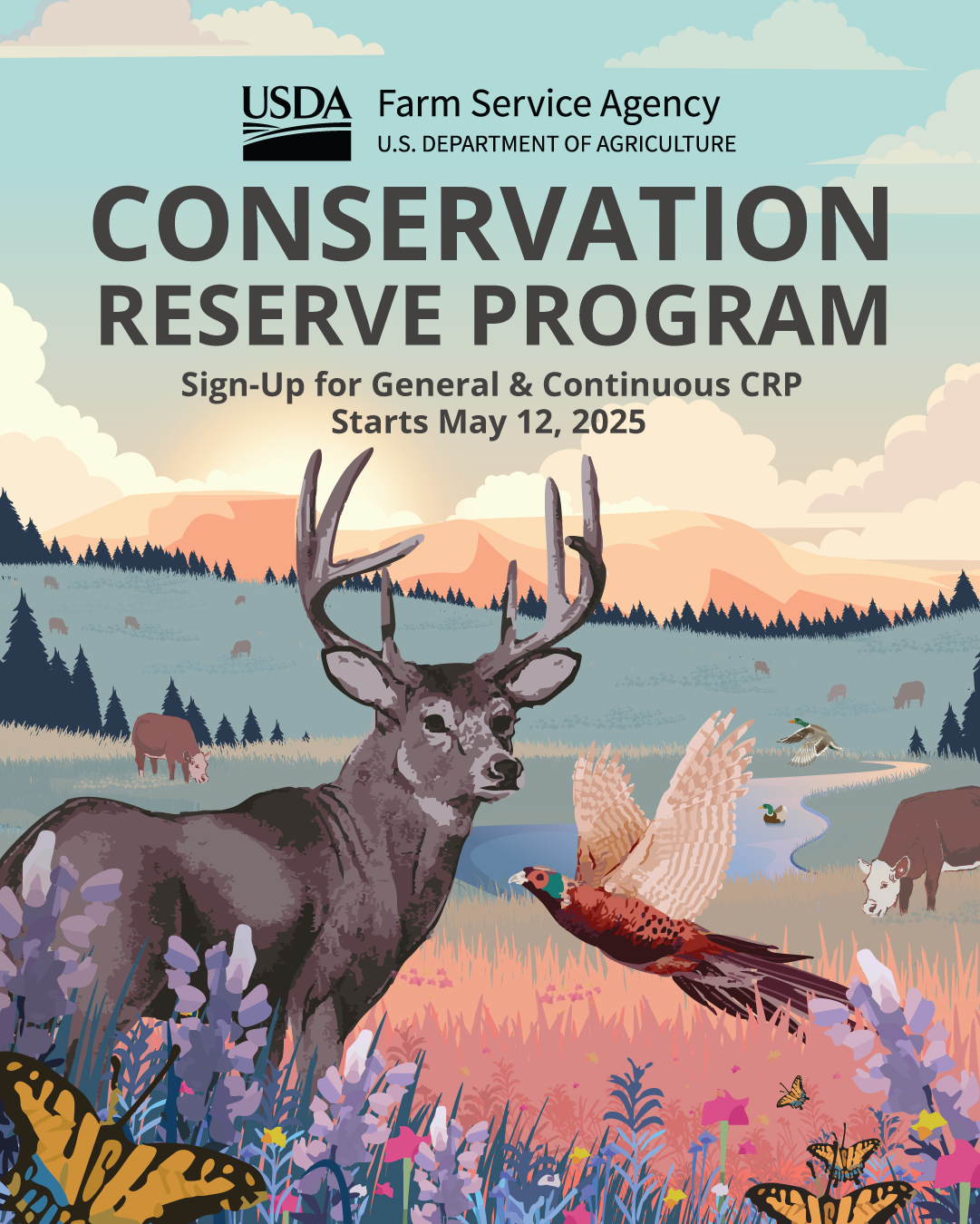
USDA has announced several Conservation Reserve Program (CRP) enrollment opportunities for agricultural producers and landowners. USDA’s Farm Service Agency (FSA) is accepting offers for both the General and Continuous CRP today through June 6, 2025.
CRP, USDA’s flagship conservation program, celebrates its 40th anniversary this year. For four decades, CRP has provided financial and technical support to agricultural producers and landowners who place unproductive or marginal cropland under contract for 10-15 years and who agree to voluntarily convert the land to beneficial vegetative cover to improve water quality, prevent soil erosion and support wildlife habitat. The American Relief Act, 2025, extended provisions for CRP through Sept. 30, 2025.
General CRP (Signup 64)
Agricultural producers and landowners submit offers for General CRP through a competitive bid process. Offers are ranked and scored, by FSA, using nationally established environmental benefits criteria. USDA will announce accepted offers once ranking and scoring for all offers is completed. In addition to annual rental payments, approved General CRP participants may also be eligible for cost-share assistance to establish long-term, resource-conserving vegetative cover.
Continuous CRP (Signup 63)
Unlike General CRP, Continuous CRP offers are not subject to a competitive bid process. To ensure enrolled acres do not exceed the current statutory cap of 27 million acres, FSA is accepting Continuous CRP offers on a first-come, first-served basis through June 6. However, should allotted CRP acreage remain available following the June 6 deadline, FSA will accept continuous CRP offers from interested landowners through July 31, 2025, and may be subsequently considered for acceptance, in batches, if it’s determined that the offered acres support USDA’s conservation priorities.
Continuous CRP participants voluntarily offer environmentally sensitive lands, typically smaller parcels than offered through General CRP including wetlands, riparian buffers, and varying wildlife habitats. In return, they receive annual rental payments and cost-share assistance to establish long-term, resource-conserving vegetative cover.
Continuous CRP enrollment options:
-
State Acres for Wildlife Enhancement Initiative: Restores vital habitat in order to meet high-priority state wildlife conservation goals.
-
Highly Erodible Land Initiative: Producers and landowners can enroll in CRP to establish long-term cover on highly erodible cropland that has a weighted erodibility index greater than or equal to 20.
-
Clean Lakes, Estuaries and Rivers (CLEAR) Initiative: Prioritizes water quality practices on the land that, if enrolled, will help reduce sediment loadings, nutrient loadings, and harmful algal blooms. The vegetative covers also contribute to increased wildlife populations.
-
CLEAR30 (a component of the CLEAR Initiative): Offers additional incentives for water quality practice adoption and can be accessed in 30-year contracts.
-
Conservation Reserve Enhancement Program: Addresses high priority conservation objectives of states and Tribal governments on agricultural lands in specific geographic areas.
Grassland and Expiring CRP Acres
FSA will announce dates for Grassland CRP signup in the near future.
Additionally, landowners with acres enrolled in CRP set to expire Sept. 30, 2025, can offer acres for re-enrollment beginning today. A producer can offer to enroll new acres into CRP and also offer to re-enroll any acres expiring Sept. 30, 2025.
For more information on CRP participant and land eligibility, approved conservation practices and detailed program fact sheets, visit FSA’s CRP webpage.
More Information
Interested producers should apply through the FSA at their local USDA Service Center.
Signed into law in 1985, CRP is one of the largest voluntary private-lands conservation programs in the United States. Originally intended to primarily control soil erosion and potentially stabilize commodity prices by taking marginal lands out of production, the program has evolved over the years, providing many conservation and economic benefits.
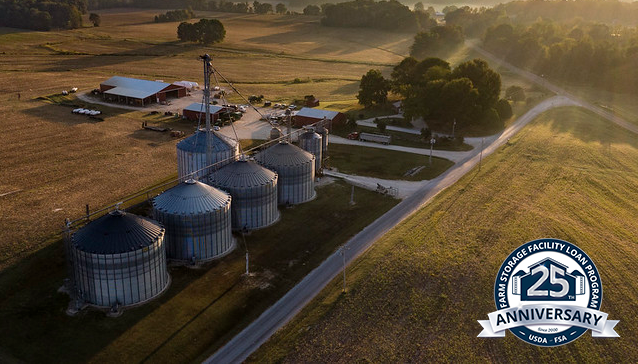 USDA’s Farm Service Agency (FSA) is celebrating 25 years of the agency’s popular Farm Storage Facility Loan Program (FSFL) this month. For a quarter century, family-owned agricultural operations have received low-interest financing through the program to enhance or expand their operations and manage marketing of the commodities they produce by building or upgrading permanent and portable storage facilities and purchasing needed handling equipment.
“Participating in FSA’s Farm Storage Facility Loans program provides producers affordable financing that allows them to build an on-farm storage system the right way from day one — a system that provides grain handling capacity for years to come,” said FSA Administrator Bill Beam. “Many people think of grain storage when they hear on-farm commodity storage, but the reality is, the program has expanded over the past quarter century to include a variety of storage and handling options including bins, cold storage, trucks and more, all designed to help agricultural producers take their commodities from field to facility to the end user.”
The FSFL program was created in May 2000 to address existing on-farm grain storage needs. Since the program’s inception, more than 40,000 loans have been issued for on-farm storage, increasing storage capacity by one billion bushels. While many producers primarily associate the program with grain storage, over the past 25 years the eligible storage has expanded to include a wide variety of facilities and related equipment - new or used and permanent or portable - including hay barns, bulk tanks, and facilities for cold storage. Drying, handling and storage equipment is also eligible, including skid steers and storage and handling trucks.
Eligibility
Eligible commodities for storage loans include grains, oilseeds, peanuts, pulse crops, hay, hemp, honey, renewable biomass commodities, fruits and vegetables, floriculture, hops, seed cotton, wool, maple sap, maple syrup, milk, cheese, yogurt, butter, eggs, unprocessed meat and poultry, rye and aquaculture. Most recently, controlled atmosphere storage was added as an eligible facility and bison meat has been also added to the list of eligible commodities.
FSFL is an excellent financing program to address on-farm storage and handling needs for small and mid-sized farms, and for new farmers. Loan terms vary from three to 12 years. The maximum loan amount for storage facilities is $500,000. The maximum loan amount for storage and handling trucks is $100,000. In 2016, FSA introduced a new storage loan category, the microloan, for loans with an aggregate balance up to $50,000. Microloans offer a 5% downpayment requirement, compared to a 15% downpayment for a regular FSFL, and microloans waive the regular three-year production history requirement.
How to apply
Loan applications should be filed in the administrative FSA county office that maintains a producer’s farm records. Producers can contact their FSA County Office to make an appointment. Beginning farmers who haven’t worked with FSA can visit farmers.gov/your-business/beginning-farmers for more information or view the New Farmers Fact Sheet.
More information
For more information, visit the FSFL webpage, view the fact sheet and our Ask the Expert Blog, or contact your FSA County Office.
The Iowa Farm Service Agency reminds producers that July 15, 2025, is the acreage reporting deadline for ALL Crops including CRP.
In order to maintain program eligibility and benefits, you must file timely acreage reports. Failure to file an acreage report by the crop acreage reporting deadline may cause ineligibility for future program benefits. FSA will not accept acreage reports provided more than a year after the acreage reporting deadline.
Producers are encouraged to file their acreage reports as soon as planting is completed. Questions? Reach out to your at their local USDA Service Center.
Farmers can use USDA farm ownership microloans to buy and improve property. These microloans are especially helpful to beginning or underserved farmers, U.S. veterans looking for a career in farming, and those who have small and mid-sized farming operations. Microloans have helped farmers and ranchers with operating costs, such as feed, fertilizer, tools, fencing, equipment, and living expenses since 2013.
Microloans can also help with farmland and building purchases and soil and water conservation improvements. FSA designed the expanded program to simplify the application process, expand eligibility requirements and expedite smaller real estate loans to help farmers strengthen their operations. Microloans provide up to $50,000 to qualified producers and can be issued to the applicant directly from the USDA Farm Service Agency (FSA).
To learn more about the FSA microloan program, contact your county USDA Service Center or visit fsa.usda.gov/microloans.
Livestock inventory records are necessary in the event of a natural disaster, so remember to keep them updated.
When disasters strike, the USDA Farm Service Agency (FSA) can help you if you’ve suffered excessive livestock death losses and grazing or feed losses due to eligible natural disasters.
To participate in the Livestock Indemnity Program (LIP), you’ll be required to provide verifiable documentation of death losses resulting from an eligible adverse weather event and must submit a notice of loss to your local FSA office no later than 60 calendar days after the end of the calendar year in which the eligible loss condition occurred. For the Emergency Assistance for Livestock, Honeybees, and Farm-raised Fish Program (ELAP), you must submit a notice of loss to your local FSA office no later than the annual program application deadline of January 30 following the program year in which the loss occurred and should maintain documentation and receipts.
You should record all pertinent information regarding livestock inventory records including:
- Documentation of the number, kind, type, and weight range of livestock
- Beginning inventory supported by birth recordings or purchase receipts.
For more information on documentation requirements, contact your local USDA Service Center or visit fsa.usda.gov.
FarmRaise, in partnership with USDA’s Farm Service Agency (FSA), launched their online, educational hub – the FarmRaise | FSA Educational Hub – comprised of videos, tools and interactive resources that enable USDA cooperators and agricultural producers to learn about and access major FSA programs.
ELAP Decision Tool
The Emergency Assistance for Livestock, Honeybees and Farm-Raised Fish (ELAP) Decision Tool helps eligible producers impacted by qualifying natural disasters and other eligible causes of loss better understand program eligibility and application requirements, learn about record-keeping and supporting loss documentation requirements and track the steps needed before applying for program benefits. The document generated by the ELAP Decision Tool can be used to support the ELAP application process, but it is not a program application. Producers will need to complete and submit the ELAP Application to their local FSA county office. Upon request, applicants may be asked to provide additional supporting documentation per the program requirements.
Through use of the ELAP Decision Tool, producers can segment by loss type (honey bee, farm-raised fish and livestock). This enables easier navigation, as guided by the tool, to assistance available to meet specific disaster recovery needs. After entering the type of loss, identifying the loss condition and entering their inventory and loss information, producers are guided through a worksheet that helps identify required loss documentation — documentation (i.e., pictures, receipts, truck logs, etc.) that can be uploaded through the ELAP tool and sent directly to the producer’s local FSA county office, or producers can provide a copy of the tool-generated worksheet summary document when they visit their local FSA county office to complete and submit the required ELAP application.
LIP Decision Tool
The Livestock Indemnity Program (LIP) Decision Tool, also available through the FarmRaise | FSA Educational Hub, assists livestock producers who suffered losses from eligible adverse weather events and other causes of loss as well as cooperators who are helping disaster-impacted livestock producers navigate available federal disaster assistance programs. The LIP Decision Tool gives producers guidance on what is needed to gather and submit required loss documentation, reducing the amount of time needed to complete applications and enabling FSA county office staff to deliver much-needed assistance faster. Using the LIP Decision Tool is not an application for benefits or a determination of eligibility.
Additional FarmRaise Resources
In addition to the new ELAP Decision Tool and the LIP Decision Tool, the FarmRaise | FSA Educational Hub offers several, easily navigated farm loan programs how-to videos designed to introduce producers to FSA’s many farm loan programs options and guide them through the application process.
More FSA program resources and tools will continue to be added to the FarmRaise | FSA Educational Hub. Cooperators and agricultural producers are encouraged to visit the FarmRaise | FSA Educational Hub often to access all available educational resources.
The USDA Farm Service Agency’s (FSA) Direct Farm Ownership loans can help farmers and ranchers become owner-operators of family farms, improve and expand current operations, increase agricultural productivity, and assist with land tenure to save farmland for future generations.
There are three types of Direct Farm Ownership Loans: regular, down payment and joint financing. FSA also offers a Direct Farm Ownership Microloan option for smaller financial needs up to $50,000.
Joint financing allows FSA to provide more farmers and ranchers with access to capital. FSA lends up to 50 percent of the total amount financed. A commercial lender, a state program or the seller of the property being purchased, provides the balance of loan funds, with or without an FSA guarantee. The maximum loan amount for a joint financing loan is $600,000, and the repayment period for the loan is up to 40 years.
The operation must be an eligible farm enterprise. Farm Ownership loan funds cannot be used to finance nonfarm enterprises and all applicants must be able to meet general eligibility requirements. Loan applicants are also required to have participated in the business operations of a farm or ranch for at least three years out of the 10 years prior to the date the application is submitted. The applicant must show documentation that their participation in the business operation of the farm or ranch was not solely as a laborer.
Communication Is Key in Lending
Farm Service Agency (FSA) is committed to providing our farm loan borrowers the tools necessary to be successful. FSA staff will provide guidance and counsel from the loan application process through the borrower’s graduation to commercial credit. While it is FSA’s commitment to advise borrowers as they identify goals and evaluate progress, it is crucial for borrowers to communicate with their farm loan staff when changes occur. It is the borrower’s responsibility to alert FSA to any of the following:
- Any proposed or significant changes in the farming operation
- Any significant changes to family income or expenses
- The development of problem situations
- Any losses or proposed significant changes in security
If a farm loan borrower can’t make payments to suppliers, other creditors, or FSA on time, contact your farm loan staff immediately to discuss loan servicing options.
Looking for ways to do business with USDA that saves you time? Look no further than farmers.gov.
When you create an account for the farmers.gov authenticated customer portal, you have access to self-service features through a secure login. Managing your business with USDA’s Farm Service Agency (FSA) and Natural Resources Conservation Service (NRCS) is faster than ever. From e-signing documents, viewing, printing, and exporting maps and receiving notifications of payment disbursements, a farmers.gov authenticated account makes doing business with USDA easy and secure.
What can you do with your farmers.gov account?
- View FSA Farm Loan information including interest payments, loan advances, payment history and paid-in-full/restructured loans.
- Make USDA direct farm loan payments using the Pay My Loan feature.
- Access the Online Loan Application portal.
- View, print and export detailed FSA farm records and farm/tract maps.
- Import precision agriculture planting boundaries, create labels containing crop information, and print both on farm tract maps.
- View and print your FSA-156EZ with farm details
- View and print your Producer Farm Data Report
- View NRCS Disbursements and Farm Loans financial activity from the past 180 days.
- View your land, access NRCS data on your conservation plans, contracts, and planning land units through the Conservation Land Area page.
- View, upload, download and e-sign NRCS documents.
- Request NRCS conservation and financial assistance, including submitting a program application.
- View detailed information on all previous and ongoing NRCS contracts, including the amount of cost- share assistance received and anticipated; and even request contract modifications, report practice completion and request practice certification.
- “Switch Profiles” to act on behalf of your entity or another individual when you have active representative authority on file
If you’d like to see the features in action and learn more about how to use them, check out the 3-5 minute farmers.gov account video tutorials.
How do you create a farmers.gov account?
Visit farmers.gov/account to access information about farmers.gov accounts and sign in to the site’s authenticated portal. You will need a Login.gov account linked to your USDA customer record to access your farmers.gov authenticated site. Customers who are new to USDA should visit Get Started at Your USDA Service Center, then go to farmers.gov/account to create a farmers.gov account.
To create a farmers.gov account you will need:
- A USDA individual customer record — A customer record contains information you have given to USDA to do business with them, like your name, address, phone number, and any legal representative authority relationships. Contact your local USDA Service Center to make sure you have an individual USDA customer record on file and your information is up to date.
- A Login.gov account — Login.gov is a sign-in service that gives people secure online access to participating government programs. You can create a Login.gov account linked to your customer record by following the directions on gov/account.
- Identity Verification — You can choose to verify your identity with Login.gov or in-person at a USDA Service Center.
In addition to the self-service features, farmers.gov also has information on USDA programs, farm loans, disaster assistance, conservation programs and crop insurance.
Iowa State Office
10500 Buena Vista Court
Des Moines, IA 50322
Phone: 515-254-1540
Karen Rawson, Acting State Executive Director
|
|








