
Jackson County USDA Service Center Updates - May 2025
In This Issue:

It's crazy how fast the planting season can go when the weather cooperates. It's exciting to see crops starting to emerge all over the county! As you wrap up the planting season, please take a moment to read through the latest FSA updates.
May is National Beef Month! The Jackson County FSA team would like to thank all the dedicated and hard-working farmers and ranchers who raise cattle in our county.
Maps for Acreage Reporting are Available
Our office is busy preparing for the acreage reporting season and look forward to seeing everyone when you come in to report acres. Maps are now available at the Jackson County FSA Office for acreage reporting. Please stop by the office at your earliest convenience to pick them up.
The deadline to timely report your 2025 crop, including CRP acres, is July 15, 2025. To accommodate producers and FSA staff effectively, the Jackson County Office is conducting acreage reporting as we have in the past. We have created a schedule by the beginning letter of your last name or entity. We ask that you complete your maps and return them to the office by mail, email, or drop-off prior to your scheduled day. On your scheduled day, we will review and sign your FSA-578. You are not done with the certification process until the FSA-578 is signed. You can find your scheduled day on the flyer in your acreage map packet.
Conservation Reserve Program
On May 12, 2025, USDA announced several Conservation Reserve Program (CRP) enrollment opportunities for agricultural producers and landowners. USDA’s Farm Service Agency (FSA) is accepting offers for both the General and Continuous CRP through June 6, 2025. This is a very short signup window, so if you are interested in re-enrolling CRP acres expiring this year or offering new acres, do not delay contacting our office to discuss your options and submit an offer. For more information, please review the article below.
As a reminder to CRP participants, keep in mind the primary nesting season begins May 15th and runs through August 1st. Required CRP management and maintenance activities may not be conducted during this timeframe. CRP participants must refrain from mowing or spraying unless you have contacted FSA to receive permission to control weeds by spot spraying or spot mowing. We would also advise contract holders to take some time and explore your CRP acreage throughout the year to ensure you do not have volunteer trees or noxious weeds. It is a CRP participant’s responsibility to maintain their CRP practice and failure to do so could result in penalties of noncompliance.
Storm Reporting Assistance
As we move through the 2025 growing season, producers are reminded to report weather events that cause significant damage to: crops, livestock and/or buildings. This information will be used to assess damages to determine what type of federal assistance is needed. Reports, as well as pictures, can be sent to sarah.pietz@usda.gov.
Farm Storage Facility Loan (FSFL)
Are you in need of additional storage or want to upgrade handling equipment? Producers can use the Farm Storage Facility Loan (FSFL) program to purchase farm equipment such as grain carts, multi-axle trucks, semi-truck and trailers, skid steers, grain augers, bins, dryers, propane tanks and much more. If you want to know more about this program and how it might be of value to your operation, email or give us a call at (507) 662-5203, ext. 2. The interest rates are listed below.
Contact our office early in your planning process to determine what level of environmental review is required for your program application so it can be completed timely.
Farm Stress
We know there is a lot of stress in the ag community right now. If you recognize this stress in your family members or friends, do not hesitate to seek the appropriate help. Farmers and rural communities face unique challenges: stress, anxiety, depression, financial burdens, and other mental and emotional challenges are common. The Minnesota Farm & Rural Helpline connects callers to financial help, mental health counselors, legal assistance, and more.
Farmers and rural Minnesotans can contact the Farm & Rural Helpline 24/7.
Call: 833-600-2670 Email: farmstress@state.mn.us Text: FarmStress to 898-211
Please contact the office at (507) 662-5203, ext. 2 regarding any questions pertaining to the information within this bulletin, or any other concerns you may have.
Thank you, Jackson County USDA Service Center Staff
|
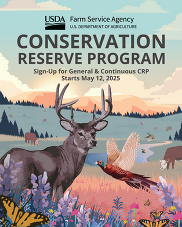
WASHINGTON, May 12, 2025 – The U.S. Department of Agriculture (USDA) today announced several Conservation Reserve Program (CRP) enrollment opportunities for agricultural producers and landowners. USDA’s Farm Service Agency (FSA) is accepting offers for both the General and Continuous CRP beginning today through June 6, 2025.
CRP, USDA’s flagship conservation program, celebrates its 40th anniversary this year. For four decades, CRP has provided financial and technical support to agricultural producers and landowners who place unproductive or marginal cropland under contract for 10-15 years and who agree to voluntarily convert the land to beneficial vegetative cover to improve water quality, prevent soil erosion and support wildlife habitat. The American Relief Act, 2025, extended provisions for CRP through Sept. 30, 2025.
|
General CRP (Signup 64)
Agricultural producers and landowners submit offers for General CRP through a competitive bid process. Offers are ranked and scored, by FSA, using nationally established environmental benefits criteria. USDA will announce accepted offers once ranking and scoring for all offers is completed. In addition to annual rental payments, approved General CRP participants may also be eligible for cost-share assistance to establish long-term, resource-conserving vegetative cover.
Continuous CRP (Signup 63)
Unlike General CRP, Continuous CRP offers are not subject to a competitive bid process. To ensure enrolled acres do not exceed the current statutory cap of 27 million acres, FSA is accepting Continuous CRP offers on a first-come, first-served basis through June 6. However, should allotted CRP acreage remain available following the June 6 deadline, FSA will accept continuous CRP offers from interested landowners through July 31, 2025, and may be subsequently considered for acceptance, in batches, if it’s determined that the offered acres support USDA’s conservation priorities.
Continuous CRP participants voluntarily offer environmentally sensitive lands, typically smaller parcels than offered through General CRP including wetlands, riparian buffers, and varying wildlife habitats. In return, they receive annual rental payments and cost-share assistance to establish long-term, resource-conserving vegetative cover.
Continuous CRP enrollment options:
-
State Acres for Wildlife Enhancement Initiative: Restores vital habitat in order to meet high-priority state wildlife conservation goals.
-
Highly Erodible Land Initiative: Producers and landowners can enroll in CRP to establish long-term cover on highly erodible cropland that has a weighted erodibility index greater than or equal to 20.
-
Clean Lakes, Estuaries and Rivers (CLEAR) Initiative: Prioritizes water quality practices on the land that, if enrolled, will help reduce sediment loadings, nutrient loadings, and harmful algal blooms. The vegetative covers also contribute to increased wildlife populations.
-
CLEAR30 (a component of the CLEAR Initiative): Offers additional incentives for water quality practice adoption and can be accessed in 30-year contracts.
-
Conservation Reserve Enhancement Program: Addresses high priority conservation objectives of states and Tribal governments on agricultural lands in specific geographic areas.
Grassland and Expiring CRP Acres
FSA will announce dates for Grassland CRP signup in the near future.
Additionally, landowners with acres enrolled in CRP set to expire Sept. 30, 2025, can offer acres for re-enrollment beginning today. A producer can offer to enroll new acres into CRP and also offer to re-enroll any acres expiring Sept. 30, 2025.
For more information on CRP participant and land eligibility, approved conservation practices and detailed program fact sheets, visit FSA’s CRP webpage.
More Information
Interested producers should apply through the FSA at their local USDA Service Center.
Signed into law in 1985, CRP is one of the largest voluntary private-lands conservation programs in the United States. Originally intended to primarily control soil erosion and potentially stabilize commodity prices by taking marginal lands out of production, the program has evolved over the years, providing many conservation and economic benefits.
|
|
Landowners and operators are reminded that in order to receive payments from USDA, compliance with Highly Erodible Land (HEL) and Wetland Conservation (WC) provisions are required. Farmers with HEL determined soils are reminded of tillage, crop residue, and rotation requirements as specified per their conservation plan. Producers are to notify the USDA Farm Service Agency prior to breaking sod, clearing land (tree removal), and of any drainage projects (tiling, ditching, etc.) to ensure compliance. Failure to update certification of compliance, with form AD-1026, triggering applicable HEL and/or wetland determinations, for any of these situations, can result in the loss of FSA farm program payments, FSA farm loans, NRCS program payments, and premium subsidy to Federal Crop Insurance administered by RMA.
The USDA Farm Service Agency’s (FSA) Direct Farm Ownership loans can help farmers and ranchers become owner-operators of family farms, improve and expand current operations, increase agricultural productivity, and assist with land tenure to save farmland for future generations.
There are three types of Direct Farm Ownership Loans: regular, down payment and joint financing. FSA also offers a Direct Farm Ownership Microloan option for smaller financial needs up to $50,000.
Joint financing allows FSA to provide more farmers and ranchers with access to capital. FSA lends up to 50 percent of the total amount financed. A commercial lender, a state program or the seller of the property being purchased, provides the balance of loan funds, with or without an FSA guarantee. The maximum loan amount for a joint financing loan is $600,000, and the repayment period for the loan is up to 40 years.
The operation must be an eligible farm enterprise. Farm Ownership loan funds cannot be used to finance nonfarm enterprises and all applicants must be able to meet general eligibility requirements. Loan applicants are also required to have participated in the business operations of a farm or ranch for at least three years out of the 10 years prior to the date the application is submitted. The applicant must show documentation that their participation in the business operation of the farm or ranch was not solely as a laborer.
For more information on FSA farm loans, contact the Farm Loan Team in the Nobles County USDA Service Center at (507) 376-6194 or visit fsa.usda.gov.
|
The Natural Resources Conservation Service (NRCS) works to help farmers, ranchers and forest landowners invest in their operations and local communities to keep working lands working, boost rural economies, increase the competitiveness of American agriculture and improve the quality of our air, water, soil and wildlife habitat.
Simply put – NRCS helps America’s farmers, ranchers and forestland owners make conservation work for them.
Our Conservation Technical Assistance (CTA) program enables every acre of voluntary conservation applied through every program NRCS administers. It is the foundation of our financial and technical assistance delivery system.
Every farm and acre is unique and requires tailored management; and every decision maker has different management concerns and needs. Our technical assistance is one-on-one, personalized advice and support to help producers make the best decisions for their lands – and is offered free of charge.
This personalized assistance provides producers with the science-based data and tools to make informed decisions about where to target efforts to get the greatest return on their investment and ensure the long-term sustainability of American agriculture.
A comprehensive conservation plan is the first step to managing all the natural resources on a farm. NRCS walks the farm with the producer and develops options to address that producer’s needs. Our toolbox includes aerial photos, soil surveys, engineering solutions and individual science-based analysis customized for the producer’s property. The plan we develop with the producer combines existing production methods with recommended conservation practices to best manage that farm’s unique natural resources, while allowing the producer to grow sustainably and productively. Supported by our expert analysis and recommendations, the producer chooses which option best meets their needs. These decisions become the producer’s conservation plan, a step-by-step guide to reach their objectives.
This planning process also makes it easier to identify how and when the farmer, rancher or forest landowner could qualify for Farm Bill financial assistance to help them install conservation systems or receive incentives for trying new ones. We have the expertise to see our customers through this process. Because identifying when, where and how to implement practices is not plug and play.
The final plan provides a roadmap for the producer to meet their natural resource conservation goals. It includes helpful information on each of the producer’s practices, such as how they benefit the farm, how to maintain them, and how they help the soil, water and wildlife.
By developing a conservation plan and adding conservation to the land, farmers, ranchers and forest landowners can protect the land’s ability to provide for their family and future generations.
With offices in communities nationwide, NRCS staff provide the information, tools and delivery systems necessary for producers – in every state and territory – to conserve, maintain and improve their natural resources.
Contact your local USDA service center to find out more.
You have a lot at stake in making sure your crop insurance acreage reporting is accurate and on time. If you fail to report on time, you may not be protected. If you report too much acreage, you may pay too much premium. If you report too little acreage, you may recover less when you file a claim.
Crop insurance agents often say that mistakes in acreage reporting are the easiest way for producers to have an unsatisfactory experience with crop insurance. Don’t depend on your agent to do this important job for you. Your signature on the bottom of the acreage reporting form makes it, legally, your responsibility. Double-check it for yourself. Remember - acreage reporting is your responsibility. Doing it right will save you money. Always get a copy of your report immediately after signing and filing it with your agent and keep it with your records.
Remember, it is your responsibility to report crop damage to your agent within 72 hours of discovery. Never put damaged acreage to another use without prior written consent of the insurance adjuster. You don’t want to destroy any evidence of a possible claim. Learn more by visiting RMA’s website.
|
Important Dates and Deadlines
May 26 - FSA Offices closed in Observance of Memorial Day
May 31 - Deadline to Apply for a Commodity Loan for 2024 Crop - Corn, Soybeans
June 19 - FSA Offices closed in Observance of Juneteenth
July 15 - Deadline to report Spring-Seeded crop acreage
July 15 - Deadline to certify Conservation Reserve Program (CRP) acres

Farm Loan Program Interest Rates
5.125% - Farm Operating Loans, Direct
5.625% - Farm Ownership Loans, Direct
3.625% - Farm Ownership Loans, Joint Financing
1.625% - Farm Ownership Loans, Beginning Farmer Down Payment
Farm Storage Facility Loan Program Interest Rates
3.875% - Farm Storage Facility Loans, 3-Year
4.000% - Farm Storage Facility Loans, 5-Year
4.125% - Farm Storage Facility Loans, 7-Year
4.250% - Farm Storage Facility Loans, 10-Year
4.375% - Farm Storage Facility Loans, 12-Year
May 2025 Commodity Loan Interest Rate
5.000% - Commodity Loans
Jackson County Commodity Loan Rates for 2024 Crop
Commodity Loan Rate
Wheat (HRS) $3.97/bu
Corn $2.06/bu
Soybeans $6.15/bu
|
Lakefield USDA Service Center
601 S Highway 86
Lakefield, MN 56150
Office Hours: Monday-Friday
8:00 AM - 4:30 PM
Phone: 507-662-5203
Fax: 855-823-7648
Email: mnlakefiel-fsa@usda.gov
|
|
FSA County Executive Director
Sarah Pietz
sarah.pietz@usda.gov
Farm Program Analysts
Chantel Christopher
Brittney Dixon
Jadi Johnson
FSA County Committee (COC)
Travis Carter
James Schubert
Jazmin Voehl
Natural Resources Conservation
Service (NRCS)
Phone: 507-662-5203 ext. 3
mnlakefiel-nrcs@usda.gov
District Conservationist
Patrick Toomey
patrick.toomey@usda.gov
|
FSA Farm Loan Program (FLP)
Phone: 507-376-6194
Fax: 855-804-4093
worthingtonfarmloan@usda.gov
Farm Loan Manager
Dawn Weseman
dawn.weseman@usda.gov
Farm Loan Team
Lindsay Bents, Farm Loan Officer
Mic Erlandson, Farm Loan Officer
Raquel Strouth, Farm Loan Officer
Melissa Rogers, Farm Loan Analyst
Jackson County FLP Availability
Raquel Strouth is available in Lakefield on Wednesdays from 7:30AM - 4:00PM
FSA District Director
Jamie Vanderweyst
jamie.vanderweyst@usda.gov
|
|
Next County Committee Meeting: May 22, 2025 @ 8:30 AM
|
Persons with disabilities who require accommodations to attend to participate in meetings should contact Sarah Pietz at (507) 662-5203 extension 2.
|
|






