
South Dakota USDA Newsletter - April 11, 2025
In This Issue:
Greetings,
Although South Dakota (SD) received much-needed moisture in recent weeks, projected forage production remains below normal. Natural Resources Conservation Service (NRCS) and partners have resources available to plan for and mitigate the effects of drought. Rainfall cannot be controlled, but being proactive and creating a drought plan is controllable. Visit the SD NRCS webpage to locate online tools and an office nearest you. An additional resource can be found on SD Grassland Coalition’s drought page.
This year the Conservation Technology Information Center’s Conservation (CTIC) Action Tour is scheduled to be hosted in South Dakota. A national-level organization, this unique planting season tour will focus on soil health, biodiversity, crop production, and innovation. Visit their tour webpage to learn more about this opportunity.
Until next time- a continued thanks to all SD farmers, ranchers, land managers, landowners, and NRCS partners who put their best foot forward every day to move the needle of conservation in our state.
Sincerely,
Tony Sunseri
State Conservationist
USDA-Natural Resources Conservation Service
Top of page
April 15, 2025 - Deadline to enroll in 2025 Agriculture Risk Coverage (ARC) and Price Loss Coverage (PLC)
May 6-7, 2025 - Conservation Technology Information Center’s Conservation in Action Tour, Sioux Falls, SD
May 14, 2025 - NRCS State Technical Committee Meeting
May 26, 2025 - Memorial Day Holiday - USDA Service Centers CLOSED
June 2, 2025 - Final loan availability date for the 2024 crops of: corn, dry peas, grain sorghum, lentils, mustard seed, safflower, chickpeas, soybeans, sunflowers
June 18, 2025 - FSA State Committee Meeting (information below)
Top of page
Agricultural producers who have not yet enrolled in the Agriculture Risk Coverage (ARC) or Price Loss Coverage (PLC) programs for the 2025 crop year have until April 15, 2025, to revise elections and sign contracts. Both safety net programs, delivered by USDA’s Farm Service Agency (FSA), provide vital income support to eligible farmers who experience substantial declines in crop prices or revenues for the 2025 crop year. In South Dakota, producers have completed 57,187 contracts to date, representing 97% of the more than 58,000 expected contracts.
Producers can elect coverage and enroll in ARC-County or PLC, which provide crop-by-crop protection, or ARC-Individual, which protects the entire farm. Although election changes for 2025 are optional, producers must enroll, with a signed contract, each year. If a producer has a multi-year contract on the farm, the contract will continue for 2025 unless an election change is made.
If producers do not submit their election revision by the April 15, 2025, deadline, the election remains the same as their 2024 election for eligible commodities on the farm. Also, producers who do not complete enrollment and sign their contract by the deadline will not be enrolled in ARC or PLC for the 2025 year and will not receive a payment if one is triggered. Farm owners can only enroll in these programs if they have a share interest in the commodity.
Producers are eligible to enroll farms with base acres for the following commodities: barley, canola, large and small chickpeas, corn, crambe, flaxseed, grain sorghum, lentils, mustard seed, oats, peanuts, dry peas, rapeseed, long grain rice, medium and short grain rice, safflower seed, seed cotton, sesame, soybeans, sunflower seed and wheat.
Web-Based Decision Tools
Many universities offer web-based decision tools to help producers make informed, educated decisions using crop data specific to their respective farming operations. Producers are encouraged to use the tool of their choice to support their ARC and PLC elections.
Crop Insurance Considerations
Producers are reminded that enrolling in ARC or PLC programs can impact eligibility for some crop insurance products offered by USDA’s Risk Management Agency (RMA). Producers who elect and enroll in PLC also have the option of purchasing Supplemental Coverage Option (SCO) through their Approved Insurance Provider, but producers of covered commodities who elect ARC are ineligible for SCO on their planted acres.
Unlike SCO, RMA’s Enhanced Coverage Option (ECO) is unaffected by participating in ARC for the same crop, on the same acres. Producers may elect ECO regardless of their farm program election.
Upland cotton farmers who enroll seed cotton base acres in ARC or PLC are ineligible for the stacked income protection plan, or STAX, on their planted cotton acres.
Optimizing FSA Office Visits
Agricultural producers visiting FSA to complete ARC/PLC elections and enrollment are encouraged to also conduct other FSA program business during their scheduled appointment including completing farm loan applications and applying for the recently announced Emergency Commodity Assistance Program (ECAP).
Sign up for ECAP began on March 19, 2025. ECAP, authorized by the American Relief Act, 2025, provides up to $10 billion to agricultural producers for the 2024 crop year. Administered by FSA, ECAP will help agricultural producers mitigate the impacts of increased input costs and falling commodity prices. Congress gave USDA 90 days to implement the program, and that deadline was met. Producers of eligible commodities must submit ECAP applications to their local FSA county office by Aug. 15, 2025. Only one application is required for all ECAP eligible commodities nationwide. ECAP applications can be submitted to FSA in-person, electronically using Box and One-Span, by fax or by applying online at fsa.usda.gov/ecap utilizing a secure login.gov account. For more information, please visit the ECAP website or review the ECAP Fact Sheet.
More details are forthcoming on more than $20 billion to be made available through the American Relief Act, 2025, for producers who suffered losses from natural disasters in 2023 and 2024 including $2 billion set aside for livestock producers and other funds that will be administered through block grants with states.
Top of page
The U.S. Department of Agriculture (USDA) is issuing up to $10 billion directly to agricultural producers through the Emergency Commodity Assistance Program (ECAP) for the 2024 crop year. Administered by USDA’s Farm Service Agency (FSA), ECAP will help agricultural producers mitigate the impacts of increased input costs and falling commodity prices.
Authorized by the American Relief Act, 2025, these economic relief payments are based on planted and prevented planted crop acres for eligible commodities for the 2024 crop year. To streamline and simplify the delivery of ECAP, FSA will begin sending pre-filled applications to producers who submitted acreage reports to FSA for 2024 eligible ECAP commodities soon after the signup period opens on March 19, 2025. Producers do not have to wait for their pre-filled ECAP application to apply. They can visit fsa.usda.gov/ecap to apply using a login.gov account or contact their local FSA office to request an application once the signup period opens.
Eligible Commodities and Payment Rates
The commodities below are eligible for these per-acre payment rates:
|
|
Eligible oilseeds:
|
|
|
|
|
|
|
|
|
|
|
|
|
- Upland cotton & Extra-long staple cotton - $84.74
|
|
- Long & medium grain rice - $76.94
|
|
|
|
|
|
|
|
|
|
|
|
|
|
|
|
|
|
|
|
Producer Eligibility
Eligible producers must report 2024 crop year planted and prevented planted acres to FSA on an FSA-578, Report of Acreage form. Producers who have not previously reported 2024 crop year acreage or filed a notice of loss for prevented planted crops must submit an acreage report by the Aug. 15, 2025, deadline. Eligible producers can visit fsa.usda.gov/ecap for eligibility and payment details.
Applying for ECAP
Producers must submit ECAP applications to their local FSA county office by Aug. 15, 2025. Only one application is required for all ECAP eligible commodities nationwide. ECAP applications can be submitted to FSA in-person, electronically using Box and One-Span, by fax or by applying online at fsa.usda.gov/ecap utilizing a secure login.gov account.
If not already on file for the 2024 crop year, producers must have the following forms on file with FSA:
-
Form AD-2047, Customer Data Worksheet.
-
Form CCC-901, Member Information for Legal Entities (if applicable).
-
Form CCC-902, Farm Operating Plan for an individual or legal entity.
-
Form CCC 943, 75 percent of Average Gross Income from Farming, Ranching, or Forestry Certification (if applicable).
-
AD-1026, Highly Erodible Land Conservation (HELC) and Wetland Conservation (WC) Certification.
-
SF-3881, Direct Deposit.
Except for the new CCC-943, most producers, especially those who have previously participated in FSA programs, likely have these forms on file. However, those who are uncertain and want to confirm the status of their forms or need to submit the new CCC-943, can contact their local FSA county office.
If a producer does not receive a pre-filled ECAP application, and they planted or were prevented from planting ECAP eligible commodities in 2024, they should contact their local FSA office.
ECAP Payments and Calculator
ECAP payments will be issued as applications are approved. Initial ECAP payments will be factored by 85% to ensure that total program payments do not exceed available funding. If additional funds remain, FSA may issue a second payment.
ECAP assistance will be calculated using a flat payment rate for the eligible commodity multiplied by the eligible reported acres. Payments are based on acreage and not production. For acres reported as prevented plant, ECAP assistance will be calculated at 50%.
For ECAP payment estimates, producers are encouraged to visit fsa.usda.gov/ecap to use the ECAP online calculator.
Top of page
The Farm Service Agency’s (FSA) Noninsured Crop Disaster Assistance Program (NAP) provides financial assistance to producers of non-insurable crops, including mechanically harvested forage with NAP coverage, to protect against natural disasters that occur during the coverage, resulting in loss of production, loss of value, or prevented planting of an eligible crop.
If you have NAP coverage on mechanically harvested forage, you must:
- Maintain separate production records for each unit, crop, practice, crop type, and intended use.
- Submit production records to FSA by the designated production reporting date for the crop.
- Notify your FSA administrative county office before grazing, abandoning, or destroying forage acreage reported, on FSA form FSA-578, as intended to be mechanically harvested; and request an appraisal.
- Notify your FSA administrative county office of a loss and timely file CCC-576, Notice of Loss and Application for Payment, Part B, the earlier of:
- 15 calendar days after the disaster occurs, or damage first becomes apparent.
- 15 calendar days after the crop’s normal harvest date.
- If you change your intended use or experience a loss during the coverage period, you must:
- Establish and maintain representative sample areas when an appraisal of the acreage is required.
- Inform your FSA administrative county office of the location of representative sample areas within 15 days of placing the panels.
- Request an appraisal of the representative sample areas at the end of harvest period but before first freeze.
For more information on NAP and NAP compliance requirements you must follow to retain NAP coverage, contact your local USDA service center.
Top of page
If you’re enrolled in the Conservation Reserve (CRP), Agriculture Risk Coverage (ARC) or Price Loss Coverage (PLC) programs, you must protect all cropland and noncropland acres on the farm from wind and water erosion and noxious weeds. By signing CRP, ARC county or individual contracts, and PLC contracts, you agree to effectively control noxious weeds on the farm according to sound agricultural practices. If you fail to take necessary actions to correct a maintenance problem on your farm that is enrolled in ARC or PLC, the County Committee may elect to terminate your contract for the program year.
Contact your local FSA Office with questions.
Top of page
Farm Service Agency (FSA) farm loans are considered progression lending. Unlike loans from a commercial lender, FSA loans are intended to be temporary in nature. Our goal is to help you graduate to commercial credit, and our farm loan staff is available to help borrowers through training and credit counseling.
The FSA team will help borrowers identify their goals to ensure financial success. FSA staff will advise borrowers on developing strategies and a plan to meet your goals and graduate to commercial credit. FSA borrowers are responsible for the success of their farming operation, but FSA staff will help in an advisory role, providing the tools necessary to help you achieve your operational goals and manage your finances.
For more information on FSA farm loan programs, contact your local County USDA Service Center or visit fsa.usda.gov.
Top of page
The Farm Loan team in your County is already working on operating loans for spring 2025 and asks potential borrowers to submit their requests early so they can be timely processed. The farm loan team can help determine which loan programs are best for applicants.
FSA offers a wide range of low-interest loans that can meet the financial needs of any farm operation for just about any purpose. The traditional farm operating and farm ownership loans can help large and small farm operations take advantage of early purchasing discounts for spring inputs as well expenses throughout the year.
Microloans are a simplified loan program that will provide up to $50,000 for both Farm Ownership and Operating Microloans to eligible applicants. These loans, targeted for smaller and non-traditional operations, can be used for operating expenses, starting a new operation, purchasing equipment, and other needs associated with a farming operation. Loans to beginning farmers and members of underserved groups are a priority.
Other types of loans available include:
Marketing Assistance Loans allow producers to use eligible commodities as loan collateral and obtain a 9-month loan while the crop is in storage. These loans provide cash flow to the producer and allow them to market the crop when prices may be more advantageous.
Farm Storage Facility Loans can be used to build permanent structures used to store eligible commodities, for storage and handling trucks, or portable or permanent handling equipment. A variety of structures are eligible under this loan, including bunker silos, grain bins, hay storage structures, and refrigerated structures for vegetables and fruit. A producer may borrow up to $500,000 per loan.
Top of page
April 2025
|
Farm Operating Loans — Direct
|
5.375% |
|
Farm Ownership Loans — Direct
|
5.75% |
|
Farm Ownership Loans — Direct Down Payment, Beginning Farmer or Rancher
|
1.75% |
|
Emergency Loans
|
3.75% |
|
Farm Storage Facility Loans (7 years)
|
4.125% |
Top of page
 The new customer kiosks from USDA’s Farm Service Agency are now available at every county office nationwide. These kiosks help to streamline your visit to your local county office and easily access a variety of features such as signing FSA documents, utilizing the Loan Assistance Tool, browsing USDA programs, accessing the internet, accessing necessary personal information, and signing up for a Login.gov account, which provides access to farmers.gov level two features and other USDA and U.S. Government web resources. Future kiosk functionality enhancements include a customer check-in application, self-service option for FSA program applications and documents, financial inquiries and more.
Learn more about how FSA is modernizing our customer experience. Link to the Ask the Expert Blog
Top of page
The South Dakota Grassland Productivity Outlook maps have been updated for the month of April and can be accessed on the South Dakota (SD) Natural Resources Conservation Service (NRCS) website under Range and Pasture (bit.ly/Range_Pasture). These maps are a product of the SD Drought Tool which utilizes a two-year weighted average of precipitation data to determine a percent of normal production calculation. These numbers are calibrated based on historical clipping data from across the state and the prediction only relates to grassland forage production (not so much cropland) and will not predict forage quality. Producers utilizing this map should consider local conditions when making decisions as the weather stations used to create the map are not equally spread out across each county of the state.
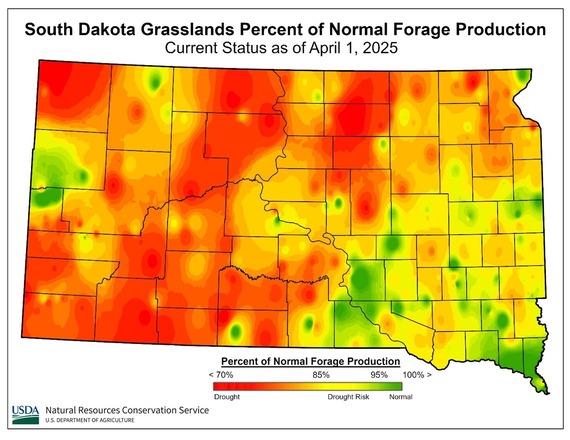 A dry fall and even drier winter have set much of the state up for dry conditions going into the spring. The most significant months for precipitation in our region are April, May, and June – so there is still time for things to turn around! Though the likelihood of higher-than-normal precipitation is not looking good according to sources like the National Weather Services’ 30- and 90-day outlooks.
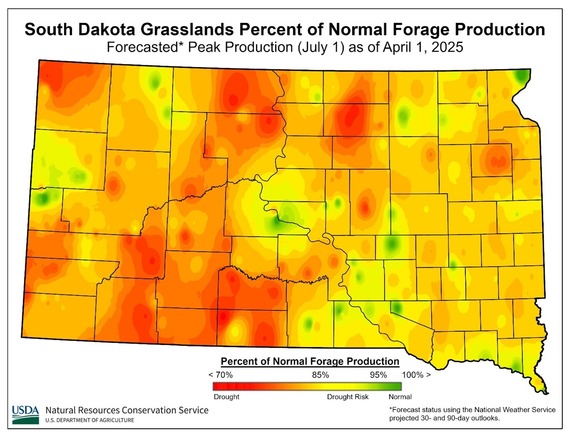 What can a producer do? Consider management adjustments to your grazing operation, review which pastures you grazed last year, and consider alternating start times in those pastures. This helps give plants differing rest periods to help build resiliency. If a pasture was heavily grazed the year prior, consider giving it additional rest or not grazing as heavily this year. Consider combining herds and speeding up your rotation through pastures to give the forage plants additional rest during the growing season as well.
For additional recommendations, visit with a local NRCS conservationist, South Dakota State University extension specialist, or consider asking a mentor through the SD Soil Health Coalition’s mentoring app: Growing Connections or seek out the SD Grassland Coalition’s mentoring network.
The following resources are also available:
SD NRCS Range and Drought page: bit.ly/Range_Pasture
South Dakota Grassland Coalition Drought Planning website: sddroughtplan.org/
National Drought Mitigation Center: drought.unl.edu/ranchplan/Monitor.aspx
National Integrated Drought Information System: drought.gov/
U.S. Drought Monitor: droughtmonitor.unl.edu
South Dakota State University Extension Drought Resources: extension.sdstate.edu/drought
SD Growing Resilience Web page: www.growingresiliencesd.com
SD Grazing Exchange: www.sdgrazingexchange.com/
Top of page
-
South Dakota FSA State Committee Meeting: June 18, 2025, 8:30 a.m. - 4:30 p.m. CT at Federal Building, 200 4th Street SW, Huron, SD 57350.
- Questions? Contact Jean Wharton at jean.wharton@usda.gov.
- If you need to request an accommodation, please contact Jean Wharton at (605) 352-1160 or jean.wharton@usda.gov by June 11, 2025, to request accommodations (e.g., an interpreter, translator, seating arrangements, etc.) or materials in an alternative format (e.g., Braille, large print, audiotape – captioning, etc.).
Top of page
USDA in South Dakota
200 4th Street SW
Huron, SD 57350
FSA Phone: (605) 352-1160
NRCS Phone: (605) 352-1200
RMA Phone: (406) 651-8450
|
|
Get Started at Your USDA Service Center
|
|
Farm Service Agency
Acting State Executive Director:
Ryan Vanden Berge
Administrative Officer:
Theresa Hoadley
Program Managers:
Owen Fagerhaug - Conservation
Logan Kopfmann - Disaster Relief
Donita Garry - Program Delivery
Bridget Weber - Farm Loan Program,
Acting
State Outreach Coordinator:
Gail Gullickson
State Committee:
Troy Knecht, Chair
Peggy Greenway
Larry Olsen
Hank Wonnenberg
|
Natural Resources Conservation
Service
State Conservationist:
Tony Sunseri
Assistant State Conservationists:
Jessica Michalski - Ecological Sciences
James Reedy - Engineering
Nathan Jones - Soils
Val Dupraz - Programs
Colette Kessler - Partnerships
Deke Hobbick - Compliance
Denise Gauer - Management & Strategy
|
|
South Dakota Farm Service Agency
South Dakota Natural Resources Conservation Service
|
|






