April 2025 Arkansas Newsletter - April, 2025.
In This Issue:
Greetings,
Spring is a favorite time for me. The days grow longer, and the temperatures rise, the changing season brings a renewed sense of energy, and fields bursting with new growth, wildlife activity, and the warmth of the sun makes outdoor moments more enjoyable. And it’s time to plant flowers and make a garden!
While spring brings a wealth of hope and opportunity it is also our most active weather season in Arkansas and this year that has certainly been evident. We have seen multiple storm systems affecting much of state. Just in the last few weeks we have seen numerous tornadoes, some very severe and now near record level rainfall and widespread flooding.
I am very thankful that everyone in the Arkansas NRCS and conservation family is safe. There are, however, some USDA staff and many producers and landowners facing a long road to recovery. NRCS can play a key role in the recovery from these events, whether through our Emergency Watershed Protection Program (EWP) or in collaboration with Farm Service Agency (FSA) and the suite of emergency programs they offer.
The storms may be a reminder to us that no matter what is going on around us, focusing on relationships and community are critical. Beautiful weather will return, the waters will recede and hope springs eternal!
Amanda Mathis
NRCS Arkansas State Conservationist
Ask USDA is now available as a tool for FSA customers to ask questions about FSA programs and services.
Ask USDA, available at ask.usda.gov provides information for all USDA programs. Ask USDA allows USDA customers to search for and read answers about FSA programs and services in the same location as they read about other USDA programs and services.
Customers are able to submit questions through email, chat, and phone if they need more information. This improved customer service approach provides a one-stop shopping experience that covers all of USDA’s many programs.
Remember to discuss your USDA Farm Service Agency (FSA) account information only with people you recognize and trust.
If you have questions about your FSA accounts, including your farm loans, contact your local County USDA Service Center or visit fsa.usda.gov.
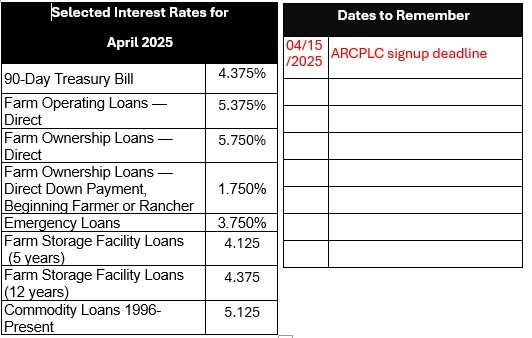
There are options for Farm Service Agency (FSA) loan customers during financial stress. If you are a borrower who is unable to make payments on a loan, contact your local FSA Farm Loan Manager to learn about your options.
FSA offers direct farm ownership and direct farm operating loans to producers who want to establish, maintain, or strengthen their farm or ranch. Direct loans are processed, approved and serviced by FSA loan officers.
Direct farm operating loans can be used to purchase livestock and feed, farm equipment, fuel, farm chemicals, insurance, and other costs including family living expenses. Operating loans can also be used to finance minor improvements or repairs to buildings and to refinance some farm-related debts, excluding real estate.
Direct farm ownership loans can be used to purchase farmland, enlarge an existing farm, construct and repair buildings, and to make farm improvements.
The maximum loan amount for direct farm ownership loans is $600,000 and the maximum loan amount for direct operating loans is $400,000 and a down payment is not required. Repayment terms vary depending on the type of loan, collateral and the producer's ability to repay the loan. Operating loans are normally repaid within seven years and farm ownership loans are not to exceed 40 years.
Please contact your local FSA office for more information or to apply for a direct farm ownership or operating loan.
The U.S. Department of Agriculture (USDA) is issuing up to $10 billion directly to agricultural producers through the Emergency Commodity Assistance Program (ECAP) for the 2024 crop year. Administered by USDA’s Farm Service Agency (FSA), ECAP will help agricultural producers mitigate the impacts of increased input costs and falling commodity prices.
Authorized by the American Relief Act, 2025, these economic relief payments are based on planted and prevented planted crop acres for eligible commodities for the 2024 crop year. To streamline and simplify the delivery of ECAP, FSA will begin sending pre-filled applications to producers who submitted acreage reports to FSA for 2024 eligible ECAP commodities soon after the signup period opens on March 19, 2025. Producers do not have to wait for their pre-filled ECAP application to apply. They can visit fsa.usda.gov/ecap to apply using a login.gov account or contact their local FSA office to request an application once the signup period opens.
Eligible Commodities and Payment Rates
The commodities below are eligible for these per-acre payment rates:
|
|
Eligible oilseeds:
|
|
|
|
|
|
|
|
|
|
|
|
|
- Upland cotton & Extra-long staple cotton - $84.74
|
|
- Long & medium grain rice - $76.94
|
|
|
|
|
|
|
|
|
|
|
|
|
|
|
|
|
|
|
|
Producer Eligibility
Eligible producers must report 2024 crop year planted and prevented planted acres to FSA on an FSA-578, Report of Acreage form. Producers who have not previously reported 2024 crop year acreage or filed a notice of loss for prevented planted crops must submit an acreage report by the Aug. 15, 2025, deadline. Eligible producers can visit fsa.usda.gov/ecap for eligibility and payment details.
Applying for ECAP
Producers must submit ECAP applications to their local FSA county office by Aug. 15, 2025. Only one application is required for all ECAP eligible commodities nationwide. ECAP applications can be submitted to FSA in-person, electronically using Box and One-Span, by fax or by applying online at fsa.usda.gov/ecap utilizing a secure login.gov account.
If not already on file for the 2024 crop year, producers must have the following forms on file with FSA:
-
Form AD-2047, Customer Data Worksheet.
-
Form CCC-901, Member Information for Legal Entities (if applicable).
-
Form CCC-902, Farm Operating Plan for an individual or legal entity.
-
Form CCC 943, 75 percent of Average Gross Income from Farming, Ranching, or Forestry Certification (if applicable).
-
AD-1026 Highly Erodible Land Conservation (HELC) and Wetland Conservation (WC) Certification.
-
SF-3881, Direct Deposit.
Except for the new CCC-943, most producers, especially those who have previously participated in FSA programs, likely have these forms on file. However, those who are uncertain and want to confirm the status of their forms or need to submit the new CCC-943, can contact their local FSA county office.
If a producer does not receive a pre-filled ECAP application, and they planted or were prevented from planting ECAP eligible commodities in 2024, they should contact their local FSA office.
ECAP Payments and Calculator
ECAP payments will be issued as applications are approved. Initial ECAP payments will be factored by 85% to ensure that total program payments do not exceed available funding. If additional funds remain, FSA may issue a second payment.
ECAP assistance will be calculated using a flat payment rate for the eligible commodity multiplied by the eligible reported acres. Payments are based on acreage and not production. For acres reported as prevented plant, ECAP assistance will be calculated at 50%.
For ECAP payment estimates, producers are encouraged to visit fsa.usda.gov/ecap to use the ECAP online calculator.
FSA and NRCS program applicants for benefits are required to submit a completed CCC-902 Farming Operation Plan and CCC-941 Average Gross Income (AGI) Certification and Consent to Disclosure of Tax Information for FSA to determine the applicant’s payment eligibility and establish the maximum payment limitation applicable to the program applicant.
Participants are not required to annually submit new CCC-902s for payment eligibility and payment limitation purposes unless a change in the farming operation occurs that may affect the previous determination of record. A valid CCC-902 filed by the participant is considered to be a continuous certification used for all payment eligibility and payment limitation determinations applicable for the program benefits requested.
Participants are responsible for ensuring that all CCC-902 and CCC-941 and related forms on file in the county office are updated, current, and correct. Participants are required to timely notify the county office of any changes in the farming operation that may affect the previous determination of record by filing a new or updated CCC-902 as applicable.
Changes that may require a new determination include, but are not limited to, a change of:
- Shares of a contract, which may reflect:
- A land lease from cash rent to share rent
- A land lease from share rent to cash rent (subject to the cash rent tenant rule
- A modification of a variable/fixed bushel-rent arrangement
- The size of the producer’s farming operation by the addition or reduction of cropland that may affect the application of a cropland factor
- The structure of the farming operation, including any change to a member's share
- The contribution of farm inputs of capital, land, equipment, active personal labor, and/or active personal management
- Farming interests not previously disclosed on CCC-902 including the farming interests of a spouse or minor child
- Certifications of average AGI are required to be filed annually for participation in an annual USDA program. For multi-year conservation contracts and NRCS easements, a certification of AGI must be filed prior to approval of the contract or easement and is applicable for the duration of the contract period.
Participants are encouraged to file or review these forms within the deadlines established for each applicable program for which program benefits are being requested.
USDA Farm Service Agency (FSA) reminds you to report prevented planted and failed acres in order to establish or retain FSA program eligibility for some programs.
You should report crop acreage you intended to plant, but due to natural disaster, were prevented from planting. Prevented planting acreage must be reported on form CCC-576, Notice of Loss, no later than 15 calendar days after the final planting date as established by FSA and the Risk Management Agency (RMA).
The final planting dates vary by crop, planting period and county so please contact your local FSA office for a list of county-specific planting deadlines.
Additionally, if you have failed acres, you should also use form CCC-576, Notice of Loss, to report failed acres.
For hand-harvested crops and certain perishables, you must notify FSA of damage or loss through the administrative county office within 72 hours of the date of damage or loss first becomes apparent. This notification can be provided by filing a CCC-576, email, fax or phone. If you notify the County Office by any method other than by filing the CCC-576, you are still required to file a CCC-576, Notice of Loss, within the required 15 calendar days.
For losses on crops covered by the Noninsured Crop Disaster Assistance Program (NAP), you must file a Notice of Loss within 15 days of the occurrence of the disaster or when losses become apparent. You must timely file a Notice of Loss for failed acres on all crops including grasses.
To file a Notice of Loss, contact your local County USDA Service Center or visit www.fsa.usda.gov.
A tract of forestland has great potential, but it must be managed well to harness its full benefits. If your woodlands have grown unproductive or overcrowded, consider some simple management techniques like an occasional cutting or thinning to improve them. Improvements to forests are easy – and the best part is, trees typically respond quickly to management techniques.
Thinning is often performed when a forest is overstocked with trees. Cutting the excess trees allows the remaining trees and understory plants to prosper from more sun, water and space. Depending on local markets and the size of the trees, it may be possible to remove and sell the thinned trees to offset the cost of the operation.
Harvest cuttings are used to remove and market logs for profit. Depending on the type of forest you own and your objectives for it, you may want to consider periodic intermediate cuttings to remove some trees of marketable size. Final harvest cutting occurs when the bulk of trees in a stand are removed and sold. After cutting, make sure the land is replanted or has existing younger trees to continue the regeneration of the forest.
USDA’s Natural Resources Conservation Service helps private landowners make their forests healthier through conservation activities, often called small woodlot improvement. In addition to these management techniques, NRCS helps landowners with other forest-related practices, such as using prescribed burning, installing fire lanes and establishing native grasses.
When land is managed well, it not only helps you, the landowner, but spurs other environmental benefits as well. For more information, contact your local county USDA Service Center or visit nrcs.usda.gov.
Healthy soil and plentiful nutrients are key ingredients to productive farms and ranches. But when they move off farms and ranches, they can harm streams and rivers. High concentrations of nutrients in water, such as nitrogen and phosphorus, can be harmful to humans, animals and plants. When the runaway nutrients reach estuaries, they can lead to hypoxic zones, or oxygen-depleted waters.
You can take proactive steps to keep nutrients and soil in their proper places – on the land and out of waterways. Many producers implement filter strips – a belt of plants – at the edge of crop fields and pastures. Producers station these strips in environmentally sensitive areas on a farm or ranch, especially near ditches and other waterways. The strips slow the speed of water flowing over fields following a rainstorm, allowing for the plants to capture sediment and nutrients. The best plants for filter strips have stiff stems and are dense near the ground.
Filter strips not only help the environment, but they can help the producer, too. They provide habitat for wildlife and pollinators. It’s always helpful to lure pollinators, such as bees and butterflies, to a farm because the more pollinators – the better the harvest.
NRCS can help you incorporate conservation practices like filter strips on your farm or ranch. For more information, contact your local USDA Service Center or visit nrcs.usda.gov.
Mulching and composting are two of the most simple and beneficial practices for home lawns, gardens and farms.
Mulching is a protective layer of material that is spread on top of the soil. Mulches can be either organic –grass clippings, straw, bark chips and similar materials – or inorganic –stone, brick chips and plastics.
The benefits of mulching include:
- Protecting soil from erosion;
- Reducing compaction from animal and vehicle traffic;
- Conserving moisture, reducing the need for frequent watering;
- Maintaining a more even soil temperature;
- Preventing weed growth;
- Keeping fruits and vegetables clean;
- Keeping feet clean, allowing access to gardens even when damp; and
- Providing a “finished” look to the garden.
Meanwhile, compost also has ample benefits to the home garden and farm. Compost largely consists of decayed organic matter and is used to add nutrients and condition the soil. Compost is blended with the soil to improve its structure and nutrients so the roots of the plants or crops can more easily penetrate down. This way your plantings will get more nutrients and more access to water.
USDA’s Natural Resources Conservation Service can help you use compost and mulch in many ways. For more information, contact your local county USDA Service Center or visit nrcs.usda.gov.
The U.S. Department of Agriculture (USDA) is bolstering support for farmers facing crop setbacks by announcing an increase in replant payments for most producers beginning with the 2026 crop year. This initiative aims to provide financial assistance to farmers who need to replant insured crops damaged by early insurable causes of loss.
Replant payment factors have not been updated since they were established in the 1990s.
RMA reviewed replant payment factors to ensure they reflect current replanting costs. The agency determined most small grains and coarse grains crops will receive a significant increase. RMA will consider future updates based on new data, further analysis, and stakeholder feedback from these changes.
RMA plans to announce the new replant payments with additional crop insurance improvements in the summer of 2025.
More Information
Crop insurance is sold and delivered solely through private crop insurance agents. A list of crop insurance agents is available at all USDA Service Centers and online at the RMA Agent Locator. Producers can learn more about crop insurance and the modern farm safety net at rma.usda.gov or by contacting their RMA Regional Office.
Top of page
|
USDA Service Centers
Arkansas USDA-FSA
700 West Capitol Room 3416, Little Rock, Arkansas 72201
FSA Acting State Executive Director - Emund Woods
FSA Phone: 501-301-3000 | FSA Fax: 855-652-2082
www.fsa.usda.gov
www.fsa.usda.gov/state-offices/Arkansas/index
Arkansas USDA-NRCS
700 West Capitol Room 3416, Little Rock, Arkansas 72201
NRCS State Conservationist - Amanda Mathis
NRCS Phone: 501-301-3149
www.nrcs.usda.gov
www.ar.nrcs.usda.gov
USDA-RMA / Jackson, Mississippi Regional Office
803 Liberty Road, Jackson, MS 39232-9000
RMA Regional Director – Roddric Bell
RMA Phone: 601-965-4771 | RMA Fax: 601-965-4517
Jackson, Mississippi | RMA (usda.gov)
Please contact your local Office for questions specific to your operation or county. To find contact information for your local office visit the website below: Get Started at Your USDA Service Center | Farmers.gov
Persons with disabilities who require accommodations to attend or participate in this meeting/event should contact Rita Smith-Clay at 501-301-3200 or Federal Relay Service at 1-800-877-8339.
|
|
|
| |
|
|
|
|