
New York FSA Updates - April 8, 2025
Click here to see our current open positions
In This Issue:
|
April 15
|
Agriculture Risk Coverage (ARC) and Price Loss Coverage (PLC) Sign-Up Deadline
|
|
April 22
|
Webinar on USDA Resources for Beginning Farmers in New York State
|
|
June 2
|
Marketing Assistance Loans and Loan Deficiency Payments Deadline for prior year harvested corn, soybeans and other oilseeds and pulse crops
|
|
June 2
|
Acreage reporting deadline for subsequent year nursery crops
|
|
August 15
|
Emergency Commodity Assistance Program Deadline
|

A free webinar will be presented by the U.S. Department of Agriculture’s (USDA) Beginning Farmer team in New York State on USDA Resources for Beginning Farmers. The webinar will be Tuesday, April 22 at noon.
This hour-long webinar is free however pre-registration is required. Everyone who registers will receive a link to a recording of the webinar afterwards. Please register here: https://events.gcc.teams.microsoft.com/event/5471aa06-69f6-4925-bff6-211aefdaf312@ed5b36e7-01ee-4ebc-867e-e03cfa0d4697
According to the 2022 Census of Agriculture, 28% of producers in New York were categorized as beginning farmers, which means they have 10 years or less of experience operating a farm.
To institutionalize support for beginning farmers and ranchers and to build upon prior agency work, the 2018 Farm Bill directed USDA to create a national coordinator position in the agency and state-level teams for four of its agencies – Farm Service Agency (FSA), Natural Resources Conservation Service (NRCS), Risk Management Agency (RMA), and Rural Development (RD).
Feel free to reach out to the Beginning Farmer Team for additional questions. The New York team consists of:
Lynnette Wright – FSA – Lynnette.wright@usda.gov
Christopher Deets – NRCS – Christopher.Deets@usda.gov
Bill Ferris – RMA – William.ferris@usda.gov
The webinar will cover a variety of USDA resources, including farm loans, risk management, disaster assistance, and conservation programs to support farmers, including beginning farmers and ranchers. Additionally, a number of these programs have provisions specifically for beginning farmers, including targeted funding for loans and conservation programs as well as waivers and exemptions. Learn more about USDA’s resources for beginning farmers at www.farmers.gov/beginning-farmers.
If you need an accommodation to participate in this webinar, please contact Lynnette Wright at (315) 477-6309, or by e-mail at lynnette.wright@usda.gov, at least two days prior to the event.
|

Agricultural producers who have not yet enrolled in the Agriculture Risk Coverage (ARC) or Price Loss Coverage (PLC) programs for the 2025 crop year have until April 15, 2025, to revise elections and sign contracts. Both safety net programs, delivered by USDA’s Farm Service Agency (FSA), provide vital income support to eligible farmers who experience substantial declines in crop prices or revenues for the 2025 crop year.
Producers can elect coverage and enroll in ARC-County or PLC, which provide crop-by-crop protection, or ARC-Individual, which protects the entire farm. Although election changes for 2025 are optional, producers must enroll, with a signed contract, each year. If a producer has a multi-year contract on the farm, the contract will continue for 2025 unless an election change is made.
If producers do not submit their election revision by the April 15, 2025, deadline, the election remains the same as their 2024 election for eligible commodities on the farm. Also, producers who do not complete enrollment and sign their contract by the deadline will not be enrolled in ARC or PLC for the 2025 year and will not receive a payment if one is triggered. Farm owners can only enroll in these programs if they have a share interest in the commodity.
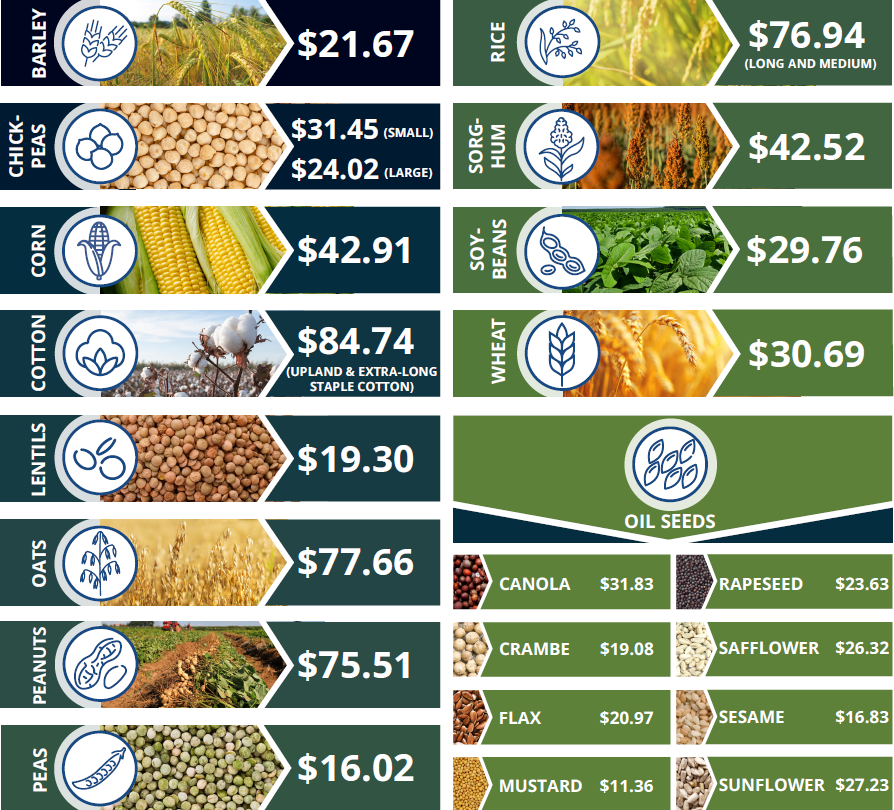
Producers are eligible to enroll farms with base acres for the following commodities: barley, canola, large and small chickpeas, corn, crambe, flaxseed, grain sorghum, lentils, mustard seed, oats, peanuts, dry peas, rapeseed, long grain rice, medium and short grain rice, safflower seed, seed cotton, sesame, soybeans, sunflower seed and wheat.
Web-Based Decision Tools
Many universities offer web-based decision tools to help producers make informed, educated decisions using crop data specific to their respective farming operations. Producers are encouraged to use the tool of their choice to support their ARC and PLC elections.
Crop Insurance Considerations
Producers are reminded that enrolling in ARC or PLC programs can impact eligibility for some crop insurance products offered by USDA’s Risk Management Agency (RMA). Producers who elect and enroll in PLC also have the option of purchasing Supplemental Coverage Option (SCO) through their Approved Insurance Provider, but producers of covered commodities who elect ARC are ineligible for SCO on their planted acres.
Unlike SCO, RMA’s Enhanced Coverage Option (ECO) is unaffected by participating in ARC for the same crop, on the same acres. Producers may elect ECO regardless of their farm program election.
|
The U.S. Department of Agriculture (USDA) is issuing up to $10 billion directly to agricultural producers through the Emergency Commodity Assistance Program (ECAP) for the 2024 crop year. Administered by USDA’s Farm Service Agency (FSA), ECAP will help agricultural producers mitigate the impacts of increased input costs and falling commodity prices.
Authorized by the American Relief Act, 2025, these economic relief payments are based on planted and prevented planted crop acres for eligible commodities for the 2024 crop year. To streamline and simplify the delivery of ECAP, FSA mailed pre-filled applications to producers who submitted acreage reports to FSA for 2024 eligible ECAP commodities. Producers do not have to wait for their pre-filled ECAP application to apply. They can visit fsa.usda.gov/ecap to apply using a login.gov account or contact their local FSA office. If you’ve already applied and then get the mailed application, please disregard it.
Eligible Commodities and Payment Rates
The commodities below are eligible for these per-acre payment rates:
 Producer Eligibility
Eligible producers must report 2024 crop year planted and prevented planted acres to FSA on an FSA-578, Report of Acreage form. Producers who have not previously reported 2024 crop year acreage or filed a notice of loss for prevented planted crops must submit an acreage report by the Aug. 15, 2025, deadline. Eligible producers can visit fsa.usda.gov/ecap for eligibility and payment details.
Applying for ECAP
Producers must submit ECAP applications to their local FSA county office by Aug. 15, 2025. Only one application is required for all ECAP eligible commodities nationwide. ECAP applications can be submitted to FSA in-person, electronically using Box and One-Span, by fax or by applying online at fsa.usda.gov/ecap utilizing a secure login.gov account.
If not already on file for the 2024 crop year, producers must have the following forms on file with FSA:
-
Form AD-2047, Customer Data Worksheet.
-
Form CCC-901, Member Information for Legal Entities (if applicable).
-
Form CCC-902, Farm Operating Plan for an individual or legal entity.
-
Form CCC 943, 75 percent of Average Gross Income from Farming, Ranching, or Forestry Certification (if applicable).
-
AD-1026, Highly Erodible Land Conservation (HELC) and Wetland Conservation (WC) Certification.
-
SF-3881, Direct Deposit.
Except for the new CCC-943, most producers, especially those who have previously participated in FSA programs, likely have these forms on file. However, those who are uncertain and want to confirm the status of their forms or need to submit the new CCC-943, can contact their local FSA county office.
If a producer does not receive a pre-filled ECAP application, and they planted or were prevented from planting ECAP eligible commodities in 2024, they should contact their local FSA office.
ECAP Payments and Calculator
ECAP payments will be issued as applications are approved. Initial ECAP payments will be factored by 85% to ensure that total program payments do not exceed available funding. If additional funds remain, FSA may issue a second payment.
ECAP assistance will be calculated using a flat payment rate for the eligible commodity multiplied by the eligible reported acres. Payments are based on acreage and not production. For acres reported as prevented plant, ECAP assistance will be calculated at 50%.
For ECAP payment estimates, producers are encouraged to visit fsa.usda.gov/ecap to use the ECAP online calculator.

The Farm Service Agency’s (FSA) Farm Storage Facility Loan (FSFL) program provides low-interest financing to help you build or upgrade storage facilities and to purchase portable (new or used) structures, equipment and storage and handling trucks.
Eligible commodities include corn, grain sorghum, rice, soybeans, oats, peanuts, wheat, barley, minor oilseeds harvested as whole grain, pulse crops (lentils, chickpeas and dry peas), hay, honey, renewable biomass, fruits, nuts and vegetables for cold storage facilities, controlled atmosphere storage, floriculture, hops, malted small grains, maple sap, maple syrup, rye, milk, cheese, butter, yogurt, meat and poultry (unprocessed), eggs, and aquaculture (excluding systems that maintain live animals through uptake and discharge of water). Qualified facilities include grain bins, hay barns and cold storage facilities for eligible commodities.
Loans up to $50,000 can be secured by a promissory note/security agreement, loans between $50,000 and $100,000 may require additional security, and loans exceeding $100,000 require additional security.
You do not need to demonstrate the lack of commercial credit availability to apply. The loans are designed to assist a diverse range of farming operations, including small and mid-sized businesses, new farmers, operations supplying local food and farmers markets, non-traditional farm products, and underserved producers.
For more information, contact your local USDA Service Center or visit fsa.usda.gov/pricesupport.
|
In this Ask the Expert, Jack Carlile, Farm Loan Manager for the USDA Farm Service Agency (FSA), answers questions about farm operating loans and when producers should apply in order to secure funds for the current crop year.
As the Farm Loan Manager for the Cherokee County Service Center, Jack is responsible for managing the loan making and loan servicing activities for five counties in northeast Oklahoma. His office provides services for over 650 farm loan customers. Jack was raised on a cross bred cow/calf operation that his grandparents started. Over the years, each generation has added to the operation by purchasing additional pasture. The operation also grows and bales their own hay. Jack’s agriculture background and degree in agriculture economics from Oklahoma State University help him better understand the financing needs of his producers.
Who can apply for FSA Farm Loans?
Anyone can apply for FSA’s loan programs. Applications will be considered on basic eligibility requirements. To apply for a loan, you must meet the following general eligibility requirements including:
- Be a U.S. citizen or qualified alien.
- Operator of a family farm or ranch.
- Have a satisfactory credit history.
- Unable to obtain credit elsewhere at reasonable rates and terms to meet actual needs.
- Not be delinquent on any federal debts.
To read the full blog visit farmers.gov/blog/ask-the-expert-farm-operating-loan-qa-with-jack-carlile.
The USDA Farm Service Agency’s (FSA) Direct Farm Ownership loans can help farmers and ranchers become owner-operators of family farms, improve and expand current operations, increase agricultural productivity, and assist with land tenure to save farmland for future generations.
There are three types of Direct Farm Ownership Loans: regular, down payment and joint financing. FSA also offers a Direct Farm Ownership Microloan option for smaller financial needs up to $50,000.
Joint financing allows FSA to provide more farmers and ranchers with access to capital. FSA lends up to 50 percent of the total amount financed. A commercial lender, a state program or the seller of the property being purchased, provides the balance of loan funds, with or without an FSA guarantee. The maximum loan amount for a joint financing loan is $600,000, and the repayment period for the loan is up to 40 years.
The operation must be an eligible farm enterprise. Farm Ownership loan funds cannot be used to finance nonfarm enterprises and all applicants must be able to meet general eligibility requirements. Loan applicants are also required to have participated in the business operations of a farm or ranch for at least three years out of the 10 years prior to the date the application is submitted. The applicant must show documentation that their participation in the business operation of the farm or ranch was not solely as a laborer.
For more information about farm loans, contact your local USDA Service Center or visit fsa.usda.gov.
|
FSA and NRCS program applicants for benefits are required to submit a completed CCC-902 Farming Operation Plan and CCC-941 Average Gross Income (AGI) Certification and Consent to Disclosure of Tax Information for FSA to determine the applicant’s payment eligibility and establish the maximum payment limitation applicable to the program applicant.
Participants are not required to annually submit new CCC-902s for payment eligibility and payment limitation purposes unless a change in the farming operation occurs that may affect the previous determination of record. A valid CCC-902 filed by the participant is considered to be a continuous certification used for all payment eligibility and payment limitation determinations applicable for the program benefits requested.
Participants are responsible for ensuring that all CCC-902 and CCC-941 and related forms on file in the county office are updated, current, and correct. Participants are required to timely notify the county office of any changes in the farming operation that may affect the previous determination of record by filing a new or updated CCC-902 as applicable.
Changes that may require a new determination include, but are not limited to, a change of:
- Shares of a contract, which may reflect:
-
- A land lease from cash rent to share rent
- A land lease from share rent to cash rent (subject to the cash rent tenant rule
- A modification of a variable/fixed bushel-rent arrangement
- The size of the producer’s farming operation by the addition or reduction of cropland that may affect the application of a cropland factor
- The structure of the farming operation, including any change to a member's share
- The contribution of farm inputs of capital, land, equipment, active personal labor, and/or active personal management
- Farming interests not previously disclosed on CCC-902 including the farming interests of a spouse or minor child
- Certifications of average AGI are required to be filed annually for participation in an annual USDA program. For multi-year conservation contracts and NRCS easements, a certification of AGI must be filed prior to approval of the contract or easement and is applicable for the duration of the contract period.
Participants are encouraged to file or review these forms within the deadlines established for each applicable program for which program benefits are being requested.

The National Environmental Policy Act (NEPA) requires Federal agencies to consider all potential environmental impacts for federally funded projects before the project is approved.
For all Farm Service Agency (FSA) programs, an environmental review must be completed before actions are approved, such as site preparation or ground disturbance. These programs include, but are not limited to, the Emergency Conservation Program (ECP), Farm Storage Facility Loan (FSFL) program and farm loans. If project implementation begins before FSA has completed an environmental review, the request will be denied. Although there are exceptions regarding the Stafford Act and emergencies, it’s important to wait until you receive written approval of your project proposal before starting any actions.
Applications cannot be approved until FSA has copies of all permits and plans. Contact your local FSA office early in your planning process to determine what level of environmental review is required for your program application so that it can be completed timely.
|
The USDA Risk Management Agency’s (RMA) Nursery Value Select (NVS) is a pilot program that allows nursery producers to select the dollar amount of coverage that best fits their risk management needs. NVS is available in all states and counties.
Beginning with the 2026 crop year, NVS will replace the Nursery Field Grown and Container (FG&C) crop insurance program. Nursery FG&C will no longer be available for producers to purchase after the 2025 crop year.
NVS will offer comparable but improved risk management options for those who currently have coverage with the Nursery FG&C program. Like Nursery FG&C, NVS also covers field grown and containerized nursery plants and offers coverage levels between catastrophic and 75%. Unlike Nursery FG&C, NVS has simplified reporting requirements, and an Occurrence Loss Option is available.
The sales closing date for the 2026 crop year is May 1, 2025, or Sept. 1, 2025, depending on location. Producers should contact a local crop insurance agent to learn more about NVS and how they can apply for coverage for the 2026 crop year.
Learn more about crop insurance and the modern farm safety net on the RMA website and the Basics for Beginners webpage. Producers may also contact their RMA Regional Office.
|
Top of page
Farm Service Agency
New York State Office
441 S. Salina St.
Syracuse, NY 13202
Ph: 315-477-6300
http://www.fsa.usda.gov/ny
Click to find your local USDA office.
|
|
Acting State Executive Director
Rob Gallinger
robert.gallinger@usda.gov
|
|
Farm Program Chief:
Jenifer Dean
jenifer.dean@usda.gov
|
Acting Farm Loan Chief:
Christen Trewer
christen.trewer@usda.gov
|
|
New York FSA State Committee
Norman Greig - Chairperson
Larry Eckhardt
Jill Gould
Julian Mangano
Michael McMahon
________________________________________________________
|
|
Current Interest Rates
|
|
Farm Storage Facility Loans:
3 yr - 4.000%
5 yr - 4.125%
7 yr - 4.125%
10 yr -4.250%
12 yr - 4.375%
Commodity Loans: 5.125%
|
Farm Loan Programs:
Farm Operating: 5.375%
Farm Ownership: 5.750%
Conservation Loans: 5.750%
Direct Down Payment: 1.750%
Joint Financing: 3.750%
Emergency Loan: 3.750%
|
|








