In This Issue:
The U.S. Department of Agriculture (USDA) is issuing up to $10 billion directly to agricultural producers through the Emergency Commodity Assistance Program (ECAP) for the 2024 crop year. Administered by USDA’s Farm Service Agency (FSA), ECAP will help agricultural producers mitigate the impacts of increased input costs and falling commodity prices.
Authorized by the American Relief Act, 2025, these economic relief payments are based on planted and prevented planted crop acres for eligible commodities for the 2024 crop year. To streamline and simplify the delivery of ECAP, FSA will begin sending pre-filled applications to producers who submitted acreage reports to FSA for 2024 eligible ECAP commodities soon after the signup period opens on March 19, 2025. Producers do not have to wait for their pre-filled ECAP application to apply. They can visit fsa.usda.gov/ecap to apply using a login.gov account or contact their local FSA office to request an application once the signup period opens.
Eligible Commodities and Payment Rates
The commodities below are eligible for these per-acre payment rates:
|
|
Eligible oilseeds:
|
|
|
|
|
|
|
|
|
|
|
|
|
- Upland cotton & Extra-long staple cotton - $84.74
|
|
- Long & medium grain rice - $76.94
|
|
|
|
|
|
|
|
|
|
|
|
|
|
|
|
|
|
|
|
Producer Eligibility
Eligible producers must report 2024 crop year planted and prevented planted acres to FSA on an FSA-578, Report of Acreage form. Producers who have not previously reported 2024 crop year acreage or filed a notice of loss for prevented planted crops must submit an acreage report by the Aug. 15, 2025, deadline. Eligible producers can visit fsa.usda.gov/ecap for eligibility and payment details.
Applying for ECAP
Producers must submit ECAP applications to their local FSA county office by Aug. 15, 2025. Only one application is required for all ECAP eligible commodities nationwide. ECAP applications can be submitted to FSA in-person, electronically using Box and One-Span, by fax or by applying online at fsa.usda.gov/ecap utilizing a secure login.gov account.
If not already on file for the 2024 crop year, producers must have the following forms on file with FSA:
-
Form AD-2047, Customer Data Worksheet.
-
Form CCC-901, Member Information for Legal Entities (if applicable).
-
Form CCC-902, Farm Operating Plan for an individual or legal entity.
-
Form CCC 943, 75 percent of Average Gross Income from Farming, Ranching, or Forestry Certification (if applicable).
-
AD-1026, Highly Erodible Land Conservation (HELC) and Wetland Conservation (WC) Certification.
-
SF-3881, Direct Deposit.
Except for the new CCC-943, most producers, especially those who have previously participated in FSA programs, likely have these forms on file. However, those who are uncertain and want to confirm the status of their forms or need to submit the new CCC-943, can contact their local FSA county office.
If a producer does not receive a pre-filled ECAP application, and they planted or were prevented from planting ECAP eligible commodities in 2024, they should contact their local FSA office.
ECAP Payments and Calculator
ECAP payments will be issued as applications are approved. Initial ECAP payments will be factored by 85% to ensure that total program payments do not exceed available funding. If additional funds remain, FSA may issue a second payment.
ECAP assistance will be calculated using a flat payment rate for the eligible commodity multiplied by the eligible reported acres. Payments are based on acreage and not production. For acres reported as prevented plant, ECAP assistance will be calculated at 50%.
For ECAP payment estimates, producers are encouraged to visit fsa.usda.gov/ecap to use the ECAP online calculator.
 |
|
Producers are encouraged to call their local NRCS office to schedule an appointment to ensure maximum use of their time and to make sure NRCS staff is available to tend to their important business needs. Please call your local NRCS office ahead to set an appointment and to discuss any records or documentation that might be needed during your appointment. To find your local NRCS office, visit: farmers.gov/service-center-locator. |
Producers who received an Emergency Relief Program (ERP) payment need to meet ERP insurance linkage requirements by purchasing crop insurance, or Noninsured Crop Disaster Assistance Program (NAP) coverage where crop insurance is not available.
Purchase coverage must be at the 60/100 coverage level or higher for insured crops or at the catastrophic coverage level or higher for NAP crops for the next two available crop years, which will be determined from the date you received an ERP payment and may vary depending on the timing and availability of coverage. The insurance coverage requirement applies to the physical location of the county where the crop was located and for which an ERP payment was issued.
Contact your crop insurance agent or local FSA county office as soon as possible to ask about coverage options. Producers who do not obtain the applicable coverage by the sales/application closing date will be required to refund the ERP benefits received on the applicable crop, plus interest. To determine which crops are eligible for federal crop insurance or NAP, visit the RMA website.
For more information, contact your local USDA Service Center or visit fsa.usda.gov.
 USDA’s Natural Resources Conservation Service, Florida State Office has released its Fiscal Year 2024 Annual Report. NRCS received an unprecedented increase in conservation program funding during FY2024 to provide technical and financial assistance to farmers and help them complete conservation practices on their agricultural land. This significantly increased workload across the state to meet program signup obligations, according to NRCS Florida State Conservationist Juan C. Hernandez. In addition, Florida experienced three major hurricanes between August and October, causing increased requests for emergency assistance from affected agricultural landowners.
“Despite these challenges, we did very well in managing our deadlines, with nearly 1,000 conservation program
contracts obligated,” said Hernandez. “We continue to strive for excellence in serving Florida’s farmers, ranchers and agricultural landowners. A huge Thank You goes to our employees and conservation partners for a successful year!”
Some of the highlights in the annual report include:
- Farm Bill program financial assistance payments of nearly $14.76 million. The Environmental Quality Incentives Program (EQIP), Conservation Stewardship Program (CSP), Regional Conservation Partnership Program (RCPP), Agricultural Conservation Easement Program (ACEP), and various initiatives are all funded through the Farm Bill.
- Approximately 16,825 acres of Agricultural Conservation Easements enrolled, bringing Florida NRCS’ total enrolled ACEP easement acreage to 290,252.
- To date, the Regional Conservation Partnership Program (RCPP) has funded 105 RCPP LMR Agreements in Florida, for a cumulative total of nearly $2.14 million on 18,845 acres (since 2018). In FY 2024, three Classic RCPP Projects were awarded to Florida totaling $71.25 million.
- The NRCS Florida Soils team completed the Indian River Subaqueous Soil Survey Special Project, Region Coastal Zone Soil Survey on 46,840 acres.
- NRCS awarded $6,819,650 in Cooperative and Contribution Agreements for Technical Assistance to agricultural producers and landowners in Florida.
Farm Service Agency (FSA) is committed to providing our farm loan borrowers the tools necessary to be successful. FSA staff will provide guidance and counsel from the loan application process through the borrower’s graduation to commercial credit. While it is FSA’s commitment to advise borrowers as they identify goals and evaluate progress, it is crucial for borrowers to communicate with their farm loan staff when changes occur. It is the borrower’s responsibility to alert FSA to any of the following:
- Any proposed or significant changes in the farming operation
- Any significant changes to family income or expenses
- The development of problem situations
- Any losses or proposed significant changes in security
If a farm loan borrower can’t make payments to suppliers, other creditors, or FSA on time, contact your farm loan staff immediately to discuss loan servicing options.
For more information on FSA farm loan programs, contact your local County USDA Service Center or visit fsa.usda.gov.
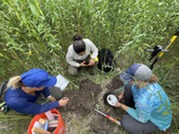
Understanding your specific soil and its dynamic properties, which can change over time due to human impacts, land management, and climate change, can be invaluable. The USDA’s Natural Resources Conservation Service (NRCS), through the National Cooperative Soil Survey (NCSS), has a team of soil and data scientists who are bringing customers the best soil information using the newest technology through the Lab Data Mart.
The Lab Data Mart website, also known as the National Cooperative Lab Characterization Database, brings valuable soil data to the public’s fingertips through a user-friendly, state-of-the-art interactive map. It includes data estimating soil properties such as organic carbon, clay content, calcium carbonate equivalent, and pH, which is beneficial in soil health assessments. Architects, educators, engineers, farmers, landowners, researchers, scientists, and anyone looking to learn more about their soil can access the latest data to make more informed decisions and reduce potential soil risks and hazards.
|
USDA’s Farm Service Agency (FSA) has implemented pre-authorized debit (PAD) for Farm Loan Program (FLP) borrowers. PAD is a voluntary and alternative method for making weekly, bi-weekly, monthly, quarterly, semi-annual or annual payments on loans.
PAD payments are pre-authorized transactions that allow the National Financial and Accounting Operations Center (NFAOC) to electronically collect loan payments from a customer’s account at a financial institution.
PAD may be useful if you use nonfarm income from regular wages or salary to make payments on loans or adjustment offers or for payments from seasonal produce stands. PAD can only be established for future payments.
To request PAD, customers, along with their financial institution, must fill out form RD 3550-28. This form has no expiration date, but a separate form RD 3550-28 must be completed for each loan to which payments are to be applied. A fillable form can be accessed on the USDA Rural Development (RD) website at rd.usda.gov/publications/regulations-guidelines. Click forms and search for “Form 3550-28.”
If you have a “filter” on the account at your financial institution, you will need to provide the financial institution with the following information: Origination ID: 1220040804, Agency Name: USDA RD DCFO.
PAD is offered by FSA at no cost. Check with your financial institution to discuss any potential cost. Preauthorized debit has no expiration date, but you can cancel at any time by submitting a written request to your local FSA office. If a preauthorized debit agreement receives three payment rejections within a three-month period, the preauthorized debit agreement will be cancelled by FSA. The payment amount and due date of your loan is not affected by a cancellation of preauthorized debit. You are responsible to ensure your full payment is made by the due date.
For more information about PAD, contact your local County USDA Service Center or visit fsa.usda.gov.
April 15 - Agriculture Risk Coverage (ARC) Price Loss Coverage (PLC)
April 15 - Emergency Commodity Assistance Program (ECAP)
| Farm Operating - Direct |
5.375% |
| Farm Operating - Microloan |
5.375% |
| Farm Ownership - Direct |
5.750% |
| Farm Ownership - Microloan |
5.750% |
| Farm Ownership - Direct, Joint Financing |
3.750% |
| Farm Ownership - Down Payment |
1.750% |
| Emergency Loan - Amount of Actual Loss |
3.750% |
|








