
West Otter Tail and Wilkin County FSA Office Program Updates - March 19, 2025
In This Issue:
April is almost here but winter weather continues to be in the forecast. Please take some time to review the information below regarding programs that may help assist your farming operation.
Emergency Commodity Assistance Program (ECAP): Signup for the ECAP began on March 19, 2025 and ends on August 15, 2025. Contact the FSA office to apply. See article below on additional details.
2025 ARC/PLC Signup Deadline is April 15, 2025: FSA has announced the 2025 enrollment period for the key safety-net program – Agriculture Risk Coverage (ARC) and Price Loss Coverage (PLC). The enrollment and election period for the 2025 crop year ends on April 15, 2025.
ARC and PLC provide financial protections to farmers from substantial drops in crop prices or revenues and are vital economic safety nets for most American farms. The U.S. Department of Agriculture’s (USDA) Farm Service Agency (FSA) in Minnesota held a public webinar with the University of Minnesota Extension on February 19, 2025. Farmers and others involved in agriculture interested in learning more about the ARCPLC programs and factors to consider when making elections for the 2025 crop year can access the webinar recording at ARCPLC Webinar.
Farm Records & Other Changes: If you are making any changes to your farming operation (land sold/purchased, renting new land, or dropping land) please notify FSA immediately after these changes occur. Updating your records now will save you time when signing up for ARCPLC, reporting your acres, and ensuring maps are ready. FSA is not notified by the County Recorder’s Office of these sales. In addition, notify FSA if your bank account has changed.
Livestock Indemnity Program: A reminder for all livestock producers to keep records throughout the year. It becomes essential to have inventory and loss records when applying for livestock programs. The Livestock Indemnity Program (LIP) provides disaster assistance to livestock owners who experience livestock deaths, in excess of normal mortality, caused by eligible events for calendar year 2025. Please notify the FSA office as soon as possible after livestock losses so the Notice of Loss to start the application process is in place.
As we move through calving season, livestock producers are reminded that it’s critical to keep accurate records of inventory to document all losses year-round. Taking time- and date-stamped video or pictures can serve as evidence. Other common documentation options include:
- Purchase records
- Production records
- Vaccination records
- Bank or other loan documents
- Third-party certification
Commodity Loans: FSA offers a 9-month commodity loan for grain in storage which is a great tool to help finance your operation. If you have 2024 grain in the bin, marketing assistance loans are able to provide interim financing following harvest time to meet cash flow needs without having to sell commodities when market prices are typically at harvest-time lows. Allowing producers to store production at harvest facilitates and allowing for orderly marketing of commodities throughout the year. A commodity loan is also a great end of year tax planning tool. Once you are ready to sell the grain or prior to loan maturity, you can pay off the loan.
Farm Storage Facility Loan Program - Need to Upgrade a Piece of Equipment for Handling Your Commodities? Producers can use the Farm Storage Facility Loan program to purchase farm equipment such as grain and beet carts, multi-axle trucks, semi-truck and trailers, skid steers, grain augers, bins, dryers, propane tanks and much more. If you want to know more about this program and how it might be of value to your operation, email or give us a call. The interest rates are listed below.
Leon Johnson, CED
|

Important Dates and Deadlines:
March 31 – Deadline to enroll in the 2025 Dairy Margin
Coverage (DMC) program
March 31 - Deadline to request Marketing Assistance Loan
(MAL) for prior year harvested wheat, barley,
canola, honey, and oats.
April 15 - Deadline for 2025 Agricultural Risk Coverage (ARC) and Price Loss
Coverage (PLC) enrollment.
May 31 – Deadline to Apply for a Commodity Loan for 2024-Crop Corn, Soybeans,
Sunflowers, & Dry Peas
July 15 - Deadline to timely report 2025 CRP and crop acres
August 15 – Deadline to sign-up into the Emergency Commodity Assistance
Program (ECAP)
|

March Interest Rates
Farm Storage Facility Loan Program Interest Rates
4.250% - Farm Storage Facility Loans, 3-Year
4.375% - Farm Storage Facility Loans, 5-Year
4.500% - Farm Storage Facility Loans, 7-Year
4.500% - Farm Storage Facility Loans, 10-Year
4.625% - Farm Storage Facility Loans, 12-Year
Farm Loan Program - Interest Rates
5.500% - Farm Operating Loans, Direct
5.875% - Farm Ownership Loans, Direct
3.875% - Farm Ownership, Joint Financing
1.875% - Farm Ownership Loans, Beginning Farmer Down Payment
Commodity Loan Interest Rate: 5.250%
|
2024 Commodity Loan Rates:
|
|
Crop
|
West Otter Tail
|
Wilkin
|
|
Corn / bu.
|
$2.09
|
$2.05
|
|
Soybeans / bu.
|
$5.99
|
$6.01
|
|
Wheat / bu.
|
$3.95
|
$3.94
|
|
Sunflowers / cwt
|
$10.14
|
$10.21
|
|
Barley / bu.
|
$2.33
|
$2.38
|
Are you getting TEXT messages from FSA? If not, keep Connected with FSA. With all of the existing programs and new programs becoming available to assist you, I don’t want you to miss out on any of these deadlines. I highly encourage you to sign up for our text message alerts. FSA provides text message alerts (no more than 2 per month) for important reminders and deadlines. Don’t miss out on getting these important reminders! Let’s get you signed up right now!
- Take out your cell-phone
- Create a new text message, send: MNWestOtterTail to 372-669
or MNWilkin to 372-669
- Press send
If you did these 3 easy steps, you are signed up to receive text alerts!
|

Program payments to offset increased input costs, market decline.
U.S. Secretary of Agriculture Brooke Rollins, on National Agriculture Day, announced that the U.S. Department of Agriculture (USDA) is issuing up to $10 billion directly to agricultural producers through the Emergency Commodity Assistance Program (ECAP) for the 2024 crop year. Administered by USDA’s Farm Service Agency (FSA), ECAP will help agricultural producers mitigate the impacts of increased input costs and falling commodity prices.
Authorized by the American Relief Act, 2025, these economic relief payments are based on planted and prevented planted crop acres for eligible commodities for the 2024 crop year. Producers can visit fsa.usda.gov/ecap to apply using a login.gov account or contact their local FSA office to request an application.
Eligible Commodities and Payment Rates
The commodities below are eligible for these per-acre payment rates:
Wheat - $30.69
Corn - $42.91
Sorghum - $42.52
Barley - $21.67
Oats - $77.66
Soybeans - $29.76
Dry peas - $16.02
Lentils - $19.30
Small Chickpeas - $31.45
Large Chickpeas - $24.02 |
Eligible oilseeds:
Canola – $31.83
Crambe – $19.08
Flax - $20.97
Mustard - $11.36
Rapeseed -$23.63
Safflower - $26.32
Sesame - $16.83
Sunflower – $27.23
|
Producer Eligibility
Eligible producers must report 2024 crop year planted and prevented planted acres to FSA on an FSA-578, Report of Acreage form. Producers who have not previously reported 2024 crop year acreage or filed a notice of loss for prevented planted crops must submit an acreage report by the Aug. 15, 2025, deadline. Eligible producers can visit fsa.usda.gov/ecap for eligibility and payment details.
Applying for ECAP
Producers must submit ECAP applications to their local FSA county office by Aug. 15, 2025. Only one application is required for all ECAP eligible commodities nationwide. ECAP applications can be submitted to FSA in-person, electronically using Box and One-Span, by fax or by applying online at fsa.usda.gov/ecap utilizing a secure login.gov account.
If not already on file for the 2024 crop year, producers must have the following forms on file with FSA:
-
Form AD-2047, Customer Data Worksheet.
-
Form CCC-901, Member Information for Legal Entities (if applicable).
-
Form CCC-902, Farm Operating Plan for an individual or legal entity.
- Form CCC 943, 75 percent of Average Gross Income from Farming,
Ranching, or Forestry Certification (if applicable).
-
AD-1026, Highly Erodible Land Conservation (HELC) and Wetland
Conservation (WC) Certification.
-
SF-3881, Direct Deposit.
Except for the new CCC-943, most producers, especially those who have previously participated in FSA programs, likely have these forms on file. However, those who are uncertain and want to confirm the status of their forms or need to submit the new Form-943, can contact their local FSA county office.
If a producer does not receive a pre-filled ECAP application, and they planted or were prevented from planting ECAP eligible commodities in 2024, they should contact their local FSA office.
ECAP Payments and Calculator
ECAP payments will be issued as applications are approved. Initial ECAP payments will be factored by 85% to ensure that total program payments do not exceed available funding. If additional funds remain, FSA may issue a second payment.
ECAP assistance will be calculated using a flat payment rate for the eligible commodity multiplied by the eligible reported acres. Payments are based on acreage and not production. For acres reported as prevented plant, ECAP assistance will be calculated at 50%.
For ECAP payment estimates, producers are encouraged to visit fsa.usda.gov/ecap to use the ECAP online calculator.
|
Top of page

The Natural Resources Conservation Service (NRCS) works to help farmers, ranchers and forest landowners invest in their operations and local communities to keep working lands working, boost rural economies, increase the competitiveness of American agriculture and improve the quality of our air, water, soil and wildlife habitat.
Simply put – NRCS helps America’s farmers, ranchers and forestland owners make conservation work for them.
Our Conservation Technical Assistance (CTA) program enables every acre of voluntary conservation applied through every program NRCS administers. It is the foundation of our financial and technical assistance delivery system.
Every farm and acre is unique and requires tailored management; and every decision maker has different management concerns and needs. Our technical assistance is one-on-one, personalized advice and support to help producers make the best decisions for their lands – and is offered free of charge.
This personalized assistance provides producers with the science-based data and tools to make informed decisions about where to target efforts to get the greatest return on their investment and ensure the long-term sustainability of American agriculture. A comprehensive conservation plan is the first step to managing all the natural resources on a farm. NRCS walks the farm with the producer and develops options to address that producer’s needs. Our toolbox includes aerial photos, soil surveys, engineering solutions and individual science-based analysis customized for the producer’s property. The plan we develop with the producer combines existing production methods with recommended conservation practices to best manage that farm’s unique natural resources, while allowing the producer to grow sustainably and productively. Supported by our expert analysis and recommendations, the producer chooses which option best meets their needs. These decisions become the producer’s conservation plan, a step-by-step guide to reach their objectives.
This planning process also makes it easier to identify how and when the farmer, rancher or forest landowner could qualify for Farm Bill financial assistance to help them install conservation systems or receive incentives for trying new ones. We have the expertise to see our customers through this process. Because identifying when, where and how to implement practices is not plug and play.
The final plan provides a roadmap for the producer to meet their natural resource conservation goals. It includes helpful information on each of the producer’s practices, such as how they benefit the farm, how to maintain them, and how they help the soil, water and wildlife.
By developing a conservation plan and adding conservation to the land, farmers, ranchers and forest landowners can protect the land’s ability to provide for their family and future generations.
With offices in communities nationwide, NRCS staff provide the information, tools and delivery systems necessary for producers – in every state and territory – to conserve, maintain and improve their natural resources.
Contact your local USDA service center to find out more.
|
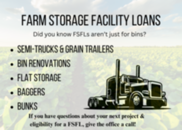
In this Ask the Expert, Toni Williams answers questions about how Farm Storage Facility Loans (FSFLs) provide low-interest financing to help producers build or upgrade commodity storage facilities. Toni is the Agricultural Program Manager for FSFLs at the Farm Service Agency (FSA).
Toni has worked for FSA for more than 32 years and is responsible for providing national policy and guidance for Farm Storage Facility Loans.
What are Farm Storage Facility Loans?
Farm Storage Facility Loans provide low-interest financing for eligible producers to build or upgrade facilities to store commodities.
The FSFL program was created in May 2000 to address an existing grain shortage. Historically, FSFLs benefitted grain farmers, but a change in the 2008 Farm Bill extended the program to fruit and vegetable producers for cold storage. An additional change extended the program to washing and packing sheds, where fresh produce is washed, sorted, graded, labeled, boxed up, and stored before it heads to market. Since May 2000, FSA has made more than 40,000 loans for on-farm storage.
Eligible facility types include grain bins, hay barns, bulk tanks, and facilities for cold storage. Drying and handling and storage equipment including storage and handling trucks are also eligible. Eligible facilities and equipment may be new or used, permanently affixed or portable.
To read the full blog visit farmers.gov/blog/ask-the-expert-qa-on-farm-storage-facility-loans-with-toni-williams.
|
Top of page
West Otter Tail & Wilkin County
USDA Service Centers
Service Center Radio Program
KBRF 1250 AM - Wednesday Morning's at 6:20 AM
|
West Otter Tail County USDA Service Center
506 Western Ave N
Fergus Falls MN 56537
Phone: 218-739-4694
FAX: 855-739-3982
FSA Office Email: mnfergusfa-fsa@usda.gov
NRCS Office Email: mnfergusfa-nrcs@usda.gov
| Renee Nelson, Minority Advisor |
|
| FSA Farm Program Analysts |
NRCS Staff |
| Vicki Hull |
Dalton Skonseng, |
| Bernie Schleske |
District Conservationist |
| Abigail Fronning |
dalton.skonseng@usda.gov |
| Logan Frigaard |
|
| |
Micayla Nelson, Soil Conservationist |
| FSA Farm Loan Program Staff |
micayla.nelson@usda.gov |
| FergusFallsFarmLoan@usda.gov |
|
| Micah Bengtson, Farm Loan Officer |
|
| Jason Winkels, Farm Loan Officer |
|
| Shelby Bengtson, Farm Loan Analyst |
|
| |
|
| FSA County Committee |
Next COC Meeting: |
| Paul Dubbels, Chairperson |
To Be Determined |
| Travis Grefsrud, Vice Chairperson |
|
| John Wold, Member |
|
|
Wilkin County USDA Service Center
1150 Highway 75 North Suite 1
Breckenridge MN 56520
Phone: 218-643-1536
FAX: 855-771-5571
FSA Office Email: mnbreckenr-fsa@usda.gov
NRCS Office Email: mnbreckenr-nrcs@usda.gov
| FSA Farm Program Analysts |
NRCS Staff |
| Mary Norman |
Jamieson Volk, District Conservationist |
| Patty Moses |
jamieson.volk@usda.gov |
| |
|
| FSA County Committee |
Next COC Meeting: |
| David Simmer, Chairperson |
To Be Determined |
| Vance Johnson, Vice Chairperson |
|
| Mike Friederichs, Member |
|
| Marissa Moxness, Minority Advisor |
|
|
Persons with disabilities who require accommodations to attend or participate in any meeting should contact Leon Johnson at 218-739-4694 or 218-643-1536 or leon.johnson@usda.gov or dial 7-1-1 to access telecommunication relay services.
|
|






