
FSA NEWSLETTER -- February, 2025
 In This Issue:
U.S. Secretary of Agriculture Brooke Rollins, on National Agriculture Day, announced that the U.S. Department of Agriculture (USDA) is issuing up to $10 billion directly to agricultural producers through the Emergency Commodity Assistance Program (ECAP) for the 2024 crop year. Administered by USDA’s Farm Service Agency (FSA), ECAP will help agricultural producers mitigate the impacts of increased input costs and falling commodity prices.
Authorized by the American Relief Act, 2025, these economic relief payments are based on planted and prevented planted crop acres for eligible commodities for the 2024 crop year. To streamline and simplify the delivery of ECAP, FSA will begin sending pre-filled applications to producers who submitted acreage reports to FSA for 2024 eligible ECAP commodities soon after the signup period opens on March 19, 2025. Producers do not have to wait for their pre-filled ECAP application to apply. They can visit fsa.usda.gov/ecap to apply using a login.gov account or contact their local FSA office to request an application once the signup period opens.
Eligible Commodities and Payment Rates
The commodities below are eligible for these per-acre payment rates:
|
· Wheat - $30.69
|
Eligible oilseeds:
|
|
· Corn - $42.91
|
· Canola – $31.83
|
|
· Sorghum - $42.52
|
· Crambe – $19.08
|
|
· Barley - $21.67
|
· Flax - $20.97
|
|
· Oats - $77.66
|
· Mustard - $11.36
|
|
· Upland cotton & Extra-long staple cotton - $84.74
|
· Rapeseed -$23.63
|
|
· Long & medium grain rice - $76.94
|
· Safflower - $26.32
|
|
· Peanuts - $75.51
|
· Sesame - $16.83
|
|
· Soybeans - $29.76
|
· Sunflower – $27.23
|
|
· Dry peas - $16.02
|
|
|
· Lentils - $19.30
|
|
|
· Small Chickpeas - $31.45
|
|
|
· Large Chickpeas - $24.02
|
|
Producer Eligibility
Eligible producers must report 2024 crop year planted and prevented planted acres to FSA on an FSA-578, Report of Acreage form. Producers who have not previously reported 2024 crop year acreage or filed a notice of loss for prevented planted crops must submit an acreage report by the Aug. 15, 2025, deadline. Eligible producers can visit fsa.usda.gov/ecap for eligibility and payment details.
Applying for ECAP
Producers must submit ECAP applications to their local FSA county office by Aug. 15, 2025. Only one application is required for all ECAP eligible commodities nationwide. ECAP applications can be submitted to FSA in-person, electronically using Box and One-Span, by fax or by applying online at fsa.usda.gov/ecap utilizing a secure login.gov account.
If not already on file for the 2024 crop year, producers must have the following forms on file with FSA:
-
Form AD-2047, Customer Data Worksheet.
-
Form CCC-901, Member Information for Legal Entities (if applicable).
-
Form CCC-902, Farm Operating Plan for an individual or legal entity.
- Form CCC 943, 75 percent of Average Gross Income from Farming, Ranching, or Forestry Certification (if applicable).
-
AD-1026, Highly Erodible Land Conservation (HELC) and Wetland Conservation (WC) Certification.
-
SF-3881, Direct Deposit.
Except for the new CCC-943, most producers, especially those who have previously participated in FSA programs, likely have these forms on file. However, those who are uncertain and want to confirm the status of their forms or need to submit the new Form-943, can contact their local FSA county office.
If a producer does not receive a pre-filled ECAP application, and they planted or were prevented from planting ECAP eligible commodities in 2024, they should contact their local FSA office.
ECAP Payments and Calculator
ECAP payments will be issued as applications are approved. Initial ECAP payments will be factored by 85% to ensure that total program payments do not exceed available funding. If additional funds remain, FSA may issue a second payment.
ECAP assistance will be calculated using a flat payment rate for the eligible commodity multiplied by the eligible reported acres. Payments are based on acreage and not production. For acres reported as prevented plant, ECAP assistance will be calculated at 50%.
For ECAP payment estimates, producers are encouraged to visit fsa.usda.gov/ecap to use the ECAP online calculator.
Agricultural producers who have not yet enrolled in the Agriculture Risk Coverage (ARC) or Price Loss Coverage (PLC) programs for the 2025 crop year have until April 15, 2025, to revise elections and sign contracts. Both safety net programs, delivered by USDA’s Farm Service Agency (FSA), provide vital income support to eligible farmers who experience substantial declines in crop prices or revenues for the 2025 crop year. In State, producers have completed 24,443 contracts to date, representing 51.6% of the more than 47,000 expected contracts.
Producers can elect coverage and enroll in ARC-County or PLC, which provide crop-by-crop protection, or ARC-Individual, which protects the entire farm. Although election changes for 2025 are optional, producers must enroll, with a signed contract, each year. If a producer has a multi-year contract on the farm, the contract will continue for 2025 unless an election change is made.
If producers do not submit their election revision by the April 15, 2025, deadline, the election remains the same as their 2024 election for eligible commodities on the farm. Also, producers who do not complete enrollment and sign their contract by the deadline will not be enrolled in ARC or PLC for the 2025 year and will not receive a payment if one is triggered. Farm owners can only enroll in these programs if they have a share interest in the commodity.
Producers are eligible to enroll farms with base acres for the following commodities: barley, canola, large and small chickpeas, corn, crambe, flaxseed, grain sorghum, lentils, mustard seed, oats, peanuts, dry peas, rapeseed, long grain rice, medium and short grain rice, safflower seed, seed cotton, sesame, soybeans, sunflower seed and wheat.
Web-Based Decision Tools
Many universities, including enter local/partner university or universities if applicable (optional), offer web-based decision tools to help producers make informed, educated decisions using crop data specific to their respective farming operations. Producers are encouraged to use the tool of their choice to support their ARC and PLC elections.
Crop Insurance Considerations
Producers are reminded that enrolling in ARC or PLC programs can impact eligibility for some crop insurance products offered by USDA’s Risk Management Agency (RMA). Producers who elect and enroll in PLC also have the option of purchasing Supplemental Coverage Option (SCO) through their Approved Insurance Provider, but producers of covered commodities who elect ARC are ineligible for SCO on their planted acres.
Unlike SCO, RMA’s Enhanced Coverage Option (ECO) is unaffected by participating in ARC for the same crop, on the same acres. Producers may elect ECO regardless of their farm program election.
Upland cotton farmers who enroll seed cotton base acres in ARC or PLC are ineligible for the stacked income protection plan, or STAX, on their planted cotton acres.
Optimizing FSA Office Visits
Agricultural producers visiting FSA to complete ARC/PLC elections and enrollment are encouraged to also conduct other FSA program business during their scheduled appointment including completing farm loan applications and applying for the recently announced Emergency Commodity Assistance Program (ECAP).
Sign up for ECAP began on March 19, 2025. ECAP, authorized by the American Relief Act, 2025, provides up to $10 billion to agricultural producers for the 2024 crop year. Administered by FSA, ECAP will help agricultural producers mitigate the impacts of increased input costs and falling commodity prices. Congress gave USDA 90 days to implement the program, and that deadline was met. Producers of eligible commodities must submit ECAP applications to their local FSA county office by Aug. 15, 2025. Only one application is required for all ECAP eligible commodities nationwide. ECAP applications can be submitted to FSA in-person, electronically using Box and One-Span, by fax or by applying online at fsa.usda.gov/ecap utilizing a secure login.gov account. For more information, please visit the ECAP website or review the ECAP Fact Sheet.
More details are forthcoming on more than $20 billion to be made available through the American Relief Act, 2025, for producers who suffered losses from natural disasters in 2023 and 2024 including $2 billion set aside for livestock producers and other funds that will be administered through block grants with states.
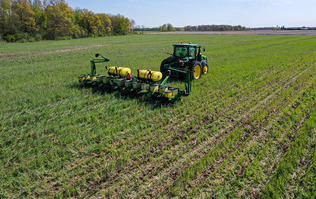
FSA guaranteed loans allow lenders to provide agricultural credit to farmers who do not meet the lender's normal underwriting criteria. Farmers and ranchers apply for a guaranteed loan through a lender, and the lender arranges for the guarantee. FSA can guarantee up to 95 percent of the loss of principal and interest on a loan. Guaranteed loans can be used for both farm ownership and operating purposes.
Guaranteed farm ownership loans can be used to purchase farmland, construct or repair buildings, develop farmland to promote soil and water conservation or to refinance debt.
Guaranteed operating loans can be used to purchase livestock, farm equipment, feed, seed, fuel, farm chemicals, insurance and other operating expenses.
FSA can guarantee farm ownership and operating loans up to $2,251,000. Repayment terms vary depending on the type of loan, collateral and the producer's ability to repay the loan. Operating loans are normally repaid within seven years and farm ownership loans are not to exceed 40 years.
|
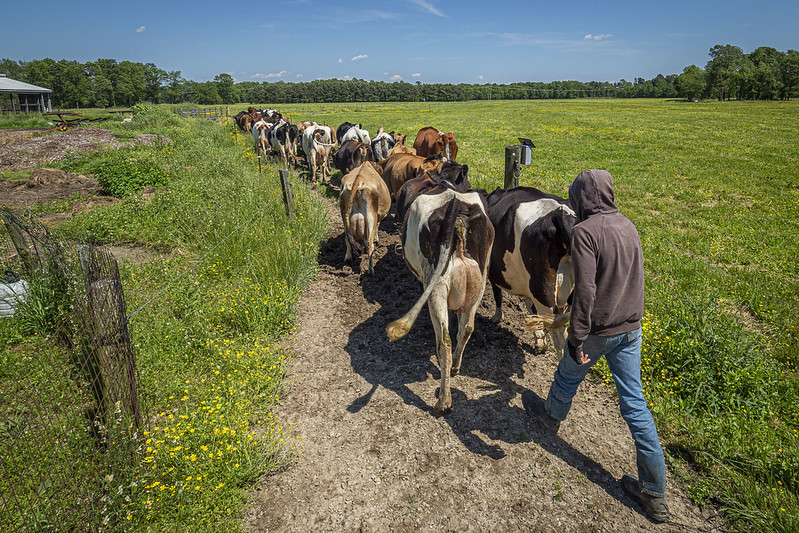 |
The U.S. Department of Agriculture (USDA) is encouraging dairy producers to enroll in Dairy Margin Coverage (DMC), an important safety net program that helps offset milk and feed price differences. This year’s DMC signup began Jan. 29 and the deadline to enroll is March 31, 2025.
The American Relief Act, 2025 extended provisions of the Agricultural Improvement Act of 2018 (2018 Farm Bill) authorizing DMC for coverage year 2025.
DMC provides dairy operations with risk management coverage that pays producers when the difference (the margin) between the national price of milk and the average cost of feed falls below a certain level selected by the program participants.
DMC offers different levels of coverage minus a $100 administrative fee. The administrative fee is waived for dairy producers who are considered limited resource, beginning, socially disadvantaged or a military veteran.
DMC payments are calculated using updated feed and premium hay costs, making the program more reflective of actual dairy producer expenses. These updated feed calculations use 100% premium alfalfa hay.
For more information on DMC, visit the DMC webpage or contact your local USDA Service Center.
Top of page
USDA Oklahoma State Office
100 USDA
Stillwater, Oklahoma 74074
Farm Service Agency: 405-742-1130
|
| |
|
Deputy State Executive Director
Jaramie Karcher
Jaramie.Karcher@usda.gov
FSA Executive Officer
Janlyn Elwood
Janlyn.Elwood@usda.gov
State Committee Members:
Jerry McPeak, Chairman
Don Schieber
Carly Griffith-Hotvedt
Leon Barrett
Tom Abernathy
|
State Conservationist
Jeanne Jasper
FSA Farm Loan Chief
Larry Daniel
Larry.Daniel@usda.gov
State Office Program Chiefs:
J.D Elwood, Production and Payment Eligibility
Tyler Castonguay, Compliance
Kimberly Haines, Conservation
Madeline Alewine, Public Relations and Outreach
|
| |
|






