Ohio FSA State Newsletter - March 24, 2025
In This Edition of the Ohio FSA State Newsletter:
With the arrival of March, comes a great deal of activity that is occurring in our county offices, please take a moment to consider whether you have business that needs to be addressed with your County FSA office.
On March 19, 2025, U.S. Secretary of Agriculture Brooke Rollins, on National Agriculture Day, announced that the U.S. Department of Agriculture (USDA) is issuing up to $10 billion directly to agricultural producers through the Emergency Commodity Assistance Program (ECAP) for the 2024 crop year. The program officially started March 19 and runs through August 15, 2025. This is being administered by the USDA Farm Service Agency (FSA). ECAP will help agricultural producers mitigate the impacts of increased input costs and falling commodity prices. Additional information about ECAP is available in our March newsletter and producers can visit the ECAP webpage at: https://www.fsa.usda.gov/ecap
The USDA is encouraging dairy producers to enroll in Dairy Margin Coverage (DMC), an important safety net program that helps offset milk and feed price differences. This year’s DMC deadline to enroll is March 31, for coverage year 2025. DMC is a voluntary risk management program that offers protection to dairy producers when the difference between the all-milk price and the average feed price (the margin) falls below a certain dollar amount selected by the producer. DMC offers different levels of coverage, even an option that is free to producers, minus a $100 administrative fee. The administrative fee is waived for dairy producers who are considered limited resource, beginning, socially disadvantaged or a military veteran. DMC payments are calculated using updated feed and premium hay costs, making the program more reflective of actual dairy producer expenses. For more information on DMC, visit the DMC webpage.
FSA continues accepting enrollments and elections for the Agriculture Risk Coverage (ARC) and Price Loss Coverage (PLC) for 2025 to April 15. Producers can elect coverage and enroll in ARC-County (ARC-CO) or PLC, which provide crop-by-crop protection, or ARC-Individual (ARC-IC), which protects the entire farm. Although election changes for 2025 are optional, producers must enroll through a signed contract each year. Also, if a producer has a multi-year contract on the farm it will continue for 2025 unless an election change is made. If producers do not submit their election revision by the April 15 deadline, their election remains the same as their 2024 election for commodities on the farm from the prior year. Farm owners cannot enroll in either program unless they have a share interest in the cropland.
Additional program details and more in-depth information is provided in our newsletter. Please don’t hesitate to contact your County FSA office for questions about our programs, loans and information that is included in this newsletter edition.
Program payments to offset increased input costs, market decline
U.S. Secretary of Agriculture Brooke Rollins, on National Agriculture Day, announced that the U.S. Department of Agriculture (USDA) is issuing up to $10 billion directly to agricultural producers through the Emergency Commodity Assistance Program (ECAP) for the 2024 crop year. Administered by USDA’s Farm Service Agency (FSA), ECAP will help agricultural producers mitigate the impacts of increased input costs and falling commodity prices.
Authorized by the American Relief Act, 2025, these economic relief payments are based on planted and prevented planted crop acres for eligible commodities for the 2024 crop year. To streamline and simplify the delivery of ECAP, FSA will begin sending pre-filled applications to producers who submitted acreage reports to FSA for 2024 eligible ECAP commodities soon after the signup period opens on March 19, 2025. Producers do not have to wait for their pre-filled ECAP application to apply. They can visit fsa.usda.gov/ecap to apply using a login.gov account or contact their local FSA office to request an application once the signup period opens.
Eligible Commodities and Payment Rates
The commodities below are eligible for these per-acre payment rates:
|
Wheat - $30.69
|
Eligible oilseeds:
|
|
Corn - $42.91
|
Canola – $31.83
|
|
Sorghum - $42.52
|
Crambe – $19.08
|
|
Barley - $21.67
|
Flax - $20.97
|
|
Oats - $77.66
|
Mustard - $11.36
|
|
Upland cotton & Extra-long staple cotton - $84.74
|
Rapeseed -$23.63
|
|
Long & medium grain rice - $76.94
|
Safflower - $26.32
|
|
Peanuts - $75.51
|
Sesame - $16.83
|
|
Soybeans - $29.76
|
Sunflower – $27.23
|
|
Dry peas - $16.02
|
|
|
Small Chickpeas - $31.45
|
|
|
Large Chickpeas - $24.02
|
|
|
Lentils - $19.30
|
|
Producer Eligibility
Eligible producers must report 2024 crop year planted and prevented planted acres to FSA on an FSA-578, Report of Acreage form. Producers who have not previously reported 2024 crop year acreage or filed a notice of loss for prevented planted crops must submit an acreage report by the Aug. 15, 2025, deadline. Eligible producers can visit fsa.usda.gov/ecap for eligibility and payment details.
Applying for ECAP
Producers must submit ECAP applications to their local FSA county office by Aug. 15, 2025. Only one application is required for all ECAP eligible commodities nationwide. ECAP applications can be submitted to FSA in-person, electronically using Box and One-Span, by fax or by applying online at fsa.usda.gov/ecap utilizing a secure login.gov account.
If not already on file for the 2024 crop year, producers must have the following forms on file with FSA:
-
Form AD-2047, Customer Data Worksheet.
-
Form CCC-901, Member Information for Legal Entities (if applicable).
-
Form CCC-902, Farm Operating Plan for an individual or legal entity.
- Form CCC 943, 75 percent of Average Gross Income from Farming, Ranching, or Forestry Certification (if applicable).
-
AD-1026, Highly Erodible Land Conservation (HELC) and Wetland Conservation (WC) Certification.
-
SF-3881, Direct Deposit.
Except for the new CCC-943, most producers, especially those who have previously participated in FSA programs, likely have these forms on file. However, those who are uncertain and want to confirm the status of their forms or need to submit the new Form-943, can contact their local FSA county office.
If a producer does not receive a pre-filled ECAP application, and they planted or were prevented from planting ECAP eligible commodities in 2024, they should contact their local FSA office.
ECAP Payments and Calculator
ECAP payments will be issued as applications are approved. Initial ECAP payments will be factored by 85% to ensure that total program payments do not exceed available funding. If additional funds remain, FSA may issue a second payment.
ECAP assistance will be calculated using a flat payment rate for the eligible commodity multiplied by the eligible reported acres. Payments are based on acreage and not production. For acres reported as prevented plant, ECAP assistance will be calculated at 50%.
For ECAP payment estimates, producers are encouraged to visit fsa.usda.gov/ecap to use the ECAP online calculator.
Dairy producers are Encouraged to Apply for DMC by March 31 for 2025 Crop Year
The U.S. Department of Agriculture (USDA) is encouraging dairy producers to enroll in Dairy Margin Coverage (DMC), an important safety net program that helps offset milk and feed price differences. This year’s DMC signup began Jan. 29 and the deadline to enroll is March 31, 2025.
The American Relief Act, 2025 extended provisions of the Agricultural Improvement Act of 2018 (2018 Farm Bill) authorizing DMC for coverage year 2025.
DMC provides dairy operations with risk management coverage that pays producers when the difference (the margin) between the national price of milk and the average cost of feed falls below a certain level selected by the program participants.
DMC offers different levels of coverage minus a $100 administrative fee. The administrative fee is waived for dairy producers who are considered limited resource, beginning, socially disadvantaged or a military veteran.
DMC payments are calculated using updated feed and premium hay costs, making the program more reflective of actual dairy producer expenses.
For more information on DMC, visit the DMC webpage or contact their County USDA Service Center.
The Ohio Department of Agriculture (ODA) announced the sign-up period for farmers to apply for state drought relief funding will close April 1, 2025. Extreme weather conditions throughout the spring and summer significantly impacted Ohio’s agricultural producers.
Governor DeWine signed Senate Bill 54 into law in December of 2024, which allocated state funding to provide relief to producers who faced challenging, persistent conditions. The legislation was spearheaded by State Representative Don Jones (Freeport), former State Representative Jay Edwards (Nelsonville) and State Senator Brian Chavez (Marietta).
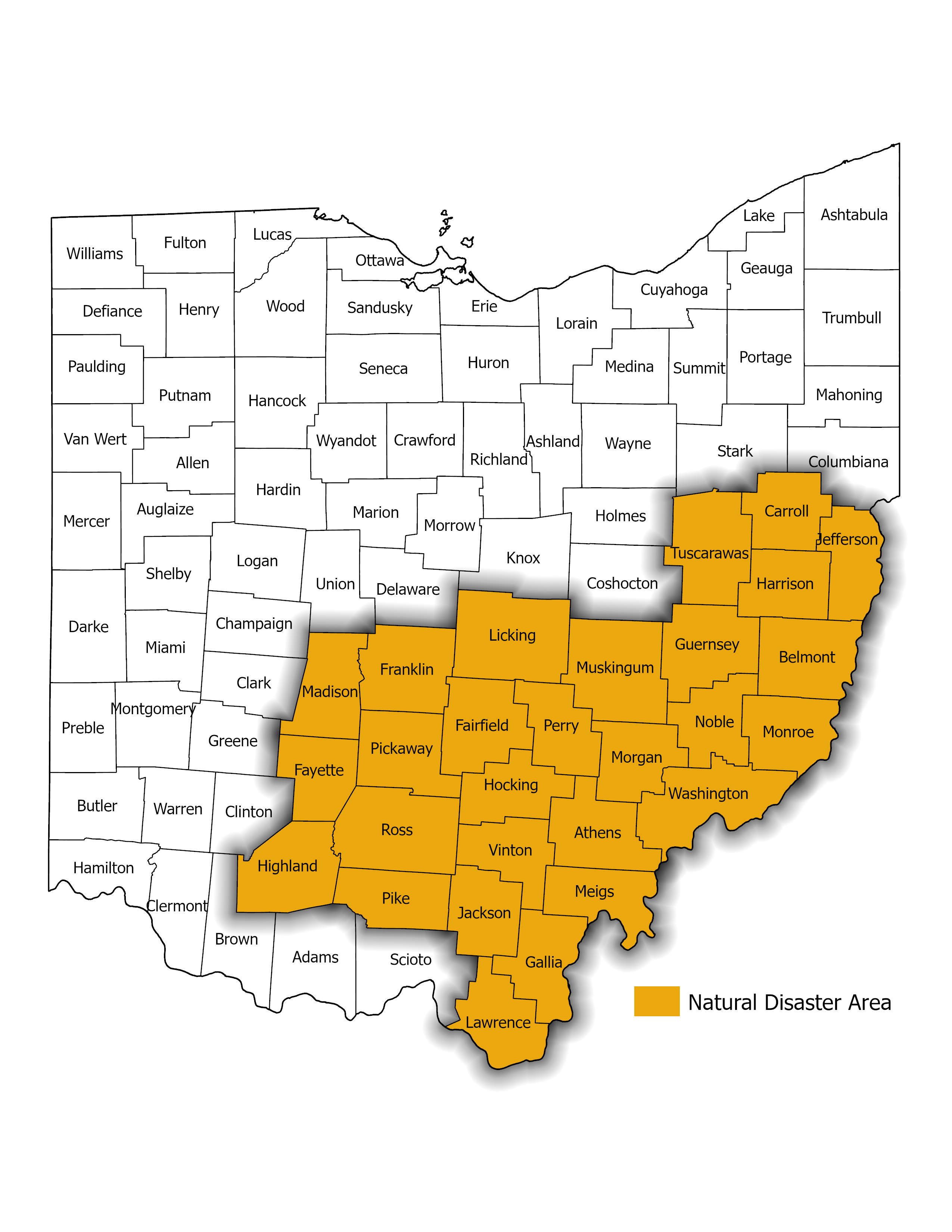
Local Soil and Water Conservation Districts will help administer the relief funding to 28 counties designated as primary natural disaster areas by the United States Department of Agriculture (USDA) between August 19th and September 16th, 2024, due to drought. Funding is available to any livestock producer participating in the USDA FSA Livestock Forage Disaster Program in a county designated as a primary natural disaster area.
The 28 counties are: Athens, Belmont, Carroll, Fairfield, Fayette, Franklin, Gallia, Guernsey, Harrison, Highland, Hocking, Jackson, Jefferson, Lawrence, Licking, Madison, Meigs, Monroe, Morgan, Muskingum, Noble, Perry, Pickaway, Pike, Ross, Tuscarawas, Vinton and Washington. (See map attached).
Some farmers are still feeling the impacts of the drought, that resulted in depleted hay and water supplies and created mental health stressors for farmers and their families.
Livestock producers located in the 28 impacted counties are encouraged to contact their local Soil and Water Conservation Districts to discuss eligibility and to apply for funding. For more resources and information please visit ODA’s drought resource webpage.
USDA’s Farm Service Agency (FSA) is accepting enrollments and elections for the Agriculture Risk Coverage (ARC) and Price Loss Coverage (PLC) for 2025 to April 15. ARC and PLC provide financial protections to farmers from substantial drops in crop prices or revenues and are vital economic safety nets for most American farms. The American Relief Act, 2025 extended many Farm Bill-authorized programs for another year, including ARC and PLC.
Producers can elect coverage and enroll in ARC-County (ARC-CO) or PLC, which provide crop-by-crop protection, or ARC-Individual (ARC-IC), which protects the entire farm. Although election changes for 2025 are optional, producers must enroll through a signed contract each year. Also, if a producer has a multi-year contract on the farm it will continue for 2025 unless an election change is made.
If producers do not submit their election revision by the April 15 deadline, their election remains the same as their 2024 election for commodities on the farm from the prior year. Farm owners cannot enroll in either program unless they have a share interest in the cropland.
Covered commodities include barley, canola, large and small chickpeas, corn, crambe, flaxseed, grain sorghum, lentils, mustard seed, oats, peanuts, dry peas, rapeseed, long grain rice, medium grain rice, safflower seed, seed cotton, sesame, soybeans, sunflower seed and wheat.
USDA also reminds producers that ARC and PLC elections and enrollments can impact eligibility for some crop insurance products including Supplemental Coverage Option, Enhanced Coverage Option and, for cotton producers, the Stacked Income Protection Plan (commonly referred to as STAX).
For more information on ARC and PLC, producers can visit the ARC and PLC webpage or contact their County USDA Service Center.
The U.S. Department of Agriculture (USDA) is now accepting applications for the 2025 Value-Added Producer Grants (VAPG) program designed to help rural small businesses, agricultural producers, farmers, and ranchers generate new products, create marketing opportunities, and increase their incomes through value-added activities.
Applications will be awarded through a competitive national process. Eligible applicants include independent producers, agricultural producer groups, farmer or rancher cooperatives, and majority-controlled producer-based business ventures.
The program expects to make approximately $30 million available for Fiscal Year (FY) 2025. Awards of up to $75,000 are available for planning activities or up to $250,000 for working capital expenses related to producing and marketing a value-added agricultural product.
Planning activities may include conducting feasibility studies and developing business plans. Working capital expenses may include costs associated with processing, marketing, advertising, inventory and salaries.
Electronic applications will be accepted via the VAPG APPLICATION PORTAL until 11:59 p.m. Eastern Time (ET) on April 17, 2025. Information on how to use the application portal is available using our convenient Grant Application Portal User Guide.
For more information about the Value-Added Producer Grant program in Ohio, contact Rural Development Business Program Specialist Danielle Frye at danielle.frye@usda.gov or go to Grants.gov.
The U.S. Department of Agriculture (USDA) reminds specialty crop producers that the application period for the Food Safety Certification for Specialty Crops (FSCSC) program for program year 2025 opened Jan. 1, 2025, and runs through Jan. 31, 2026. The program has been expanded to include medium-sized businesses in addition to small businesses. Eligible specialty crop growers can apply for assistance for expenses related to obtaining or renewing a food safety certification.
Program Details
FSCSC covers a percentage of the specialty crop operation’s cost of obtaining or renewing its on-farm food safety certification, as well as a portion of related expenses.
Eligible FSCSC applicants must be a specialty crop operation; meet the definition of a small or medium-size business and have paid eligible expenses related to certification.
- A small business has an average annual monetary value of specialty crops sold by the applicant during the three-year period preceding the program year of no more than $500,000.
- A medium size business has an average annual monetary value of specialty crops the applicant sold during the three-year period preceding the program year of at least $500,001 but no more than $1,000,000.
Specialty crop operations can receive the following cost assistance:
- Developing a food safety plan for first-time food safety certification.
- Maintaining or updating an existing food safety plan.
- Food safety certification.
- Certification upload fees.
- Microbiological testing for products, soil amendments and water.
- Training
FSCSC payments are calculated separately for each eligible cost category. Details about payment rates and limitations are available at farmers.gov/food-safety.
Applying for Assistance
For program year 2025, the application period began Jan. 1, 2025, and runs through Jan. 31, 2026. FSA will issue 50% of the calculated payment for program year 2025 following application approval, with the remaining amount to be paid after the application deadline. If calculated payments exceed the amount of available funding, payments will be prorated.
Specialty crop producers can apply by completing the FSA-888-1, Food Safety Certification for Specialty Crops Program (FSCSC) for Program Years 2024 and 2025 application. The application, along with the AD-2047, Customer Data Worksheet and SF-3881, ACH Vendor/Miscellaneous Payment Enrollment Form, if not already on file with FSA, can be submitted to the FSA county office at any USDA Service Center nationwide by mail, fax, hand delivery or via electronic means. Producers with an eAuthentication account can apply for FSCSC online. Producers interested in creating an eAuthentication account should visit farmers.gov/sign-in.
Visit farmers.gov/food-safety for additional program details, eligibility information and application forms.
More Information
To learn more about FSA programs, producers can contact their local USDA Service Center.
The Farm Service Agency (FSA) makes loans to youth to establish and operate agricultural income-producing projects in connection with 4-H clubs, FFA and other agricultural groups. Projects must be planned and operated with the help of the organization advisor, produce sufficient income to repay the loan and provide the youth with practical business and educational experience. The maximum loan amount is $10,000.
Youth Loan Eligibility Requirements:
- Be a citizen of the United States (which includes Puerto Rico, the Virgin Islands, Guam, American Samoa, the Commonwealth of the Northern Mariana Islands) or a legal resident alien
- Be 10 years to 20 years of age
- Comply with FSA’s general eligibility requirements
- Conduct a modest income-producing project in a supervised program of work as outlined above
- Demonstrate capability of planning, managing and operating the project under guidance and assistance from a project advisor. The project supervisor must recommend the youth loan applicant, along with providing adequate supervision.
For help preparing the application forms, contact your FSA County office to setup an appointment with a Loan Approval Official.
USDA has worked with the Conservation Biology Institute (CBI) to design and build a free online easy-to-use Seed and Vendor finder tool to support the producers enrolling in the CRP program, along with other conservation efforts involving native plantings. CBI also partnered with the Institute for Applied Ecology (IAE) to address the needs of the Native Seed Network and significantly expanded the native seed customer and vendor base.
The seed and vendor finder can be found here: Seed and Vendor Finder
Currently, CBI has seeded the tool with 214 vendors found through an online search from across the country with limited profiles, and 42 have voluntarily completed full profiles which includes their plant inventory. The tool is designed for easy uploading of their profile and inventory. It also provides an opportunity for vendors without a website to have an online presence and be found by customers looking for seeds. Also check out the plant finder tool where you can find suitable plants, including pollinator friendly plants for your area and soil type. Currently we have 20+ unique visitors to the tool every day and that number is growing!
All vendors are encouraged to add their profile and inventory to the tool. You can do this easily by filling out this simple form located here: https://crptool.org/contact/. A member of the CBI team will send you an invite within 24 h to create your full profile.
In this Ask the Expert, Jack Carlile, Farm Loan Manager for the USDA Farm Service Agency (FSA), answers questions about farm operating loans and when producers should apply in order to secure funds for the current crop year.
As the Farm Loan Manager for the Cherokee County Service Center, Jack is responsible for managing the loan making and loan servicing activities for five counties in northeast Oklahoma. His office provides services for over 650 farm loan customers. Jack was raised on a cross bred cow/calf operation that his grandparents started. Over the years, each generation has added to the operation by purchasing additional pasture. The operation also grows and bales their own hay. Jack’s agriculture background and degree in agriculture economics from Oklahoma State University help him better understand the financing needs of his producers.
Who can apply for FSA Farm Loans?
Anyone can apply for FSA’s loan programs. Applications will be considered on basic eligibility requirements. To apply for a loan, you must meet the following general eligibility requirements including:
- Be a U.S. citizen or qualified alien.
- Operator of a family farm or ranch.
- Have a satisfactory credit history.
- Unable to obtain credit elsewhere at reasonable rates and terms to meet actual needs.
- Not be delinquent on any federal debts.
To read the full blog visit farmers.gov/blog/ask-the-expert-farm-operating-loan-qa-with-jack-carlile.
Farm Operating Loans, Direct -- 5.500%
Farm Ownership Loans, Direct -- 5.875%
Limited Resource Loans -- 5.000%
Farm Ownership Loans, Down Payment -- 1.875%
Farm Ownership – Joint Financing -- 3.875%
Emergency Loans -- 3.750%
Farm Storage Facility Loan, 3 year -- 4.250%
Farm Storage Facility Loan, 5 year -- 4.375%
Farm Storage Facility Loan, 7 year -- 4.500%
Farm Storage Facility Loan, 10 year -- 4.500%
Farm Storage Facility Loan, 12 year -- 4.625%
Sugar Storage Facility Loans, 15 year -- 4.750%
Commodity Loans -- 5.250%
March 1 --- Ohio's Primary Nesting Season begins.
March 31 -- Deadline to sign up for the 2025 Dairy Margin Coverage (DMC) program.
April 15 ---- Deadline to make election and enrollment decisions for 2025 ARC/PLC.
May 27 ----- Memorial Day Holiday. USDA Service Centers Closed.
May 31 ----- Deadline to apply for 2024 commodity loans and LDP's on feed grains, soybeans, pulse crops.
Top of page
Ohio FSA State Office
200 North High Street, Room 540
Columbus, Ohio 43215
Phone: 614-255-2441
|
|
Visit the Ohio FSA website at: www.fsa.usda.gov/oh
|
State Executive Director:
Vacant
|
Deputy State Executive Director:
Traci Garza
|
|
Administrative Officer:
Stephanie Moran
|
Conservation Chief:
Brandi Koehler
|
|
Farm Loan Chief:
Andrew Huey
|
Price Support Chief:
Trevor Kerr
|
|
Production Adjustment / Compliance and Risk Management Chief:
Matt Kleski
|
|
|
|
Ohio FSA State Committee Members
Theodore Finnarn, Chairperson
Fred Deel
Tracy Hundley
Thomas Jackson, Jr.
Mark Mechling
|
| |
|