
Arkansas USDA Newsletter - March, 2025.
In This Issue:
Greetings,
As the days grow longer and the temperatures rise, we can all feel the excitement of spring approaching. The changing season brings a renewed sense of energy, and fields will soon be bursting with new growth, wildlife will be more active, and the warmth of the sun will make every outdoor moment more enjoyable. It’s the season of change, growth, and opportunity, much like what we’re experiencing here at the NRCS.
Spring offers an opportunity to implement soil health building techniques, prepare for irrigation water management strategies, and habitat restoration efforts that benefit both the land and future generations. Communication with our producers is key in the process, ensuring they have access to the latest resources and technical information. As we kick off the growing season, NRCS aims to help producers refine their natural resource goals and objectives and assist them in implementing practices that result in sustainable agricultural operations that can thrive for years to come.
Collaboration and communication are key to these successes, which is why it’s important to support each other in our mission to protect and enhance our natural resources.
Regards,
Amanda Mathis
Arkansas State Conservationist
Producers are encouraged to call their local FSA office to schedule an appointment to ensure maximum use of their time and to make sure FSA staff is available to tend to their important business needs. Please call your local FSA office ahead to set an appointment and to discuss any records or documentation that might be needed during your appointment. To find your local FSA office, visit farmers.gov/working-with-us/service-center-locator.
Did you know that, as a customer in any USDA service center, employees are required, per federal law and USDA regulations, to provide you with a computer-generated receipt at the end of your visit? This Receipt for Service details the type of service you requested, the service and response provided by the staff, and the date and time of your visit.
The 2014 Farm Bill designated that FSA, Natural Resources Conservation Service (NRCS) and Rural Development (RD) employees are statutorily required to provide producers a receipt when a current or prospective producer or landowner interacts or engages with the Agency regarding a USDA benefit or service.
On behalf of our customers, FSA employees are required to enter receipts timely and create only one receipt per customer per visit, regardless of the number of employee interactions a customer may encounter in a single visit. A single receipt will be generated that provides a summary of the customer’s visit on behalf of the other employees who also met with the customer on the same day. Employees must also ensure that all services rendered are properly reflected in that receipt.
Issuing a receipt is required by our offices. If you do not receive a receipt, please be sure to request one. For more information, FSA’s Receipt for Service handbook is now available online.
Don’t leave the office without your receipt!
The U.S. Department of Agriculture’s (USDA) updates to the Farm Service Agency’s (FSA) Farm Loan Programs are officially in effect. These changes, part of the Enhancing Program Access and Delivery for Farm Loans rule, are designed to increase financial flexibility for agricultural producers, allowing them to grow their operations, boost profitability, and build long-term savings.
These program updates reflect USDA’s ongoing commitment to supporting the financial success and resilience of farmers and ranchers nationwide, offering critical tools to help borrowers manage their finances more effectively.
What the new rules mean for you:
- Low-interest installment set-aside program: Financially distressed borrowers can now defer up to one annual loan payment at a reduced interest rate. This simplified option helps ease financial pressure while keeping farming operations running smoothly.
- Flexible repayment terms: New repayment options give borrowers the ability to increase their cash flow and build working capital reserves, allowing for long-term financial planning that includes saving for retirement, education, and other future needs.
- Reduced collateral requirements: FSA has lowered the amount of additional loan security needed for direct farm loans, making it easier for borrowers to leverage their existing equity without putting their personal residence at risk.
These new rules provide more financial freedom to borrowers. By giving farmers and ranchers better tools to manage their operations, we’re helping them build long-term financial stability. It’s all about making sure they can keep their land, grow their business, and invest in the future.
If you’re an FSA borrower or considering applying for a loan, now is the time to take advantage of these new policies. We encourage you to reach out to your local FSA farm loan staff to ensure you fully understand the wide range of loan making and servicing options available to assist with starting, expanding, or maintaining your agricultural operation.
To conduct business with FSA, please contact your local USDA Service Center.
There are options for Farm Service Agency (FSA) loan customers during financial stress. If you are a borrower who is unable to make payments on a loan, contact your local FSA Farm Loan Manager to learn about your options.
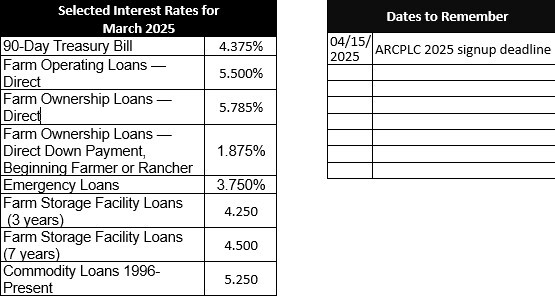
USDA’s Farm Service Agency (FSA) is accepting enrollments and elections for the Agriculture Risk Coverage (ARC) and Price Loss Coverage (PLC) for 2025 from Jan. 21 to April 15. ARC and PLC provide financial protections to farmers from substantial drops in crop prices or revenues and are vital economic safety nets for most American farms. The American Relief Act, 2025 extended many Farm Bill-authorized programs for another year, including ARC and PLC.
Producers can elect coverage and enroll in ARC-County (ARC-CO) or PLC, which provide crop-by-crop protection, or ARC-Individual (ARC-IC), which protects the entire farm. Although election changes for 2025 are optional, producers must enroll through a signed contract each year. Also, if a producer has a multi-year contract on the farm it will continue for 2025 unless an election change is made.
If producers do not submit their election revision by the April 15 deadline, their election remains the same as their 2024 election for commodities on the farm from the prior year. Farm owners cannot enroll in either program unless they have a share interest in the cropland.
Covered commodities include barley, canola, large and small chickpeas, corn, crambe, flaxseed, grain sorghum, lentils, mustard seed, oats, peanuts, dry peas, rapeseed, long grain rice, medium grain rice, safflower seed, seed cotton, sesame, soybeans, sunflower seed and wheat.
USDA also reminds producers that ARC and PLC elections and enrollments can impact eligibility for some crop insurance products including Supplemental Coverage Option, Enhanced Coverage Option and, for cotton producers, the Stacked Income Protection Plan (commonly referred to as STAX).
For more information on ARC and PLC, producers can visit the ARC and PLC webpage or contact your local County USDA Service Center
Landowners and operators are reminded that in order to receive payments from USDA, compliance with Highly Erodible Land (HEL) and Wetland Conservation (WC) provisions are required. Farmers with HEL determined soils are reminded of tillage, crop residue, and rotation requirements as specified per their conservation plan. Producers are to notify the USDA Farm Service Agency prior to breaking sod, clearing land (tree removal), and of any drainage projects (tiling, ditching, etc.) to ensure compliance. Failure to update certification of compliance, with form AD-1026, triggering applicable HEL and/or wetland determinations, for any of these situations, can result in the loss of FSA farm program payments, FSA farm loans, NRCS program payments, and premium subsidy to Federal Crop Insurance administered by RMA.
The Farm Service Agency’s (FSA) Farm Storage Facility Loan (FSFL) program provides low-interest financing to help you build or upgrade storage facilities and to purchase portable (new or used) structures, equipment and storage and handling trucks.
Eligible commodities include corn, grain sorghum, rice, soybeans, oats, peanuts, wheat, barley, minor oilseeds harvested as whole grain, pulse crops (lentils, chickpeas and dry peas), hay, honey, renewable biomass, fruits, nuts and vegetables for cold storage facilities, controlled atmosphere storage, floriculture, hops, malted small grains, maple sap, maple syrup, rye, milk, cheese, butter, yogurt, meat and poultry (unprocessed), eggs, and aquaculture (excluding systems that maintain live animals through uptake and discharge of water). Qualified facilities include grain bins, hay barns and cold storage facilities for eligible commodities.
Loans up to $50,000 can be secured by a promissory note/security agreement, loans between $50,000 and $100,000 may require additional security, and loans exceeding $100,000 require additional security.
You do not need to demonstrate the lack of commercial credit availability to apply. The loans are designed to assist a diverse range of farming operations, including small and mid-sized businesses, new farmers, operations supplying local food and farmers markets, non-traditional farm products, and underserved producers.
For more information, contact your local County USDA Service Center or visit fsa.usda.gov/pricesupport.
Summer is the season for freshwater harmful algal blooms, which can produce toxins that are harmful to humans, livestock, working animals, and pets. The U.S. Department of Agriculture’s (USDA) Natural Resources Conservation Service (NRCS) has several conservation practices that may help farmers and ranchers protect animals and people by restricting access to contaminated water or providing alternate water sources.
The ABCs of HABs
Freshwater harmful algal blooms (HABs) are usually caused by rapid of blue-green algae (known as cyanobacteria) in water bodies such as lakes, ponds, and streams. These organisms can produce toxins (known as cyanotoxins) that are harmful to humans, livestock, working animals, and pets. Contacting or ingesting contaminated water (including water spray or mist) can result in irritation, illness, or even death.
Cyanobacteria are naturally found in water bodies, so they cannot be eradicated. Instead, it’s important to understand how and why blooms occur. Cyanobacterial blooms and their potential toxicity often are a result of excess nutrients, such as phosphorus and nitrogen, in water bodies. Excess nutrients can come from adjacent agricultural lands, livestock waste, and leaky septic systems, among other sources. HABs typically form in summer, when warm, nutrient-rich, stagnant waters and more frequent sunlight increase the opportunity for their growth.
Treatment of current HABs involves chemical, biological, or mechanical treatment targeted directly at the contaminated waters. Prevention of future HABs involves changing the conditions that favor cyanobacteria, including nutrient management of the surrounding land and trapping or treating nutrient losses to waterbodies.
Risks HABs pose to livestock, working animals, and pets
Symptoms* of cyanotoxin exposure in animals include:
- vomiting
- excessive salivation
- fatigue
- staggered walking
- difficulty breathing
- weakness
- convulsions
- liver failure
In severe cases, HAB poisoning can lead to death. Therefore, any potential intoxication needs to be immediately addressed by qualified professionals.
NRCS is not the authority on HAB symptoms in animals and humans. Please refer to the Centers for Disease Control (CDC) website for further information on HAB symptoms or contact your state or county health department.
Steps you can take if a potential exposure to cyanotoxins has occurred:
- Eliminate animal access to the suspected contaminated water source.
- Wash animals with clean water and monitor for symptoms of exposure to cyanotoxins. Isolate any animals exhibiting symptoms and seek veterinary care as soon as possible.
- An alternative source of livestock drinking water might be needed.
- Contact the appropriate state agency for sampling and testing guidance to test the water source for HABs and cyanotoxins. It is not safe for landowners to sample the water themselves without proper personal protective equipment and procedures.
- If a HAB occurs, there is potential for recurrence. Therefore, the waterbody should be monitored.
- Adopt conservation practices that reduce the risk of livestock exposure to HABs and prevent and reduce nutrient loading to waters to minimize the risk of future HABs occurrences.
Reduce livestock exposure to HABs
If HABs or cyanotoxins have been detected in a water body, preventing exposure by restricting access is key to ensuring the health and well-being of people, livestock, working animals and pets on the farm.
NRCS has several conservation practices that may be useful to exclude livestock from contaminated waters or provide alternative water sources. Some examples are:
- Fencing
- Pond
- Access control
- Water well
- Watering facility
For more information or assistance:
To learn more about how NRCS can help address HAB concerns or other natural resource concerns, visit the NRCS website or contact NRCS at your local USDA Service Center.
USDA’s Natural Resources Conservation Service can help you conserve water and build resilience to drought, through conservation practices that improve irrigation efficiency, boost soil health, and manage grazing lands.
Irrigation Efficiency
USDA helps you improve your irrigation efficiency to ensure each drop of water is used wisely. Saving water on your farm can help during drought and can offset rising water costs; reduce expenditures for energy, chemicals, and labor; and enhance revenues through higher crop yields and improved crop quality. Funded conservation practices include conversion to more efficient irrigation systems, such as micro-irrigation or subsurface drip irrigation, installation of irrigation pipeline, irrigation water management, structures for water control, and flow meters. Tools like drip irrigation, which provides water precisely where and when it’s needed, can achieve greater precision with flow meters and soil moisture sensors.
Soil Health
In addition, soil health conservation practices, such as reduced- or no-till, cover crops, mulching and residue management can help to make your soil, and the plants you grow or animals you raise, healthier. Healthier soil can absorb and retain more water for longer periods of time, making your farm or ranch more resilient to drought. Using soil health practices, you can conserve water by increasing your soil’s water-holding capacity and use conservation tillage to keep the ground covered, reducing water loss through transpiration and evaporation.
And soil health practices increase organic matter, and each pound of organic matter can hold up to 20 pounds of water. Every 1% increase in organic matter results in as much as 25,000 gallons of soil water per acre. Each 1% increase in organic matter can also provide up to 30 pounds of more available nitrogen per acre. That means less money and time spent on inputs like water and fertilizer, which make your operation more profitable.
Rotational/Prescribed Grazing, Water Sources for Livestock
Drought also impacts grazing lands, and NRCS works with you to increase the resilience of your livestock operation. Ranchers can adapt to dry conditions in two main ways: increasing the availability and suitability of forage and ensuring that cattle have an adequate and reliable source of water. For forage, rotational or prescribed grazing (rotating cattle among pastures) can relieve pressure on stressed vegetation and ensure a more consistent supply of forage for animals. NRCS conservationists can also work with you to plant more drought-tolerant forage species, plants best suited to local soils and conditions. For reliable sources of water, NRCS can help you with installing watering facilities, water wells, or water pipeline for livestock. Having available forage and water for livestock can make a big difference in difficult drought conditions.
USDA and NRCS are here for you, helping you recover from drought and prepare for the next one. For more information on drought recovery assistance at farmers.gov/protection-recovery/drought#recovery. For more information on conservation practices to make your operation more resilient to drought in future years, go to www.nrcs.usda.gov.
The Natural Resources Conservation Service (NRCS) works to help farmers, ranchers and forest landowners invest in their operations and local communities to keep working lands working, boost rural economies, increase the competitiveness of American agriculture and improve the quality of our air, water, soil and wildlife habitat.
Simply put – NRCS helps America’s farmers, ranchers and forestland owners make conservation work for them.
Our Conservation Technical Assistance (CTA) program enables every acre of voluntary conservation applied through every program NRCS administers. It is the foundation of our financial and technical assistance delivery system.
Every farm and acre is unique and requires tailored management; and every decision maker has different management concerns and needs. Our technical assistance is one-on-one, personalized advice and support to help producers make the best decisions for their lands – and is offered free of charge.
This personalized assistance provides producers with the science-based data and tools to make informed decisions about where to target efforts to get the greatest return on their investment and ensure the long-term sustainability of American agriculture.
A comprehensive conservation plan is the first step to managing all the natural resources on a farm. NRCS walks the farm with the producer and develops options to address that producer’s needs. Our toolbox includes aerial photos, soil surveys, engineering solutions and individual science-based analysis customized for the producer’s property. The plan we develop with the producer combines existing production methods with recommended conservation practices to best manage that farm’s unique natural resources, while allowing the producer to grow sustainably and productively. Supported by our expert analysis and recommendations, the producer chooses which option best meets their needs. These decisions become the producer’s conservation plan, a step-by-step guide to reach their objectives.
This planning process also makes it easier to identify how and when the farmer, rancher or forest landowner could qualify for Farm Bill financial assistance to help them install conservation systems or receive incentives for trying new ones. We have the expertise to see our customers through this process. Because identifying when, where and how to implement practices is not plug and play.
The final plan provides a roadmap for the producer to meet their natural resource conservation goals. It includes helpful information on each of the producer’s practices, such as how they benefit the farm, how to maintain them, and how they help the soil, water and wildlife.
By developing a conservation plan and adding conservation to the land, farmers, ranchers and forest landowners can protect the land’s ability to provide for their family and future generations.
With offices in communities nationwide, NRCS staff provide the information, tools and delivery systems necessary for producers – in every state and territory – to conserve, maintain and improve their natural resources.
Contact your local USDA service center to find out more.
You have a lot at stake in making sure your crop insurance acreage reporting is accurate and on time. If you fail to report on time, you may not be protected. If you report too much acreage, you may pay too much premium. If you report too little acreage, you may recover less when you file a claim.
Crop insurance agents often say that mistakes in acreage reporting are the easiest way for producers to have an unsatisfactory experience with crop insurance. Don’t depend on your agent to do this important job for you. Your signature on the bottom of the acreage reporting form makes it, legally, your responsibility. Double-check it for yourself.
Remember - acreage reporting is your responsibility. Doing it right will save you money. Always get a copy of your report immediately after signing and filing it with your agent and keep it with your records. Remember, it is your responsibility to report crop damage to your agent within 72 hours of discovery. Never put damaged acreage to another use without prior written consent of the insurance adjuster. You don’t want to destroy any evidence of a possible claim. Learn more by visiting RMA’s website.
Top of page
|
USDA Service Centers
Arkansas USDA-FSA
700 West Capitol Room 3416, Little Rock, Arkansas 72201
FSA Acting State Executive Director - Emund Woods
FSA Phone: 501-301-3000 | FSA Fax: 855-652-2082
www.fsa.usda.gov
www.fsa.usda.gov/state-offices/Arkansas/index
Arkansas USDA-NRCS
700 West Capitol Room 3416, Little Rock, Arkansas 72201
NRCS State Conservationist - Amanda Mathis
NRCS Phone: 501-301-3149
www.nrcs.usda.gov
www.ar.nrcs.usda.gov
USDA-RMA / Jackson, Mississippi Regional Office
803 Liberty Road, Jackson, MS 39232-9000
RMA Regional Director – Roddric Bell
RMA Phone: 601-965-4771 | RMA Fax: 601-965-4517
Jackson, Mississippi | RMA (usda.gov)
Please contact your local Office for questions specific to your operation or county. To find contact information for your local office visit the website below: Get Started at Your USDA Service Center | Farmers.gov
Persons with disabilities who require accommodations to attend or participate in this meeting/event should contact Rita Smith-Clay at 501-301-3200 or Federal Relay Service at 1-800-877-8339.
|
| |
| |
|
| |
|






