Emporia/Greensville -March 2025
In This Issue:
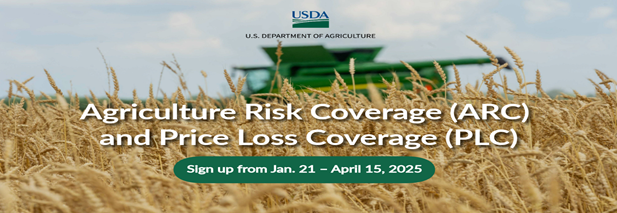
USDA’s Farm Service Agency (FSA) is accepting enrollments and elections for the Agriculture Risk Coverage (ARC) and Price Loss Coverage (PLC) for 2025 from Jan. 21 to April 15. ARC and PLC provide financial protections to farmers from substantial drops in crop prices or revenues and are vital economic safety nets for most American farms. The American Relief Act, 2025 extended many Farm Bill-authorized programs for another year, including ARC and PLC.
Producers can elect coverage and enroll in ARC-County (ARC-CO) or PLC, which provide crop-by-crop protection, or ARC-Individual (ARC-IC), which protects the entire farm. Although election changes for 2025 are optional, producers must enroll through a signed contract each year. Also, if a producer has a multi-year contract on the farm it will continue for 2025 unless an election change is made.
If producers do not submit their election revision by the April 15 deadline, their election remains the same as their 2024 election for commodities on the farm from the prior year. Farm owners cannot enroll in either program unless they have a share interest in the cropland.
Covered commodities include barley, canola, large and small chickpeas, corn, crambe, flaxseed, grain sorghum, lentils, mustard seed, oats, peanuts, dry peas, rapeseed, long grain rice, medium grain rice, safflower seed, seed cotton, sesame, soybeans, sunflower seed and wheat.
USDA also reminds producers that ARC and PLC elections and enrollments can impact eligibility for some crop insurance products including Supplemental Coverage Option, Enhanced Coverage Option and, for cotton producers, the Stacked Income Protection Plan (commonly referred to as STAX).
For more information on ARC and PLC, producers can visit the ARC and PLC webpage or contact your Greensville County USDA Service Center at 434-336-6242.
Farm Service Agency (FSA) loans require applicants to have a satisfactory credit history. A credit report is requested for all FSA direct farm loan applicants. These reports are reviewed to verify outstanding debts, see if bills are paid timely and to determine the impact on cash flow.
Information on your credit report is strictly confidential and is used only as an aid in conducting FSA business.
Our farm loan staff will discuss options with you if you have an unfavorable credit report and will provide a copy of your report. If you dispute the accuracy of the information on the credit report, it is up to you to contact the issuing credit report company to resolve any errors or inaccuracies.
There are multiple ways to remedy an unfavorable credit score:
- Make sure to pay bills on time
- Setting up automatic payments or automated reminders can be an effective way to remember payment due dates.
- Pay down existing debt
- Keep your credit card balances low
- Avoid suddenly opening or closing existing credit accounts
FSA’s farm loan staff will guide you through the process, which may require you to reapply for a loan after improving or correcting your credit report.
For more information on FSA farm loan programs, contact your Greensville County USDA Service Center at 434-634-2462 or visit fsa.usda.gov.
Top of page
Looking for ways to do business with USDA that saves you time? Look no further than farmers.gov.
When you create an account for the farmers.gov authenticated customer portal, you have access to self-service features through a secure login. Managing your business with USDA’s Farm Service Agency (FSA) and Natural Resources Conservation Service (NRCS) is faster than ever. From e-signing documents, viewing, printing, and exporting maps and receiving notifications of payment disbursements, a farmers.gov authenticated account makes doing business with USDA easy and secure.
What can you do with your farmers.gov account?
- View FSA Farm Loan information including interest payments, loan advances, payment history and paid-in-full/restructured loans.
- Make USDA direct farm loan payments using the Pay My Loan feature.
- Access the Online Loan Application portal.
- View, print and export detailed FSA farm records and farm/tract maps.
- Import precision agriculture planting boundaries, create labels containing crop information, and print both on farm tract maps.
- View and print your FSA-156EZ with farm details
- View and print your Producer Farm Data Report
- View NRCS Disbursements and Farm Loans financial activity from the past 180 days.
- View your land, access NRCS data on your conservation plans, contracts, and planning land units through the Conservation Land Area page.
- View, upload, download and e-sign NRCS documents.
- Request NRCS conservation and financial assistance, including submitting a program application.
- View detailed information on all previous and ongoing NRCS contracts, including the amount of cost- share assistance received and anticipated; and even request contract modifications, report practice completion and request practice certification.
- “Switch Profiles” to act on behalf of your entity or another individual when you have active representative authority on file
If you’d like to see the features in action and learn more about how to use them, check out the 3-5 minute farmers.gov account video tutorials.
How do you create a farmers.gov account?
Visit farmers.gov/account to access information about farmers.gov accounts and sign in to the site’s authenticated portal. You will need a Login.gov account linked to your USDA customer record to access your farmers.gov authenticated site. Customers who are new to USDA should visit Get Started at Your USDA Service Center, then go to farmers.gov/account to create a farmers.gov account.
To create a farmers.gov account you will need:
- A USDA individual customer record — A customer record contains information you have given to USDA to do business with them, like your name, address, phone number, and any legal representative authority relationships. Contact your local USDA Service Center to make sure you have an individual USDA customer record on file and your information is up to date.
- A Login.gov account — Login.gov is a sign-in service that gives people secure online access to participating government programs. You can create a Login.gov account linked to your customer record by following the directions on gov/account.
- Identity Verification — You can choose to verify your identity with Login.gov or in-person at a USDA Service Center.
In addition to the self-service features, farmers.gov also has information on USDA programs, farm loans, disaster assistance, conservation programs and crop insurance.
How much fuel can farmers save each year by transitioning from conventional tillage to continuous no-till? According to a report from USDA’s Conservation Effects Assessment Project (CEAP), 3.6 gallons per acre is a reasonable estimate. With current off-road diesel fuel prices, this could translate into approximately $17 per acre saved annually.
Nearly 87 percent of all cropland acres nationwide are farmed using some form of conservation tillage, where tillage is reduced for at least one crop within a given field. Continuous no-till accounts for 33 percent of this total.
Farmers who minimize tillage across their operation may reduce soil erosion, maximize water infiltration, improve nutrient cycling, build organic matter, and strengthen resilience to disaster events or challenging growing conditions. Based on the latest data, they may also use significantly less fuel than with conventional tillage and reduce their associated carbon dioxide emissions.
According to CEAP, farmers who implement conservation tillage practices instead of continuous conventional tillage:
- Reduce potential nationwide fuel use by 763 million gallons of diesel equivalents each year, roughly the amount of energy used by 2.8 million households.
- Reduce potential associated emissions by 8.5 million tons of carbon dioxide (CO2) equivalents each year, equivalent to removing nearly 1.7 million gasoline-powered passenger vehicles from the road.
The bottom line for farmers: Reducing tillage leads to fuel savings that deliver significant financial benefits while building healthier soils for a more resilient operation. Contact your local NRCS field office for more information on the advantages of no- or low-till farming.
|
Top of page
Emporia/Greensville USDA Service Center
706 South Main Street
Emporia Virginia 23847
Phone:434-634-2462
Fax:855-592-3184
|
| |
|
FSA FARM PROGRAMS
|
|
|
|
| |
| |
| |
| |
| Upcoming COC Meeting: |
| |
| April 09, 2025 |
| |
|
NRCS
|
|
|
Greensville County Committee
|
| Brandon Clements – Chairperson |
| Jesse Battle Harell – Vice Chairperson |
| James Payton Doyle - Member |
| |
| |
| |
| |
| |
|
|
|
|