
Benton County - March, 2025
In This Issue:
We’re halfway there! With just over a month remaining, we have a third of our farms enrolled in the Farm Program. If you are not part of the “done” half, please give Shane a call. You can sign your Farm Program contracts in person, electronically or we can mail the contracts to you. The choice is yours, all you need to do is ask!
Now is a great time to make sure we have your land interests properly recorded. We rely on you to tell us when you have sold or purchased ground, or took on a new lease. If you have had, or intend to have, your land interests change, please contact Tara.
We look forward to hearing from many of you soon as we round the corner into the home stretch of the Farm Program election and enrollment period. If you have any questions, we can be contacted at 319-472-5274 or iavinton-fsa@usda.gov
Acting CED Amie J.
|
DATES TO REMEMBER
|
|
March 13
|
COC Meeting
|
|
March 26
|
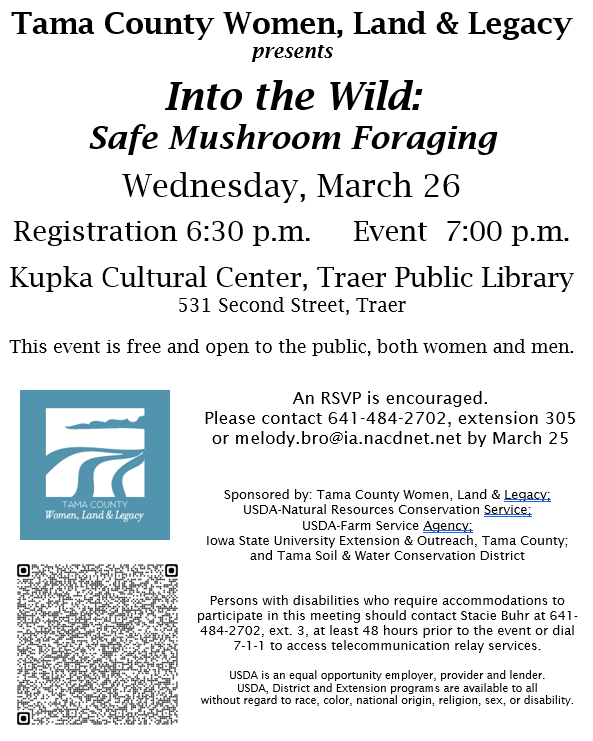
Tama Co. Woman, Land & Legacy: Mushroom Foraging
|
|
April 15
|
Farm Program Enrollment Deadline
|
|
Top of page
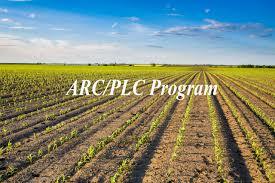
USDA’s Farm Service Agency (FSA) is accepting enrollments and elections for the Agriculture Risk Coverage (ARC) and Price Loss Coverage (PLC) for 2025 from Jan. 21 to April 15. ARC and PLC provide financial protections to farmers from substantial drops in crop prices or revenues and are vital economic safety nets for most American farms. The American Relief Act, 2025 extended many Farm Bill-authorized programs for another year, including ARC and PLC.
Producers can elect coverage and enroll in ARC-County (ARC-CO) or PLC, which provide crop-by-crop protection, or ARC-Individual (ARC-IC), which protects the entire farm. Although election changes for 2025 are optional, producers must enroll through a signed contract each year. Also, if a producer has a multi-year contract on the farm it will continue for 2025 unless an election change is made.
If producers do not submit their election revision by the April 15 deadline, their election remains the same as their 2024 election for commodities on the farm from the prior year. Farm owners cannot enroll in either program unless they have a share interest in the cropland.
Covered commodities include barley, canola, large and small chickpeas, corn, crambe, flaxseed, grain sorghum, lentils, mustard seed, oats, peanuts, dry peas, rapeseed, long grain rice, medium grain rice, safflower seed, seed cotton, sesame, soybeans, sunflower seed and wheat.
USDA also reminds producers that ARC and PLC elections and enrollments can impact eligibility for some crop insurance products including Supplemental Coverage Option, Enhanced Coverage Option and, for cotton producers, the Stacked Income Protection Plan (commonly referred to as STAX).
For more information on ARC and PLC, producers can visit the ARC and PLC webpage or contact the Benton County USDA Service Center at 319-472-5274 option 2.
|
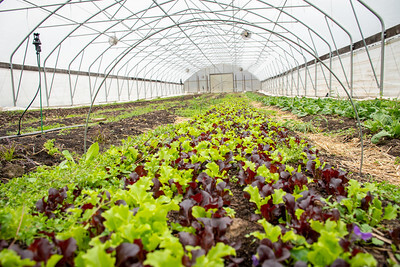
It’s hard to beat produce grown in the area. It’s often fresher and tastier, uses less energy for transport, and helps farmers in your community. But the off-season presents a big challenge for farmers who grow fruits and vegetables and for consumers who want to find local produce throughout the year.
When farmers can lengthen the growing season, even by several weeks, their options change. That’s why the USDA’s Natural Resources Conservation Service promotes seasonal high tunnel as such a powerful tool. High tunnels are plastic-wrapped, metal-framed structures that are fairly easy and inexpensive to build. They are designed to extend the growing season into the colder months, helping to increase the availability of local produce, keep plants at a steady temperature and even conserve water and energy.
High tunnels are similar to greenhouses, except they are considered “passively heated.” That means they do not require electricity to heat – only sunlight. The plastic on the frame actually provides enough insulation to add up to 12 extra weeks to the growing season, depending on location. The inside of a high tunnel boasts its own microclimate, often producing crops of higher quality and quantity that those in traditional farm fields. High tunnels are also different than greenhouses in that the plants are actually in the ground, not in pots or on tables. You can think of it as a plastic covering over a field.
High tunnels can cut costs for the producer by conserving water and requiring fewer inputs, like fertilizers or pesticides. In high tunnels, these inputs are often applied through tubes that run along the base of the plants, allowing water and fertilizer to be delivered directly above the soil. Outside of high tunnels, these inputs are often dispersed on a larger scale and require more to ensure the plants receive an adequate amount.
NRCS helps farmers build high tunnels, providing technical expertise and funding. Local and regional markets often provide farmers with a higher share of the food dollar, and money spent at a local business often continues to circulate within community, creating a multiplier effect and providing greater economic benefits to the area.
For more information, contact your Benton County USDA Service Center at [319-462-2161] or visit nrcs.usda.gov. You can also watch this NRCS video on high tunnels.
|
Top of page

Farm Service Agency (FSA) is committed to providing our farm loan borrowers the tools necessary to be successful. FSA staff will provide guidance and counsel from the loan application process through the borrower’s graduation to commercial credit. While it is FSA’s commitment to advise borrowers as they identify goals and evaluate progress, it is crucial for borrowers to communicate with their farm loan staff when changes occur. It is the borrower’s responsibility to alert FSA to any of the following:
- Any proposed or significant changes in the farming operation
- Any significant changes to family income or expenses
- The development of problem situations
- Any losses or proposed significant changes in security
If a farm loan borrower can’t make payments to suppliers, other creditors, or FSA on time, contact your farm loan staff immediately to discuss loan servicing options.
For more information on FSA farm loan programs, contact your Iowa County USDA Service Center at 319-668-2010 or visit fsa.usda.gov.
|
Top of page
Benton County USDA Service Center
1705 W D Street
Vinton, IA 52349
Phone: 319-472-5274
Fax: 855-218-8671
|
|
|
|
Acting County Executive Director
Amie Johansen 319-472-5274 option 2
or 319-824-5416 option 2
Program Analysts
Shelly Hagen
Tara Kane
Meg Ferguson
Devon Burroughs
Jennie Schade
Shane Vest
iavinton-fsa@usda.gov
Farm Loan Manager
Mary Glaspie 319-668-2010 ext. 8013
mary.glaspie@usda.gov
|
District Conservationist
Michelle German 319-472-5274 option 3 michelle.german@usda.gov
County Office Committee
Chairperson: Alan Henkle
Vice Chairperson: Tanner Brecht
Member: Steven Williams
Minority Advisor: Cory Cronbaugh
|
|
|
|






