Carroll County USDA Service Center - February 12, 2024
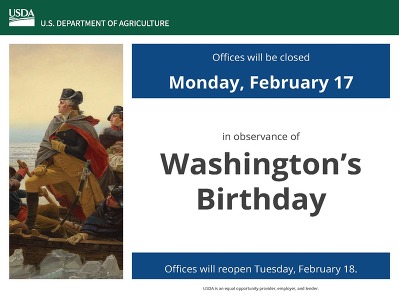
USDA Service Centers will be closed on Monday, February 17 to observe Washington's Birthday. Offices will reopen Tuesday, February 18.
In This Issue:
Office News - Effective January 26, Amy Bange is Acting CED for Carroll County FSA. Thanks to Charlie Bennett for serving almost a year as Acting CED for our County Office.
February Interest Rates
Dairy Margin Coverage - The margin for December is $13.38 and no payments were triggered. 2025 DMC Signup is currently underway and ends March 31, 2025. Fact Sheet
ARC/PLC - Signup for 2025 ARC/PLC has begun and ends April 15, 2025. Fact Sheet - please note the RMA's SCO and STAX section. Appendix to Contract
Important Dates/Deadlines...
February 15 - NAP application deadline for coverage on 2025 early spring vegetables with a crop reporting date of May 15, 2025. This includes, but is not limited to: asparagus, broccoli, cauliflower, cabbage, greens, horseradish, kale, lettuce, onions, peas and radishes.
February 17 - Office closed - George Washington's birthday observance/President's Day
March 3 - Application deadline for Livestock Disaster Programs (LFP, LIP, and ELAP) for calendar year 2024 losses.
March 15 - NAP application deadline for coverage on most yield-based CY2025 crops.
March 31 - Deadline for 2025 DMC signup
March 31 - Deadline to request MAL/Commodity Loans for CY2024 small grains
April 7 - Application deadline for Emergency Loan (see September 2024 Bulletin)
April 15 - Deadline for 2025 ARCPLC signup
September 15 - Application deadline for Emergency Loan (see below)
Check with NRCS concerning their program deadlines.
Check with RMA concerning their deadlines for insurance coverage and loss claims.
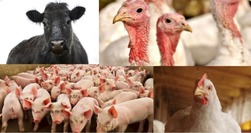
The U.S. Department of Agriculture (USDA) updated three livestock disaster assistance programs to synchronize deadlines and streamline program delivery. The changes take effect for the 2024 program applications for the Emergency Assistance for Livestock, Honeybees and Farm-raised Fish Program (ELAP), Livestock Forage Disaster Program (LFP) and Livestock Indemnity Program (LIP).
USDA’s Farm Service Agency (FSA) is now accepting applications for ELAP, LFP and LIP until March 1 following the end of the calendar year in which the disaster circumstances occurred. For 2024 program applications, which are being accepted at FSA offices across the nation right now, the deadline to apply for this assistance is March 3, 2025, because March 1 falls on a Saturday.
ELAP Policy Clarification
FSA is clarifying the feed transportation provisions of the program. In 2022, ELAP policy was revised to recognize the impact of adverse weather, including drought, on producer expenses associated with the need to transport feed to livestock, or livestock to new forage resources. To be eligible for assistance, producers must have a loss resulting from the cost to transport livestock feed to eligible livestock for mileage above normal or transport livestock to feed resources outside the adversely impacted area. The policy clarifies what is considered an eligible feed expense under the feed transportation provisions and what is considered eligible documentation for claiming feed transportation expenses. This clarification also provides a program standard for calculating feed transportation costs based on the expected feed needs of eligible animals.
Programs Overview
ELAP provides financial assistance to producers of livestock, honeybees and farm-raised fish to assist with the impacts of adverse weather and disease that are not covered by other FSA programs. ELAP also helps dairy producers who incur milk production losses due to H5N1 infections in their dairy herds. LFP provides financial assistance to livestock producers who suffer eligible grazing losses on land impacted by qualifying droughts or are restricted from grazing federally managed lands due to wildfire. LIP provides financial assistance to producers who face livestock deaths in excess of normal mortality due to adverse weather or attacks by animals reintroduced into the wild by the federal government.
More Information
The updates to ELAP, LFP and LIP are detailed in this Jan. 17, 2025, notice in the Federal Register.
Producers who have questions about these program policy changes, including producers who previously submitted ELAP, LFP or LIP applications for 2024, should contact the FSA at their local USDA Service Center for additional information prior to the March 3, 2025, application deadline.
|
Top of page

If you’re an orchardist or nursery tree grower whose experienced losses from natural disasters during calendar year 2024, you must submit a TAP application either 90 calendar days after the disaster event or the date when the loss is apparent.
TAP provides financial assistance to help you replant or rehabilitate eligible trees, bushes and vines damaged by natural disasters.
Eligible tree types include trees, bushes or vines that produce an annual crop for commercial purposes. Nursery trees include ornamental, fruit, nut and Christmas trees that are produced for commercial sale. Trees used for pulp or timber are ineligible.
To qualify for TAP, orchardists must suffer a qualifying tree, bush or vine loss in excess of 15 percent mortality from an eligible natural disaster, plus an adjustment for normal mortality. The eligible trees, bushes or vines must have been owned when the natural disaster occurred; however, eligible growers are not required to own the land on which the eligible trees, bushes and vines were planted.
If the TAP application is approved, the eligible trees, bushes and vines must be replaced within 12 months from the date the application is approved. The cumulative total quantity of acres planted to trees, bushes or vines, for which you can receive TAP payments, cannot exceed 1,000 acres annually.
|
 Producers Can Now Enroll in ARC and PLC
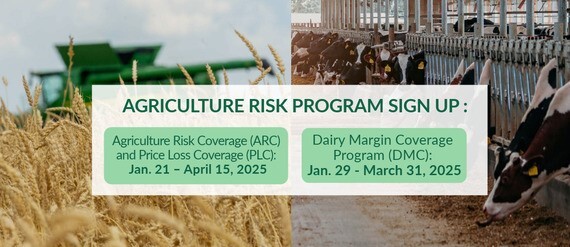
USDA’s Farm Service Agency (FSA) is accepting enrollments and elections for the Agriculture Risk Coverage (ARC) and Price Loss Coverage (PLC) for 2025 from Jan. 21 to April 15. ARC and PLC provide financial protections to farmers from substantial drops in crop prices or revenues and are vital economic safety nets for most American farms. The American Relief Act, 2025 extended many Farm Bill-authorized programs for another year, including ARC and PLC.
Producers can elect coverage and enroll in ARC-County (ARC-CO) or PLC, which provide crop-by-crop protection, or ARC-Individual (ARC-IC), which protects the entire farm. Although election changes for 2025 are optional, producers must enroll through a signed contract each year. Also, if a producer has a multi-year contract on the farm it will continue for 2025 unless an election change is made.
If producers do not submit their election revision by the April 15 deadline, their election remains the same as their 2024 election for commodities on the farm from the prior year. Farm owners cannot enroll in either program unless they have a share interest in the cropland.
Covered commodities include barley, canola, large and small chickpeas, corn, crambe, flaxseed, grain sorghum, lentils, mustard seed, oats, peanuts, dry peas, rapeseed, long grain rice, medium grain rice, safflower seed, seed cotton, sesame, soybeans, sunflower seed and wheat.
USDA also reminds producers that ARC and PLC elections and enrollments can impact eligibility for some crop insurance products including Supplemental Coverage Option, Enhanced Coverage Option and, for cotton producers, the Stacked Income Protection Plan (commonly referred to as STAX).
For more information on ARC and PLC, producers can visit the ARC and PLC webpage or contact your Carroll County USDA Service Center at 410-848-2780 X2.
Producers Can Now Enroll in Dairy Margin Coverage
USDA’s Farm Service Agency (FSA) is accepting applications for Dairy Margin Coverage (DMC) for the 2025 coverage year from Jan. 29 to March 31. DMC is a voluntary risk management program that offers protection to dairy producers when the difference between the all-milk price and the average feed price (the margin) falls below a certain dollar amount selected by the producer. The American Relief Act, 2025 extended many Farm Bill-authorized programs for another year, including DMC.
DMC offers different levels of coverage, even an option that is free to producers, minus a $100 administrative fee. The administrative fee is waived for dairy producers who are considered limited resource, beginning, socially disadvantaged or a military veteran.
DMC payments are calculated using updated feed and premium hay costs, making the program more reflective of actual dairy producer expenses. These updated feed calculations use 100% premium alfalfa hay. For more information on DMC, visit the DMC webpage or contact your Carroll County USDA Service Center at 410-848-2780 X2.
Top of page
Carroll County was declared a CONTIGUOUS disaster due to drought and excessive heat in crop year 2024, from June 22 through October 22. Under this designation, if you have operations in any primary or contiguous county, you are eligible to apply for low interest emergency loans.
Emergency loans help you recover from production and physical losses due to drought, flooding and other natural disasters or quarantine.
You have eight months from the date of the declaration to apply for emergency loan assistance. For this disaster declaration, the application deadline is September 15, 2025. FSA will consider each loan application on its own merits, taking into account the extent of losses, security available and repayment ability. You can borrow up to 100 percent of actual production or physical losses, to a maximum amount of $500,000.
For more information about emergency loans, contact the Farm Loan Team at your Frederick County USDA Service Center at 301-662-1321 or visit fsa.usda.gov.
|
Top of page

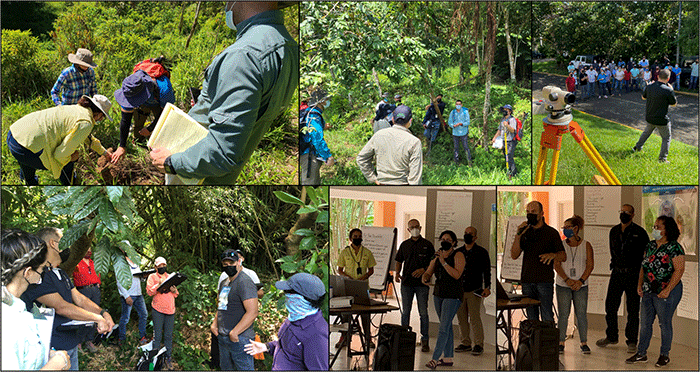
A video series from NRCS and farmers.gov, Conservation at Work, presents short and easy to understand videos about popular conservation practices. These videos feature producers explaining how an individual practice helps their land and why they are using it.
The videos shine the spotlight on farmers, ranchers, and forestland owners from across the U.S. who explain why they’ve implemented the conservation practices and how they work on their land. They also provide insight into how each practice is helping them protect and improve resources and save time and money.
We’ve got videos showcasing high tunnels, no-till, cover crops, prescribed grazing, and many more. Check out the Conservation at Work video series at farmers.gov/conserve/conservationatwork.
|
Top of page
Carroll County, MD USDA Service Center
698 Corporate Center Court
NRCS - Suite J,
FSA - Suite K Westminster, MD 21157
Phone: 410-848-6696
FSA - Ext 2; NRCS - Ext 3
Fax: 855-401-6643 FSA, 855-432-9024 NRCS
|
| |
|
Farm Service Agency
Amy Bange, Acting
County Executive Director (CED)
amy.bange@usda.gov
|
|
|
Farm Service Agency - Farm Loan
Sarah Fogle, Farm Loan Manager (FLM)
sarah.fogle@usda.gov
Frederick County FSA Office
Phone: 301-662-1321
|
|
Natural Resources Conservation Service
Samantha Cox, District Conservationist
samantha.cox@usda.gov
|
|
FSA Program Analysts (PA)
Carole Hill - Teleworking
Patrick Ransom
Danielle Wilson
|
|
|
FSA County Committee
Evan Staley (LAA3), Chair
D Mark Savage (LAA1), Vice-Chair
Jerry Frock (LAA2), Member
Susie Stonesifer Lawrence, Advisor
Next Meeting: February 25, 2025
|
|
| |
Carroll Soil Conservation District
Matt McMahon, District Manager
mattd.mcmahon@maryland.gov
|
|