
Arkansas USDA Newsletter - January, 2025.
In This Issue:
Greetings,
Happy New Year to those of you I have not had the pleasure of meeting. I am Emund Woods, Deputy State Executive Director for the state of Arkansas. As a native of Arkansas, I am pleased to have the opportunity to come back and serve the farmers of my home state. I grew up on a small farm in St. Francis County, near the town of Colt, Arkansas. I graduated from Forrest City High School, furthering my education at Mississippi State University, where I obtained a Bachelor of Science degree in Agricultural and Extension Education, I also received a Master of Agriculture in Agricultural and Extension Education.
I began my career with the United States Department of Agriculture (USDA) Agriculture Stabilization and Conservation Service (ASCS) in 1992 as a County Office Trainee (COT) in Mississippi. I’ve served as County Executive Director (CED) in several counties in Mississippi (Jefferson, Holmes and Lafayette). I was also a County Office Reviewer (COR) and most currently, a District Director (DD) serving 21 counites in the Mississippi Delta. As a career Farm Service Agency (FSA) employee, having spent most of my time in Mississippi, acquiring many years of knowledge and experience on farm programs and farm loans. I’m elated to bring that experience to the farmers of Arkansas.
I am currently serving as Acting State Executive Director. I look forward to working with you and providing the service our farmers rely on so that we can continue to provide the food, fiber and fuel the world needs.
Respectfully,
Emund I. Woods
Greetings!
This January marks my first month as Arkansas State Conservationist and I am proud of the work I have already seen being accomplished in our offices and out in the field in 2025. Though I have been with the agency since 2004, I am eager to take on the opportunities and challenges that this year will bring as I take on my first year in this role.
Now that the new year has begun, this could be a good time to review your farm’s conservation plan. A conservation plan identifies your conservation objectives and assesses and analyzes the natural resources issues on your land.
The conservation plan includes tools and resources customized specifically for you, like a land use map, soils information, inventory of resources, schedule of recommended practices, maintenance schedules, and engineering notes — all based on your goals and the resource needs.
This technical assistance from NRCS is free, and it can help you reduce soil loss from erosion, solve issues with plants, animals, and water quality, reduce potential damage from excess water and drought, enhance the quality of wildlife habitat, address waste management concerns, and improve the long-term sustainability.
How does conservation planning work? NRCS is here to provide one-on-one support to our customers at our 61 USDA Service Centers statewide. NRCS staff can help guide farmers to the best USDA assistance based on their conservation goals. You will meet with your local NRCS district conservationist, or conservation planning technician, for a science-based evaluation of the problems and opportunities on your land. NRCS staff members then analyze the findings and recommend the best strategies to address your issues and achieve valuable conservation opportunities and objectives.
Farmers who work with us at their local USDA Service Center can:
- Verify eligibility for USDA programs
- Discuss their business and conservation goals
- Create a conservation plan
- Learn how to meet conservation compliance provisions
Conservation plans are roadmaps for improving your operation while conserving natural resources. They provide proven strategies that landowners can use to solve identified natural resource concerns and take advantage of conservation opportunities.
If you’re interested in finding out more about conservation planning, I encourage you to contact your local USDA Service Center to discuss your operation’s needs.
Regards,
Amanda Mathis
See what other landowners are doing –
Learn more about the benefits of conservation practices directly from the farmers, ranchers, and forest landowners applying them with our Conservation at Work series. Explore the different types of conservation practices by watching these 90-second videos.
Important Dates to Remember:
- January 29, 2025: Arkansas Soil & Water Education Conference and Irrigation Expo in Jonesboro, AR
- January 30-February 1, 2025: Arkansas Grown Conference in Hot Springs, AR
- May 3, 2024: Application deadline for the KKAC Organization - AR-MS Conservation & Social Consortium Easement Project
- May 17, 2024: Application deadline for CSP-Urban, EQIP-Urban, and EQIP-Migratory Bird Resurgence Initiative (MRBI)
USDA’s Farm Service Agency (FSA) is committed to helping navigate the many opportunities we provide to farmers, ranchers, tribal nations, and landowners. Our agency is honored to partner with agricultural producers as they navigate every stage of their operation—from getting started to expanding.
FSA offers a full suite of programs to help agricultural producers access capital, protect the land and manage risk. We recognize it can be challenging for new customers to navigate the agency and get started, so we developed a packet of information that will help producers get to know FSA.
The new FSA Apply Now Packets will ensure a more productive customer experience when visiting with local FSA staff. The forms in the packet are needed for customers to participate in FSA and Natural Resources and Conservation Service (NRCS) programs.
To access these resources, visit www.farmers.gov/working-with-us/common-forms.
Get started today!
For more information on FSA programs, contact your local FSA office or visit fsa.usda.gov.
Are you gardening or farming in an urban environment or involved in controlled environment agriculture, rooftop farms, hydroponic aeroponic, aquaponic facilities or other types of innovative production? Agencies across USDA including the Office of Urban Agriculture and Innovative Production (OUAIP) have programs and resources available for you, and many are listed in this Urban Agriculture Programs at a Glance brochure.
USDA offers resources to help you
-
Starting, Financing, and Protecting Your Farm or Garden: Our resources can help you access land and capital for equipment and operating costs and start a business plan. USDA’s Farm Service Agency (FSA) offers a variety of funding opportunities and Rural Development (RD) can help urban and innovative producers locate guaranteed financing through the Business and Industry Guaranteed Loan Program. Our Risk Management Agency (RMA) can help you insure your crops against losses, including the micro farm policy. Learn more about USDA programs that support risk management.
-
On-Farm Guidance and Innovation: Natural Resources Conservation Service (NRCS) offers technical and financial assistance with conservation planning based on your goals, including high tunnels, soil health management systems, composting facilities and irrigation. Local organizations like Cooperative Extension also offer free training and expertise. OUAIP offers competitive grants for NRCS Conservation Innovation Grants fund innovative on-farm projects, some of which are targeted towards urban and innovative producers.
-
Marketing and Selling: FSA, Agricultural Marketing Service (AMS), and Food and Nutrition Service (FNS) can help you reach customers in new ways and open additional revenue streams when selling products. The Women, Infants, Children (WIC) Farmers’ Market Nutrition Program and Seniors Farmers Market Nutrition Program issues coupons for eligible foods from state-approved farmers, farmers' markets, or roadside stands. Farm Storage Facility Loans (FSA) provide low-interest loans to build, upgrade, or purchase permanent or portable facilities to store commodities, including fruit and vegetable cold storage, washing, packing, and handling buildings and equipment.
Farmers Market Promotion Program (FMPP) funds projects that develop, coordinate and expand direct producer-to-consumer markets like farmers markets. Agricultural businesses and cooperative are among the eligible entities.
A first step is to contact your local USDA Service Center, including our new Urban Service Centers, to meet face to face with our staff from FSA and NRCS. If you’re a new farmer, you can also reach out to your state Beginning Farmer and Rancher Coordinator.
We also invite you to get involved with your FSA Urban County Committee, which provides local input on USDA urban agriculture policy, and the Advisory Committee for Urban Agriculture and Innovative Production, which advises the Secretary of Agriculture and holds public meetings.
Sign up for e-mail updates on Urban Agriculture and learn more at farmers.gov/urban or usda.gov/urban.
The U.S. Department of Agriculture (USDA) is announcing the launch of the Debt Consolidation Tool, an innovative online tool available through farmers.gov that allows agricultural producers to enter their farm operating debt and evaluate the potential savings that might be provided by obtaining a debt consolidation loan with USDA’s Farm Service Agency (FSA) or a local lender.
A debt consolidation loan is a new loan used to pay off other existing operating loans or lines of credit that might have unreasonable rates and terms. By combining multiple eligible debts into a single, larger loan, borrowers may obtain more favorable payment terms such as a lower interest rate or lower payments. Consolidating debt may also provide farmers and ranchers additional cash flow flexibilities.
The Debt Consolidation Tool is a significant addition to FSA’s suite of improvements designed to modernize its Farm Loan Programs. The tool enhances customer service and increases opportunities for farmers and ranchers to achieve financial viability by helping them identify potential savings that could be reinvested in their farming and ranching operation, retirement accounts, or college savings accounts.
Producers can access the Debt Consolidation Tool by visiting farmers.gov/debt-consolidation-tool. The tool is built to run on modern browsers including Chrome, Edge, Firefox, or the Safari browser. Producers do not need to create a farmers.gov account or access the authenticated customer portal to use the tool.
Additional Farm Loan Programs Improvements
FSA recently announced significant changes to Farm Loan Programs through the Enhancing Program Access and Delivery for Farm Loans rule. These policy changes, to take effect September 25, 2024, are designed to better assist borrowers to make strategic investments in the enhancement or expansion of their agricultural operations.
FSA also has a significant initiative underway to streamline and automate the Farm Loan Program customer-facing business process. For the over 26,000 producers who submit a direct loan application annually, FSA has made several impactful improvements including:
- The Loan Assistance Tool that provides customers with an interactive online, step-by-step guide to identifying the direct loan products that may be a fit for their business needs and to understanding the application process.
- The Online Loan Application, an interactive, guided application that is paperless and provides helpful features including an electronic signature option, the ability to attach supporting documents such as tax returns, complete a balance sheet, and build a farm operating plan.
- An online direct loan repayment feature that relieves borrowers from the necessity of calling, mailing, or visiting a local USDA Service Center to pay a loan installment.
- A simplified direct loan paper application, reduced from 29 pages to 13 pages.
- A new educational hub with farm loan resources and videos.
USDA encourages producers to reach out to their local FSA farm loan staff to ensure they fully understand the wide range of loan and servicing options available to assist with starting, expanding, or maintaining their agricultural operation. To conduct business with FSA, please contact your local USDA Service Center.
The U.S. Department of Agriculture’s (USDA) long-awaited updates to the Farm Service Agency’s (FSA) Farm Loan Programs are officially in effect. These changes, part of the Enhancing Program Access and Delivery for Farm Loans rule, are designed to increase financial flexibility for agricultural producers, allowing them to grow their operations, boost profitability, and build long-term savings.
These program updates reflect USDA’s ongoing commitment to supporting the financial success and resilience of farmers and ranchers nationwide, offering critical tools to help borrowers manage their finances more effectively.
What the new rules mean for you:
- Low-interest installment set-aside program: Financially distressed borrowers can now defer up to one annual loan payment at a reduced interest rate. This simplified option helps ease financial pressure while keeping farming operations running smoothly.
- Flexible repayment terms: New repayment options give borrowers the ability to increase their cash flow and build working capital reserves, allowing for long-term financial planning that includes saving for retirement, education, and other future needs.
- Reduced collateral requirements: FSA has lowered the amount of additional loan security needed for direct farm loans, making it easier for borrowers to leverage their existing equity without putting their personal residence at risk.
- These new rules provide more financial freedom to borrowers. By giving farmers and ranchers better tools to manage their operations, we’re helping them build long-term financial stability. It’s all about making sure they can keep their land, grow their business, and invest in the future.
If you’re an FSA borrower or considering applying for a loan, now is the time to take advantage of these new policies. We encourage you to reach out to your local FSA farm loan staff to ensure you fully understand the wide range of loan making and servicing options available to assist with starting, expanding, or maintaining your agricultural operation.
To conduct business with FSA, please contact your local USDA Service Center.
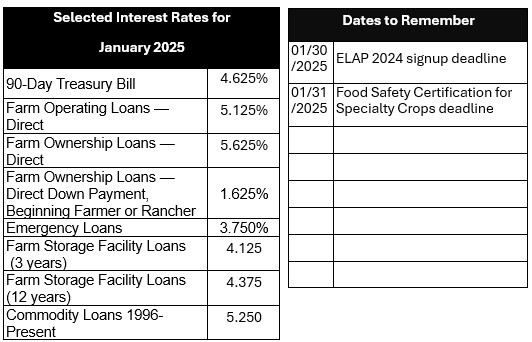
The U.S. Department of Agriculture (USDA) reminds specialty crop producers that the deadline to enroll in the Food Safety Certification for Specialty Crops (FSCSC) program for 2024 expenses is Jan. 31, 2025. The program has been expanded to include medium-sized businesses in addition to small businesses. Eligible specialty crop growers can apply for assistance for expenses related to obtaining or renewing a food safety certification. For program year 2025, the application period starts Jan. 1, 2025, and runs through Jan. 31, 2026.
Program Details
FSCSC covers a percentage of the specialty crop operation’s cost of obtaining or renewing its on-farm food safety certification, as well as a portion of related expenses.
Eligible FSCSC applicants must be a specialty crop operation; meet the definition of a small or medium-size business and have paid eligible expenses related to certification.
- A small business has an average annual monetary value of specialty crops sold by the applicant during the three-year period preceding the program year of no more than $500,000.
- A medium size business has an average annual monetary value of specialty crops the applicant sold during the three-year period preceding the program year of at least $500,001 but no more than $1,000,000.
Specialty crop operations can receive the following cost assistance:
- Developing a food safety plan for first-time food safety certification.
- Maintaining or updating an existing food safety plan.
- Food safety certification.
- Certification upload fees.
- Microbiological testing for products, soil amendments and water.
FSCSC payments are calculated separately for each eligible cost category. Details about payment rates and limitations are available at farmers.gov/food-safety.
Applying for Assistance
Interested applicants have until Jan. 31, 2025, to apply for assistance for 2024 eligible expenses. FSA will issue payments as applications are processed and approved. For program year 2025, the application period begins Jan. 1, 2025, and runs through Jan. 31, 2026. FSA will issue 50% of the calculated payment for program year 2025 following application approval, with the remaining amount to be paid after the application deadline. If calculated payments exceed the amount of available funding, payments will be prorated. Specialty crop producers can apply by completing the FSA-888-1, Food Safety Certification for Specialty Crops Program (FSCSC) for Program Years 2024 and 2025 application. The application, along with the AD-2047, Customer Data Worksheet and SF-3881, ACH Vendor/Miscellaneous Payment Enrollment Form, if not already on file with FSA, can be submitted to the FSA county office at any USDA Service Center nationwide by mail, fax, hand delivery or via electronic means. Producers with an eAuthentication account can apply for FSCSC online. Producers interested in creating an eAuthentication account should visit farmers.gov/sign-in.
Visit farmers.gov/food-safety for additional program details, eligibility information and application forms.
More Information
To learn more about FSA programs, producers can contact their local USDA Service Center. Producers can also prepare maps for acreage reporting as well as manage farm loans and view other farm records data and customer information by logging into their farmers.gov account. Producers without an account can sign up today.
FSA and NRCS program applicants for benefits are required to submit a completed CCC-902 Farming Operation Plan and CCC-941 Average Gross Income (AGI) Certification and Consent to Disclosure of Tax Information for FSA to determine the applicant’s payment eligibility and establish the maximum payment limitation applicable to the program applicant.
Participants are not required to annually submit new CCC-902s for payment eligibility and payment limitation purposes unless a change in the farming operation occurs that may affect the previous determination of record. A valid CCC-902 filed by the participant is considered to be a continuous certification used for all payment eligibility and payment limitation determinations applicable for the program benefits requested.
Participants are responsible for ensuring that all CCC-902 and CCC-941 and related forms on file in the county office are updated, current, and correct. Participants are required to timely notify the county office of any changes in the farming operation that may affect the previous determination of record by filing a new or updated CCC-902 as applicable.
Changes that may require a NEW determination include, but are not limited to, a change of:
- Shares of a contract, which may reflect:
- A land lease from cash rent to share rent
- A land lease from share rent to cash rent (subject to the cash rent tenant rule
- A modification of a variable/fixed bushel-rent arrangement
- The size of the producer’s farming operation by the addition or reduction of cropland that may affect the application of a cropland factor
- The structure of the farming operation, including any change to a member's share
- The contribution of farm inputs of capital, land, equipment, active personal labor, and/or active personal management
- Farming interests not previously disclosed on CCC-902 including the farming interests of a spouse or minor child
- Certifications of average AGI are required to be filed annually for participation in an annual USDA program. For multi-year conservation contracts and NRCS easements, a certification of AGI must be filed prior to approval of the contract or easement and is applicable for the duration of the contract period.
Participants are encouraged to file or review these forms within the deadlines established for each applicable program for which program benefits are being requested.
The National Environmental Policy Act (NEPA) requires Federal agencies to consider all potential environmental impacts for federally funded projects before the project is approved.
For all Farm Service Agency (FSA) programs, an environmental review must be completed before actions are approved, such as site preparation or ground disturbance. These programs include, but are not limited to, the Emergency Conservation Program (ECP), Farm Storage Facility Loan (FSFL) program and farm loans. If project implementation begins before FSA has completed an environmental review, the request will be denied. Although there are exceptions regarding the Stafford Act and emergencies, it’s important to wait until you receive written approval of your project proposal before starting any actions.
Applications cannot be approved until FSA has copies of all permits and plans. Contact your local FSA office early in your planning process to determine what level of environmental review is required for your program application so that it can be completed timely.
Here at USDA’s Natural Resources Conservation Service (NRCS), we are supporting conservation efforts on working lands. We provide one-on-one assistance to producers and communities, and we are taking steps to ensure our conservation solutions integrate Traditional Ecological Knowledge (TEK) and Indigenous Stewardship Methods (ISM).
Native Americans are this land’s original conservationists, and we want to make sure that NRCS is listening to tribes to help shape conservation programs and practices.
We’re proud of the technical assistance that we provide to 345 federally recognized tribes, or 60 percent of all tribal nations, on 75 million acres, through our field offices nationwide. Between 2005 and 2021, NRCS also provided financial assistance to 163 Native American tribes.
In recent years, NRCS has taken bold steps toward equity, justice and opportunity for all producers, including tribal producers. These efforts are driven by wise council from tribes and intertribal organizations.
In 2022, NRCS formed the Tribal and Indigenous Practices Team to help regions develop new Environmental Quality Incentives Program (EQIP) scenarios, Conservation Stewardship Program (CSP) enhancements, improve accessibility of existing conservation practice standards, develop new interim conservation practice standards, provide targeted training, adjust programmatic and technical policies, and improve availability of natural resources data and information important to Tribes and indigenous peoples in order to make NRCS assistance more meaningful on tribal lands and in native communities, while respecting that TEK and ISM are the intellectual property of tribes and indigenous peoples.
With the help of our staff in California, we developed a Conservation Evaluation and Monitoring Activity (CEMA), Indigenous Stewardship Methods Evaluation (CEMA 222), to provide funding to assist in sharing knowledge among tribal subject matter experts. Through this new conservation activity, which originated with council from tribes, landowners and agricultural producers can now get financial assistance to hire qualified individuals, identified by tribes, to incorporate Tribal Ecological Knowledge into their conservation plans.
NRCS began providing targeted soil health training to tribes, tribal members, and native communities, while also using the opportunity to learn native technologies used to improve soil health from the tribal and indigenous communities participating in the training events. Since 2022, NRCS has reached more than 25 Tribal Nations, dozens of Alaska Native villages, and several communities in the Pacific Islands and Caribbean Islands Areas with these targeted exchanges of knowledge. More requests for these events are continually coming in, and there are many planned for fiscal year 2025.
In a similar vein, NRCS has been partnering with tribes and key organizations to improve NRCS assistance for bison management. Training for NRCS and partner staff to build competency in bison management has begun, new EQIP payment scenarios have been released, the grazing management conservation practice standard has been updated to reflect considerations for bison management, and there are several more products and activities planned for fiscal year 2025 related to bison management.
All of these efforts are making our conservation programs and practices better align with tribal producers, and help USDA meet our federal trust responsibilities to tribes by improving program access. We’re excited to soon unveil a new Tribal Relations Strategy as well as information on our growing team to serve tribes and tribal producers across the country.
We encourage tribes and tribal producers who aren’t working with us or who want to take their conservation activities to the next level to give us a call. We’ll be excited to share the improvements that we’ve made to better serve tribes. Please contact the NRCS at your local USDA Service Center.
USDA is providing a total of $14.4 million in grants and technical assistance through two separately funded projects.
The U.S. Department of Agriculture (USDA) is providing a total of $14.4 million in grants and technical assistance through two separately funded projects to support urban agriculture and innovative production. USDA’s Office of Urban Agriculture and Innovative Production (OUAIP) is making available $2.5 million for Urban Agriculture and Innovative Production (UAIP) grants, building on $53.7 million invested in UAIP grant projects by OUAIP since 2020. In addition, USDA’s Natural Resources Conservation Service (NRCS), which oversees OUAIP, is providing $11.9 million in funding through an interagency agreement with the National Institute of Food and Agriculture (NIFA) to promote the hiring of Urban Agriculture Conservation Extension Educators through the Cooperative Extension programs at Land-grant Universities.
Urban Agriculture and Innovative Production Grants
Recipients of UAIP competitive grants, including community gardens and nonprofit farms, will increase food production and access in economically distressed communities, provide job training and education, and allow partners to develop business plans and zoning proposals. The program supports a wide range of activities through grants that include planning and implementation activities. Planning activities initiate or expand efforts of farmers, gardeners, citizens, government officials, schools and other stakeholders in urban areas and suburbs, while implementation activities accelerate existing and emerging models of urban, indoor and other agricultural practices that serve farmers and communities. USDA will accept applications on Grants.gov until 11:59 p.m. Eastern Time on March 10, 2025.
Examples of selected projects from previous years include:
- The Howard-Sumaico School District in Green Bay, Wis., which improved the school’s access to local fresh and nutritious food while also teaching student about innovative agriculture production using hydroponic technology.
- The Golden Triangle RC&D in Dawson, Ga., which increased food production and facilitated entrepreneurial business development assistance for new and beginning farmers to provide resources, mentorship, marketing, job training, innovative urban practices for vertical tower and hydroponic growing systems along with Farm to Table demonstrations.
- The Technical Assistance Partnership of Arizona in Phoenix, which created a robust urban farming industry, healthier residents, and a flourishing economic outlook in South Phoenix.
For a complete list of recipients and project summaries, visit www.usda.gov/urban.
Webinar
A pre-recorded webinar on Urban Agriculture and Innovative Production Grants | USDA provides an overview of the grants’ purpose, project types, eligibility and basic requirements for submitting an application.
Technical Assistance Funding to Land-Grant Universities
The interagency agreement between NRCS and NIFA will fund the hiring of Urban Agriculture Conservation Extension Educators through cooperative extension programs at land-grant universities who will work with NRCS employees in 27 cities nationwide that USDA has designated as urban priority locations. The educators hired through this partnership will deliver technical assistance and link producers to NRCS conservation planning and program opportunities.
Their duties will include:
- Working with NRCS to help urban agriculture producers conserve, maintain, and restore natural resources while improving the health of their operation.
- Providing direct technical assistance to urban producers to help identify resource concerns and develop science-based solutions for addressing their conservation priorities.
- Assisting producers with awareness of zoning, permitting, and administrative complexities associated with conservation practice implementation.
- Assisting producers with climate-smart mitigation activities that deliver quantifiable greenhouse gas reductions.
- Evaluating the conservation needs and assisting innovative forms of agricultural production including controlled environment agriculture systems.
The agreement will also fund the development of an Impact Collaborative for urban agriculture service delivery. The Impact Collaborative will help NRCS scale their assistance to urban producers beyond the priority cities. More information about Urban Agriculture Extension Educators and the Impact Collaborative will be forthcoming.
More Information
OUAIP was established through the 2018 Farm Bill. It is led by the Natural Resources Conservation Service (NRCS) and works in partnership with numerous USDA agencies that support urban agriculture and innovative production. The grants are part of a broad USDA investment in urban agriculture. Other efforts include:
-
Investing $9 million in new funding to local organizations that will conduct outreach, education and technical assistance to urban producers and support urban service centers in 10 cities as part of a $40 million investment in urban agriculture through President Biden’s American Rescue Plan.
- Organizing 27 FSA urban county committees to make important decisions about how FSA farm programs are administered locally. Urban farmers who participate in USDA programs in the areas selected are encouraged to participate by nominating and voting for county committee members.
- Establishing 17 new Urban Service Centers staffed by FSA and NRCS employees to better serve urban producers.
- Administering the People’s Garden Initiative, which celebrates collaborative gardens across the country and worldwide that benefit their communities by growing fresh, healthy food and supporting resilient, local food systems using sustainable practices and providing greenspace.
- Creating and managing a Federal Advisory Committee for Urban Agriculture and Innovative Production to advise the Secretary on the development of policies and outreach relating to urban agriculture.
- Providing cooperative agreements that develop and test strategies for planning and implementing municipal compost plans and food waste reduction plans.
- Investing in risk management education to broaden the reach of crop insurance among urban and innovative producers.
- Partnering with the Vermont Law and Graduate School Center for Agriculture and Food Systems to develop resources that help growers understand and work through local policies.
USDA NRCS announced Jessica Roles as the newly selected State Public Affairs Specialist. Jess recently moved to the agency from the U.S. Small Business Administration’s Arkansas District Office where she was the Economic Development Specialist and Public Information Officer. Prior to the SBA, she was enlisted in the Air Force on active duty for 13 years and Arkansas Air National Guard as a fulltime service member for eight years. There, she served as the Public Affairs Superintendent of the 189th Airlift Wing Public Affairs office. She retired from the Air Force in June after 21 years of service in the U.S. Air Force and Arkansas Air National Guard.
Jess has an extensive background in public affairs including coordinating public events, writing news and feature articles, production of visual information and other communication products, social media content and management, and leveraging partnerships.
The Risk Management Agency (RMA) serves America’s agricultural producers through effective, market-based risk management tools to strengthen the economic stability of agricultural producers and rural communities. RMA is committed to increasing the availability and effectiveness of Federal crop insurance as a risk management tool.
RMA manages the Federal Crop Insurance Corporation (FCIC) to provide innovative crop insurance products to America’s farmers and ranchers. Approved Insurance Providers (AIP) sell and service Federal crop insurance policies in every state and in Puerto Rico through a public-private partnership with RMA. RMA backs the AIPs who share the risks associated with catastrophic losses due to major weather events. Learn more by visiting RMA’s website.
Top of page
USDA Service Centers
Arkansas USDA-FSA
700 West Capitol Room 3416, Little Rock, Arkansas 72201
FSA Acting State Executive Director - Emund Woods
FSA Phone: 501-301-3000 | FSA Fax: 855-652-2082
www.fsa.usda.gov
www.fsa.usda.gov/state-offices/Arkansas/index
Arkansas USDA-NRCS
700 West Capitol Room 3416, Little Rock, Arkansas 72201
NRCS State Conservationist - Amanda Mathis
NRCS Phone: 501-301-3149
www.nrcs.usda.gov
www.ar.nrcs.usda.gov
USDA-RMA / Jackson, Mississippi Regional Office
803 Liberty Road, Jackson, MS 39232-9000
RMA Regional Director – Roddric Bell
RMA Phone: 601-965-4771 | RMA Fax: 601-965-4517
Jackson, Mississippi | RMA (usda.gov)
Please contact your local Office for questions specific to your operation or county. To find contact information for your local office visit the website below: Get Started at Your USDA Service Center | Farmers.gov
|
|
Persons with disabilities who require accommodations to attend or participate in this meeting/event should contact Rita Smith-Clay at 501-301-3200 or Federal Relay Service at 1-800-877-8339.
|
| |
|
| |
|






