
Idaho State Office FSA Newsletter - January 14, 2025
In This Issue:
-
January 20: Martin Luther King, Jr. Day - Office Closed
-
January 30: Emergency Assistance for Livestock, Honey Bees, and Farm-Raised Fish (ELAP)
-
January 31: Food Safety Certification for Specialty Crops Program (FSCSC)
-
February 17: Presidents Day - Office Closed
-
March 31: Dairy Margin Coverage Program (DMC)
-
April 15: Agriculture Risk Coverage (ARC) and Price Loss Coverage (PLC) Programs
Click here to learn more about local deadlines and ongoing programs.
Top of page
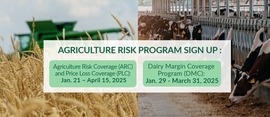
The U.S. Department of Agriculture (USDA) announced the 2025 enrollment periods for key safety-net programs – Agriculture Risk Coverage (ARC) and Price Loss Coverage (PLC) as well as Dairy Margin Coverage (DMC). Agricultural producers can submit applications to USDA’s Farm Service Agency (FSA) for ARC and PLC for the 2025 crop year from Jan. 21 to April 15 and for DMC for the 2025 coverage year from Jan. 29 to March 31.
ARC and PLC provide financial protections to farmers from substantial drops in crop prices or revenues and are vital economic safety nets for most American farms. Meanwhile, DMC provides producers with price support to help offset milk and feed price differences.
The American Relief Act, 2025 extended many Farm Bill-authorized programs for another year, including ARC and PLC as well as DMC.
ARC and PLC
Producers can elect coverage and enroll in ARC-County (ARC-CO) or PLC, which provide crop-by-crop protection, or ARC-Individual (ARC-IC), which protects the entire farm. Although election changes for 2025 are optional, producers must enroll through a signed contract each year. Also, if a producer has a multi-year contract on the farm it will continue for 2025 unless an election change is made.
If producers do not submit their election revision by the April 15 deadline, their election remains the same as their 2024 election for commodities on the farm from the prior year. Farm owners cannot enroll in either program unless they have a share interest in the cropland.
Covered commodities include barley, canola, large and small chickpeas, corn, crambe, flaxseed, grain sorghum, lentils, mustard seed, oats, peanuts, dry peas, rapeseed, long grain rice, medium grain rice, safflower seed, seed cotton, sesame, soybeans, sunflower seed and wheat.
USDA also reminds producers that ARC and PLC elections and enrollments can impact eligibility for some crop insurance products including Supplemental Coverage Option, Enhanced Coverage Option and, for cotton producers, the Stacked Income Protection Plan (commonly referred to as STAX).
For more information on ARC and PLC, producers can visit the ARC and PLC webpage or contact their local USDA Service Center.
|
The U.S. Department of Agriculture (USDA) reminds specialty crop producers that the deadline to enroll in the Food Safety Certification for Specialty Crops (FSCSC) program for 2024 expenses is Jan. 31, 2025. The program has been expanded to include medium-sized businesses in addition to small businesses. Eligible specialty crop growers can apply for assistance for expenses related to obtaining or renewing a food safety certification. For program year 2025, the application period starts Jan. 1, 2025, and runs through Jan. 31, 2026.
Program Details
FSCSC covers a percentage of the specialty crop operation’s cost of obtaining or renewing its on-farm food safety certification, as well as a portion of related expenses.
Eligible FSCSC applicants must be a specialty crop operation; meet the definition of a small or medium-size business and have paid eligible expenses related to certification.
- A small business has an average annual monetary value of specialty crops sold by the applicant during the three-year period preceding the program year of no more than $500,000.
- A medium size business has an average annual monetary value of specialty crops the applicant sold during the three-year period preceding the program year of at least $500,001 but no more than $1,000,000.
Specialty crop operations can receive the following cost assistance:
- Developing a food safety plan for first-time food safety certification.
- Maintaining or updating an existing food safety plan.
- Food safety certification.
- Certification upload fees.
- Microbiological testing for products, soil amendments and water.
FSCSC payments are calculated separately for each eligible cost category. Details about payment rates and limitations are available at farmers.gov/food-safety.
Applying for Assistance
Interested applicants have until Jan. 31, 2025, to apply for assistance for 2024 eligible expenses. FSA will issue payments as applications are processed and approved. For program year 2025, the application period begins Jan. 1, 2025, and runs through Jan. 31, 2026. FSA will issue 50% of the calculated payment for program year 2025 following application approval, with the remaining amount to be paid after the application deadline. If calculated payments exceed the amount of available funding, payments will be prorated.
Specialty crop producers can apply by completing the FSA-888-1, Food Safety Certification for Specialty Crops Program (FSCSC) for Program Years 2024 and 2025 application. The application, along with the AD-2047, Customer Data Worksheet and SF-3881, ACH Vendor/Miscellaneous Payment Enrollment Form, if not already on file with FSA, can be submitted to the FSA county office at any USDA Service Center nationwide by mail, fax, hand delivery or via electronic means. Producers with an eAuthentication account can apply for FSCSC online. Producers interested in creating an eAuthentication account should visit farmers.gov/sign-in.
Visit farmers.gov/food-safety for additional program details, eligibility information and application forms.
More Information
To learn more about FSA programs, producers can contact their local USDA Service Center. Producers can also prepare maps for acreage reporting as well as manage farm loans and view other farm records data and customer information by logging into their farmers.gov account. Producers without an account can sign up today.
Producers who received an Emergency Relief Program (ERP) payment need to meet ERP insurance linkage requirements by purchasing crop insurance, or Noninsured Crop Disaster Assistance Program (NAP) coverage where crop insurance is not available.
Purchase coverage must be at the 60/100 coverage level or higher for insured crops or at the catastrophic coverage level or higher for NAP crops for the next two available crop years, which will be determined from the date you received an ERP payment and may vary depending on the timing and availability of coverage. The insurance coverage requirement applies to the physical location of the county where the crop was located and for which an ERP payment was issued.
Contact your crop insurance agent or local FSA county office as soon as possible to ask about coverage options. Producers who do not obtain the applicable coverage by the sales/application closing date will be required to refund the ERP benefits received on the applicable crop, plus interest. To determine which crops are eligible for federal crop insurance or NAP, visit the RMA website.
For more information, contact your local USDA Service Center or visit fsa.usda.gov.
|
FSA is cleaning up our producer record database and needs your help. Please report any changes of address, zip code, phone number, email address or an incorrect name or business name on file to our office. You should also report changes in your farm operation, like the addition of a farm by lease or purchase. You should also report any changes to your operation in which you reorganize to form a Trust, LLC or other legal entity.
FSA and NRCS program participants are required to promptly report changes in their farming operation to the County Committee in writing and to update their Farm Operating Plan on form CCC-902.
To update your records, contact your local USDA Service Center or visit fsa.usda.gov.
|
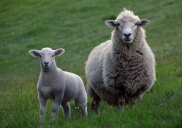
Marketing Assistance Loans (MALs) and Loan Deficiency Payments (LDPs) provide financing and marketing assistance for producers of many commodities, including graded and non-graded wool, mohair, and unshorn pelts. MALs and LDPs are available during shearing and provide interim financing to help you meet cash flow needs without having to sell commodities when market prices are low, enabling you to delay selling until more favorable marketing conditions emerge. LDPs are payments made to producers who, although eligible to obtain an MAL, agree to forgo the loan in return for a payment on the eligible commodity.
FSA is now accepting requests for 2024 MALs and LDPs for all eligible wool, mohair and unshorn pelts. These requests should be made on or before the final availability date of Jan. 31, 2025. USDA recently announced 2024 wool and mohair marketing assistance loan rates.
Eligibility
To be eligible for a wool or mohair MAL or LDP, producers must produce and shear eligible mohair and wool in the U.S. during the applicable crop year and must:
- comply with conservation and wetland protection requirements;
- report all cropland acreage on applicable farms where the eligible commodity is produced;
- have and retain beneficial interest in the commodity until the MAL is repaid or the Commodity Credit Corporation (CCC) takes title to the commodity, and;
- meet Adjusted Gross Income (AGI) limitations.
Unshorn pelts are eligible for LDPs only. In addition to the criteria above, producers of unshorn pelts must have sold the unshorn lamb for immediate slaughter or slaughter the lambs for personal use. LDPs and marketing loan gains are not subject to payment limitation, including actively engaged in farming and cash rent tenant provisions.
In addition to producer eligibility, the loan commodity must have been produced and shorn from live animals by an eligible producer, be in storable condition, and meet specific CCC minimum grade and quality standards. Producers are responsible for any loss in quantity or quality of the wool or mohair pledged as loan collateral.
To retain beneficial interest, the producer must have control and title of the wool, mohair, or unshorn pelt. If beneficial interest in the commodity is lost, the commodity loses eligibility for an MAL or LDP and remains ineligible even if the producer later regains beneficial interest. The producer must be able to make all decisions affecting the commodity including movement, sale, and the request for an MAL or LDP.
Producers may repay an MAL any time during the loan period at the lesser of the loan rate plus accrued interest and other charges or an alternative loan repayment rate, the national posted price, which is announced weekly. Visit the Farm Service Agency (FSA) website for posted loan and LDP rates.
How to Apply
Producers can apply for an MAL by contacting their local FSA county office. To be considered for a LDP, producers must first have the form CCC-633 EZ, Page 1, on file with FSA prior to losing beneficial interest in the wool, mohair or unshorn pelt. It is best to visit the county office and submit the CCC-633 Page 1 right before you shear. This is completed one time per crop year and indicates your intention to receive LDP benefits.
To apply and learn more information, contact your local USDA Service Center or visit fsa.usda.gov.
|
Free basic coverage available for new and underserved loan applicants
Producers who apply for Farm Service Agency (FSA) farm loans will be offered the opportunity to enroll in the Noninsured Crop Disaster Assistance Program (NAP). NAP is available to producers who grow noninsurable crops and is especially important to fruit, vegetable, and other specialty crop growers.
New, underserved and limited income specialty growers who apply for farm loans could qualify for basic loss coverage at no cost.
The basic disaster coverage protects at 55 percent of the market price for crop losses that exceed 50 percent of production. Covered “specialty” crops include vegetables, fruits, mushrooms, floriculture, ornamental nursery, aquaculture, turf grass, ginseng, honey, syrup, hay, forage, grazing and energy crops. FSA allows beginning, underserved or limited income producers to obtain NAP coverage up to 90 days after the normal application closing date when they also apply for FSA credit.
Producers can also protect value-added production, such as organic or direct market crops, at their fair market value in those markets. Targeted underserved groups eligible for free or discounted coverage include American Indians or Alaskan Natives, Asians, Blacks or African Americans, Native Hawaiians or other Pacific Islanders, Hispanics, and women.
FSA offers a variety of loan products, including farm ownership loans, operating loans and microloans that have a streamlined application process.
NAP coverage is not limited to FSA borrowers, beginning, limited resource, or underserved farmers. Any producer who grows eligible NAP crops can purchase coverage. To learn more, contact your local County USDA Service Center or visit fsa.usda.gov/nap or fsa.usda.gov/farmloans.
Top of page
Idaho FSA State Office
9173 West Barnes Drive, Ste. B
Boise, Idaho 83709
Phone: 208-378-5650
Fax: 855-516-8875
|
| |
|
Deputy State Executive Director
Nick Treasure ~ 208-378-5671 nicholas.treasure@usda.gov
Farm Program Chief
Kyla Pearson ~ 208-378-5667 kyla.pearson@usda.gov
|
Administrative Officer
Brandi May ~ 208-378-5670 brandi.may@usda.gov
Farm Loan Chief
Susan R. Smith ~ 208-378-5664 susan.r.smith@usda.gov
|
|
Idaho FSA State Committee
Roy Bunderson ~ Committee Chair
Marie Linehan, Member
Next State Committee Meeting: TBD
Note: To check the status of your FSA Farm Loan (FLP) account, call 1-888-518-4983 or check with your local office. To find contact information for your local office go to www.fsa.usda.gov/id
|
|






