Minnesota FSA Updates - December 17, 2024
In This Issue:

As we come to the end of another year I want to recognize the remarkable accomplishments of the USDA Farm Service Agency staff in 2024. The local farm loan and farm program staff are who many of you think of when you hear ‘USDA.’ In addition to existing program and loan activities, over the last year local employees have delivered new programs such as the Emergency Relief Program and new farm loan initiatives like those funded through the Inflation Reduction Act.
It is also important to recognize that 2024 has been a challenging season for many in the state. USDA has tracked extreme moisture, flooding, and other severe weather throughout Minnesota. Disaster conditions have triggered Presidential Major Disaster Declarations, Secretarial Disaster Designations, Administrator’s Physical Loss Notifications, and Quarantine Designations in portions of Minnesota. These declarations and designations make USDA Emergency Farm Loans available in both primary and contiguous counties. Looking forward, it is important for farmers and ranchers to remain informed regarding both program and loan updates from the Department. In addition to receiving newsletters like this one, customers can also subscribe to alerts for news releases and other topics on farmers.gov. Subscribing is one more way to stay current on updates from the Department and avoid missing a loan or program opportunity.
Just last week USDA announced the opening of enrollment for a new program, the Marketing Assistance for Specialty Crop (MASC) Program. The program is open through January 8, 2025. With the deadline for the program early in the new year specialty crop producers are encouraged to familiarize themselves with the program requirements through the article in the newsletter below and to contact their local offices to submit an application.
USDA has also announced a new Commodity Storage Assistance Program to make available commercial storage facilities such as grain elevators and packinghouses necessary for the orderly marketing of commodities by producers experiencing reduced commercial storage access due to 2024 natural disasters. The details and potential enrollment period for the Commodity Storage Assistance Program have not yet been announced.
Amongst other program and loan activity USDA offices in Minnesota are receiving applications for Farm Storage Facility Loans, Marketing Assistance Loans, and Farm Ownership and Operating Loans. As we end one year and look to meet the needs of the next consider initiating inquiries for loans early to allow adequate time to meet all the requirements of these loan programs.
Wishing you a happy holiday season,
Daniel Mahoney
Deputy State Executive Director
|
The Farm Service Agency (FSA) is an exciting and rewarding place to start, build, and/or continue your career. Be part of our team and support the well-being of Minnesota agriculture and the American public.
FSA's diverse culture and benefits allow for a healthy balance between your career and home life. In addition to a generous salary, FSA offers a friendly and professional working environment with a diverse workforce, flexible hours/work schedules, and other family-friendly benefits such as: paid vacation and sick leave, paid holidays, retirement and supplemental savings plan, a wide array of health, dental, vision, and life insurance plans, flexible spending accounts, twelve weeks of paid parental leave with FMLA eligibility, and long-term care insurance. Working for the U.S. Department of Agriculture (USDA) will afford you the opportunity to contribute to projects that positively impact the lives of over 300 million people. Explore a career with the USDA at www.usajobs.gov.
New job openings are posted on a regular basis. Interested individuals can search for career opportunities based upon keywords and/or specific locations as well as create search profiles and job announcement notifications. Currently, Minnesota FSA is seeking candidates to perform work in support of Minnesota agriculture and farmers in a number of locations across the state. Individuals who are interested in applying for these job opportunities will need to apply online at www.usajobs.gov. Applicants may enter the appropriate job announcement number below into the keyword search or click on the applicable link(s).
Expanded County Executive Director:
USDA Makes $2 Billion Available to Support Expansion of Current and Development of New Markets
The U.S. Department of Agriculture (USDA) Farm Service Agency’s (FSA) $2 billion Marketing Assistance for Specialty Crops (MASC) program, aimed at helping specialty crop producers expand markets and manage higher costs, is now accepting applications from Dec. 10, 2024 through Jan. 8, 2025. Funded by the Commodity Credit Corporation, MASC was announced in November alongside the $140 million Commodity Storage Assistance Program for facilities impacted by 2024 natural disasters.
MASC helps specialty crop producers meet higher marketing costs related to:
- Perishability of specialty crops like fruits, vegetables, floriculture, nursery crops and herbs;
- Specialized handling and transport equipment with temperature and humidity control;
- Packaging to prevent damage;
- Moving perishables to market quickly; and
- Higher labor costs.
MASC Eligibility
To be eligible for MASC, a producer must be in business at the time of application, maintain an ownership share and share in the risk of producing a specialty crop that will be sold in calendar year 2025.
MASC covers the following commercially marketed specialty crops:
- Fruits (fresh, dried);
- Vegetables (including dry edible beans and peas, mushrooms, and vegetable seed);
- Tree nuts;
- Nursery crops, Christmas trees, and floriculture;
- Culinary and medicinal herbs and spices; and
- Honey, hops, maple sap, tea, turfgrass and grass seed.
Applying for MASC
Eligible established specialty crop producers can apply for MASC benefits by completing the FSA-1140, Marketing Assistance for Specialty Crops (MASC) Program Application, and submitting the form to any FSA county office by Jan. 8, 2025. When applying, eligible specialty crop producers must certify their specialty crop sales for calendar year 2023 or 2024.
New specialty crop producers are required to certify 2025 expected sales, submit an FSA-1141 application and provide certain documentation to support reported sales i.e., receipts, contracts, acreage reports, input receipts, etc. New producers are those who began producing specialty crops in 2023 or 2024 but did not have sales due to the immaturity of the crop, began producing specialty crops in 2024 but did not have a complete year of sales or will begin growing specialty crops in 2025.
MASC applicants, established and new, must also submit the following information to FSA if not already on file at the time of application:
- Form AD-2047, Customer Data Worksheet.
- Form CCC-902, Farm Operating Plan for an individual or legal entity.
- Form CCC-941, Average Adjusted Gross Income (AGI) Certification and Consent to Disclosure of Tax Information.
- Form FSA-942, Certification of Income from Farming, Ranching and Forestry Operations, if applicable, for the producer and members of entities.
- A highly erodible land conservation (sometimes referred to as HELC) and wetland conservation certification (Form AD-1026 Highly Erodible Land Conservation (HELC) and Wetland Conservation (WC) Certification) for the ERP producer and applicable affiliates.
- Other Documentation if requested by FSA to support reported specialty crop sales.
Most producers, especially those who have previously participated in FSA programs, will likely have these required forms on file. However, those who are uncertain or want to confirm the status of their forms or producers who may be new to conducting business with FSA, can contact their local FSA county office. For MASC program participation, eligible specialty crop sales only include sales of commercially marketed raw specialty crops grown in the United States by the producer. The portion of sales derived from adding value to a specialty crop (such as sorting, processing, or packaging) is not included when determining eligible sales. Further explanation of what is considered by FSA for specialty crop sales as well as an online MASC decision tool and applicable program forms, are available on the MASC program webpage.
MASC Payments
For established specialty crop growers, those who certify crop sales in 2023 or 2024, FSA will calculate MASC payments based on the producer’s total specialty crop sales for the calendar year elected by the producer. Payments for new producers will be based on their expected 2025 calendar year sales. Payment calculation details and examples are available on the MASC webpage or related questions can be directed to local FSA county office staff.
FSA will issue MASC payments after the end of the application period. If demand for MASC payments exceeds available funding, MASC payments may be prorated, and the payment limitation of $125,000 may be lowered. If additional funding is available after MASC payments are issued, FSA may issue an additional payment.
Specialty crop producers interested in applying for MASC benefits, are encouraged to review the program fact sheet for detailed information on program eligibility, required documentation, payment calculations and more.
More Information
Additional information on MASC is available in the Notice of Funding Availability, which went on public inspection in the Federal Register on Dec. 9, 2024.
Apply for a Farm Storage Facility Loan today.
Agricultural producers of perishable commodities including fruits, vegetables and floriculture can now get funding for controlled atmosphere storage through Farm Storage Facility Loans (FSFL) offered by the U.S. Department of Agriculture’s (USDA) Farm Service Agency (FSA). Controlled atmosphere storage regulates the concentrations of oxygen, carbon dioxide and nitrogen in a storage room to increase the shelf life of crops.
In addition to now supporting controlled atmosphere storage, FSFLs also provide low-interest financing to help producers build or upgrade storage facilities and to purchase portable (new or used) structures, equipment and storage and handling trucks.
The low-interest funds can also be used for controlled atmosphere storage monitoring equipment, designed to notify facility owners immediately if potential atmospheric concerns are detected. Producers may renovate existing storage facilities to include controlled atmosphere storage monitoring equipment. Authorized loan terms for FSFL renovations are three and five years only.
To assist with monitoring gases and particle concentrations for controlled atmosphere storage, the following equipment, but not limited to, is eligible for an FSFL:
- Optical oxygen sensor.
- Low power CO2 sensor.
- Air quality sensor.
- Gas detection devices.
- Air temperature and relative humidity sensor.
- Water activity meter.
- Temperature stabilized water activity analyzer.
- Precision and performance humidity and temperature transmitter.
Loans of up to $50,000 can be secured by a promissory note/security agreement, loans between $50,000 and $100,000 may require additional security and loans exceeding $100,000 require additional security.
FSFL borrowers do not need to demonstrate lack of commercial credit availability to apply. The loans are designed to assist a diverse range of agricultural operations, including small and mid-sized businesses, new farmers and ranchers, operations supplying local food and farmers markets, non-traditional farm products and underserved producers.
For more information, see the FSFL fact sheet and contact FSA at your local USDA Service Center.
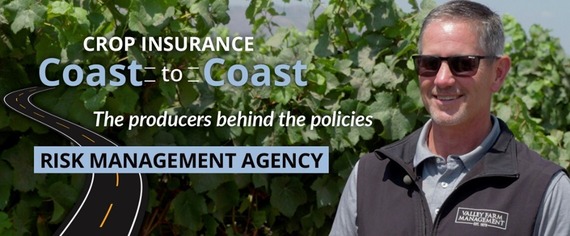 Learn how a California Winegrape grower is overcoming harsh weather and market challenges with the help of USDA’s Risk Management Agency
What happens when your most profitable crop is also your riskiest? That’s the case for Jason Smith, a second generation winegrape grower in California’s Salinas Valley. Jason says that putting food on your plate and wine in your glass also means putting crop insurance into his farm’s business plan.
The winegrape business is one shot at one harvest. If that crop is lost, so is the whole year. For Jason crop insurance has been paramount, especially over the last 10 years. Through the support of USDA and RMA, Jason along with other wine grape growers, have a sense of security to know that if a catastrophic event happens, they are going to be able to survive and plant again the next year.
Watch Producers Behind the Policies Coast to Coast with the Risk Management Agency to learn how Jason overcomes the risks associated with growing winegrapes in California. We can drink to that!
The U.S. Department of Agriculture, in partnership with FarmRaise, today launched a new, online Emergency Assistance for Livestock, Honey Bees and Farm-raised Fish Program (ELAP) Decision Tool. The USDA’s Farm Service Agency (FSA) tool is designed to assist agricultural producers who have been impacted by natural disasters access available program support. This ELAP Decision Tool, a component of a broader disaster assistance program educational module, further expands the library of online FSA disaster and farm loan program reference resources and decision aids currently available to agricultural producers on the FarmRaise FSA educational hub. The Decision Tool is a resource only and is not an application for benefits or a determination of eligibility.
ELAP is designed to address losses not covered by other FSA disaster assistance programs. The program provides recovery assistance to eligible producers of livestock, honey bee, and farm-raised fish losses due to an eligible adverse weather or loss condition, including drought, blizzards, disease, water shortages and wildfires. ELAP covers grazing and feed losses, transportation of water and feed to livestock and hauling livestock to grazing acres due to an eligible loss condition. ELAP also covers certain mortality losses, due to an eligible condition, for livestock including honey bees and farm-raised fish as well as honey bee hive losses.
New FarmRaise Tools and Resources
FarmRaise, in partnership with FSA, recently launched their online, educational hub – the FarmRaise | FSA Educational Hub – comprised of videos, tools and interactive resources that enable USDA cooperators and agricultural producers to learn about and access major FSA programs.
A new addition to the hub, the ELAP Decision Tool helps eligible producers impacted by qualifying natural disasters and other eligible causes of loss better understand program eligibility and application requirements, learn about record-keeping and supporting loss documentation requirements and track the steps needed before applying for program benefits. The document generated by the ELAP Decision Tool can be used to support the ELAP application process, but it is not a program application. Producers will need to complete and submit the ELAP Application to their local FSA county office. Upon request, applicants may be asked to provide additional supporting documentation per the program requirements.
Through use of the ELAP Decision Tool, producers can segment by loss type (honey bee, farm-raised fish and livestock). This enables easier navigation, as guided by the tool, to assistance available to meet specific disaster recovery needs. After entering the type of loss, identifying the loss condition and entering their inventory and loss information, producers are guided through a worksheet that helps identify required loss documentation — documentation (i.e., pictures, receipts, truck logs, etc.) that can be uploaded through the ELAP tool and sent directly to the producer’s local FSA county office, or producers can provide a copy of the tool-generated worksheet summary document when they visit their local FSA county office to complete and submit the required ELAP application.
Additional FarmRaise Resources
The previously announced Livestock Indemnity Program (LIP) Decision Tool, also available through the FarmRaise | FSA Educational Hub, assists livestock producers who suffered losses from eligible adverse weather events and other causes of loss as well as cooperators who are helping disaster-impacted livestock producers navigate available federal disaster assistance programs. The LIP Decision Tool gives producers guidance on what is needed to gather and submit required loss documentation, reducing the amount of time needed to complete applications and enabling FSA county office staff to deliver much-needed assistance faster. Using the LIP Decision Tool is not an application for benefits or a determination of eligibility.
In addition to the new ELAP Decision Tool and the LIP Decision Tool, the FarmRaise | FSA Educational Hub offers several, easily navigated farm loan programs how-to videos designed to introduce producers to FSA’s many farm loan programs options and guide them through the application process.
More FSA program resources and tools will continue to be added to the FarmRaise | FSA Educational Hub. Cooperators and agricultural producers are encouraged to visit the FarmRaise | FSA Educational Hub often to access all available educational resources.

If you’re an orchardist or nursery tree grower who experienced losses from natural disasters during calendar year 2024, you must submit a TAP application either 90 calendar days after the disaster event or the date when the loss is apparent.
TAP provides financial assistance to help you replant or rehabilitate eligible trees, bushes and vines damaged by natural disasters.
Eligible tree types include trees, bushes or vines that produce an annual crop for commercial purposes. Nursery trees include ornamental, fruit, nut and Christmas trees that are produced for commercial sale. Trees used for pulp or timber are ineligible.
To qualify for TAP, orchardists must suffer a qualifying tree, bush or vine loss in excess of 15 percent mortality from an eligible natural disaster, plus an adjustment for normal mortality. The eligible trees, bushes or vines must have been owned when the natural disaster occurred; however, eligible growers are not required to own the land on which the eligible trees, bushes and vines were planted.
If the TAP application is approved, the eligible trees, bushes and vines must be replaced within 12 months from the date the application is approved. The cumulative total quantity of acres planted to trees, bushes or vines, for which you can receive TAP payments, cannot exceed 1,000 acres annually.
|

Urban and innovative agriculture producers will be able to more easily participate in U.S. Department of Agriculture (USDA) programs as a result of acreage reporting improvements. These improvements, implemented by USDA’s Farm Service Agency, provide more flexibility for reporting acreage on a smaller scale and identifying innovative planting practices like multi-level planting or vertical farming practices.
An acreage report documents crops and where they are grown on a farm or ranch along with the intended use of the crop. Filing an accurate and timely acreage report for all crops and land uses, including failed acreage and prevented planted acreage, can prevent the loss of program benefits.
Acreage Reporting Improvements
FSA’s acreage reporting software previously allowed acreage to be reported down to .0001 acres, approximately a four-square foot area. Producers will now be able to report acreage-based crops at a minimum size of .000001 acre, approximately a 2.5-inch by 2.5-inch area.
Additional improvements will distinguish alternate growing methods such as crops grown within multiple levels of a building, or crops grown using multi-level or multi-layer growing structures such as panels or towers within a container system. This change allows the distinction of vertical farming practices. Urban and innovative producers will also have the option to report plant inventory along with their acreage-based report, allowing producers to better report the full scope of their operation. Producers can contact FSA at their local USDA Service Center for acreage reporting deadlines that are specific to their county.
USDA Urban Service Centers
USDA is committed to working with farms of all sizes and in all locations, including those in urban areas. USDA works with agricultural producers through a network of more than 2,300 Service Centers nationwide. To better serve urban farmers, USDA is establishing 17 new Urban Service Centers.
The Urban Service Centers are staffed by FSA and Natural Resources Conservation Service (NRCS) employees and offer farm loan, conservation, disaster assistance and risk management programs.
To find exact locations and contact information for these Urban Service Centers or to learn how to prepare for a USDA Service Center appointment, producers can visit farmers.gov/your-business/urban-growers/urban-service-centers.
For questions, producers should call their FSA county office. Urban operations that are not located near one of the Urban Service Centers can contact one of the more than 2,300 Service Centers across the country by visiting farmers.gov/service-locator.
Additional resources include:
|
In order to claim a Farm Service Agency (FSA) payment on behalf of a deceased producer, all program conditions for the payment must have been met before the applicable producer’s date of death.
If a producer earned a FSA payment prior to his or her death, the following is the order of precedence for the representatives of the producer:
- administrator or executor of the estate
- the surviving spouse
- surviving sons and daughters, including adopted children
- surviving father and mother
- surviving brothers and sisters
- heirs of the deceased person who would be entitled to payment according to the State law
For FSA to release the payment, the legal representative of the deceased producer must file a form FSA-325 to claim the payment for themselves or an estate. The county office will verify that the application, contract, loan agreement, or other similar form requesting payment issuance, was signed by the applicable deadline by the deceased or a person legally authorized to act on their behalf at that time of application.
If the application, contract or loan agreement form was signed by someone other than the deceased participant, FSA will determine whether the person submitting the form has the legal authority to submit the form.
Payments will be issued to the respective representative’s name using the deceased program participant’s tax identification number. Payments made to representatives are subject to offset regulations for debts owed by the deceased.
FSA is not responsible for advising persons in obtaining legal advice on how to obtain program benefits that may be due to a participant who has died, disappeared or who has been declared incompetent.
The U.S. Department of Agriculture (USDA) is announcing the launch of the Debt Consolidation Tool, an innovative online tool available through farmers.gov that allows agricultural producers to enter their farm operating debt and evaluate the potential savings that might be provided by obtaining a debt consolidation loan with USDA’s Farm Service Agency (FSA) or a local lender.
A debt consolidation loan is a new loan used to pay off other existing operating loans or lines of credit that might have unreasonable rates and terms. By combining multiple eligible debts into a single, larger loan, borrowers may obtain more favorable payment terms such as a lower interest rate or lower payments. Consolidating debt may also provide farmers and ranchers additional cash flow flexibilities.
The Debt Consolidation Tool is a significant addition to FSA’s suite of improvements designed to modernize its Farm Loan Programs. The tool enhances customer service and increases opportunities for farmers and ranchers to achieve financial viability by helping them identify potential savings that could be reinvested in their farming and ranching operation, retirement accounts, or college savings accounts.
Producers can access the Debt Consolidation Tool by visiting farmers.gov/debt-consolidation-tool. The tool is built to run on modern browsers including Chrome, Edge, Firefox, or the Safari browser. Producers do not need to create a farmers.gov account or access the authenticated customer portal to use the tool.
Additional Farm Loan Programs Improvements
FSA recently announced significant changes to Farm Loan Programs through the Enhancing Program Access and Delivery for Farm Loans rule. These policy changes, to take effect September 25, 2024, are designed to better assist borrowers to make strategic investments in the enhancement or expansion of their agricultural operations.
FSA also has a significant initiative underway to streamline and automate the Farm Loan Program customer-facing business process. For the over 26,000 producers who submit a direct loan application annually, FSA has made several impactful improvements including:
- The Loan Assistance Tool that provides customers with an interactive online, step-by-step guide to identifying the direct loan products that may be a fit for their business needs and to understanding the application process.
- The Online Loan Application, an interactive, guided application that is paperless and provides helpful features including an electronic signature option, the ability to attach supporting documents such as tax returns, complete a balance sheet, and build a farm operating plan.
- An online direct loan repayment feature that relieves borrowers from the necessity of calling, mailing, or visiting a local USDA Service Center to pay a loan installment.
- A simplified direct loan paper application, reduced from 29 pages to 13 pages.
- A new educational hub with farm loan resources and videos.
USDA encourages producers to reach out to their local FSA farm loan staff to ensure they fully understand the wide range of loan and servicing options available to assist with starting, expanding, or maintaining their agricultural operation. To conduct business with FSA, please contact your local USDA Service Center.
The U.S. Department of Agriculture’s (USDA) long-awaited updates to the Farm Service Agency’s (FSA) Farm Loan Programs are officially in effect. These changes, part of the Enhancing Program Access and Delivery for Farm Loans rule, are designed to increase financial flexibility for agricultural producers, allowing them to grow their operations, boost profitability, and build long-term savings.
These program updates reflect USDA’s ongoing commitment to supporting the financial success and resilience of farmers and ranchers nationwide, offering critical tools to help borrowers manage their finances more effectively.
What the new rules mean for you:
- Low-interest installment set-aside program: Financially distressed borrowers can now defer up to one annual loan payment at a reduced interest rate. This simplified option helps ease financial pressure while keeping farming operations running smoothly.
- Flexible repayment terms: New repayment options give borrowers the ability to increase their cash flow and build working capital reserves, allowing for long-term financial planning that includes saving for retirement, education, and other future needs.
- Reduced collateral requirements: FSA has lowered the amount of additional loan security needed for direct farm loans, making it easier for borrowers to leverage their existing equity without putting their personal residence at risk.
These new rules provide more financial freedom to borrowers. By giving farmers and ranchers better tools to manage their operations, we’re helping them build long-term financial stability. It’s all about making sure they can keep their land, grow their business, and invest in the future.
If you’re an FSA borrower or considering applying for a loan, now is the time to take advantage of these new policies. We encourage you to reach out to your local FSA farm loan staff to ensure you fully understand the wide range of loan making and servicing options available to assist with starting, expanding, or maintaining your agricultural operation.
To conduct business with FSA, please contact your local USDA Service Center.
Marketing Assistance Loans (MALs) and Loan Deficiency Payments (LDPs) provide financing and marketing assistance for wheat, feed grains, soybeans, and other oilseeds, pulse crops, rice, peanuts, cotton, wool and honey. MALs provide you with interim financing after harvest to help you meet cash flow needs without having to sell your commodities when market prices are typically at harvest-time lows. A producer who is eligible to obtain a loan, but agrees to forgo the loan, may obtain an LDP if such a payment is available. Marketing loan provisions and LDPs are not available for sugar and extra-long staple cotton.
FSA is now accepting requests for 2024 MALs and LDPs for all eligible commodities after harvest. Requests for loans and LDPs shall be made on or before the final availability date for the respective commodities.
Commodity certificates are available to loan holders who have outstanding nonrecourse loans for wheat, upland cotton, rice, feed grains, pulse crops (dry peas, lentils, large and small chickpeas), peanuts, wool, soybeans and designated minor oilseeds. These certificates can be purchased at the posted county price (or adjusted world price or national posted price) for the quantity of commodity under loan, and must be immediately exchanged for the collateral, satisfying the loan. MALs redeemed with commodity certificates are not subject to Adjusted Gross Income provisions.
To be considered eligible for an LDP, you must have form CCC-633EZ, Page 1 on file at your local FSA Office before losing beneficial interest in the crop. Pages 2, 3 or 4 of the form must be submitted when payment is requested.
Marketing loan gains (MLGs) and loan deficiency payments (LDPs) are no longer subject to payment limitations, actively engaged in farming and cash-rent tenant rules.
Adjusted Gross Income (AGI) provisions state that if your total applicable three-year average AGI exceeds $900,000, then you’re not eligible to receive an MLG or LDP. You must have a valid CCC-941 on file to earn a market gain of LDP. The AGI does not apply to MALs redeemed with commodity certificate exchange.
The Farm Service Agency’s (FSA) Farm Storage Facility Loan (FSFL) program provides low-interest financing to help you build or upgrade storage facilities and to purchase portable (new or used) structures, equipment and storage and handling trucks.
Eligible commodities include corn, grain sorghum, rice, soybeans, oats, peanuts, wheat, barley, minor oilseeds harvested as whole grain, pulse crops (lentils, chickpeas and dry peas), hay, honey, renewable biomass, fruits, nuts and vegetables for cold storage facilities, floriculture, hops, maple sap, rye, milk, cheese, butter, yogurt, meat and poultry (unprocessed), eggs, and aquaculture (excluding systems that maintain live animals through uptake and discharge of water). Qualified facilities include grain bins, hay barns and cold storage facilities for eligible commodities.
Loans up to $50,000 can be secured by a promissory note/security agreement, loans between $50,000 and $100,000 may require additional security, and loans exceeding $100,000 require additional security.
You do not need to demonstrate the lack of commercial credit availability to apply. The loans are designed to assist a diverse range of farming operations, including small and mid-sized businesses, new farmers, operations supplying local food and farmers markets, non-traditional farm products, and underserved producers.
For more information visit fsa.usda.gov/pricesupport.
Top of page
Minnesota USDA Farm Service Agency
375 Jackson Street
Suite 400
Saint Paul, MN 55101
Phone: 651-602-7700
Fax: 855-719-9917
|
|
Minnesota FSA Deputy State Executive Director:
Daniel Mahoney
|
|
Division Leaders:
Cassie Buck
Lee Crawford
Savanah Farrell
Calvin Gellatly
Angela Hanson
|
Minnesota State Committee:
Eunice Biel, Committee Chairperson
Hannah Bernhardt, Committee Member
Kurt Blomgren, Committee Member
Lisa Brunner, Committee Member
Tim Velde, Committee Member
|
|
To find contact information for your local USDA Farm Service Agency office, go to: www.fsa.usda.gov/mn
|
|