
USDA NEWSLETTER - December, 2024.
 In This Issue:

As the year comes to a close, we bid farewell to three valued members of our Oklahoma NRCS team who are entering retirement- Shelly Oliphant, Gary Soderstrom and Saska Koch. Their combined service of over 90 years is a testament to their unwavering commitment to conservation in their local communities and the state. While we will miss their experience and expertise, we wish them all the best in their well-deserved retirements.
In November, we held a successful all-employee training that provided valuable opportunities for professional development and team building. The energy and enthusiasm by everyone in attendance were truly inspiring.
Also in November, OK Tribal Caucus representatives and I attended the Regional Tribal Conservation Advisory Committee meeting and then the Intertribal Ag Council meeting earlier this month, both in Las Vegas. These productive meetings with Tribal partners strengthened our collaborative efforts toward conservation goals that benefit our states. These partnerships, like our many others, are essential to ensuring the long-term health of our natural resources in Oklahoma.
As we look ahead to the new year, I am filled with optimism for what we can accomplish together. I wish you all a happy and restful holiday season.
Jeanne Jasper
State Conservationist
|
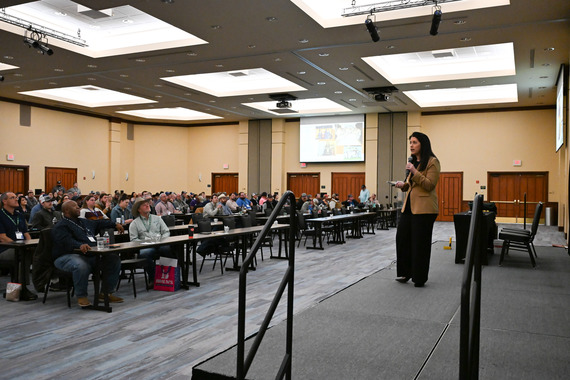 Ag Secretary Blayne Arthur speaking at Oklahoma NRCS all-employee training.
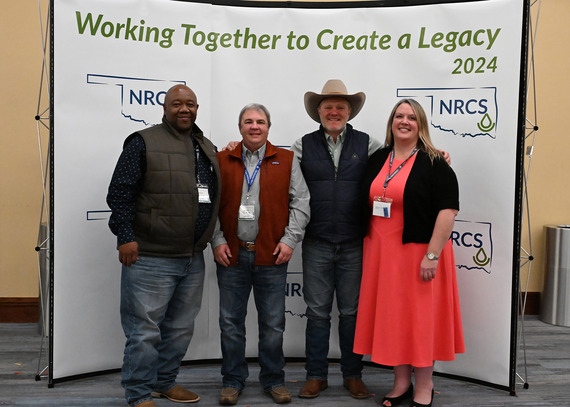 Retiree Shelly Oliphant (2nd from Left) with Assistant State Conservationists for Field Operations and State Conservationist, Jeanne Jasper.
Oklahoma Agriculture events where NRCS will have a presence are now being shared via the OK NRCS website events page. Bookmark it now for easy return access!
Oklahoma NRCS Updates:
The National Resources Inventory (NRI) is a statistical survey created to provide support for conservation policy development program implementation. It was designed and implemented to assess conditions and trends of soil, water, and related resources on non-Federal rural lands. Non-Federal lands include privately owned lands, tribal and trust lands, and lands controlled by State and local governments.
The nationwide survey is conducted annually for the USDA by the Natural Resources Conservation Service (NRCS) in cooperation with Iowa State University Center for Statistics and Methodology (CSSM). Oklahoma NRCS Resource Soil Scientists and Area Biologists use remote sensing techniques and conservation planning information to complete the annual assessment of 950 to 1000 locations across all 77 counties in the state. Data assessments begin in October and conclude after final data reviews the following January of each year. Locations involved in the data collection and other identifying details are confidential information to protect data integrity.
The NRI captures data on land cover and use, soils, soil erosion, wetlands, habitat diversity, selected conservation practices, and related resource attributes at scientifically selected sample sites. NRI reports provide updated information on the status, condition, and trends of land, soil, water, and related resources. Data summaries are publicly available and interactive dashboards for data investigation and more information about NRI and can be found at the website: https://www.nrcs.usda.gov/nri.
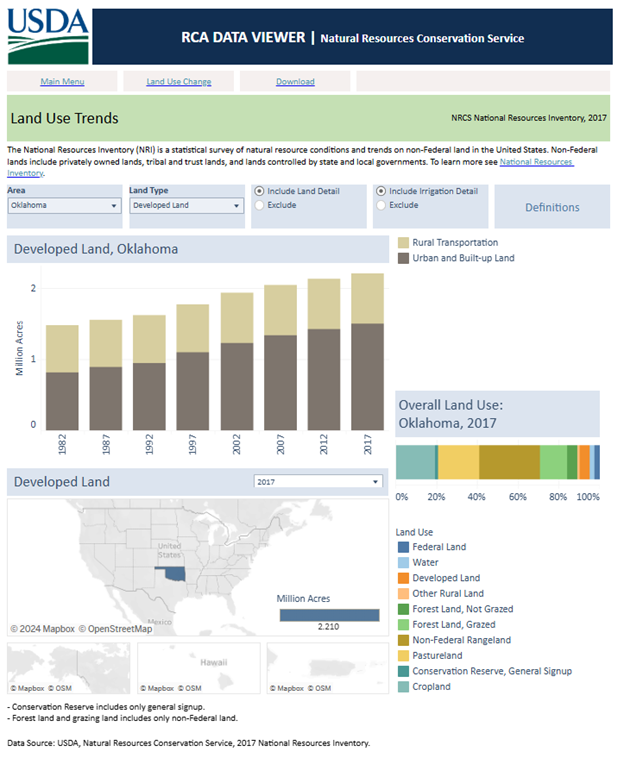 Example dashboard for viewing NRI data trends for developed land in Oklahoma. Links to this dashboard and other similar data visualizations can be found at: https://www.nrcs.usda.gov/nri.
Oklahoma FSA Updates:
Agricultural producers of perishable commodities including fruits, vegetables and floriculture can now get funding for controlled atmosphere storage through Farm Storage Facility Loans (FSFL) offered by the U.S. Department of Agriculture’s (USDA) Farm Service Agency (FSA). Controlled atmosphere storage regulates the concentrations of oxygen, carbon dioxide and nitrogen in a storage room to increase the shelf life of crops.
In addition to now supporting controlled atmosphere storage, FSFLs also provide low-interest financing to help producers build or upgrade storage facilities and to purchase portable (new or used) structures, equipment and storage and handling trucks.
The U.S. Department of Agriculture’s (USDA) long-awaited updates to the Farm Service Agency’s (FSA) Farm Loan Programs are officially in effect. These changes, part of the Enhancing Program Access and Delivery for Farm Loans rule, are designed to increase financial flexibility for agricultural producers, allowing them to grow their operations, boost profitability, and build long-term savings.
These program updates reflect USDA’s ongoing commitment to supporting the financial success and resilience of farmers and ranchers nationwide, offering critical tools to help borrowers manage their finances more effectively.
What the new rules mean for you:
- Low-interest installment set-aside program: Financially distressed borrowers can now defer up to one annual loan payment at a reduced interest rate. This simplified option helps ease financial pressure while keeping farming operations running smoothly.
- Flexible repayment terms: New repayment options give borrowers the ability to increase their cash flow and build working capital reserves, allowing for long-term financial planning that includes saving for retirement, education, and other future needs.
- Reduced collateral requirements: FSA has lowered the amount of additional loan security needed for direct farm loans, making it easier for borrowers to leverage their existing equity without putting their personal residence at risk.
These new rules provide more financial freedom to borrowers. By giving farmers and ranchers better tools to manage their operations, we’re helping them build long-term financial stability. It’s all about making sure they can keep their land, grow their business, and invest in the future.
If you’re an FSA borrower or considering applying for a loan, now is the time to take advantage of these new policies. We encourage you to reach out to your local FSA farm loan staff to ensure you fully understand the wide range of loan making and servicing options available to assist with starting, expanding, or maintaining your agricultural operation.
To conduct business with FSA, please contact your local USDA Service Center.
The U.S. Department of Agriculture (USDA) Farm Service Agency’s (FSA) $2 billion Marketing Assistance for Specialty Crops (MASC) program, aimed at helping specialty crop producers expand markets and manage higher costs, is now accepting applications from Dec. 10, 2024 through Jan. 8, 2025. Funded by the Commodity Credit Corporation, MASC was announced in November alongside the $140 million Commodity Storage Assistance Program for facilities impacted by 2024 natural disasters.
MASC helps specialty crop producers meet higher marketing costs related to:
- Perishability of specialty crops like fruits, vegetables, floriculture, nursey crops and herbs;
- Specialized handling and transport equipment with temperature and humidity control;
- Packaging to prevent damage;
- Moving perishables to market quickly; and
- Higher labor costs.
The U.S. Department of Agriculture (USDA) welcomes input on the assessment of environmental impacts on two programs – the Tree Assistance Program (TAP) and Farm Storage Facility Loan (FSFL) program. USDA’s Farm Service Agency (FSA) is accepting comments until Jan. 18 on its draft programmatic environmental assessments. The TAP environmental assessment includes updates to streamline the program and enable a quick response to natural disasters. The FSFL environmental assessment recommends continuing the program as currently administered.
Top of page
|






