|
Dates to Remember
December 15 - Deadline to report fall seeded crops
**Producers have until 12/16 due to 12/15 falling on a Sunday.
January 8, 2025 - Deadline to apply for Marketing Assistance for Specialty Crops (MASC)
NOTE HOLIDAY OFFICE CLOSURE SCHEDULE:
December 25: Christmas Day
January 1: New Years Day
January 20: Martin Luther King Day
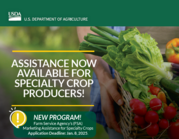
USDA Makes $2 Billion Available to Support Expansion of Current and Development of New Markets
The U.S. Department of Agriculture (USDA) Farm Service Agency’s (FSA) $2 billion Marketing Assistance for Specialty Crops (MASC) program, aimed at helping specialty crop producers expand markets and manage higher costs, is now accepting applications from Dec. 10, 2024 through Jan. 8, 2025. Funded by the Commodity Credit Corporation, MASC was announced in November alongside the $140 million Commodity Storage Assistance Program for facilities impacted by 2024 natural disasters.
MASC helps specialty crop producers meet higher marketing costs related to:
- Perishability of specialty crops like fruits, vegetables, floriculture, nursey crops and herbs;
- Specialized handling and transport equipment with temperature and humidity control;
- Packaging to prevent damage;
- Moving perishables to market quickly; and
- Higher labor costs.
MASC Eligibility
To be eligible for MASC, a producer must be in business at the time of application, maintain an ownership share and share in the risk of producing a specialty crop that will be sold in calendar year 2025.
MASC covers the following commercially marketed specialty crops:
- Fruits (fresh, dried);
- Vegetables (including dry edible beans and peas, mushrooms, and vegetable seed);
- Tree nuts;
- Nursery crops, Christmas trees, and floriculture;
- Culinary and medicinal herbs and spices; and
- Honey, hops, maple sap, tea, turfgrass and grass seed.
Applying for MASC
Eligible established specialty crop producers can apply for MASC benefits by completing the FSA-1140, Marketing Assistance for Specialty Crops (MASC) Program Application, and submitting the form to any FSA county office by Jan. 8, 2025. When applying, eligible specialty crop producers must certify their specialty crop sales for calendar year 2023 or 2024.
New specialty crop producers are required to certify 2025 expected sales, submit an FSA-1141 application and provide certain documentation to support reported sales i.e., receipts, contracts, acreage reports, input receipts, etc. New producers are those who began producing specialty crops in 2023 or 2024 but did not have sales due to the immaturity of the crop, began producing specialty crops in 2024 but did not have a complete year of sales or will begin growing specialty crops in 2025.
MASC applicants, established and new, must also submit the following information to FSA if not already on file at the time of application:
- Form AD-2047, Customer Data Worksheet.
- Form CCC-902, Farm Operating Plan for an individual or legal entity.
- Form CCC-941, Average Adjusted Gross Income (AGI) Certification and Consent to Disclosure of Tax Information.
- Form FSA-942, Certification of Income from Farming, Ranching and Forestry Operations, if applicable, for the producer and members of entities.
- A highly erodible land conservation (sometimes referred to as HELC) and wetland conservation certification (Form AD-1026 Highly Erodible Land Conservation (HELC) and Wetland Conservation (WC) Certification) for the ERP producer and applicable affiliates.
- Other Documentation if requested by FSA to support reported specialty crop sales.
Most producers, especially those who have previously participated in FSA programs, will likely have these required forms on file. However, those who are uncertain or want to confirm the status of their forms or producers who may be new to conducting business with FSA, can contact their local FSA county office. For MASC program participation, eligible specialty crop sales only include sales of commercially marketed raw specialty crops grown in the United States by the producer. The portion of sales derived from adding value to a specialty crop (such as sorting, processing, or packaging) is not included when determining eligible sales. Further explanation of what is considered by FSA for specialty crop sales as well as an online MASC decision tool and applicable program forms, are available on the MASC program webpage.
MASC Payments
For established specialty crop growers, those who certify crop sales in 2023 or 2024, FSA will calculate MASC payments based on the producer’s total specialty crop sales for the calendar year elected by the producer. Payments for new producers will be based on their expected 2025 calendar year sales. Payment calculation details and examples are available on the MASC webpage or related questions can be directed to local FSA county office staff.
FSA will issue MASC payments after the end of the application period. If demand for MASC payments exceeds available funding, MASC payments may be prorated, and the payment limitation of $125,000 may be lowered. If additional funding is available after MASC payments are issued, FSA may issue an additional payment.
Specialty crop producers interested in applying for MASC benefits, are encouraged to review the program fact sheet for detailed information on program eligibility, required documentation, payment calculations and more.
More Information
Additional information on MASC is available in the Notice of Funding Availability, which went on public inspection in the Federal Register on Dec. 9, 2024.
|
Landowners and operators are reminded that in order to receive payments from USDA, compliance with Highly Erodible Land (HEL) and Wetland Conservation (WC) provisions are required. Farmers with HEL determined soils are reminded of tillage, crop residue, and rotation requirements as specified per their conservation plan. Producers are to notify the USDA Farm Service Agency prior to breaking sod, clearing land (tree removal), and of any drainage projects (tiling, ditching, etc.) to ensure compliance. Failure to update certification of compliance, with form AD-1026, triggering applicable HEL and/or wetland determinations, for any of these situations, can result in the loss of FSA farm program payments, FSA farm loans, NRCS program payments, and premium subsidy to Federal Crop Insurance administered by RMA.
The Farm Loan teams are already working on operating loans for spring 2025 and asks potential borrowers to submit their requests early so they can be timely processed. The farm loan team can help determine which loan programs are best for applicants.
FSA offers a wide range of low-interest loans that can meet the financial needs of any farm operation for just about any purpose. The traditional farm operating and farm ownership loans can help large and small farm operations take advantage of early purchasing discounts for spring inputs as well expenses throughout the year.
Microloans are a simplified loan program that will provide up to $50,000 for both Farm Ownership and Operating Microloans to eligible applicants. These loans, targeted for smaller and non-traditional operations, can be used for operating expenses, starting a new operation, purchasing equipment, and other needs associated with a farming operation. Loans to beginning farmers and members of underserved groups are a priority.
Other types of loans available include:
Marketing Assistance Loans allow producers to use eligible commodities as loan collateral and obtain a 9-month loan while the crop is in storage. These loans provide cash flow to the producer and allow them to market the crop when prices may be more advantageous.
Farm Storage Facility Loans can be used to build permanent structures used to store eligible commodities, for storage and handling trucks, or portable or permanent handling equipment. A variety of structures are eligible under this loan, including bunker silos, grain bins, hay storage structures, and refrigerated structures for vegetables and fruit. A producer may borrow up to $500,000 per loan.
|








