
Louisiana USDA-FSA Updates - December 2024
Table of Contents:
The FPAC agencies launched a single web experience that provides farmers, ranchers, and forest landowners with online self-service applications, educational materials, engagement opportunities, and business tools to increase efficiency and productivity while preserving and fostering long-held traditional relationships between local USDA Service Centers and producers, regardless of agency.
Farmers.gov serves as a customer gateway and informational counterpart to an authenticated, transactional portal where USDA customers can apply for programs, process technical and financial transactions, and manage accounts.
Producers will need a Login.gov account linked to their USDA customer record to access the farmers.gov authenticated site. If they have not already signed-up for a Login.gov account and verified their identity via farmers.gov/account, doing so will grant them access to information and other self-service features available through the farmers.gov portal.
USDA is transitioning from eAuth to Login.gov for customer access to USDA resources. Learn more about the transition. If you already have a farmers.gov account and are still using their eAuth username and password to log into farmers.gov, they are encouraged to switch to using a Login.gov account as soon as possible.
Agricultural producers of perishable commodities including fruits, vegetables and floriculture can now get funding for controlled atmosphere storage through Farm Storage Facility Loans (FSFL) offered by the U.S. Department of Agriculture’s (USDA) Farm Service Agency (FSA). Controlled atmosphere storage regulates the concentrations of oxygen, carbon dioxide and nitrogen in a storage room to increase the shelf life of crops.
In addition to now supporting controlled atmosphere storage, FSFLs also provide low-interest financing to help producers build or upgrade storage facilities and to purchase portable (new or used) structures, equipment and storage and handling trucks.
The low-interest funds can also be used for controlled atmosphere storage monitoring equipment, designed to notify facility owners immediately if potential atmospheric concerns are detected. Producers may renovate existing storage facilities to include controlled atmosphere storage monitoring equipment. Authorized loan terms for FSFL renovations are three and five years only.
To assist with monitoring gases and particle concentrations for controlled atmosphere storage, the following equipment, but not limited to, is eligible for an FSFL:
- Optical oxygen sensor.
- Low power CO2 sensor.
- Air quality sensor.
- Gas detection devices.
- Air temperature and relative humidity sensor.
- Water activity meter.
- Temperature stabilized water activity analyzer.
- Precision and performance humidity and temperature transmitter.
Loans of up to $50,000 can be secured by a promissory note/security agreement, loans between $50,000 and $100,000 may require additional security and loans exceeding $100,000 require additional security.
FSFL borrowers do not need to demonstrate lack of commercial credit availability to apply. The loans are designed to assist a diverse range of agricultural operations, including small and mid-sized businesses, new farmers and ranchers, operations supplying local food and farmers markets, non-traditional farm products and underserved producers.
For more information, see the FSFL fact sheet and contact FSA at your local USDA Service Center.
USDA’s Farm Service Agency (FSA) is providing $2 billion in funding through the new Marketing Assistance for Specialty Crops (MASC) program.
Sign-up dates: Dec. 10, 2024 – Jan. 8, 2025
MASC is designed to help specialty crop producers expand domestic markets, develop new markets, and tackle the challenges of higher costs.
Eligible commercially marketed specialty crops: fruits (fresh, dried), vegetables (including dry edible beans and peas, mushrooms, and vegetable seed), tree nuts, nursery crops, Christmas trees, floriculture, honey, hops, maple sap, tea, turfgrass, grass seed, and culinary and medicinal herbs and spices.
For information on eligibility and to submit an application, contact FSA at your local USDA Service Center, or visit fsa.usda.gov/marketing-assistance-specialty-crops.
FSA and NRCS program applicants for benefits are required to submit a completed CCC-902 Farming Operation Plan and CCC-941 Average Gross Income (AGI) Certification and Consent to Disclosure of Tax Information for FSA to determine the applicant’s payment eligibility and establish the maximum payment limitation applicable to the program applicant.
Participants are not required to annually submit new CCC-902s for payment eligibility and payment limitation purposes unless a change in the farming operation occurs that may affect the previous determination of record. A valid CCC-902 filed by the participant is considered to be a continuous certification used for all payment eligibility and payment limitation determinations applicable for the program benefits requested.
Participants are responsible for ensuring that all CCC-902 and CCC-941 and related forms on file in the county office are updated, current, and correct. Participants are required to timely notify the county office of any changes in the farming operation that may affect the previous determination of record by filing a new or updated CCC-902 as applicable.
Changes that may require a NEW determination include, but are not limited to, a change of:
- Shares of a contract, which may reflect:
- A land lease from cash rent to share rent
- A land lease from share rent to cash rent (subject to the cash rent tenant rule
- A modification of a variable/fixed bushel-rent arrangement
- The size of the producer’s farming operation by the addition or reduction of cropland that may affect the application of a cropland factor
- The structure of the farming operation, including any change to a member's share
- The contribution of farm inputs of capital, land, equipment, active personal labor, and/or active personal management
- Farming interests not previously disclosed on CCC-902 including the farming interests of a spouse or minor child
- Certifications of average AGI are required to be filed annually for participation in an annual USDA program. For multi-year conservation contracts and NRCS easements, a certification of AGI must be filed prior to approval of the contract or easement and is applicable for the duration of the contract period.
Participants are encouraged to file or review these forms within the deadlines established for each applicable program for which program benefits are being requested.
|
The U.S. Department of Agriculture (USDA) is expanding the Food Safety Certification for Specialty Crops (FSCSC) program to now include medium-sized businesses in addition to small businesses. Eligible specialty crop growers can apply for assistance for expenses related to obtaining or renewing a food safety certification. The program has also been expanded to include assistance for 2024 and 2025 expenses. Producers can apply for assistance on their calendar year 2024 expenses beginning July 1, 2024, through Jan. 31, 2025. For program year 2025, the application period will be Jan. 1, 2025, through Jan. 31, 2026.
Program Details
FSCSC assists specialty crop operations that incurred eligible on-farm food safety certification and expenses related to obtaining or renewing a food safety. FSCSC covers a percentage of the specialty crop operation’s cost of obtaining or renewing its certification, as well as a portion of related expenses.
Eligible FSCSC applicants must be a specialty crop operation; meet the definition of a small or medium-size business and have paid eligible expenses related to certification.
- A small business has an average annual monetary value of specialty crops sold by the applicant during the three-year period preceding the program year of no more than $500,000.
- A medium size business has an average annual monetary value of specialty crops the applicant sold during the three-year period preceding the program year of at least $500,001 but no more than $1,000,000.
Specialty crop operations can receive the following cost assistance:
- Developing a food safety plan for first-time food safety certification.
- Maintaining or updating an existing food safety plan.
- Food safety certification.
- Certification upload fees.
- Microbiological testing for products, soil amendments and water.
FSCSC payments are calculated separately for each eligible cost category. Details about payment rates and limitations are available at farmers.gov/food-safety.
Applying for Assistance
Interested applicants have until Jan. 31, 2025, to apply for assistance for 2024 eligible expenses. FSA will issue payments as applications are processed and approved. For program year 2025, the application period will be January 1, 2025, through January 31, 2026. FSA will issue 50% of the calculated payment for program year 2025 following application approval, with the remaining amount to be paid after the application deadline. If calculated payments exceed the amount of available funding, payments will be prorated.
Specialty crop producers can apply by completing the FSA-888-1, Food Safety Certification for Specialty Crops Program (FSCSC) for Program Years 2024 and 2025 application. The application, along with the AD-2047, Customer Data Worksheet and SF-3881, ACH Vendor/Miscellaneous Payment Enrollment Form, if not already on file with FSA, can be submitted to the FSA office at any USDA Service Center nationwide by mail, fax, hand delivery or via electronic means. Alternatively, producers with an eAuthentication account can apply for FSCSC online. Producers interested in creating an eAuthentication account should visit farmers.gov/sign-in.
Specialty crop producers can also call 877-508-8364 to speak directly with a FSA employee ready to assist. Visit farmers.gov/food-safety for additional program details, eligibility information and forms needed to apply.
More Information
To learn more about FSA programs, producers can contact their local USDA Service Center. Producers can also prepare maps for acreage reporting as well as manage farm loans and view other farm records data and customer information by logging into their farmers.gov account. Producers without an account can sign up today.
Landowners and operators are reminded that in order to receive payments from USDA, compliance with Highly Erodible Land (HEL) and Wetland Conservation (WC) provisions are required. Farmers with HEL determined soils are reminded of tillage, crop residue, and rotation requirements as specified per their conservation plan. Producers are to notify the USDA Farm Service Agency prior to breaking sod, clearing land (tree removal), and of any drainage projects (tiling, ditching, etc.) to ensure compliance. Failure to update certification of compliance, with form AD-1026, triggering applicable HEL and/or wetland determinations, for any of these situations, can result in the loss of FSA farm program payments, FSA farm loans, NRCS program payments, and premium subsidy to Federal Crop Insurance administered by RMA.
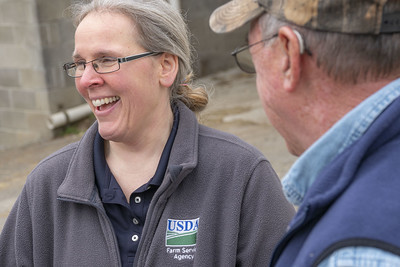
The U.S. Department of Agriculture’s (USDA) long-awaited updates to the Farm Service Agency’s (FSA) Farm Loan Programs are officially in effect. These changes, part of the Enhancing Program Access and Delivery for Farm Loans rule, are designed to increase financial flexibility for agricultural producers, allowing them to grow their operations, boost profitability, and build long-term savings.
These program updates reflect USDA’s ongoing commitment to supporting the financial success and resilience of farmers and ranchers nationwide, offering critical tools to help borrowers manage their finances more effectively.
What the new rules mean for you:
- Low-interest installment set-aside program: Financially distressed borrowers can now defer up to one annual loan payment at a reduced interest rate. This simplified option helps ease financial pressure while keeping farming operations running smoothly.
- Flexible repayment terms: New repayment options give borrowers the ability to increase their cash flow and build working capital reserves, allowing for long-term financial planning that includes saving for retirement, education, and other future needs.
- Reduced collateral requirements: FSA has lowered the amount of additional loan security needed for direct farm loans, making it easier for borrowers to leverage their existing equity without putting their personal residence at risk.
These new rules provide more financial freedom to borrowers. By giving farmers and ranchers better tools to manage their operations, we’re helping them build long-term financial stability. It’s all about making sure they can keep their land, grow their business, and invest in the future.
If you’re an FSA borrower or considering applying for a loan, now is the time to take advantage of these new policies. We encourage you to reach out to your local FSA farm loan staff to ensure you fully understand the wide range of loan making and servicing options available to assist with starting, expanding, or maintaining your agricultural operation.
To conduct business with FSA, please contact your local USDA Service Center.
|
The National Environmental Policy Act (NEPA) requires Federal agencies to consider all potential environmental impacts for federally funded projects before the project is approved.
For all Farm Service Agency (FSA) programs, an environmental review must be completed before actions are approved, such as site preparation or ground disturbance. These programs include, but are not limited to, the Emergency Conservation Program (ECP), Farm Storage Facility Loan (FSFL) program and farm loans. If project implementation begins before FSA has completed an environmental review, the request will be denied. Although there are exceptions regarding the Stafford Act and emergencies, it’s important to wait until you receive written approval of your project proposal before starting any actions.
Applications cannot be approved until FSA has copies of all permits and plans. Contact your local FSA office early in your planning process to determine what level of environmental review is required for your program application so that it can be completed timely.
The USDA Farm Service Agency (FSA) made several policy updates to acreage reporting and prevented planted acres.
Prevented Planted Acres
In order to certify prevented planted acreage due to drought, all of the following must apply:
- The area that is prevented from being planted has insufficient soil moisture for germination of seed on the final planting date for non-irrigated acreage
- Prolonged precipitation deficiencies that meet the D3 o4 D4 level as determined by the U.S. Drought Monitor
- Verifiable information must be collected from sources whose business or purpose is recording weather conditions as determined by FSA and the sources include, but are not limited to:
- S. National Weather Service
- Bureau of Reclamation
- S. Army Corps of Engineers
- National Institute of Food and Agriculture
- Natural Resources Conservation Service
- Local irrigation authorities responsible for water allocations
- State Department of Water Resources
- National Institute of Food and Agriculture
- Other sources responsible for the collection of water data or regulation of water resources (water allocations).
FSA reminds producers to report prevented planted and failed acres in order to establish or retain FSA program eligibility for some programs. You should report crop acreage you intended to plant, but due to natural disaster, were prevented from planting. Prevented planting acreage must be reported on form CCC-576, Notice of Loss, no later than 15 calendar days after the final planting date as established by FSA and the Risk Management Agency (RMA).
Late-Filed Acreage Reports
FSA can now accept late-filed acreage reports without a field visit if the producer can provide proof of existence and disposition. Producers are required to pay the late filed fee.
Proof of existence of the crop includes, but is not limited to:
- seed receipts showing the amount, variety, and date purchased;
- receipts for cleaning, treating, etc., for seed planted on the farm;
- a written contract or documentation of an oral contract to produce a specific crop;
- evidence that was accepted and approved by the RMA or another USDA agency;
- precision planting, spraying, or harvesting geospatial data or maps;
- drone photos with location and notable physical boundaries;
- other aerial or ground imagery with the ability to determine date, acres, and crop.
Proof of disposition of the crop includes, but is not limited to:
- receipts showing number and units sold if the sale can be positively identified as sale of the crop for the farm for the year represented;
- a written contract or documentation of an oral contract to produce a specific crop;
- records showing the crop was fed to livestock;
- documentation of payment for custom harvesting indicating acreage, location, and crop year;
- evidence that was accepted and approved by another USDA agency.
Farmers and ranchers can contact a call center to receive one-on-one assistance from USDA Farm Service Agency (FSA) employees ready to help. By calling 877-508-8364, customers can ask questions about FSA programs.
The call center was created as a way to better serve customers, especially those who have not worked with FSA previously.
Customers who contact the call center can expect to receive the same great service they would receive as if they were in their FSA county office.
FSA Call Center staff can also provide service to non-English speaking customers. Customers using the call center will still call 877-508-8364 and select 1 for English and 2 to speak with a Spanish-speaking employee. For other languages, customers select 1 and indicate their language to the call center staff.
The call center is just one of many ways USDA has adjusted and added flexibilities to meet the needs of our customers. One thing remains the same, USDA stands committed to offering exceptional customer service to our nation’s farmers and ranchers.
Interest rates for Operating and Ownership loans for December 2024 are as follows:
FSA also offers guaranteed loans through commercial lenders at rates set by those lenders. To access an interactive online, step-by-step guide through the farm loan process, visit the Loan Assistance Tool on farmers.gov.
Additionally, FSA provides low-interest financing to producers to build or upgrade on-farm storage facilities and purchase handling equipment and loans that provide interim financing to help producers meet cash flow needs without having to sell their commodities when market prices are low. Funds for these loans are provided through the Commodity Credit Corporation (CCC) and are administered by FSA.

Dec. 13 - USDA Extends Application Deadline for Organic Dairy Marketing Assistance
Dec. 15 - Last day to timely report planted/prevented wheat and oats
Dec. 15 - Last day to certify Fall seeded small grains
Dec. 31 - Non-Insured Crop Disaster Assistance Program (NAP) sales closing date for honey
Jan. 8, 2025 - Deadline to apply for Marketing Assistance for Specialty Crops (MASC)
Jan. 30, 2025: Deadline to apply for 2024 Farm-Raised Fish Losses through Emergency Assistance for Livestock, Honeybees, and Farm-raised Fish Program (ELAP)
|
Louisiana FSA State Office
3737 Government Street
Alexandria, LA 70508
Phone: 318-473-7721
Fax: 1-844-325-6942
|
|
Ronald C. Guidry, Jr.
State Executive Director
Ronald.Guidry@usda.gov
Terrick Boley,
Farm Loan Program Chief
terrick.boley@usda.gov
|
Dewanna Pittman
Deputy State Executive Director
dewanna.pitman@usda.gov
Christine Normand,
Administrative Officer
christine.normand@usda.gov
Farm Program Chief
Dewanna Pittman
dewanna.pitman@usda.gov
|
|
LOUISIANA STATE FSA COMMITTEE
Julie Baker-Richard-Chairperson
Brian Guidry-Member
Monica Hernandez-Member
Kristy Jones-Member
Willis Nelson-Member
|
The STC is scheduled to meet the second Tuesday of each month at the LA State Office, 3737 Government Street, Alexandria, LA 71302 unless the meeting is conducted virtually. Anyone wishing to attend should verify the meeting will take place as scheduled, by calling 318/473-7721.
|
| |
|








