
October 2024 Newsletter - October 15, 2024.
In This Issue:
I am excited to announce the new changes and program initiatives that have taken place within the United States Department of Agriculture (USDA) Farm Service Agency (FSA). From the updates that were made to the Farm Service Loan Program, to help farmers and ranchers increase their profits and reduce personal risks. To the automatic payments for distressed borrowers under section 22006 of the Inflation Reduction Act that continues our commitment to keep agricultural producers financially viable. In addition to these efforts, USDA is also focusing on urban agriculture to connect urban farmers with support and resources to ensure the growth of their operations.
The changes to the Farm Service Loan program are now in effect as part of the Enhancing Program Access and Delivery for Farm Loans Rule, which is aims to provide financial flexibility for agricultural producers. Key changes include a low-interest installment set-aside program that allows financially distressed borrowers to defer loan payments at reduced rates, flexible repayment terms to enhance cash flow and savings for future needs, and reduce collateral requirements for direct loans, so borrowers can minimize their risks (more information here).
These new rules provide greater financial freedom to borrowers. By equipping farmers and ranchers with better tools to manage their operation and maintain financial stability. We encourage FSA borrowers to take advantage of the new policies and to contact your local USDA Service Center.
Additionally, USDA plans to provide an estimated $250 million dollars in assistance for distressed farm loan borrowers. $235 million will go to delinquent borrowers and $15 million will be given to borrowers with Shared Appreciation Agreements, which will require borrowers to repay or convert their debt write-downs into accruing repayment agreement. Learn more here.
Lastly, the USDA is allocating $9 million to ten organizations, including the Central Arkansas Sphinx Foundation, Nationwide to support Urban Agriculture producers. This initiative, administer by the FSA in partnership with To Improve Mississippi Economics (T.I.M.E), is part of a $40 million investment made possible by President Biden’s American Rescue Plan. The Central Arkansas Sphinx Foundation will work closely with T.I.M.E. and FSA to help urban producers learn about and access FSA programs and services. For more information, click here.
Our goal is to serve all farmers, ranchers, and agriculture partners; equitably; through the delivery of effective and efficient agricultural programs
For more information on Farm Service Agency (FSA), visit www.farmers.gov.
Greetings!
USDA’s Natural Resources Conservation Service (NRCS) assists farmers, ranchers and foresters with conservation practices on their operations. Now that the new year has begun, this could be a good time to review your farm’s conservation plan. A conservation plan identifies your conservation objectives and assesses and analyzes the natural resources issues on your land.
The conservation plan includes tools and resources customized specifically for you, like a land use map, soils information, photos, inventory of resources, economic costs and benefits, schedule of recommended practices, maintenance schedules, and engineering notes — all based on your goals and the resource needs.
This technical assistance from NRCS is free, and it can help you reduce soil loss from erosion, solve issues with soil, air and water quality, reduce potential damage from excess water and drought, enhance the quality of wildlife habitat, address waste management concerns, and improve the long-term sustainability.
How does conservation planning work? NRCS is here to provide one-on-one support to our customers at our 61 USDA Service Centers statewide. NRCS staff can help guide farmers to the best USDA assistance based on their conservation goals. You will meet with your local NRCS district conservationist, or conservation planning technician, for a science-based evaluation of the problems and opportunities on your land. NRCS staff members then analyze the findings and recommend the best strategies to address your issues and achieve valuable conservation opportunities and objectives.
Farmers who work with us at their local USDA Service Center can:
- Verify eligibility for USDA programs
- Discuss their business and conservation goals
- Create a conservation plan
- Learn how to meet conservation compliance provisions
A conservation plan is critical to maintain and improve your operation’s productivity. Plans of any kind are important as they set goals and outline how to reach them. Conservation plans are roadmaps for improving your operation while conserving natural resources. They provide proven strategies that landowners can use to solve identified natural resource concerns and take advantage of conservation opportunities.
If you’re interested in finding out more about conservation planning, I encourage you to contact your local USDA Service Center to discuss your operation’s needs.
See what other landowners are doing –
Learn more about the benefits of conservation practices directly from the farmers, ranchers, and forest landowners applying them with our Conservation at Work series. Explore the different types of conservation practices by watching these 90-second videos.
A multi-agency guide for USDA assistance for underserved farmers and ranchers is now available. If you are a farmer or rancher and are a minority, woman, veteran, beginning, or limited resource producer, you can use this booklet to learn about assistance and targeted opportunities available to you. This includes programs offered through the Farm Service Agency, Natural Resources Conservation Service, and Risk Management Agency. Download the guide here. The guide is also available in Spanish, Hmong, Korean, Vietnamese, Thai and Chinese on farmers.gov/translations.
The U.S. Department of Agriculture (USDA) welcomes school gardens, community gardens, urban farms, and small-scale agriculture projects in rural, suburban and urban areas to be recognized as a “People’s Garden.” People’s Gardens grow fresh, healthy food and support resilient, local food systems; teach people how to garden using conservation practices; nurture habitat for pollinators and wildlife and create greenspace for neighbors.
To be part of the initiatives, gardens should be registered on the USDA website and meet criteria including benefitting the community, working collaboratively, incorporating conservation practices and educating the public. Affiliate People’s Garden locations will be indicated on a map on the USDA website, featured in USDA communications, and provided with a People’s Garden sign. New gardens will join the People’s Garden at USDA headquarters in Washington, D.C. and 17 other flagship gardens established in 2022.
USDA originally launched the People’s Garden Initiative in 2009. It’s named for the “People’s Department,” former President Abraham Lincoln’s nickname for USDA, which was established during his presidency in 1862.
To learn more about People’s Garden or to register one, visit the People’s Garden webpage at usda.gov/Peoples-Garden.
The People’s Garden Initiative is part of USDA’s broader efforts to advance equity, support local and regional food systems and access to food, and encourage use of conservation and climate-smart practices.
Farm loan borrowers who have pledged real estate as security for their Farm Service Agency (FSA) direct or guaranteed loans are responsible for maintaining loan collateral. Borrowers must obtain prior consent or approval from FSA or the guaranteed lender for any transaction that affects real estate security. These transactions include, but are not limited to:
- Leases of any kind
- Easements of any kind
- Subordinations
- Partial releases
- Sales
Failure to meet or follow the requirements in the loan agreement, promissory note, and other security instruments could lead to nonmonetary default which could jeopardize your current and future loans.
It is critical that borrowers keep an open line of communication with their FSA loan staff or guaranteed lender when it comes to changes in their operation. For more information on borrower responsibilities, read Your FSA Farm Loan Compass.
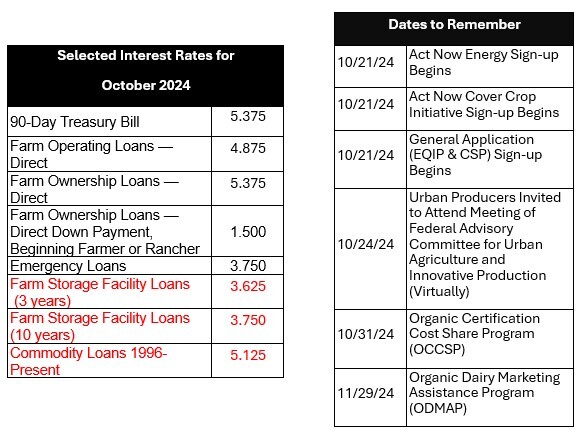
FSA offers direct farm ownership and direct farm operating loans to producers who want to establish, maintain, or strengthen their farm or ranch. Direct loans are processed, approved and serviced by FSA loan officers.
Direct farm operating loans can be used to purchase livestock and feed, farm equipment, fuel, farm chemicals, insurance, and other costs including family living expenses. Operating loans can also be used to finance minor improvements or repairs to buildings and to refinance some farm-related debts, excluding real estate.
Direct farm ownership loans can be used to purchase farmland, enlarge an existing farm, construct and repair buildings, and to make farm improvements.
The maximum loan amount for direct farm ownership loans is $600,000 and the maximum loan amount for direct operating loans is $400,000 and a down payment is not required. Repayment terms vary depending on the type of loan, collateral and the producer's ability to repay the loan. Operating loans are normally repaid within seven years and farm ownership loans are not to exceed 40 years.
Please contact your local FSA office for more information or to apply for a direct farm ownership or operating loan.
The U.S. Department of Agriculture (USDA) announced $58 million available for assistance to dairy producers through the Organic Dairy Marketing Assistance Program (ODMAP) 2024. ODMAP 2024 helps mitigate market volatility, higher input and transportation costs, and unstable feed supply and prices that have created unique hardships in the organic dairy industry. Specifically, through ODMAP 2024, USDA’s Farm Service Agency (FSA) is assisting organic dairy operations with projected marketing costs in 2024 calculated using their marketing costs in 2023. FSA will begin accepting ODMAP 2024 applications on Sept. 30. Eligible producers include certified organic dairy operations that produce milk from cows, goats, and sheep.
ODMAP 2024 Program Improvements
Dairy producers who participate in ODMAP 2024 will benefit from improvements to provisions outlined in the program. Specifically, ODMAP 2024 provides for an increase in the payment rate to $1.68 per hundredweight compared to the previous $1.10 per cwt. Additionally, the production cap has increased to nine million pounds compared to the previous five million pounds.
How ODMAP 2024 Works
FSA is providing financial assistance for a producer’s projected marketing costs in 2024 based on their 2023 costs. ODMAP 2024 provides a one-time cost-share payment based on marketing costs on pounds of organic milk marketed in the 2023 calendar year or estimated 2024 marketing costs for organic dairy operations that have increased milk production.
ODMAP 2024 provides financial assistance that immediately supports certified organic dairy operations during 2024 keeping organic dairy operations sustainable until markets return to more normal conditions.
How to Apply
FSA is accepting applications from Sept. 30 to Nov. 29. To apply, producers should contact FSA at their local USDA Service Center. To complete the ODMAP 2024 application, producers must certify to pounds of 2023 milk production, show documentation of their organic certification, and submit a completed application form.
Organic dairy operations are required to provide their USDA certification of organic status confirming operation as an organic dairy in 2024 and 2023 along with the certification of 2023 milk production or estimated 2024 milk production in hundredweight.
ODMAP 2024 complements other assistance available to dairy producers, including Dairy Margin Coverage (DMC), with more than $36 million in benefits paid for the 2024 program year to date. Learn more on the FSA Dairy Programs webpage.
More Information
To learn more about USDA programs, producers can contact their local USDA Service Center. Producers can also prepare maps for acreage reporting as well as manage farm loans and other programs by logging into their farmers.gov account. If you don’t have an account, sign up today
If you’re a new farmer or rancher, can help you get started or grow your operation through a variety of programs and services, from farm loans to crop insurance, and conservation programs to disaster assistance. We offer dedicated help to beginning farmers and ranchers. USDA considers anyone who has operated a farm or ranch for less than ten years to be a beginning farmer or rancher.
The first step is to find your local USDA Service Center by visiting farmers.gov/service-center-locator. Call your local Farm Service Agency (FSA) office to make an appointment to establish a farm number. You can establish a farm number for any land being used for agricultural purposes that is over 0.01 acre.
You’ll need to bring the following to your appointment:
- Proof of identify (driver’s license, social security card, IRS Employer Identification Number (EIN))
- Proof of Ownership (copy of recorded deed or recorded land contract)
- Lease agreements
- Entity Identification Status (articles of incorporation, trust and estate documents, or partnership agreement)
FSA staff will work with you one-on-one to review your documents and register your farm with FSA. Registering your farm allows you to apply for FSA and other USDA programs.
After your farm is registered, you can meet with FSA and Natural Resources Conservation Service (NRCS) staff to discuss your business and conservation goals. FSA and NRCS staff can help you determine program eligibility and walk you through the application process.
Depending on your operation, you may want to consider crop insurance. The USDA’s Risk Management Agency provides crop insurance to help you manage risks on your farm. There are many types of insurance products available for a wide variety of production practices, including organic and sustainable agriculture.
More Information
This is likely no surprise to you, but drought persists across the western U.S. and is intensifying in some areas. No geographic area is immune to the potential of drought at any given time. The U.S. Drought Monitor provides a weekly drought assessment, and it plays an important role in USDA programs that help farmers and ranchers recover from drought.
Fact #1 - Numerous agencies use the Drought Monitor to inform drought-related decisions.
The map identifies areas of drought and labels them by intensity on a weekly basis. It categorizes the entire country as being in one of six levels of drought. The first two, None and Abnormally Dry (D0), are not considered to be drought. The next four describe increasing levels of drought: Moderate (D1), Severe (D2), Extreme (D3) and Exceptional (D4).
While many entities consult the Drought Monitor for drought information, drought declarations are made by federal, state and local agencies that may or may not use the Drought Monitor to inform their decisions. Some of the ways USDA uses it to determine a producer’s eligibility for certain drought assistance programs, like the Livestock Forage Disaster Program and Emergency Haying or Grazing on Conservation Reserve Program acres and to “fast-track” Secretarial drought disaster designations.
Fact #2 - U.S. Drought Monitor is made with more than precipitation data.
When you think about drought, you probably think about water, or the lack of it. Precipitation plays a major role in the creation of the Drought Monitor, but the map’s author considers numerous indicators, including drought impacts and local insight from over 450 expert observers around the country. Authors use several dozen indicators to assess drought, including precipitation, streamflow, reservoir levels, temperature and evaporative demand, soil moisture and vegetation health. Because the drought monitor depicts both short and long‐term drought conditions, the authors must look at data for multiple timeframes. The final map produced each week represents a summary of the story being told by all the pieces of data. To help tell that story, authors don’t just look at data. They converse over the course of the map-making week with experts across the country and draw information about drought impacts from media reports and private citizens.
Fact #3 - A real person, using real data, updates the map.
Each week’s map author, not a computer, processes and analyzes data to update the drought monitor. The map authors are trained climatologists or meteorologists from the National Drought Mitigation Center at the University of Nebraska-Lincoln (the academic partner and website host of the Drought Monitor), the National Oceanic and Atmospheric Administration and USDA. The author’s job is to do what a computer can’t – use their expertise to reconcile the sometimes-conflicting stories told by each stream of data into a single assessment.
Fact #4 - The Drought Monitor provides a current snapshot, not a forecast.
The Drought Monitor is a “snapshot” of conditions observed during the most recent week and builds off the previous week’s map. The map is released on Thursdays and depicts conditions based on data for the week that ended the preceding Tuesday. Rain that falls on the Wednesday just before the USDM’s release won’t be reflected until the next map is published. This provides a consistent, week‐to‐week product and gives the author a window to assess the data and come up with a final map.
Fact #5 – Your input can be part of the drought-monitoring process.
State climatologists and other trained observers in the drought monitoring network relay on-the-ground information from numerous sources to the US Drought monitor author each week. That can include information that you contribute.
The Drought Monitor serves as a trigger for multiple forms of federal disaster relief for agricultural producers, and sometimes producers contact the author to suggest that drought conditions in their area are worse than what the latest drought monitor shows. When the author gets a call like that, it prompts them to look closely at all available data for that area, to see whether measurements of precipitation, temperature, soil moisture and other indicators corroborate producer-submitted reports. This is the process that authors follow whether they receive one report or one hundred reports, although reports from more points may help state officials and others know where to look for impacts.
There are multiple ways to contribute your observations:
-
Talk to your state climatologist - Find the current list at the American Association of State Climatologists website.
-
Email - Emails sent to droughtmonitor@unl.edu inform the USDM authors.
-
Become a CoCoRaHS observer - Submit drought reports along with daily precipitation observations to the Community Collaborative Rain, Hail & Snow Network.
-
Submit Condition Monitoring Observer Reports (CMOR) - go.unl.edu/CMOR.
For more information, read our Ask the Expert blog with a NDMC climatologist or visit farmers.gov/protection-recovery.
Article 1: Biden-Harris Administration Makes up to $7.7 Billion Available for Climate-Smart Practices on Agricultural Lands as Part of Investing in America Agenda
The U.S. Department of Agriculture (USDA) announced up to $7.7 billion in assistance for fiscal year 2025 to help agricultural and forestry producers adopt conservation practices on working lands. This includes up to $5.7 billion for climate-smart practices, made possible by the Inflation Reduction Act, which is part of President Biden’s Investing in America Agenda and $2 billion in Farm Bill funding. This is more than double the amount available last year and the most conservation assistance made available in a single year in U.S. history for popular USDA conservation programs.
Through changing temperatures, precipitation patterns, drought, flooding, and increasingly more severe extreme events, such as hurricanes and wildfires, climate change is affecting the livelihood of USDA’s stakeholders. Innovations in adapting to such changes will be central to the future success of working lands. USDA’s Natural Resources Conservation Service (NRCS) received more than 156,485 applications for its conservation programs in fiscal year 2024. While NRCS accepts applications year-round, interested agricultural producers can now apply for fiscal year 2025 funding through NRCS at their local USDA Service Center.
The Inflation Reduction Act, the largest climate and conservation investment in history, invests an additional $19.5 billion in NRCS’ oversubscribed conservation programs over five years, which began in fiscal year 2023. This year through the Inflation Reduction Act, producers can apply for $2.8 billion through the Environmental Quality Incentives Program (EQIP), $943 million through the Conservation Stewardship Program (CSP), $472 million through the Agricultural Conservation Easement Program (ACEP), and up to $1.4 billion in the Regional Conservation Partnership Program (RCPP). This is in addition to the $2 billion available for these programs through the Farm Bill, including $860 million for EQIP, $600 million for CSP, $450 million for ACEP, and $250 million for RCPP.
This assistance through the Inflation Reduction Act also helps advance the President’s Justice40 Initiative, which set a goal that 40% of the overall benefits of certain climate, clean energy and other federal investments flow to disadvantaged communities that are marginalized by underinvestment and overburdened by pollution. These investments also advance President Biden’s America the Beautiful Initiative, a locally led, voluntary conservation and restoration effort that aims to address the nature and climate crises, support working lands conservation, improve equitable access to the outdoors, and strengthen the economy.
Since implementation began in 2023, this climate smart conservation assistance has helped over 28,500 farmers and ranchers apply conservation to 361 million acres of land during the past two years. These funds provide direct climate mitigation benefits, advance a host of other environmental co-benefits, and expand access to financial and technical assistance for producers to advance conservation on their farm, ranch or forest land through practices like cover cropping, conservation tillage, wetland restoration, prescribed grazing, nutrient management, tree planting and more.
Climate-Smart Agriculture and Forestry Activities
NRCS recently released an updated list of Climate-Smart Agriculture and Forestry Mitigation Activities eligible for Inflation Reduction Act funding in fiscal year 2025, which includes 14 new activities. NRCS also released the NRCS Conservation Practices and Greenhouse Gas Mitigation Information dashboard sharing the expected mitigation benefits and science-based estimation approach for listed practices.
These in-demand activities are expected to reduce greenhouse gas emissions or increase carbon sequestration, as well as provide other significant benefits to natural resources like soil health, water quality, pollinator and wildlife habitat and air quality. In response to feedback received from conservation partners, producers and NRCS staff across the country, NRCS considered and evaluated activities based on scientific literature demonstrating expected climate change mitigation benefits.
These activities will also help producers mitigate the risks of climate change, including drought and flooding from extreme weather events such as the recent hurricane. Agriculture faces significant exposure to the physical risks of climate change. The USDA estimates that due to increased drought fueled by climate change, the Agency could see up to double the number of ranchers seeking assistance under the Livestock Forage Disaster Program by the end of the century compared to today. This corresponds to an increase of more than $800 million per year in Federal expenditures by the end of the century.
Conservation Easements
NRCS is accepting applications for ACEP for fiscal year 2025, which includes $472 million in Inflation Reduction Act funds for this year. ACEP helps producers conserve and protect grasslands, wetlands and farmlands. Producers interested in Inflation Reduction Act funding through ACEP should submit their applications by the next two ranking dates, Oct. 4, 2024, or Dec. 20, 2024. Any ACEP application submitted to NRCS that was unfunded in fiscal year 2024 will be automatically re-considered during the Oct. 4 funding cycle.
In addition, NRCS is also accepting ACEP applications eligible for Farm Bill funding. Application dates for fiscal year 2025 funding differ by state, and they’re available on the NRCS Ranking Dates webpage.
How to Apply
NRCS accepts producer applications for EQIP and CSP year-round, but producers interested in fiscal year 2025 funding should apply by their state’s ranking dates through NRCS at their local USDA Service Center. Funding is provided through a competitive process and is an opportunity to address the unmet demand from producers who have previously sought funding for climate-smart conservation activities.
Additionally, USDA will hold a briefing on Oct. 4 at 11:30 a.m. EDT for interested agriculture and conservation partners. USDA Farm Production and Conservation Under Secretary Robert Bonnie, NRCS Chief Cosby and several producers who have implemented NRCS programs with the help of the Inflation Reduction Act will talk about voluntary conservation on working lands. Add to your calendar: Google, iCal or Outlook. Or, join the event virtually via Microsoft Teams on Friday, October 4 at 11:30 a.m. ET.
More Information
On Aug. 16, 2022, President Biden signed the Inflation Reduction Act, the largest climate investment in history, into law. It is a historic, once-in-a-generation investment and opportunity for the agricultural communities that USDA serves. The Inflation Reduction Act will help producers stay on the farm, prevent producers from becoming ineligible for future assistance and promote climate-smart agriculture by increasing access to conservation assistance.
For more than 90 years, NRCS has helped farmers, ranchers and forestland owners make investments in their operations and local communities to improve the quality of our air, water, soil, and wildlife habitat. NRCS uses the latest science and technology to help keep working lands working, boost agricultural economies, and increase the competitiveness of American agriculture. NRCS provides one-on-one, personalized advice and financial assistance and works with producers to help them reach their goals through voluntary, incentive-based conservation programs. Now, with additional funding from the Inflation Reduction Act, NRCS is working to get even more conservation practices on the ground while ensuring access to programs for all producers. For more information, visit www.nrcs.usda.gov
USDA touches the lives of all Americans each day in so many positive ways. Under the Biden-Harris administration, USDA is transforming America’s food system with a greater focus on more resilient local and regional food production, fairer markets for all producers, ensuring access to safe, healthy and nutritious food in all communities, building new markets and streams of income for farmers and producers using climate smart food and forestry practices, making historic investments in infrastructure and clean energy capabilities in rural America, and committing to equity across the Department by removing systemic barriers and building a workforce more representative of America. To learn more, visit usda.gov.
Findings from recent Conservation Effects Assessment Project (CEAP) studies can help landowners get the most “buzz” from their pollinator habitat conservation choices. Virginia Tech collaborated on a first-of-its-kind study to evaluate the impacts of NRCS’s voluntary conservation practices on pollinator habitat nationwide. This study identifies 51 NRCS conservation practices that benefit pollinators and provides insight on the best areas to target pollinator habitat to maximize those benefits. A regional study in the southeastern U.S. by Auburn University assessed the attractiveness of native wildflower species to bees and found there are three clear favorites. Learn More
Meeting will take place October 23, 2024, 2:00 – 5:00 p.m. ET
We’re inviting urban producers, innovative producers, and other stakeholders to virtually attend a public meeting of the Federal Advisory Committee for Urban Agriculture and Innovative Production on October 23, 2024, from 2:00 – 5:00 p.m. Eastern.
Meeting details can be viewed in the Federal Register Notice. Written comments can be submitted via UrbanAgricultureFederalAdvisoryCommittee@usda.gov by November 6, 2024, at 11:59 p.m. The Committee will deliberate and vote on proposed recommendations and address public comments during the meeting. USDA will share the agenda between 24 to 48 hours prior to the meeting on the Committee’s webpage.
The Committee is managed by the Office of Urban Agriculture and Innovative Production and was established through the 2018 Farm Bill and is part of a broad USDA investment in urban agriculture.
Learn more and register.
The U.S. Department of Agriculture (USDA) announced changes to the Enhanced Coverage Option (ECO) beginning with the 2025 crop year. USDA’s Risk Management Agency (RMA) is expanding coverage options to additional crops as well as increasing premium support to make the policy more affordable for producers.
ECO is currently approved for 36 crops and RMA is expanding coverage options to almonds, apples, blueberries, grapes, and walnuts for the 2025 crop year and to citrus crops where the Supplemental Coverage Option is currently available in California and Arizona for the 2026 crop year.
Additionally, RMA is increasing premium support for all crops covered by ECO to 65% to make the policy more affordable.
ECO provides additional area-based coverage for a portion of a producer’s underlying crop insurance policy deductible. ECO can be purchased as an endorsement to Yield Protection, Revenue Protection, Revenue Protection with the Harvest Price Exclusion or Actual Production History. ECO offers producers a choice of 90 or 95% trigger levels. Trigger is the percentage of expected yield or revenue at which a loss becomes payable.
ECO coverage is unaffected by participation in USDA’s Farm Service Agency’s (FSA) Agriculture Risk Coverage program for the same crop, on the same acres. Producers may select ECO regardless of FSA farm program election.
Crop insurance is sold and delivered solely through private crop insurance agents. A list of crop insurance agents is available at all USDA Service Centers and online at the RMA Agent Locator. Producers can learn more about crop insurance and the modern farm safety net at rma.usda.gov or by contacting their RMA Regional Office.
Top of page
|






