
Our move has been temporarily delayed. We are still at 601 4J Court Suite B until further notice. NRCS will be operating out of both sites. Due to heavy workload, please make an appointment before visiting the office.
DROUGHT & FIRE DISASTER ASSISTANCE AVAILABLE
Below is a list of Farm Service Agency programs which may be helpful to you following the recent drought and wildfires in Campbell County:
- Emergency Conservation Program (ECP) – See fact sheet: https://www.fsa.usda.gov/Assets/USDA-FSA-Public/usdafiles/FactSheets/emergency-conservation-program-ecp-fact_sheet.pdf
- ECP provides a cost-share up to 75% for restoration of fences, providing emergency water during periods of severe drought, removing debris, restoring conservation structures such as waterways
- Limited to $500,000 per person or legal entity per disaster.
- Sign-up period for ECP Wells Drought: November 4th-December 4th, 2024
- Sign-up period for ECP Fire: November 4th, 2024- January 3rd, 2025
- Emergency Assistance for Livestock Honeybees, and Farm-Raised Fish Program (ELAP) - See fact sheet: https://www.fsa.usda.gov/Assets/USDA-FSA-Public/usdafiles/FactSheets/2024/FSA_ELAP_GeneralFactSheet_24.pdf
- ELAP provides producers with compensation for feed and grazing losses, transportation of feed to livestock, hauling livestock to forage or other grazing acres, and transporting water to livestock.
- Producers must complete a notice of loss and an application to the FSA office by January 30, 2025.
- Livestock Forage Disaster Program (LFP) – See fact sheet: https://www.fsa.usda.gov/Assets/USDA-FSA-Public/usdafiles/FactSheets/fsa_lfp_livestockforageprogramfactsheet_2022.pdf
- LFP provides compensation to livestock producers who have suffered grazing losses.
- Eligible livestock include: alpacas, beef cattle, buffalo/bison, beefalo, dairy cattle, equine, goats, llamas, ostrich, and sheep
- Payment limitation: $125,000
- Livestock Indemnity Program (LIP) - See fact sheet: https://www.fsa.usda.gov/Assets/USDA-FSA-Public/usdafiles/FactSheets/2024/fsa_lip_livestock_3_2024.pdf
- LIP compensates producers who experience livestock deaths in excess of normal mortality or sell injured livestock at a reduced price.
- Producers will need to provide acceptable documentation of death losses or evidence of reduced sales resulting from fire and must submit a notice of loss to FSA.
- Emergency Loan Program - See fact sheet: https://www.fsa.usda.gov/Assets/USDA-FSA-Public/usdafiles/FactSheets/fsa_emergencyloanprogram_factsheet-2020.pdf
- If the President or Secretary of Agriculture declares a disaster designation due to wildfire, farmers and ranchers may become eligible for Emergency Loans through FSA who have suffered either a physical or production loss due to the fire, and who are unable to receive credit from commercial sources. Note that there has not been a disaster designation declared for fire as of 8/27/24.
- Loan funds may be used to restore or replace property, pay production costs for 2024, pay for essential family living expenses, replace livestock, replace equipment, replace hay, etc.
Call the office to report losses and for further information: 307/682-8843 ext. 2
|
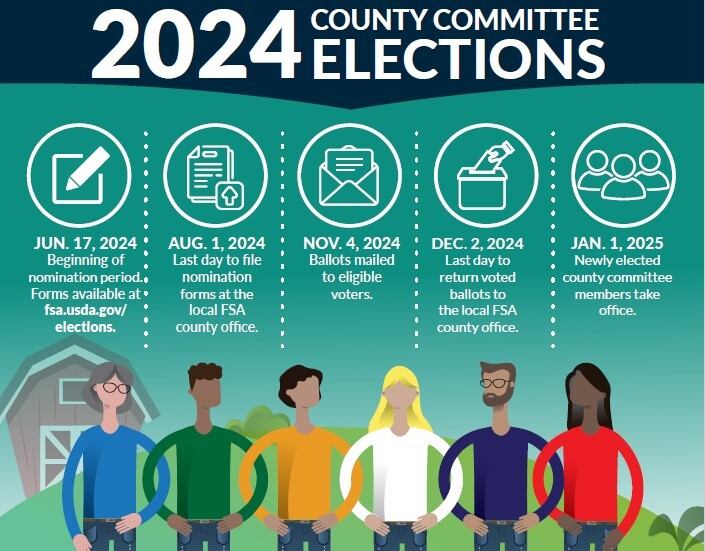
Elections for USDA’s Farm Service Agency’s (FSA) Campbell County Committee are underway.
It is important that every eligible producer participate in these elections because FSA county committees are a link between the agricultural community and the USDA. The 2024 election in Campbell County will be conducted for the representative Local Administrative Area (LAA): LAA 2. Customers can identify which LAA they or their farming operation is in by using our GIS locator tool available at fsa.usda.gov/elections.
To be eligible to vote in the elections, a person must:
- Be of legal voting age or, if not of legal voting age, supervise and conduct the farming operation of an entire farm.
- Have an interest in a farm or ranch as either:
- An individual who meets one or more of the following:
- Is eligible and capable to vote in one’s own right.
- Is a partner of a general partnership.
- Is a member of a joint venture.
- Participates or cooperates in any FSA program that is provided by law. a cooperating producer is someone who has provided information about their farming or ranching operation(s) but may not have applied or receive FSA program benefits.
The candidate for this years election is Cinnamon Lenhart.
Cinnamon is nominated in LAA#2, Campbell County, to serve as COC member for a 3-year term beginning January 1st, 2025.
Cinnamon resides in LAA#2 and has produced black angus cattle for 10 years. She is an active member of Ranching FYI and is a Ranching for Profit graduate.
Cinnamon is willing to serve if elected.
 |
|
Just a reminder that if any planting is done for fall seeded crops, your planting must be reported by November 15th to the County office. To avoid any late filed charges please call and make an appointment to complete your Acreage Report. |
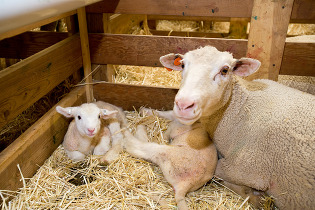
The wool LDP rates have continued to stay at .40 cents per pound. If you have not received an LDP for your 2024 wool, you may still be eligible if the following applies:
- The CCC-633EZ,page 1, must be filed with the FSA office before your commodity is sold and documentation of when beneficial interest was lost.
- If you still have a commodity at your farm or ranch, you may apply for a loan or LDP. The payment will be based on the certification of weights and the rate in effect on the date you bring this information to the FSA office and complete the application.
- Your commodity does not have to be sold to receive benefits. Receipts from approved storage facilities will be accepted and the LDP rate used will be the date the receipts are received and page 4 of the application completed.
If you have any questions please feel free to call the office.
|
 |
|
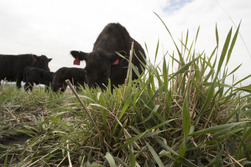
In order to potentially receive benefits in 2025 you must be enrolled in NAP and have purchased coverage for the eligible crop you produce in which a loss occurred due to a qualifying natural disaster. December 2nd, 2024 is the final day to enroll fall seeded crops, perennial forage and honey for the 2025 program year. |

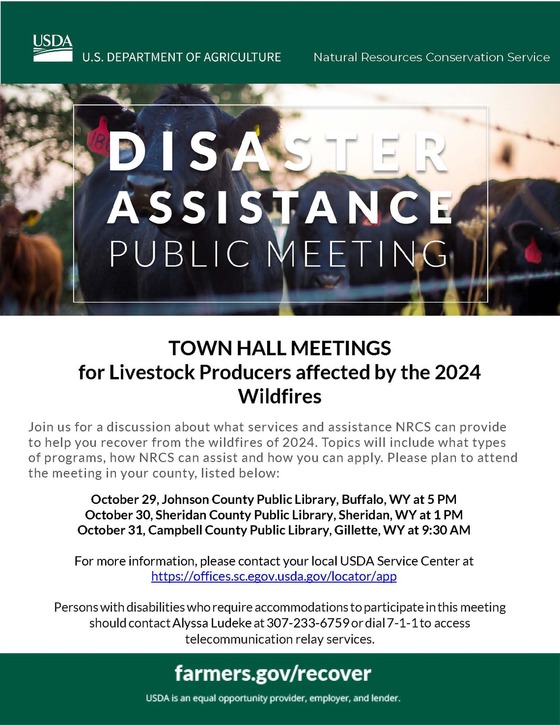
Campbell County was declared primary disaster due to wildfires that occurred from 6/11/2024 through 10/1/2024. Under this designation, if you have operations in any primary or contiguous county, you are eligible to apply for low interest emergency loans.
Emergency loans help you recover from production and physical losses due to drought, flooding and other natural disasters or quarantine.
You have eight months from the date of the declaration to apply for emergency loan assistance. FSA will consider each loan application on its own merits, taking into account the extent of losses, security available and repayment ability. You can borrow up to 100 percent of actual production or physical losses, to a maximum amount of $500,000.
For more information about emergency loans, contact your Campbell County USDA Service Center at 307-682-8843 Ext. 2 or visit fsa.usda.gov.
|
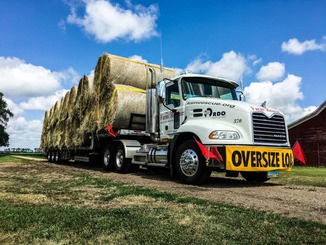
USDA’s Farm Service Agency (FSA) reminds drought-impacted producers in Wyoming that they may be eligible for assistance through the Emergency Assistance for Livestock, Honeybees, and Farm-Raised Fish Program (ELAP). For eligible livestock in qualifying counties, ELAP provides financial assistance for the transportation of water to livestock, the above normal cost of mileage for transporting feed to livestock, and the above normal cost of transporting livestock to forage/ grazing acres.
Eligible livestock include cattle, bison, goats and sheep, among others, that are maintained for commercial use and located in a county where qualifying drought conditions occur. Producers must have risk in both eligible livestock and eligible grazing land in an eligible county to qualify for ELAP assistance.
Transporting Water
Producers must be transporting water to eligible livestock on eligible grazing land where adequate livestock watering systems or facilities were in place before the drought occurred and where water transportation is not normally required. ELAP covers costs associated with personal labor, equipment, hired labor, and contracted water transportation fees. Cost of the water itself is not covered. ELAP covers $0.07 per gallon to transport water.
- Eligible livestock must be adults and weaned nonadult beef cattle, beefalo, buffalo/bison, dairy cattle, alpacas, deer, elk emus, equine, goats, llamas, reindeer, ostrich or sheep, and unweaned > 500 lbs.
- Water must be transported to grazing land that normally does not require water to be transported to and cannot include a working well or water source.
- Eligible grazing land is private, state and federal lands that are leased on a long-term basis, leased for cash or fixed amount.
- Non eligible grazing land includes use of forage and leased under basis of weight gain, cost per head per day or month, or on AUM only basis with no additional expense for maintenance.
- Documentation Required:
- Start and end dates water was hauled.
- Number of livestock water was hauled for.
- Total gallons hauled. Can be broken out for each day water was hauled.
- How was the water transport? Hired or personal.
- Copies of documentation for gallons of water hauled.
- Copies of documentation for what you hauled with, if it was personal equipment.
Transporting Feed
ELAP provides financial assistance to livestock producers who incur above normal expenses for transporting feed to livestock during drought. Livestock feed that is transported to livestock located on land enrolled in the Conservation Reserve Program (CRP) is eligible if the producer has an approved conservation plan with acceptable grazing practices developed in coordination with the Natural Resources Conservation Service.
- Reimbursement for mileage when feed is hauled above your normal hauling due to drought where livestock would have been grazing physically within Fremont County.
- Eligible livestock must be adult and weaned nonadult beef cattle, beefalo, buffalo/bison, dairy cattle, alpacas, deer, elk emus, equine, goats, llamas, reindeer, ostrich or sheep.
- Feed must be transported to eligible livestock more than 25 miles and not to exceed 1,000 per load.
- Various feed types includes feed, forage, and feedstuffs that include proteins.
- Ineligible: empty miles, the first 25 miles, normal commuting miles from a secondary job, salt and minerals, feed transported by planes/trains/helicopter/barges/boats. Feed hauled cannot be to stockpiled, sold to another producer and paid for transportation, purchased for another producer, and transported to ineligible livestock.
- Documentation Required:
- Number of truckloads of feed hauled from Aug. 20th - Dec. 31st
- Milage per truckload hauled
- Tons or pounds of feed hauled per truckload
- Type of feed hauled
- Livestock inventory
- Number of truckloads of feed hauled on a normal year from Aug. 20th - Dec. 31st
- National Average Price: $6.60/mile
Transporting Livestock
ELAP provides financial assistance to livestock producers who are hauling livestock to a new location for feed resources due to insufficient feed or grazing in drought-impacted areas. For both transporting feed and livestock, the payment formula for transporting livestock excludes the first 25 miles and any mileage over 1,000 miles. The reimbursement rate is 60% of the costs above what would normally have been incurred during the same time period in a normal (non-drought) year. An online tool is now available to help ranchers document and estimate payments to cover feed and livestock transportation costs caused by drought.
- Reimbursement for mileage when livestock are hauled above your normal due to drought where livestock would have been grazing physically within Fremont County to other grazing areas or feed lots.
- Eligible livestock must be adult and weaned nonadult beef cattle, beefalo, buffalo/bison, dairy cattle, alpacas, deer, elk emus, equine, goats, llamas, reindeer, ostrich or sheep.
- Livestock must have been physically located in Carbon County on February 25th or Albany County on March 4th, 2024. Transporting returning livestock is eligible and must return within 1 calendar year.
- Ineligible: empty miles, the first 25 miles, normal commuting miles from a secondary job, CRP without an approved conservation plan with acceptable grazing practices.
- Documentation Required:
- Number of truckloads of livestock hauled from: Aug. 20th - Dec. 31st
- Mileage per truckload hauled
- Milage logs, vendor receipts from hauling companies, contemporaneous trucking and hauling records and/or written checks for paying for livestock hauling
- Number of truckloads of livestock hauled on a normal year from:
- National Average Price: $6.60/mile
*For receipts to be considered acceptable they must include all of the following:
- Date of feed purchase
- Name, address, and telephone number of feed vendor
- Type and quantity of feed purchased
- Cost of feed purchased
- Signature of feed vendor if the vendor does not have a license to conduct this type of transaction.
Reporting Losses
Producers should contact FSA as soon as the loss of water or feed resources are known.
For ELAP eligibility, documentation of expenses is critical. Producers should maintain records and receipts associated with the costs of transporting water to eligible livestock, the costs of transporting feed to eligible livestock, the costs of additional feed purchases, and the costs of transporting eligible livestock to forage or other grazing acres. Producers interested in ELAP assistance can contact their local USDA Service Center to learn more or to apply for programs.
If you’ve suffered eligible livestock, honeybee, or farm-raised fish losses during calendar year 2024, you must file a notice of loss and an application for payment by Jan. 30, 2025.
|
Nov. 11th: Office Closed in Observance of Veterans Day
Nov. 15th: Deadline to Report Fall Seeded Crops
Nov. 28th: Office Closed in Observance of Thanksgiving
Dec 2nd: Deadline to purchase 2025 Non-Insured Crop Disaster Assistance Program (NAP) policy
Dec. 25th: Office Closed in Observance of Christmas
Jan. 30th, 2025: Deadline to apply for Livestock Forage Program (LFP)
Jan. 30th, 2025: Deadline to apply for Emergency Livestock Assistance Program (ELAP)
|








