
Utah Farm Service Agency Newsletter - October 7, 2024
In This Issue:
The U.S. Department of Agriculture (USDA) is announcing the launch of the Distressed Borrowers Assistance Network, an initiative designed to provide personalized support to financially distressed farmers and ranchers across the nation. Through a series of Cooperative Agreements, this national network will connect distressed borrowers with individualized assistance to help them stabilize and regain financial footing. USDA’s Farm Service Agency (FSA) made this announcement today at the Farm Aid Festival in Saratoga Springs, N.Y.
Network partners include Farm Aid, Rural Advancement Foundation International, the University of Arkansas, the Socially Disadvantaged Farmers and Ranchers Policy Center at Alcorn State University, and the University of Minnesota. Through this initiative, we are collaborating with community-based organizations to better serve financially distressed producers. Network partners will provide farm loan policy training to the community-based organizations so the organizations can work alongside FSA to help producers understand financing available through FSA, ensuring that when they visit an FSA office, the partner organization representative and FSA staff can better assist.
FSA, in collaboration with farm support organizations and land-grant institutions, will facilitate this network, which will provide the technical resources and guidance of USDA partners to experts from distressed and underserved communities. The network's approach includes integrating knowledgeable service providers to deliver one-on-one support to borrowers so they can best make plans and understand options to overcome their financial challenges.
The Distressed Borrowers Assistance Network will address the immediate needs of distressed borrowers and provide comprehensive, wraparound services aimed at addressing the unique challenges faced by financially distressed producers. Once stabilized financially, these borrowers will be better positioned to access new opportunities and continue contributing to the agricultural economy. These investments will also build a system of service providers that can better support agricultural communities for years to come. Investing in a network of agricultural financing service providers to help bridge access to FSA loans is a benefit for rural and agricultural communities.
Additional Farm Loan Programs Improvements
FSA recently announced significant changes to Farm Loan Programs through the Enhancing Program Access and Delivery for Farm Loans rule. These policy changes, to take effect Sept. 25, 2024, are designed to expand opportunities for borrowers to increase profitability and be better prepared to make strategic investments in enhancing or expanding their agricultural operations.
FSA also has a significant initiative underway to streamline and automate the Farm Loan Program customer-facing business process. For the over 26,000 producers who submit a direct loan application annually, FSA has made several meaningful improvements including:
- The Loan Assistance Tool that provides customers with an interactive online, step-by-step guide to identifying the direct loan products that may fit their business needs and to understanding the application process.
- The Online Loan Application, an interactive, guided application that is paperless and provides helpful features including an electronic signature option, the ability to attach supporting documents such as tax returns, complete a balance sheet, and build a farm operating plan.
- An online direct loan repayment feature that relieves borrowers from the necessity of calling, mailing, or visiting a local USDA Service Center to pay a loan installment.
- A simplified direct loan paper application, reduced from 29 pages to 13 pages.
- A new educational hub with farm loan resources and videos.
USDA encourages producers to reach out to their local FSA farm loan staff to ensure they fully understand the wide range of loan making and servicing options available to assist with starting, expanding, or maintaining their agricultural operation. To conduct business with FSA, producers should contact their local USDA Service Center.
FSA helps America’s farmers, ranchers and forest landowners invest in, improve, protect and expand their agricultural operations through the delivery of agricultural programs for all Americans. FSA implements agricultural policy, administers credit and loan programs, and manages conservation, commodity, disaster recovery and marketing programs through a national network of state and county offices and locally elected county committees. For more information, visit fsa.usda.gov.
USDA touches the lives of all Americans each day in so many positive ways. In the Biden-Harris administration, USDA is transforming America’s food system with a greater focus on more resilient local and regional food production, fairer markets for all producers, ensuring access to safe, healthy and nutritious food in all communities, building new markets and streams of income for farmers and producers using climate smart food and forestry practices, making historic investments in infrastructure and clean energy capabilities in rural America, and committing to equity across the Department by removing systemic barriers and building a workforce more representative of America. To learn more, visit usda.gov.
|
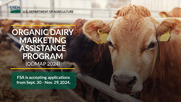
The U.S. Department of Agriculture (USDA) today announced $58 million available for assistance to dairy producers through the Organic Dairy Marketing Assistance Program (ODMAP) 2024. ODMAP 2024 helps mitigate market volatility, higher input and transportation costs, and unstable feed supply and prices that have created unique hardships in the organic dairy industry. Specifically, through ODMAP 2024, USDA’s Farm Service Agency (FSA) is assisting organic dairy operations with projected marketing costs in 2024 calculated using their marketing costs in 2023. FSA will begin accepting ODMAP 2024 applications on Sept. 30. Eligible producers include certified organic dairy operations that produce milk from cows, goats, and sheep.
ODMAP 2024 Program Improvements
Dairy producers who participate in ODMAP 2024 will benefit from improvements to provisions outlined in the program. Specifically, ODMAP 2024 provides for an increase in the payment rate to $1.68 per hundredweight compared to the previous $1.10 per cwt. Additionally, the production cap has increased to nine million pounds compared to the previous five million pounds.
How ODMAP 2024 Works
FSA is providing financial assistance for a producer’s projected marketing costs in 2024 based on their 2023 costs. ODMAP 2024 provides a one-time cost-share payment based on marketing costs on pounds of organic milk marketed in the 2023 calendar year or estimated 2024 marketing costs for organic dairy operations that have increased milk production.
ODMAP 2024 provides financial assistance that immediately supports certified organic dairy operations during 2024 keeping organic dairy operations sustainable until markets return to more normal conditions.
How to Apply
FSA is accepting applications from Sept. 30 to Nov. 29. To apply, producers should contact FSA at their local USDA Service Center. To complete the ODMAP 2024 application, producers must certify to pounds of 2023 milk production, show documentation of their organic certification, and submit a completed application form.
Organic dairy operations are required to provide their USDA certification of organic status confirming operation as an organic dairy in 2024 and 2023 along with the certification of 2023 milk production or estimated 2024 milk production in hundredweight.
ODMAP 2024 complements other assistance available to dairy producers, including Dairy Margin Coverage (DMC), with more than $36 million in benefits paid for the 2024 program year to date. Learn more on the FSA Dairy Programs webpage.
More Information
To learn more about USDA programs, producers can contact their local USDA Service Center. Producers can also prepare maps for acreage reporting as well as manage farm loans and other programs by logging into their farmers.gov account. If you don’t have an account, sign up today.
FSA helps America’s farmers, ranchers and forest landowners invest in, improve, protect and expand their agricultural operations through the delivery of agricultural programs for all Americans. FSA implements agricultural policy, administers credit and loan programs, and manages conservation, commodity, disaster recovery and marketing programs through a national network of state and county offices and locally elected county committees. For more information, visit fsa.usda.gov.
USDA touches the lives of all Americans each day in so many positive ways. In the Biden-Harris administration, USDA is transforming America’s food system with a greater focus on more resilient local and regional food production, fairer markets for all producers, ensuring access to safe, healthy and nutritious food in all communities, building new markets and streams of income for farmers and producers using climate smart food and forestry practices, making historic investments in infrastructure and clean energy capabilities in rural America, and committing to equity across the Department by removing systemic barriers and building a workforce more representative of America. To learn more, visit usda.gov.
|
The U.S. Department of Agriculture (USDA) is announcing the launch of the Debt Consolidation Tool, an innovative online tool available through farmers.gov that allows agricultural producers to enter their farm operating debt and evaluate the potential savings that might be provided by obtaining a debt consolidation loan with USDA’s Farm Service Agency (FSA) or a local lender.
A debt consolidation loan is a new loan used to pay off other existing operating loans or lines of credit that might have unreasonable rates and terms. By combining multiple eligible debts into a single, larger loan, borrowers may obtain more favorable payment terms such as a lower interest rate or lower payments. Consolidating debt may also provide farmers and ranchers additional cash flow flexibilities.
The Debt Consolidation Tool is a significant addition to FSA’s suite of improvements designed to modernize its Farm Loan Programs. The tool enhances customer service and increases opportunities for farmers and ranchers to achieve financial viability by helping them identify potential savings that could be reinvested in their farming and ranching operation, retirement accounts, or college savings accounts.
Producers can access the Debt Consolidation Tool by visiting farmers.gov/debt-consolidation-tool. The tool is built to run on modern browsers including Chrome, Edge, Firefox, or the Safari browser. Producers do not need to create a farmers.gov account or access the authenticated customer portal to use the tool.
Additional Farm Loan Programs Improvements
FSA recently announced significant changes to Farm Loan Programs through the Enhancing Program Access and Delivery for Farm Loans rule. These policy changes, to take effect September 25, 2024, are designed to better assist borrowers to make strategic investments in the enhancement or expansion of their agricultural operations.
FSA also has a significant initiative underway to streamline and automate the Farm Loan Program customer-facing business process. For the over 26,000 producers who submit a direct loan application annually, FSA has made several impactful improvements including:
- The Loan Assistance Tool that provides customers with an interactive online, step-by-step guide to identifying the direct loan products that may be a fit for their business needs and to understanding the application process.
- The Online Loan Application, an interactive, guided application that is paperless and provides helpful features including an electronic signature option, the ability to attach supporting documents such as tax returns, complete a balance sheet, and build a farm operating plan.
- An online direct loan repayment feature that relieves borrowers from the necessity of calling, mailing, or visiting a local USDA Service Center to pay a loan installment.
- A simplified direct loan paper application, reduced from 29 pages to 13 pages.
- A new educational hub with farm loan resources and videos.
USDA encourages producers to reach out to their local FSA farm loan staff to ensure they fully understand the wide range of loan and servicing options available to assist with starting, expanding, or maintaining their agricultural operation. To conduct business with FSA, please contact your local USDA Service Center.
FSA helps America’s farmers, ranchers and forest landowners invest in, improve, protect and expand their agricultural operations through the delivery of agricultural programs for all Americans. FSA implements agricultural policy, administers credit and loan programs, and manages conservation, commodity, disaster recovery and marketing programs through a national network of state and county offices and locally elected county committees. For more information, visit fsa.usda.gov.
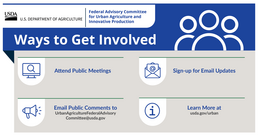 We’re inviting urban producers, innovative producers, and other stakeholders to virtually attend a public meeting of the Federal Advisory Committee for Urban Agriculture and Innovative Production on October 23, 2024, from 2:00 – 5:00 p.m. Eastern.
Meeting details can be viewed in the Federal Register Notice. Written comments can be submitted via UrbanAgricultureFederalAdvisoryCommittee@usda.gov by November 6, 2024, at 11:59 p.m. The Committee will deliberate and vote on proposed recommendations and address public comments during the meeting. USDA will share the agenda between 24 to 48 hours prior to the meeting on the Committee’s webpage.
The Committee is managed by the Office of Urban Agriculture and Innovative Production and was established through the 2018 Farm Bill and is part of a broad USDA investment in urban agriculture.
Learn more and register.
Nationwide, more than 7,700 dedicated members of the agricultural community serve on USDA Farm Service Agency (FSA) county committees. The committees are made up of three to 11 members who serve three-year terms. Committee members are vital to how FSA administers disaster assistance, conservation, commodity and price support programs, advises county office employment and addresses other agricultural issues.
To hold office or vote in FSA county committee elections, there are specific provisions for American Indian and Alaska Native (AI/AN) citizens.
Watch this video to hear from agricultural producers, current and retired USDA staff and tribal government officials about the importance of tribal participation in FSA county committee elections.
Nominations
Tribal nation leaders and farm and ranch organizations can nominate agricultural producers for County Committees serving tribal lands. Agricultural producers may be nominated for candidacy for the county committee if they:
A cooperating producer is someone who has provided information about their farming or ranching operation to FSA, even if they have not applied or received program benefits. Individuals may nominate themselves or others and qualifying organizations may also nominate candidates.
Voting
Since the 1990s, every member of an American Indian tribe is considered an agricultural landowner if the land on which the tribal member’s voting eligibility is based is tribally owned or held in trust by the United States for the tribe, even if the individual does not personally produce an agricultural commodity on that land. Members of American Indian tribes holding agricultural land are eligible to vote in an FSA county committee election if the tribal member meets the age requirement of 18 years and older. Tribal agricultural landowner voting eligibility applies only to members of federally recognized Tribes.
How to Vote
Tribal agricultural landowners 18 years and older can contact their USDA Service Center to register to vote with FSA. After providing FSA with contact information, including a current mailing address, tribal landowners will be updated as an eligible voter in the FSA county committee election database.
Tribal Engagement
Additionally, FSA can collaborate directly with Tribal Nations to obtain names and addresses of tribal members 18 years and older to get tribal membership registered in the FSA election system. View FSA’s 2024 call for tribal nominations.
Additional Information
USDA Farm Service Agency (FSA) and the USDA Office of Communications collaborated with the Blackfeet Tribal Business Council in Montana to highlight FSA opportunities for federally recognized tribal nations to expand USDA service, outreach and education in tribal communities nationwide.
The national outreach and education project includes aerial footage of the 1.5 million-acre Blackfeet Indian Reservation in northwestern Montana and video interviews with agricultural producers, current and retired USDA staff and tribal government officials. This is part one of a two-part video series – part two will be released later in the year.
For more information, including a USDA Tribal Agricultural Landowner Voting Eligibility poster, visit your local USDA Service Centers, fsa.usda.gov/elections and farmers.gov/tribal.
Farmers and ranchers rely on crop insurance to protect themselves from disasters and unforeseen events, but not all crops are insurable through the USDA’s Risk Management Agency. The Farm Service Agency’s (FSA) Noninsured Crop Disaster Assistance Program (NAP) provides producers another option to obtain coverage against disaster for these crops. NAP provides financial assistance to producers of non-insurable crops impacted by natural disasters that result in lower yields, crop losses, or prevents crop planting.
Commercially produced crops and agricultural commodities for which crop insurance is not available are generally eligible for NAP. Eligible crops include those grown specifically for food, fiber, livestock consumption, biofuel or biobased products, or value loss crops such as aquaculture, Christmas trees, ornamental nursery, and others. Contact your local FSA office to see which crops are eligible in your state and county.
Eligible causes of loss include drought, freeze, hail, excessive moisture, excessive wind or hurricanes, earthquake and flood. These events must occur during the NAP policy coverage period, before or during harvest, and the disaster must directly affect the eligible crop. For guidance on causes of loss not listed, contact your local FSA county office.
Interested producers apply for NAP coverage using FSA form CCC-471, “Application for Coverage,” and pay the applicable service fee at the FSA office where their farm records are maintained. These must be filed by the application closing date, which varies by crop. Contact your local FSA office to verify application closing dates and ensure coverage for eligible NAP crops.
At the time of application, each producer acknowledges they have received the NAP Basic Provisions, which describes NAP requirements for coverage. NAP participants must report crop acreage shortly after planting and provide verifiable or reliable crop production records when required by FSA.
Producers are required to pay service fees which vary depending on the number of crops and number of counties your operation is located in. The NAP service fee is the lesser of $325 per crop or $825 per producer per administrative county, not to exceed a total of $1,950 for a producer with farming interests in multiple counties. Premiums also apply when producers elect higher levels of coverage with a maximum premium of $15,750 per person or legal entity.
A producer’s certification on Form CCC-860 Socially Disadvantaged, Limited Resource, Beginning and Veteran Farmer or Rancher Certification may serve as an application for basic NAP coverage for all eligible crops beginning with crop year 2022. These producers will have all NAP-related service fees for basic coverage waived, in addition to a 50 percent premium reduction if higher levels of coverage are elected.
For more detailed information on NAP, download the NAP Fact Sheet. To get started with NAP, we recommend you contact your local USDA service center.
FSA and NRCS program applicants for benefits are required to submit a completed CCC-902 Farming Operation Plan and CCC-941 Average Gross Income (AGI) Certification and Consent to Disclosure of Tax Information for FSA to determine the applicant’s payment eligibility and establish the maximum payment limitation applicable to the program applicant.
Participants are not required to annually submit new CCC-902s for payment eligibility and payment limitation purposes unless a change in the farming operation occurs that may affect the previous determination of record. A valid CCC-902 filed by the participant is considered to be a continuous certification used for all payment eligibility and payment limitation determinations applicable for the program benefits requested.
Participants are responsible for ensuring that all CCC-902 and CCC-941 and related forms on file in the county office are updated, current, and correct. Participants are required to timely notify the county office of any changes in the farming operation that may affect the previous determination of record by filing a new or updated CCC-902 as applicable.
Changes that may require a NEW determination include, but are not limited to, a change of:
- Shares of a contract, which may reflect:
- A land lease from cash rent to share rent
- A land lease from share rent to cash rent (subject to the cash rent tenant rule
- A modification of a variable/fixed bushel-rent arrangement
- The size of the producer’s farming operation by the addition or reduction of cropland that may affect the application of a cropland factor
- The structure of the farming operation, including any change to a member's share
- The contribution of farm inputs of capital, land, equipment, active personal labor, and/or active personal management
- Farming interests not previously disclosed on CCC-902 including the farming interests of a spouse or minor child
- Certifications of average AGI are required to be filed annually for participation in an annual USDA program. For multi-year conservation contracts and NRCS easements, a certification of AGI must be filed prior to approval of the contract or easement and is applicable for the duration of the contract period.
Participants are encouraged to file or review these forms within the deadlines established for each applicable program for which program benefits are being requested.
Don’t know much about Federal crop insurance, but you want to learn more?
Crop insurance is a risk management strategy that farmers use to protect their livelihoods. By purchasing a policy through a crop insurance agent, farmers are financially protected if there are losses due to a covered cause of loss. It’s not so different from car or homeowners insurance.
Start your journey out right by reading RMA’s Beginners Guide to Crop Insurance.
Landowners and operators are reminded that in order to receive payments from USDA, compliance with Highly Erodible Land (HEL) and Wetland Conservation (WC) provisions are required. Farmers with HEL determined soils are reminded of tillage, crop residue, and rotation requirements as specified per their conservation plan. Producers are to notify the USDA Farm Service Agency prior to breaking sod, clearing land (tree removal), and of any drainage projects (tiling, ditching, etc.) to ensure compliance. Failure to update certification of compliance, with form AD-1026, triggering applicable HEL and/or wetland determinations, for any of these situations, can result in the loss of FSA farm program payments, FSA farm loans, NRCS program payments, and premium subsidy to Federal Crop Insurance administered by RMA.
The U.S. Department of Agriculture (USDA) today announces changes to the Farm Service Agency’s (FSA) Farm Loan Programs, effective Sept. 25, 2024 — changes that are intended to increase opportunities for farmers and ranchers to be financially viable. These improvements, part of the Enhancing Program Access and Delivery for Farm Loans rule, demonstrate USDA’s commitment to improving farm profitability through farm loans designed to provide important financing options used by producers to cover operating expenses and purchase land and equipment.
Farm loan policy changes outlined in the Enhancing Program Access and Delivery for Farm Loans rule, are designed to better assist borrowers to make strategic investments in the enhancement or expansion of their agricultural operations.
The three most notable policy changes include:
- Establishing a new low-interest installment set-aside program for financially distressed borrowers. Eligible financially distressed borrowers can defer up to one annual loan installment per qualified loan at a reduced interest rate, providing a simpler and expedited option to resolve financial distress in addition to FSA’s existing loan servicing programs.
- Providing all eligible loan applicants access to flexible repayment terms that can increase profitability and help build working capital reserves and savings. By creating upfront positive cash flow, borrowers can find opportunities in their farm operating plan budgets to include a reasonable margin for increased working capital reserves and savings, including for retirement and education.
- Reducing additional loan security requirements to enable borrowers to leverage equity. This reduces the amount of additional security required for direct farm loans, including reducing the frequency borrowers must use their personal residence as additional collateral for a farm loan.
Additional Farm Loan Program Improvements
Under the Biden-Harris Administration, USDA’s FSA has embarked on a comprehensive and systemic effort to ensure equitable delivery of Farm Loan Programs and improve access to credit for small and mid-size family farms.
FSA has also included additional data in its annual report to Congress to provide information that Congress, stakeholders, and the general public need to hold USDA accountable on the progress that has been made in improving services to underserved producers. This year’s report shows FSA direct and guaranteed loans were made to a greater percentage of young and beginning farmers and ranchers, as well as improvements in the participation rates of minority borrowers. The report also highlights FSA’s microloan program’s new focus on urban agriculture operations and niche market lending, as well as increased support for producers seeking direct loans for farm ownership in the face of increasing land values across the country.
FSA has a significant initiative underway to streamline and automate the Farm Loan Program customer-facing business process. For the over 26,000 producers who submit a direct loan application annually, FSA has made several impactful improvements including:
- The Loan Assistance Tool that provides customers with an interactive online, step-by-step guide to identifying the direct loan products that may be a fit for their business needs and to understanding the application process.
- The Online Loan Application, an interactive, guided application that is paperless and provides helpful features including an electronic signature option, the ability to attach supporting documents such as tax returns, complete a balance sheet, and build a farm operating plan.
- An online direct loan repayment feature that relieves borrowers from the necessity of calling, mailing, or visiting a local USDA Service Center to pay a loan installment.
- A simplified direct loan paper application, reduced from 29 pages to 13 pages.
USDA encourages producers to reach out to their local FSA farm loan staff to ensure they fully understand the wide range of loan and servicing options available to assist with starting, expanding, or maintaining their agricultural operation. To conduct business with FSA, please contact your local USDA Service Center
FSA helps America’s farmers, ranchers and forest landowners invest in, improve, protect and expand their agricultural operations through the delivery of agricultural programs for all Americans. FSA implements agricultural policy, administers credit and loan programs, and manages conservation, commodity, disaster recovery and marketing programs through a national network of state and county off ices and locally elected county committees. For more information, visit, www.fsa.usda.gov
The U.S. Department of Agriculture (USDA) is expanding the Food Safety Certification for Specialty Crops (FSCSC) program to now include medium-sized businesses in addition to small businesses. Eligible specialty crop growers can apply for assistance for expenses related to obtaining or renewing a food safety certification. The program has also been expanded to include assistance for 2024 and 2025 expenses. Producers can apply for assistance on their calendar year 2024 expenses beginning July 1, 2024, through Jan. 31, 2025. For program year 2025, the application period will be Jan. 1, 2025, through Jan. 31, 2026.
Program Details
FSCSC assists specialty crop operations that incurred eligible on-farm food safety certification and expenses related to obtaining or renewing a food safety. FSCSC covers a percentage of the specialty crop operation’s cost of obtaining or renewing its certification, as well as a portion of related expenses.
Eligible FSCSC applicants must be a specialty crop operation; meet the definition of a small or medium-size business and have paid eligible expenses related to certification.
- A small business has an average annual monetary value of specialty crops sold by the applicant during the three-year period preceding the program year of no more than $500,000.
- A medium size business has an average annual monetary value of specialty crops the applicant sold during the three-year period preceding the program year of at least $500,001 but no more than $1,000,000.
Specialty crop operations can receive the following cost assistance:
- Developing a food safety plan for first-time food safety certification.
- Maintaining or updating an existing food safety plan.
- Food safety certification.
- Certification upload fees.
- Microbiological testing for products, soil amendments and water.
- Training
FSCSC payments are calculated separately for each eligible cost category. Details about payment rates and limitations are available at farmers.gov/food-safety.
Applying for Assistance
Interested applicants have until Jan. 31, 2025, to apply for assistance for 2024 eligible expenses. FSA will issue payments as applications are processed and approved. For program year 2025, the application period will be January 1, 2025, through January 31, 2026. FSA will issue 50% of the calculated payment for program year 2025 following application approval, with the remaining amount to be paid after the application deadline. If calculated payments exceed the amount of available funding, payments will be prorated.
Specialty crop producers can apply by completing the FSA-888-1, Food Safety Certification for Specialty Crops Program (FSCSC) for Program Years 2024 and 2025 application. The application, along with the AD-2047, Customer Data Worksheet and SF-3881, ACH Vendor/Miscellaneous Payment Enrollment Form, if not already on file with FSA, can be submitted to the FSA office at any USDA Service Center nationwide by mail, fax, hand delivery or via electronic means. Alternatively, producers with an eAuthentication account can apply for FSCSC online. Producers interested in creating an eAuthentication account should visit farmers.gov/sign-in.
Specialty crop producers can also call 877-508-8364 to speak directly with a FSA employee ready to assist. Visit farmers.gov/food-safety for additional program details, eligibility information and forms needed to apply.
More Information
To learn more about FSA programs, producers can contact their local USDA Service Center. Producers can also prepare maps for acreage reporting as well as manage farm loans and view other farm records data and customer information by logging into their farmers.gov account. Producers without an account can sign up today.
Top of page
Utah Farm Service Agency
125 South State Street
Room 3202
Salt Lake City, UT 84138
Phone: 801-524-4530
Fax: 844-715-5091
|
| |
|
State Executive Director
Mark Gibbons
mark.gibbons@usda.gov
Farm Program Specialist
Cary Son
cary.son@usda.gov
Farm Program Specialist
Heidi Brooks
heidi.brooks@usda.gov
|
Utah FSA State Committee
Lance Munns, Chairman
Merlin Esplin
Alisa Meyer
Farm Loan Chief
Korry Soper
korry.soper@usda.gov
|
| |
|







