|
The U.S. Department of Agriculture (USDA) announced the launch of the Distressed Borrowers Assistance Network, an initiative designed to provide personalized support to financially distressed farmers and ranchers across the nation. Through a series of Cooperative Agreements, this national network will connect distressed borrowers with individualized assistance to help them stabilize and regain financial footing.
Network partners include Farm Aid, Rural Advancement Foundation International, the University of Arkansas, the Socially Disadvantaged Farmers and Ranchers Policy Center at Alcorn State University, and the University of Minnesota. Through this initiative, we are collaborating with community-based organizations to better serve financially distressed producers. Network partners will provide farm loan policy training to the community-based organizations so the organizations can work alongside FSA to help producers understand financing available through FSA, ensuring that when they visit an FSA office, the partner organization representative and FSA staff can better assist.
FSA, in collaboration with farm support organizations and land-grant institutions, will facilitate this network, which will provide the technical resources and guidance of USDA partners to experts from distressed and underserved communities. The network's approach includes integrating knowledgeable service providers to deliver one-on-one support to borrowers so they can best make plans and understand options to overcome their financial challenges.
The Distressed Borrowers Assistance Network will address the immediate needs of distressed borrowers and provide comprehensive, wraparound services aimed at addressing the unique challenges faced by financially distressed producers. Once stabilized financially, these borrowers will be better positioned to access new opportunities and continue contributing to the agricultural economy. These investments will also build a system of service providers that can better support agricultural communities for years to come. Investing in a network of agricultural financing service providers to help bridge access to FSA loans is a benefit for rural and agricultural communities.
Additional Farm Loan Programs Improvements
FSA recently announced significant changes to Farm Loan Programs through the Enhancing Program Access and Delivery for Farm Loans rule. These policy changes, to take effect Sept. 25, 2024, are designed to expand opportunities for borrowers to increase profitability and be better prepared to make strategic investments in enhancing or expanding their agricultural operations.
FSA also has a significant initiative underway to streamline and automate the Farm Loan Program customer-facing business process. For the over 26,000 producers who submit a direct loan application annually, FSA has made several meaningful improvements including:
- The Loan Assistance Tool that provides customers with an interactive online, step-by-step guide to identifying the direct loan products that may fit their business needs and to understanding the application process.
- The Online Loan Application, an interactive, guided application that is paperless and provides helpful features including an electronic signature option, the ability to attach supporting documents such as tax returns, complete a balance sheet, and build a farm operating plan.
- An online direct loan repayment feature that relieves borrowers from the necessity of calling, mailing, or visiting a local USDA Service Center to pay a loan installment.
- A simplified direct loan paper application, reduced from 29 pages to 13 pages.
- A new educational hub with farm loan resources and videos.
USDA encourages producers to reach out to their local FSA farm loan staff to ensure they fully understand the wide range of loan making and servicing options available to assist with starting, expanding, or maintaining their agricultural operation. To conduct business with FSA, producers should contact their local USDA Service Center.
FSA helps America’s farmers, ranchers and forest landowners invest in, improve, protect and expand their agricultural operations through the delivery of agricultural programs for all Americans. FSA implements agricultural policy, administers credit and loan programs, and manages conservation, commodity, disaster recovery and marketing programs through a national network of state and county offices and locally elected county committees. For more information, visit fsa.usda.gov.
The U.S. Department of Agriculture (USDA) is accepting applications through its updated Emergency Assistance for Livestock, Honeybees, and Farm-raised Fish Program (ELAP) to provide financial assistance to eligible dairy producers who incur milk losses due to Highly Pathogenic Avian Influenza, also known as H5N1infection in their dairy herds. USDA’s Farm Service Agency (FSA) expanded ELAP through the rule-making process to assist with a portion of financial losses resulting from reduced milk production when cattle are removed from commercial milking in dairy herds having a confirmed positive H5N1 test. Positive test results must be confirmed through the USDA’s Animal and Plant Health Inspection Service (APHIS) National Veterinary Services Laboratories (NVSL).
“USDA remains committed to working with producers, state veterinarians, animal health professionals, and our federal partners as we continue to detect the presence of H5N1 in dairy herds and take additional measures to contain the spread of the disease,” said Agriculture Secretary Tom Vilsack. “When something unexpected, like H5N1, threatens the economic viability of the producers we serve, we are committed to finding ways, where we have the authority to do so, to revisit existing program policies and provide the financial support needed to help producers recover and sustain production.”
ELAP provides emergency relief to eligible producers of livestock, honeybees, and farm-raised fish to assist with losses due to disease, adverse weather, or other conditions, such as wildfires, that are not covered by other FSA disaster assistance programs.
H5N1 infections have been detected in 14 states including California, Colorado, Idaho, Iowa, Kansas, Michigan, Minnesota, New Mexico, North Carolina, New Mexico, Ohio, South Dakota, Texas and Wyoming. Dairy producers in all states are reminded to stay vigilant and follow established APHIS biosecurity, detection and testing guidelines. In addition to testing, enhanced biosecurity is critical to containing this virus. USDA works closely with state animal health official, producers, and industry organizations to provide guidance and resources for cleaning and disinfection not only on affected farms but for all livestock producers as a part of practicing good biosecurity. APHIS has made available a number of biosecurity documents on its landing page.
ELAP Eligibility
Eligible adult dairy cattle must be:
- Part of a herd that has a confirmed positive H5N1 test from NVSL;
- Initially removed from commercial milk production at some point during the 14-day time period before the sample collection date for the positive H5N1 test date through 120 days after the sample collection date for the positive H5N1 test;
- Milk-producing, currently lactating; and
- Maintained for commercial milk production, in which the producer has a financial risk, on the beginning date of the eligible loss condition.
Applying for ELAP Assistance
To apply, producers need to submit the following to FSA:
- Proof of herd infection through a confirmed positive H5N1 test (based on USDA’s APHIS H5N1 case definition) on individual animal or bulk tank samples confirmed by NVSL;
- A notice of loss indicating the date when the loss is apparent, which is the sample collection date for the positive H5N1 test; and
- An application for payment certifying the number of eligible adult dairy cows, the month the cows were removed from production, and the producer’s share in the milk production.
The final date to file a notice of loss and application for payment for eligible losses is 30 days after the end of the prior calendar year, which is January 30.
Calculating ELAP Payments
The per cow milk loss payment due to H5N1 will be determined based on an expected 21-day period of no milk production when a cow is removed from the milking herd, followed by seven days when the cow has returned to milking but produces 50% of the normal amount of production.
ELAP payments are determined using a per head payment rate calculated based on the monthly all-milk price and national milk production published by the National Agricultural Statistics Service and a standard number of days with reduced or no production — (per head payment rate x number of eligible adult dairy cows x producer’s share in milk production x 90%)
To apply, producers should contact the FSA at their local USDA Service Center.
More Information
Details on updated ELAP policy to provide financial assistance for milk loss due H5N1.
USDA continues to work with the Food and Drug Administration, Centers for Disease Control and Prevention, and State veterinary and public health officials to investigate H5N1 among cattle. APHIS continues to provide confirmatory testing for samples from livestock as well as guidance for producers, veterinarians, and state animal health officials. Learn more at APHIS’ Highly Pathogenic Avian Influenza Detections in Livestock webpage.
Applications accepted from Sept. 30 to Nov. 29
The U.S. Department of Agriculture (USDA) announced $58 million available for assistance to dairy producers through the Organic Dairy Marketing Assistance Program (ODMAP) 2024. ODMAP 2024 helps mitigate market volatility, higher input and transportation costs, and unstable feed supply and prices that have created unique hardships in the organic dairy industry. Specifically, through ODMAP 2024, USDA’s Farm Service Agency (FSA) is assisting organic dairy operations with projected marketing costs in 2024 calculated using their marketing costs in 2023. FSA will begin accepting ODMAP 2024 applications on Sept. 30. Eligible producers include certified organic dairy operations that produce milk from cows, goats, and sheep.
ODMAP 2024 Program Improvements
Dairy producers who participate in ODMAP 2024 will benefit from improvements to provisions outlined in the program. Specifically, ODMAP 2024 provides for an increase in the payment rate to $1.68 per hundredweight compared to the previous $1.10 per cwt. Additionally, the production cap has increased to nine million pounds compared to the previous five million pounds.
How ODMAP 2024 Works
FSA is providing financial assistance for a producer’s projected marketing costs in 2024 based on their 2023 costs. ODMAP 2024 provides a one-time cost-share payment based on marketing costs on pounds of organic milk marketed in the 2023 calendar year or estimated 2024 marketing costs for organic dairy operations that have increased milk production.
ODMAP 2024 provides financial assistance that immediately supports certified organic dairy operations during 2024 keeping organic dairy operations sustainable until markets return to more normal conditions.
How to Apply
FSA is accepting applications from Sept. 30 to Nov. 29. To apply, producers should contact FSA at their local USDA Service Center. To complete the ODMAP 2024 application, producers must certify to pounds of 2023 milk production, show documentation of their organic certification, and submit a completed application form.
Organic dairy operations are required to provide their USDA certification of organic status confirming operation as an organic dairy in 2024 and 2023 along with the certification of 2023 milk production or estimated 2024 milk production in hundredweight.
ODMAP 2024 complements other assistance available to dairy producers, including Dairy Margin Coverage (DMC), with more than $36 million in benefits paid for the 2024 program year to date. Learn more on the FSA Dairy Programs webpage.
More Information
To learn more about USDA programs, producers can contact their local USDA Service Center. Producers can also prepare maps for acreage reporting as well as manage farm loans and other programs by logging into their farmers.gov account. If you don’t have an account, sign up today.
FSA helps America’s farmers, ranchers and forest landowners invest in, improve, protect and expand their agricultural operations through the delivery of agricultural programs for all Americans. FSA implements agricultural policy, administers credit and loan programs, and manages conservation, commodity, disaster recovery and marketing programs through a national network of state and county offices and locally elected county committees. For more information, visit fsa.usda.gov.
USDA touches the lives of all Americans each day in so many positive ways. In the Biden-Harris administration, USDA is transforming America’s food system with a greater focus on more resilient local and regional food production, fairer markets for all producers, ensuring access to safe, healthy and nutritious food in all communities, building new markets and streams of income for farmers and producers using climate smart food and forestry practices, making historic investments in infrastructure and clean energy capabilities in rural America, and committing to equity across the Department by removing systemic barriers and building a workforce more representative of America. To learn more, visit usda.gov.
The U.S. Department of Agriculture (USDA) is accepting offers for more than 2.2 million acres from agricultural producers and private landowners through this year’s Grassland, General, and Continuous Conservation Reserve Program (CRP) signups administered by USDA’s Farm Service Agency (FSA). With these accepted acres, enrollment is very near the 27 million CRP acreage cap.
Grassland CRP
Including the nearly 1.44 million acres recently accepted in Grassland CRP for offers received in 2024, producers will have enrolled more than 10 million acres in this popular working-lands program.
Grassland CRP allows producers and landowners to continue grazing and haying practices while protecting grasslands and further CRP’s impacts. Grassland CRP leverages working lands practices to improve biodiversity and conserve environmentally sensitive land.
Enrolled acres help sequester carbon in vegetation and soil, while enhancing resilience to drought and wildfire. Meanwhile, producers can still conduct common grazing practices, such as haying, mowing or harvesting seed from the enrolled land, which supports agricultural production.
Top states for this year’s Grassland CRP signup include:
-
Nebraska with 237,853 acres accepted
-
Colorado with 218,145 acres accepted
-
New Mexico with 185,619 acres accepted
Additionally, to target conservation in key geographies, USDA prioritizes land within two National Priority Zones: The Greater Yellowstone Ecosystem and the Dust Bowl area. The 2024 Grassland CRP enrollment has added more than 560,000 acres in the Priority Zones, bringing the total acres to 3.8 million. By conserving working grasslands and other lands that underpin iconic big game migrations, land enrolled in these zones contributes to broader USDA conservation efforts through Working Lands for Wildlife.
General and Continuous CRP
FSA also has accepted nearly 200,000 acres through the General signup, bringing total acres enrolled in General CRP to 7.9 million acres. As one of the largest private lands conservation programs in the United States, CRP offers a range of conservation options to farmers, ranchers and landowners. It has been an especially strong opportunity for farmers with less productive or marginal cropland, helping them re-establish valuable land cover to help improve water quality, prevent soil erosion and support wildlife habitat.
In January 2024, FSA opened enrollment for Continuous CRP. Under this enrollment, producers and landowners can enroll in CRP throughout the year. Offers are automatically accepted provided the producer and land meet the eligibility requirements and the enrollment levels do not exceed the statutory cap. To date, in 2024, more than 565,000 acres have been offered through Continuous CRP bringing the total acres enrolled to 8.5 million.
Producers can still make an offer to participate in CRP through the Continuous CRP signup, which is ongoing, by contacting FSA at their local USDA Service Center.
The U.S. Department of Agriculture (USDA) has technical and financial assistance available to help farmers and livestock producers across California recover from recent wildfires. Producers impacted by wildfires should contact their local USDA Service Center to report losses and learn more about program options available to assist in their recovery from crop, land, infrastructure and livestock losses and damages.
USDA Disaster Assistance for Wildfire Recovery
Producers who experience livestock deaths in excess of normal mortality may be eligible for the Livestock Indemnity Program (LIP). To participate in LIP, producers will need to provide documentation of death losses and submit a notice of loss to the USDA Farm Service Agency (FSA) no later than the annual program payment application date. The LIP payment application and notice of loss deadline is March 3, 2025, for 2024 calendar year losses.
Meanwhile, the Emergency Assistance for Livestock, Honeybees, and Farm-Raised Fish Program (ELAP) provides eligible producers with compensation for feed and grazing losses and transportation cost associated with transporting feed/forage to livestock and livestock to feed. For ELAP, producers are required to complete a notice of loss and a payment application to their local FSA office no later than Jan. 30, 2025, for 2024 calendar year losses.
FSA also offers a variety of direct and guaranteed farm loans, including operating and emergency farm loans, to producers unable to secure commercial financing. Depending on program funding availability, producers in counties with a primary or contiguous disaster designation may be eligible for low-interest emergency loans to help them recover from production and physical losses. Loans can help producers replace essential property, purchase inputs like livestock, equipment, feed and seed, cover family living expenses or refinance farm-related debts and other needs. Additionally, FSA offers several loan servicing options available for borrowers who are unable to make scheduled payments on their farm loan programs debt to the agency because of reasons beyond their control.
Conservation
Outside of the primary nesting season, emergency and non-emergency haying and grazing of Conservation Reserve Program (CRP) acres may be authorized to provide relief to livestock producers in areas affected by a severe drought or similar natural disasters. Producers interested in haying or grazing of CRP acres should contact their county FSA office to determine eligibility.
FSA’s Emergency Conservation Program (ECP) can assist landowners with financial and technical assistance to remove debris from farmland such as woody material, sand, rock and materials from collapsed hoop houses/high tunnels on cropland or pastureland. Through the program, FSA can provide assistance toward the restoration or replacement of fences including livestock cross fences, boundary fences, cattle gates or wildlife exclusion fences on agricultural land.
Additionally, the Emergency Forest Restoration Program (EFRP) can assist eligible owners of nonindustrial private forestland to also restore the land by removing debris, repairing forestland roads, and replacing fence. For both programs, farmers and ranchers should check with their local FSA office to find out about sign-up periods, which are set by the FSA County Committee.
More Information
On farmers.gov, the Disaster Assistance Discovery Tool, Disaster Assistance-at-a-Glance fact sheet, and Farm Loan Discovery Tool can help producers and landowners determine program or loan options. For assistance with a crop insurance claim, producers and landowners should contact their crop insurance agent. For FSA and NRCS programs, they should contact their local USDA Service Center.
The USDA Risk Management Agency (RMA) is offering Fire Insurance Protection - Smoke Index (FIP-SI) endorsement for grapes grown in California that provides coverage against smoke events starting with the 2025 crop year.
The Fire Insurance Protection-Smoke Index (FIP-SI) Endorsement covers a portion of the deductible of the Grape Crop Provisions when the insured county experiences a minimum number of Smoke Events as determined by the Federal Crop Insurance Corporation (FCIC) in accordance with the Smoke Data Provisions (SDP) and identified in the actuarial documents. The coverage provided by this Endorsement may be combined with the Supplemental Coverage Option (SCO) Endorsement or the Catastrophic Risk Protection Endorsement (CAT).
For the 2025 crop year, the FIP-SI Endorsement is only available for grapes grown in California, insured under the Grape Crop Provisions, and in those counties listed in the Grape actuarial documents. The deadline to purchase FIP-SI coverage for the 2025 crop year and beyond will be the same sales closing date as for the underlying policy.
An administrative fee and premium for the crop covered by each FIP-SI Endorsement will be due in addition to any administrative fee and/or premium for the underlying policy. However, the FIP-SI administrative fee may be waived if the producer qualifies as a limited resource farmer, a Beginning Farmer Rancher (BFR) or a Veteran Farmer Rancher (VFR).
FIP-SI provides protection against widespread loss in a county. Individual vineyard yields and revenues are not considered under FIP-SI, and it is possible that an insured may experience reduced yield and not receive an indemnity under FIP-SI. Likewise, producers may receive an indemnity under FIP-SI but not their grape policy. Triggered counties will be determined after the end of the insurance period. An insured is not required to file a notice of loss. The counties where payments occur will be identified in the actuarial documents.
Informational Videos
Nationwide, more than 7,700 dedicated members of the agricultural community serve on USDA Farm Service Agency (FSA) county committees. The committees are made up of three to 11 members who serve three-year terms. Committee members are vital to how FSA administers disaster assistance, conservation, commodity and price support programs, advises county office employment and addresses other agricultural issues.
To hold office or vote in FSA county committee elections, there are specific provisions for American Indian and Alaska Native (AI/AN) citizens.
Watch this video to hear from agricultural producers, current and retired USDA staff and tribal government officials about the importance of tribal participation in FSA county committee elections.
Nominations
Tribal nation leaders and farm and ranch organizations can nominate agricultural producers for County Committees serving tribal lands. Agricultural producers may be nominated for candidacy for the county committee if they:
A cooperating producer is someone who has provided information about their farming or ranching operation to FSA, even if they have not applied or received program benefits. Individuals may nominate themselves or others and qualifying organizations may also nominate candidates.
Voting
Since the 1990s, every member of an American Indian tribe is considered an agricultural landowner if the land on which the tribal member’s voting eligibility is based is tribally owned or held in trust by the United States for the tribe, even if the individual does not personally produce an agricultural commodity on that land. Members of American Indian tribes holding agricultural land are eligible to vote in an FSA county committee election if the tribal member meets the age requirement of 18 years and older. Tribal agricultural landowner voting eligibility applies only to members of federally recognized Tribes.
How to Vote
Tribal agricultural landowners 18 years and older can contact their USDA Service Center to register to vote with FSA. After providing FSA with contact information, including a current mailing address, tribal landowners will be updated as an eligible voter in the FSA county committee election database.
Tribal Engagement
Additionally, FSA can collaborate directly with Tribal Nations to obtain names and addresses of tribal members 18 years and older to get tribal membership registered in the FSA election system. View FSA’s 2024 call for tribal nominations.
Additional Information
USDA Farm Service Agency (FSA) and the USDA Office of Communications collaborated with the Blackfeet Tribal Business Council in Montana to highlight FSA opportunities for federally recognized tribal nations to expand USDA service, outreach and education in tribal communities nationwide.
The national outreach and education project includes aerial footage of the 1.5 million-acre Blackfeet Indian Reservation in northwestern Montana and video interviews with agricultural producers, current and retired USDA staff and tribal government officials. This is part one of a two-part video series – part two will be released later in the year.
For more information, including a USDA Tribal Agricultural Landowner Voting Eligibility poster, visit your local USDA Service Centers, fsa.usda.gov/elections and farmers.gov/tribal.
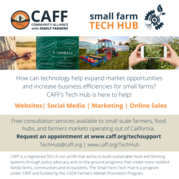
How can technology help expand market opportunities and increase business efficiencies for small farms?
Community Alliance with Family Farmers (CAFF) Tech Hub is here to Help!
Free Consultation services available to small scale farmers, food hubs and farmers markets operating out of California.
Request an appointment at www.caff.org/techsupport
For any questions email Techhub@caff.org or visit www.caff.org/techhub
|
Farmers can use USDA farm ownership microloans to buy and improve property. These microloans are especially helpful to beginning or underserved farmers, U.S. veterans looking for a career in farming, and those who have small and mid-sized farming operations.
Microloans have helped farmers and ranchers with operating costs, such as feed, fertilizer, tools, fencing, equipment, and living expenses since 2013.
Microloans can also help with farmland and building purchases and soil and water conservation improvements. FSA designed the expanded program to simplify the application process, expand eligibility requirements and expedite smaller real estate loans to help farmers strengthen their operations. Microloans provide up to $50,000 to qualified producers and can be issued to the applicant directly from the USDA Farm Service Agency (FSA).
To learn more about the FSA microloan program, contact your local County USDA Service Center or visit fsa.usda.gov/microloans.
Farmers, are you searching for your future manager or supervisor? Whether you have a current employee who could use some additional training, or are seeking to hire a new team member, The Beginning Farm and Ranch Management Apprenticeship provides a structured pathway for aspiring farm managers to develop the knowledge and skills they need to be successful on your farm. The Center for Land-Based Learning covers all tuition for coursework and provides support for farmers and apprentices. To learn more about training an apprentice, visit https://landbasedlearning.org/apprentice-farmer-mentor
|






