
New Jersey State FSA Bulletin - September 3, 2024
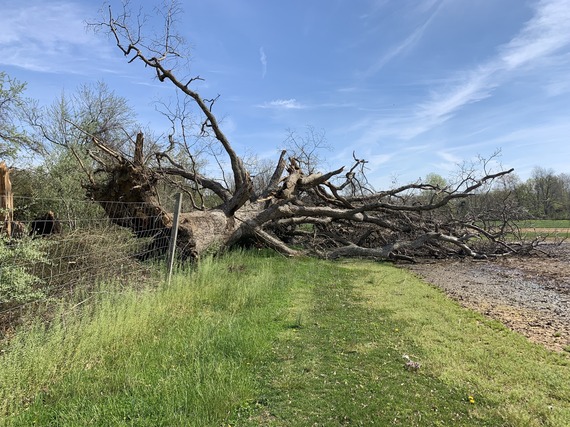
Hamilton Square, New Jersey, September 3, 2024 – The U.S. Department of Agriculture (USDA) announced that it has extended the application deadline to September 27, 2024 for the Emergency Conservation Program (ECP) and the Emergency Forest Restoration Program (EFRP). New Jersey agricultural producers and owners of nonindustrial private forestland who have suffered losses from recent severe storms, that occurred Jan. 1 through June 30, 2024, should contact their local FSA Service Center. The previous statewide signup deadline for both ECP and EFRP was Aug. 28, 2024.
These programs may also be able to address damage from ash trees that were killed by emerald ash borer beetles.
“Recovering from the impacts of natural disasters is never easy, but there’s no need to go it alone,” said Robert Andrzejczak, State Executive Director for FSA in New Jersey. “If you have an immediate need to clean up and restore your farm and forestland and need assistance, we’re ready to help but it’s imperative that you call our office for to determine program eligibility and restoration practice approval before you take any action.”
Emergency Conservation Program
ECP provides cost-share reimbursement to producers to restore farmland to pre-disaster conditions. Conservation concerns that were present on the land prior to the disaster are not eligible for ECP assistance.
Approved ECP practices include fence repair and debris removal.
Approved ECP applicants can receive up to 75% of the cost of the approved restoration activity. Producers who are considered limited resource, socially disadvantaged and beginning farmers and ranchers can receive up to 90% cost-share. FSA is authorized to provide advance payments, up to 25% of the approved cost share. The advance cost-share payment must be spent within 60 days from receipt of payment.
Producers with damage from qualifying natural disaster events must apply for assistance before beginning reconstructive work. FSA’s National Environmental Policy Act and environmental compliance review process is required to be completed before any actions are taken. Submitting an application after reconstructive work has been completed may not qualify for ECP.
FSA county committees will evaluate applications based on an on-site inspection of the damaged land, taking into consideration the type and extent of the damage. An on-site inspection does not guarantee that cost-share funding will be provided.
The 2018 Farm Bill increased the payment limitation for ECP to $500,000 per natural disaster event.
Emergency Forest Restoration Program
EFRP is a cost-share program that provides financial and technical assistance to owners of nonindustrial private forestland (NIPF) to restore NIPF land damaged by a qualifying natural disaster event.
After applications are received, local FSA county committees determine land eligibility using on-site inspections to assess the type and extent of damage.
Financial assistance is not provided upfront but is reimbursed, at no more than 75% of the lesser of the actual costs incurred or allowable cost, after a restoration activity is complete. If an EFRP application is approved, the participant is expected to perform restoration and conservation practices based on the FSA-848A Cost-Share Agreement and restoration plan provided.
The following requirements for participation in EFRP include:
- Restoration must be completed to meet the Natural Resources Conservation Service and/ or state forestry agency technical standards.
- Participants must document and keep records of all costs incurred, including costs associated with personal labor, to complete the restoration activities.
- The minimum qualifying cost of restoration is $1,000.
- The program’s payment limitation is $500,000.
In order to meet eligibility requirements, NIPF land must have existing tree cover or had tree cover immediately before the natural disaster occurred and be sustainable for growing trees.
The land must also be owned or leased by any nonindustrial private individual, group, association, corporation, or other private legal entity that has definitive decision-making authority over the land.
The natural disaster event must have resulted in damage that, if untreated, would impair or endanger the natural resources on the land and/or materially affect future use of the land.
For more information on ECP or EFRP, please contact your local USDA service center or visit farmers.gov/recover.
Additional Important Information
Myth: I can complete restoration after a natural disaster and later request ECP/EFRP assistance to receive cost-share.
Fact: Cropland and forestland owners whose land has been damaged by a natural disaster should contact their local FSA County Office to inquire about applying for ECP/EFRP as soon as possible after the natural disaster occurs. FSA and/or its partners (such as the U.S. Forest Service or state forestry agencies) will need to perform an on-site inspection to document damage, identify needed restoration activities, and and develop a forest restoration plan for EFRP applicants. Any restoration activities done before a producer applies for the program may not be reimbursed, unless:
- The natural disaster created a situation that required immediate emergency action to prevent further losses.
- A waiver is requested by the applicant and approved by FSA.
An ECP/EFRP application is submitted within a reasonable amount of time after the start of the enrollment period.
New Jersey
Farm Service Agency
200 Clocktower Drive Suite 101 Hamilton Square, NJ
Phone: (609) 587 - 0104
Fax: (855) 305 - 6635
State Executive Director
Bob Andrzejczak
Bob.Andrzejczak@usda.gov
FSA Communications Coordinator
Gabi Grunstein
(848) 482-7724,
Gabor.Grunstein@usda.gov
|
|
USDA is an equal opportunity provider, employer and lender. To file a complaint of discrimination, write: USDA, Office of the Assistant Secretary for Civil Rights, Office of Adjudication, 1400 Independence Ave., SW, Washington, DC 20250-9410 or call (866) 632-9992 (Toll-free Customer Service), (800) 877-8339 (Local or Federal relay), (866) 377-8642 (Relay voice users).
|
|







